The arrival of electric vehicles from China is expected to give a boost to Peru's green energy transition.
Chinese electric vehicles (EVs) have been gaining popularity in the South American country. Meanwhile, the newly constructed mega port -- Chancay Port, built by China -- allows an increasing number of EVs to be imported directly from China.
Among them is Dongfeng Motor, a Chinese automobile brand.
"We've brought around 600 vehicles, of which 15 percent are electric vehicles. For us in Peru, it is much easier with Chancay port because the vehicles arrive faster. What used to take 45 days, now takes between 20 and 25 days to arrive in Peru," said Antonio Alarcon, chief of sales at Dongfeng Motor Peru.
Dongfeng offers a range of fully electric models. Among them, the Dongfeng T5 stands out as a competitively priced and technologically advanced option.
Instead of an internal combustion engine, the car features an electric motor powered by a rechargeable battery.
"For a gasoline car with the same characteristics to have 400 kilometers on the clock, you would spend between 50 and 65 dollars. But for an electric car, we are talking about an average of nine dollars," said Hector Fernandez, sales assistant at Dongfeng Motor Peru.
Alarcon points out that the only thing lacking is sufficient charging stations.
"There are going to be more many people with electric cars in a short time, and they will need their electric charge points. With the evolution of electric cars, gas stations are going to turn their attention to making sure they have electric charging stations," he said.
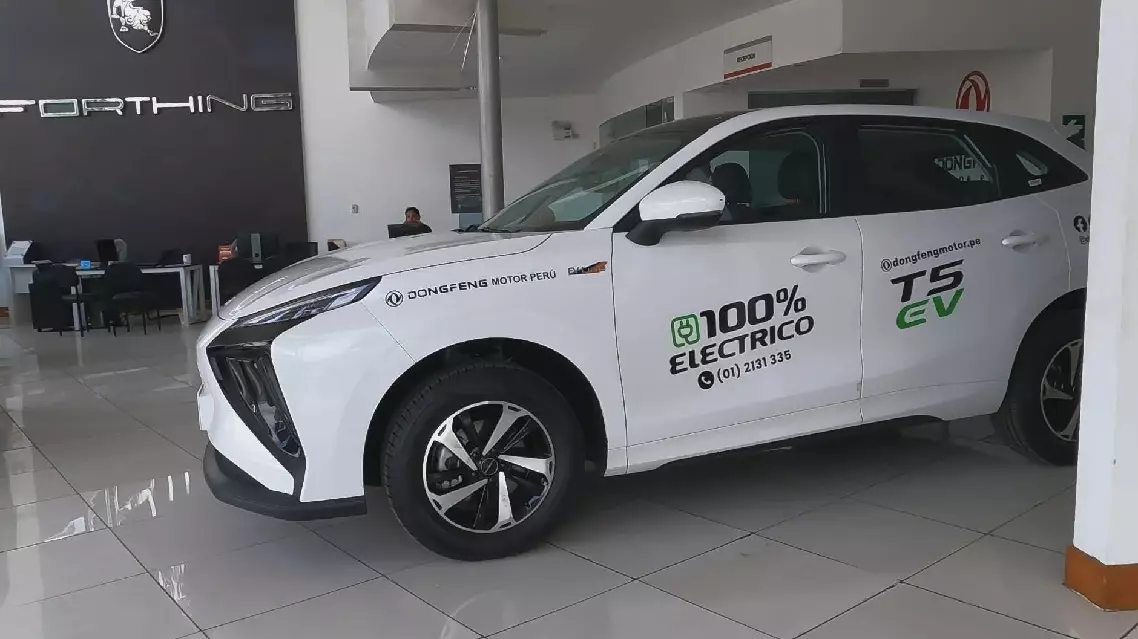
Chinese EVs poised to boost Peru’s green energy transition
China aims to achieve secure and reliable supply of key core artificial intelligence (AI) technologies by 2027, with its industrial scale and empowerment level remaining among the world's forefront, according to a recent government action plan.
The plan, jointly issued by eight departments including the Ministry of Industry and Information Technology, the Cyberspace Administration of China, and the National Development and Reform Commission, outlines an ambitious push to deeply integrate AI with the manufacturing sector, foster new quality productive forces and comprehensively empower new industrialization. By 2027, the plan targets the deep application of three to five general-purpose large AI models in manufacturing, the development of specialized, full-coverage industry-specific large models, the creation of 100 high-quality industrial datasets, and the promotion of 500 typical application scenarios.
It also aims to cultivate two to three globally influential ecosystem-leading enterprises, a batch of specialized and sophisticated small and medium-sized enterprises, and a group of enabling service providers proficient in both AI technology and industry know-how.
Furthermore, China plans to build a world-leading open-source ecosystem, enhance security governance capabilities, and contribute Chinese solutions to global AI development.
The document outlines measures including promoting the coordinated development of AI chips' hardware and software, supporting innovations in model training and inference methods, fostering key industry-specific large models, and deeply embedding large model technology into core production processes.
The plan also emphasizes making breakthroughs in key technologies such as security protection for industrial model algorithms and training data protection.
China aims for secure, reliable supply of AI core tech by 2027