 |
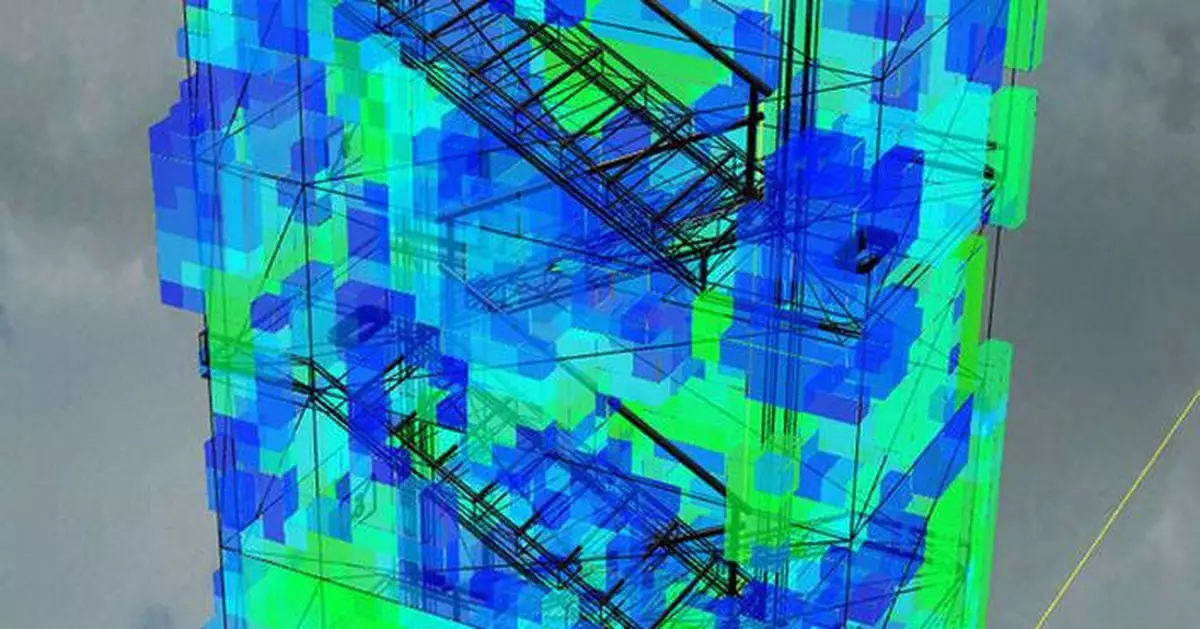
Simulating indoor radio coverage for first responders has been made simpler thanks to a new capability called Phase Tracing.
GLOUCESTER, England, Jan. 30, 2025 /PRNewswire/ -- The novel design was influenced by the 2017 Grenfell Tower inferno, where radio communication in concrete stairwells was highlighted as a major problem. Using computer game graphic techniques, a new capability has been launched to simulate propagation in a digital twin model.
The intensive computation required to perform a true 3D simulation with reflections has been made practical through developments in graphics processing. As a result, accurate radio coverage in stairs, tunnels and elevator shafts can be simulated, at the network edge, by an operator with minimal training. In contrast to legacy indoor planning tools, which use floor plans and images; Phase Tracing is designed for critical communications and industrial markets in challenging and dynamic 3D environments, represented by digital models.
Alex Farrant, Technical Director at CloudRF said:
"Phase Tracing represents a leap forward for radio simulation from overlaying images on a 2D map or floor plan. There exists a huge gap in the market between indoor simulation packages and the skill required to use them effectively, and first responders who are left guessing where they will lose communications on a stairwell.
For RF theory students who are taught the impact of multipath; they now have a tool to visualise and explore this important concept; so they can see why movement may cure a dead spot. Better still, they can identify constructive multipath they didn't know about."
The GPU accelerated engine reads and writes to open standard glTF models and uses ray tracing techniques from computer games to bounce photons around the model. With the addition of phase, multipath artefacts such as signal "dead spots", where out of phase signals on the same wavelength cancel each out, can be modelled. The number of reflections, material attenuation and scattering properties can be configured. This is essential for modern buildings which are built with materials which disrupt radio communication.
Phase Tracing is available to use now at CloudRF.com and will be available offline in Q2 2025.
The scalable design supports different client devices from phones to computers and the developer's API enables integration into other systems.
CloudRF is a Gloucester based SME, founded in 2012 specialising in scalable radio simulation software.
Simulating indoor radio coverage for first responders has been made simpler thanks to a new capability called Phase Tracing.
GLOUCESTER, England, Jan. 30, 2025 /PRNewswire/ -- The novel design was influenced by the 2017 Grenfell Tower inferno, where radio communication in concrete stairwells was highlighted as a major problem. Using computer game graphic techniques, a new capability has been launched to simulate propagation in a digital twin model.
The intensive computation required to perform a true 3D simulation with reflections has been made practical through developments in graphics processing. As a result, accurate radio coverage in stairs, tunnels and elevator shafts can be simulated, at the network edge, by an operator with minimal training. In contrast to legacy indoor planning tools, which use floor plans and images; Phase Tracing is designed for critical communications and industrial markets in challenging and dynamic 3D environments, represented by digital models.
Alex Farrant, Technical Director at CloudRF said:
"Phase Tracing represents a leap forward for radio simulation from overlaying images on a 2D map or floor plan. There exists a huge gap in the market between indoor simulation packages and the skill required to use them effectively, and first responders who are left guessing where they will lose communications on a stairwell.
For RF theory students who are taught the impact of multipath; they now have a tool to visualise and explore this important concept; so they can see why movement may cure a dead spot. Better still, they can identify constructive multipath they didn't know about."
The GPU accelerated engine reads and writes to open standard glTF models and uses ray tracing techniques from computer games to bounce photons around the model. With the addition of phase, multipath artefacts such as signal "dead spots", where out of phase signals on the same wavelength cancel each out, can be modelled. The number of reflections, material attenuation and scattering properties can be configured. This is essential for modern buildings which are built with materials which disrupt radio communication.
Phase Tracing is available to use now at CloudRF.com and will be available offline in Q2 2025.
The scalable design supports different client devices from phones to computers and the developer's API enables integration into other systems.
CloudRF is a Gloucester based SME, founded in 2012 specialising in scalable radio simulation software.
** The press release content is from PR Newswire. Bastille Post is not involved in its creation. **
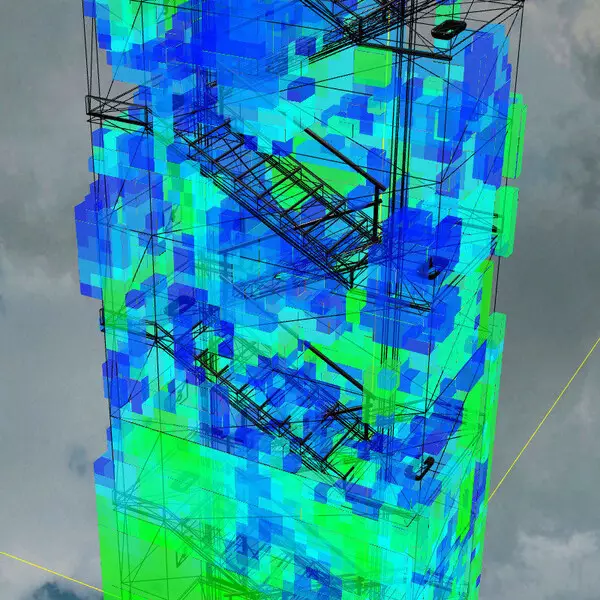
CloudRF Phase Tracing developed for true 3D comms planning
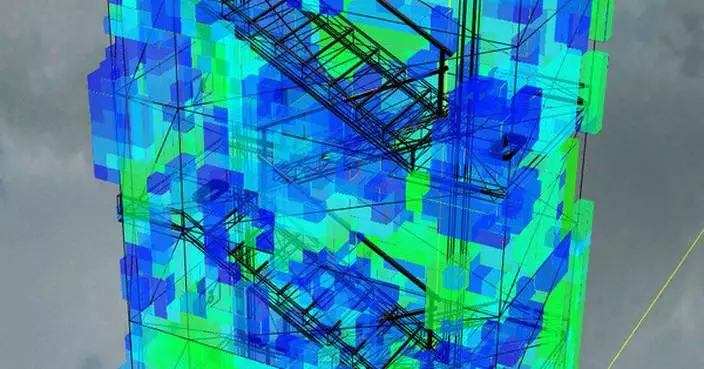
CloudRF Phase Tracing developed for true 3D comms planning

CloudRF Phase Tracing developed for true 3D comms planning
SAN MATEO, Calif., Dec. 13, 2025 /PRNewswire/ -- AI infrastructure company EverMind has recently released EverMemOS, an open-source Memory Operating System designed to address one of artificial intelligence's most profound challenges: equipping machines with scalable, long-term memory.
The Memory Bottleneck
For years, large language models (LLMs) have been constrained by fixed context windows, a limitation that causes "forgetfulness" in long-term tasks. This results in broken context, factual inconsistencies, and an inability to deliver deep personalization or maintain knowledge coherence. The issue extends beyond technical hurdles; it represents an evolutionary bottleneck for AI. An entity without memory cannot exhibit behavioral consistency or initiative, let alone achieve self-evolution. Personalization, consistency, and proactivity, which are considered the hallmarks of intelligence, all depend on a robust memory system.
There is a consensus that memory is becoming the core competitive edge and defining boundary of future AI. Yet existing solutions, such as Retrieval-Augmented Generation (RAG) and fragmented memory systems, remain limited in scope, failing to support both 1-on-1 companion use cases and complex multi-agent enterprise collaboration. Few meet the standard of precision, speed, usability, and adaptability required for widespread adoption. Equipping large models with a high-performance, pluggable memory module remains a core unmet demand across AI applications.
Discoverative Intelligence
"Discoverative Intelligence" is a concept proposed in late 2025 by entrepreneur and philanthropist Chen Tianqiao. Unlike generative AI, which mimics human output by processing existing data, Discoverative Intelligence describes an advanced AI form that actively asks questions, forms testable hypotheses, and discovers new scientific principles. It prioritizes understanding causality and underlying principles over statistical patterns, a shift Chen argues is essential to achieving Artificial General Intelligence (AGI).
Chen contrasted two dominant AI development paths: the "Scaling Path," which relies on expanding parameters, data, and compute power to extrapolate within a search space, and the "Structural Path," which focuses on the "cognitive anatomy" of intelligence and how systems operate over time.
Discoverative Intelligence falls into the latter category, built on a brain-inspired model called Structured Temporal Intelligence (STI) that requires five core capabilities in a closed loop: neural dynamics (sustained, self-organizing activity to keep systems "alive"), long-term memory (storing and selectively forgetting experiences to build knowledge), causal reasoning (inferring "why" events occur), world modeling (an internal simulation of reality for prediction), and metacognition & intrinsic motivation (curiosity-driven exploration, not just external rewards).
Among these capabilities, long-term memory serves as the vital link between time and intelligence, highlighting its indispensable role in the path toward achieving true AGI.
EverMind's Answer
EverMemOS is EverMind's answer to this need: an open-source Memory Operating System designed as foundational technology for Discoverative Intelligence. Inspired by the hierarchical organization of the human memory system, EverMemOS features a four-layer architecture analogous to key brain regions: an Agentic Layer (task planning, mirroring the prefrontal cortex), a Memory Layer (long-term storage, like cortical networks), an Index Layer (associative retrieval, drawing from the hippocampus), and an API/MCP Interface Layer (external integration, serving as AI's "sensory interface").
The system delivers breakthroughs in both scenario coverage and technical performance. It is the first memory system capable of supporting both 1-on-1 conversation use cases and complex multi-agent enterprise collaboration. On technical benchmarks, EverMemOS achieved 92.3% accuracy on LoCoMo (a long-context memory evaluation) and 82% on LongMemEval-S (a suite for assessing long-term memory retention), significantly surpassing prior state-of-the-art results and setting a new industry standard.
The open-source version of EverMemOS is now available on GitHub, with a cloud service version to be launched late this year. The dual-track model, combining open collaboration with managed cloud services, aims to drive industry-wide evolution in long-term memory technology, inviting developers, enterprises, and researchers to contribute to and benefit from the system.
About EverMind
EverMind is redefining the future of AI by solving one of its most fundamental limitations: long-term memory. Its flagship platform, EverMemOS, introduces a breakthrough architecture for scalable and customizable memory systems, enabling AI to operate with extended context, maintain behavioral consistency, and improve through continuous interaction.
To learn more about EverMind and EverMemOS, please visit:
Website: https://evermind.ai/
GitHub: https://github.com/EverMind-AI/EverMemOS
X: https://x.com/EverMindAI
Reddit: https://www.reddit.com/r/EverMindAI/
** The press release content is from PR Newswire. Bastille Post is not involved in its creation. **

AI Infrastructure Company EverMind Released EverMemOS, Responding to Profound Challenges in AI