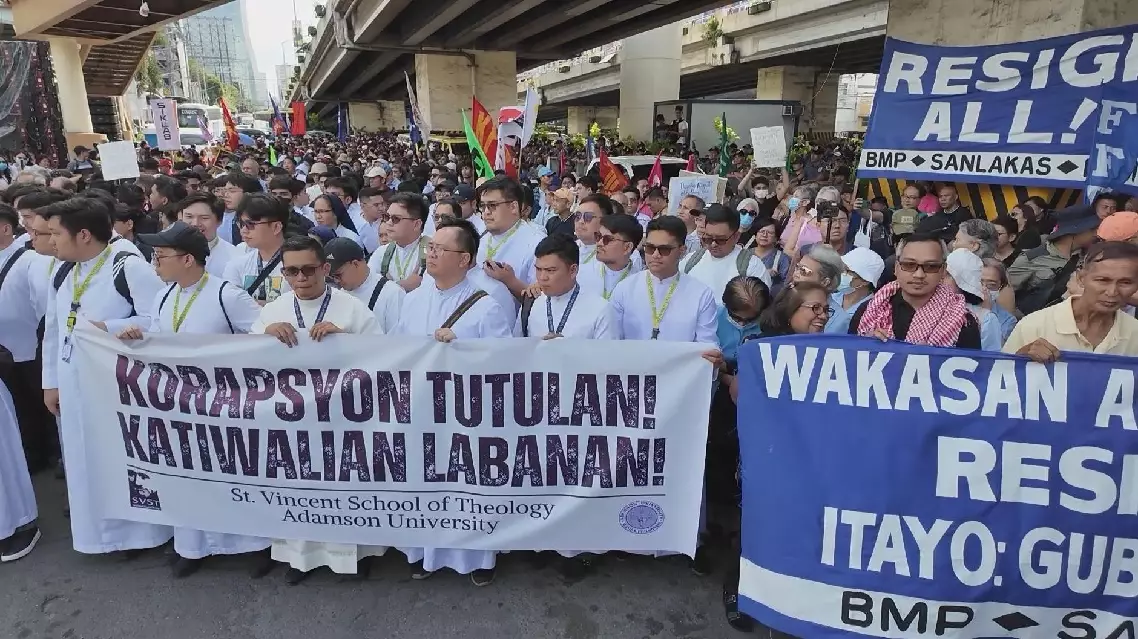
Tensions over the 2025 national budget in the Philippines have escalated as crowds gathered for an indignation rally against corruption and impunity, blocking a portion of a road in front of the EDSA Shrine in Quezon City, an urban center in Metro Manila, on Friday.
Protesters expressed their outrage over the national budget, which many believe undermines essential services like education and healthcare.
The rally's battle cry, "to fight and not to fear," resonated through the crowd, which included members of the Catholic Church, civil society organizations, youth activists, and senior citizens.
The protesters voiced their frustration over what they describe as a lack of transparency in the budget, claiming it prioritizes the interests of politicians over the welfare of the Filipino people.
"I personally expressed that this is the most corrupt budget in the history of the Philippines. It is the most corrupt not because there are a lot of leakages in terms of money. It is the most corrupt because the priorities of this budget are so obvious. The priority is to finance programs and projects that would promote the interests of politicians," said Cielo Magno, spokeswoman of the Clergy and Citizens for Good Governance.
In December last year, Philippine President Ferdinand Romualdez Marcos signed into law a 6.33 trillion peso (approximately 109.3 billion U.S. dollar) national budget for 2025, marking a 9.7 percent increase from the previous year. However, concerns are mounting over significant cuts to crucial sectors.
Notably, the Philippine Health Insurance Corporation has faced defunding, while the Department of Education's computerization program lost 10 billion pesos (171 million U.S. dollars), raising alarms about the government's commitment to digital literacy and school modernization.
Legal challenges are also emerging, as a petition questioning the constitutionality of the 2025 national budget has been filed with the Supreme Court by Marcos' former executive secretary Vic Rodriguez in late January.
In response, Marcos dismissed the petition as baseless, criticizing its motives and warning of potential destabilization.
The Clergy and Citizens for Good Governance says it plans to file a similar petition, urging the court to evaluate the budget's constitutionality and calling for its repeal. The organization says it advocates for a "people's budget" that prioritizes education, healthcare, and infrastructure, while cutting funding for programs they argue foster corruption.
Tensions rise over Philippines' 2025 national budget amid anti-corruption protests
The Iranian government is focusing on public concerns and maintaining stable supplies of essential goods amid recent protests, Iranian President Masoud Pezeshkian said in a televised interview on Sunday.
In the city of Karaj, northwest of the capital Tehran, daily life has largely continued as normal. A video filmed by a local resident on Sunday shows food stores open and grocery shelves fully stocked.
"This is the block near my home, and there are some food stores here. Daily life continues here. Last night we did not see many protests in Karaj. Right now the city is very safe. This is a grocery store close to my home. All the food is available; nothing is in shortage. Here are noodles and different types of beans. Here are dairy products, cheese, and yogurt. I also checked other grocery stores and didn't see any shortages. Everything is available," said local resident Ali Reza.
Iranian officials have described recent disturbances as acts orchestrated by the "enemy," including some carried out by well-trained and armed "terrorists." The incidents have caused casualties among security personnel and civilians, as well as property damage.
The Secretary of Iran's Supreme National Security Council Ali Larijani has directed authorities to severely punish the "terrorists."
Meanwhile, Iran's police chief Ahmad-Reza Radan said on Sunday that the police had raised alert levels and arrested several leaders of the troublemakers during the operations on Saturday.
President Pezeshkian noted in the interview that the normal demands of the Iranian people are reasonable and justified, but they must realize that triggering riots and carrying out terrorist acts are the enemy's attempts to undermine the country. He urged the public to remain vigilant.
Also on Sunday, Iranian Parliament Speaker Mohammad Baqer Qalibaf warned that Tehran would regard U.S. and Israeli bases and facilities in the Middle East as "legitimate targets" if Washington takes military action against Iran. His remarks followed media reports saying U.S. President Donald Trump is "seriously considering authorizing a strike" against Iran.
Iranian state media reported that at least 109 members of Iran's security forces have been killed in clashes since the protests began 14 days ago. Meanwhile, human rights groups based outside the country said the number of protesters killed has exceeded 200, though the figure could not be independently verified.
The protests initially erupted over a sharp depreciation of the rial and sweeping subsidy reforms. Iranian authorities have blamed the unrest on foreign-linked agents and sanctions imposed by the United States.
Iranian president says government focusing on ensuring supplies amid protests