A Chinese team has unveiled a robotic dog that sprinted into the "10-second club" of the 100-meter dash, marking a new technological advancement in robotics.
The impressive machine Black Panther 2.0, weighing 38 kilograms and standing 0.63 meters tall, achieves a remarkable peak stride frequency of five times per second, making it one of the world's fastest quadruped robots.
The researchers behind this project, a collaboration between a humanoid innovation institute under Zhejiang University (ZJU) and Hangzhou-based startup Mirror Me, took cues from the joints and paws of animals like black panthers and jerboas to improve the robot's high-speed movement in terms of strength, flexibility, power, precision and fluidity.
Its development commenced in 2018 and spanned six years, during which significant advancements were achieved through multiple innovative upgrades in both control algorithms and hardware structures.
"We are committed to the deep integration of science and technological innovation and industrial innovation. Therefore, especially in the current research direction of humanoid robots, the main focus is on achieving a more perfect integration of mechanics and machinery, enabling our humanoid robots to run faster and be more powerful," explained Dong Shihong, secretary of Party Working Committee at ZJU-Hangzhou Global Scientific and Technological Innovation Center (HIC).
Now, the team has developed advanced high-power-density, high-load motor drivers, laying the foundation for the next generation of industrial quadruped robots and expects the new generation can sprint at 15 meters per second.
"This speed indicator is set based on the average speed of living creatures. According to our statistics, for a land mammal weighing between 40 and 50 kilograms, its average running speed is approximately 15 meters per second. Therefore, we hope that the mobility of the next generation of Black Panther robot can be on par with the average level of living creatures," said Jin Rongbin, a researcher from the ZJU-HIC.

Chinese researchers develop super-fast quadrupedal robot
The U.S. military strike against Venezuela and capture of its president, Nicolas Maduro, has shocked the international community, triggering a steady stream of condemnation and serious concerns worldwide.
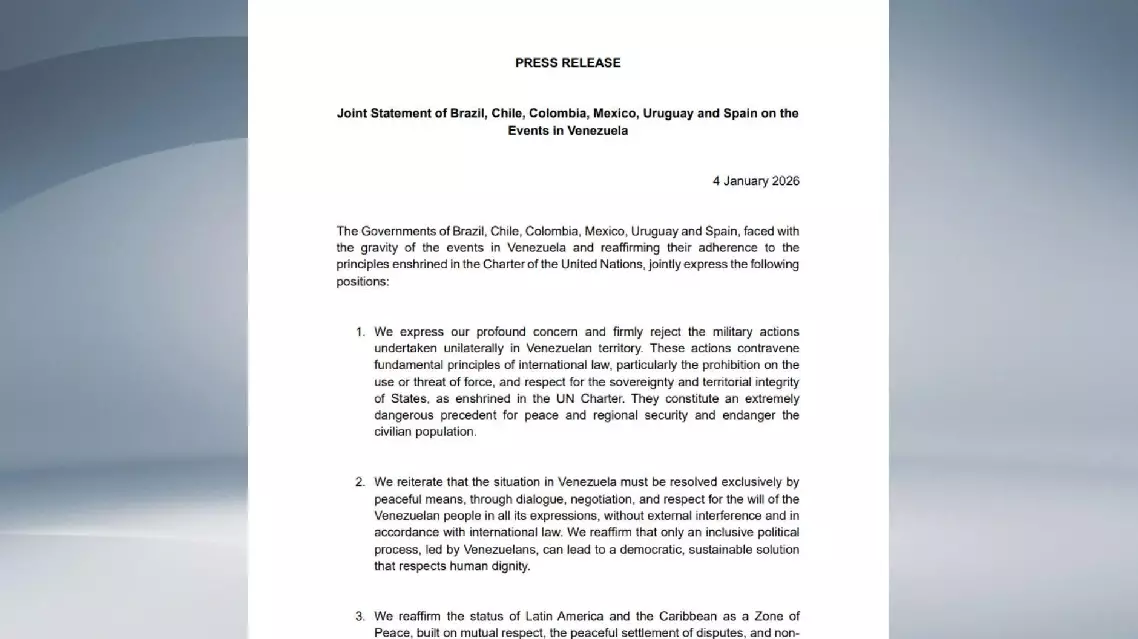
Brazil, Chile, Colombia, Mexico, Uruguay and Spain issued a joint statement on Sunday, expressing serious concern about and firm opposition to the U.S. unilateral military operations in Venezuela.
The U.S. actions contravene fundamental principles of international law, particularly the prohibition on the use or threat of force, and respect for the sovereignty and territorial integrity of States, as enshrined in the UN Charter, constituting an extremely dangerous precedent against peace and regional security, according to the statement.
In expressing profound concern and firm rejection, the six countries stressed in the statement that the situation in Venezuela must be resolved exclusively by peaceful means, and through dialogue, negotiation and respect for the will of the Venezuelan people in all its expressions, without external interference and in accordance with international law.
Only an inclusive political process, led by Venezuelans, can lead to a democratic, sustainable solution that respects human dignity, according to the statement.
Spanish Prime Minister Pedro Sanchez condemned the U.S. raid in Venezuela as a violation of international law, adding that the Spanish government always advocates and defends international law and peaceful resolution of conflicts.
Addressing a meeting of the Community of Latin American and Caribbean States (CELAC), Cuban Foreign Minister Bruno Rodriguez demanded the unconditional and immediate release of Maduro and his wife.
Noting that Latin America and the Caribbean are a zone of peace, he expressed his firm opposition to the use of force, which is an unshakable principle.
Any aggression against Venezuela shall be regarded as an attack against all CELAC member states, and nations must collectively oppose it, he stressed.
The South African government denounced the U.S. attack on Venezuela as a violation of international law, according to a statement released on Sunday.
History has repeatedly demonstrated that military invasions against sovereign states yield only instability and deepening crisis, the statement said.
South Africa calls on the UN Security Council to urgently convene a session to address this situation, according to the statement.
Serbian President Aleksandar Vucic said what happened in Venezuela demonstrates that international law and the UN Charter are losing their practical effectiveness.
U.S. military action against Venezuela marks a dangerous precedent, as similar actions could be taken against any other nations, he said.
In addition, the foreign ministries of Namibia, Singapore, Oman and Pakistan also issued statements on the same day, expressing grave concern over U.S. interference in Venezuela's internal affairs.
They emphasized the need to uphold international law and the principles of the UN Charter while respecting Venezuela's sovereignty.
They also called on all parties to exercise restraint and resolve the crisis through peaceful dialogue.
U.S. move against Venezuela sparks condemnation, concerns worldwide