CHP conducts comprehensive investigation into suspected Shiga toxin-producing Escherichia coli infection cluster at PMH
The Head of the Communicable Disease Branch of the Centre for Health Protection (CHP) of the Department of Health, Dr Albert Au, said today (February 11) that the CHP is conducting a comprehensive investigation into a suspected Shiga toxin-producing Escherichia coli (STEC) infection cluster, involving three doctors in the Oncology Department of Princess Margaret Hospital (PMH), with one of them passed away on February 7.
After receiving notification from PMH yesterday (February 10), the CHP representatives, together with representatives from PMH and the Chair of Infectious Diseases of the Department of Microbiology of the University of Hong Kong (HKU), Professor Yuen Kwok-yung, conducted an inspection of the workplace of the Oncology Department and other facilities of the hospital this morning.
"The case involves three oncologists at the hospital. Initial investigation revealed that they developed symptoms on February 4, 6 and 10 respectively. Symptoms included fever, abdominal pain and diarrhea. One of them, who had onset of symptoms on February 4, was admitted to PMH for treatment on February 6 and passed away the following day. The other two affected persons had mild symptoms," Dr Au said.
"Preliminary test results showed that the stool specimen from one of the three affected persons tested positive for STEC, while that of the other two affected persons (including the deceased patient) tested negative. Taking into account the clinical and epidemiological information, the CHP tentatively believed that the cluster may be associated with STEC infection," he said.
The CHP's epidemiological and environmental investigations are ongoing. The CHP will continue to collaborate with the Hospital Authority and the Department of Microbiology of the HKU to investigate the incident and trace the potential source of infection.
PMH has strengthened the monitoring of the gastrointestinal symptoms among its staff and has requested any staff members with relevant symptoms to report immediately for laboratory tests. The PMH has also arranged comprehensive disinfection of the oncology office area.
In general, STEC infections are usually associated with the consumption of contaminated food or water, such as raw or undercooked meat products, contaminated fruits and vegetables, and unpasteurised dairy products. Direct person-to-person transmission through the faecal-oral route can also occur.
Second cross-boundary large-scale stress test conducted at Huanggang Port
The Hong Kong Special Administrative Region Government today (August 29) conducted the second cross-boundary stress test at the Huanggang Port with the relevant units of Shenzhen. The drill focused on testing the peak carrying capacity by further increasing passenger and vehicular flows to ensure comprehensive preparation for the opening of the port.
The drill marked the first test of the "joint one-stop" vehicle lanes for vehicle clearance. Automobile associations, associations, and chambers of commerce were invited to assist in recruiting private vehicles permitted to travel between the two places. The vehicles participated in cyclical trials with more than 1 000 vehicle trips made to test the operation and tuning of the lane systems and vehicular flow management. Participating vehicles were instructed to enter the port through the new connecting road in batches. They underwent risk assessment at the "customs front kiosks", and then entered the "joint one-stop" vehicle lanes for "five-party inspection" to complete clearance procedures for the Shenzhen General Station of Exit and Entry Frontier Inspection, the Shenzhen Customs, as well as the Customs and Excise Department, the Department of Health and the Immigration Department of Hong Kong in one go, through the "integrated information collection devices" next to the lanes to complete the collection of body temperature, travel document data, facial features and fingerprints. The drill also simulated scenarios such as passengers disembarking and proceeding to the immigration clearance hall for on-board passengers to undergo passenger clearance procedures, as well as vehicles being selected at the "customs front kiosks" to proceed to the inspection area for inspection. Vehicles participating in the drill first departed and then returned to the Hong Kong Port Area via the Shenzhen side's vehicle clearance level for departure to conduct the cyclical trials.
To assess the port's capacity under sustained ultra-high passenger flow, over 20 000 civil servants from more than 70 bureaux and departments were mobilised. Participants were instructed to take various public transport to arrive at the port. They passed through the "collaborative inspection" automated channels or manual counters to depart from the Hong Kong Port Area. After returning from the Shenzhen side, they left the port by taking vehicles dispatched by public transport operators, undergoing cyclical trials involving more than 600 departures. The stress test also advanced the "crowd concentrated-flow test" by releasing large batches of people several times within a short period of time to create greater crowd pressure. This simulated a situation where a large number of arriving passengers arrive Hong Kong via the Huanggang Port during peak hours and take different public transport (including franchised buses, minibuses, cross-boundary coaches, and taxis) at the public transport interchange, thereby testing the management of passenger and vehicular flows, as well as co-ordination of supporting arrangements.
After that, the Fire Services Department conducted a fire drill, simulating an electric vehicle catching fire. Personnel from the Huanggang Fire Station fought the fire with water jets and used specialised equipment such as high-pressure fog applicators and fire blankets to extinguish the blaze. Ambulance personnel were also on-site to treat the injured.
The Secretary for Security, Mr Tang Ping-keung, inspected the drill on-site and held a meeting with participating departments immediately after the drill to review procedures and participants' feedback. Meetings will be arranged between the relevant Hong Kong and Shenzhen units to review and identify areas for improvement in the management of passenger and vehicular traffic, emergency response and collaborative mechanisms of the two places, so as to ensure the port's safe and smooth operation and a positive passenger experience to prepare for the opening of the port.
To further facilitate travel between Hong Kong and the Mainland for Hong Kong residents, both places will implement the arrangement that Hong Kong residents who hold both Mainland Travel Permits for Hong Kong and Macao Residents (including non-Chinese) (commonly known as the Home Visit Permit), and Hong Kong permanent identity card or Hong Kong non-permanent identity card, may choose to use either their Hong Kong identity card or Home Visit Permit at the first gate of the "collaborative inspection" automated channels, for completing immigration clearance procedures of both Hong Kong and Shenzhen, regardless of whether they are travelling "northbound" or "southbound".
Representatives from various bureaux, departments and organisations participated in the drill, including the Security Bureau, the Transport and Logistics Bureau, the Civil Service Bureau, the Hong Kong Police Force, the Transport Department, the Highways Department, the Immigration Department, the Hong Kong Customs and Excise Department, the Department of Health, the Fire Services Department, the Architectural Services Department, the Electrical and Mechanical Services Department, the Government Property Agency, the Digital Policy Office, the Office of the Communications Authority, the Food and Environmental Hygiene Department, the Agriculture, Fisheries and Conservation Department, the Civil Aid Service, the Auxiliary Medical Service, and various public transport operators.
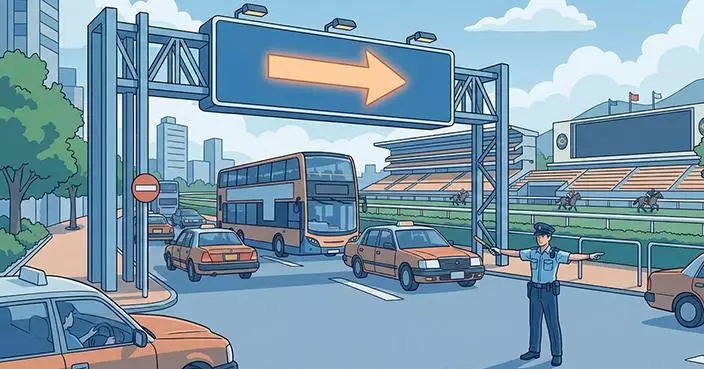
Source: AI-found images