Skip to Content Facebook Feature Image

Plastic straws have come to symbolize a global pollution crisis. Trump wants them to stay

News

Plastic straws have come to symbolize a global pollution crisis. Trump wants them to stay
News

News

Plastic straws have come to symbolize a global pollution crisis. Trump wants them to stay

2025-02-12 04:42 Last Updated At:04:50

Straws might seem insignificant, inspiring jokes about the plastic vs. paper debate, but the plastic straw has come to symbolize a global pollution crisis over the past decade.

On Monday, President Donald Trump waded into the issue when he signed an executive order to reverse a federal push away from plastic straws, declaring that paper straws “don’t work” and don’t last very long. Trump said he thinks “it’s OK” to continue using plastic straws, although they've have been blamed for polluting oceans and harming marine life.

More Images
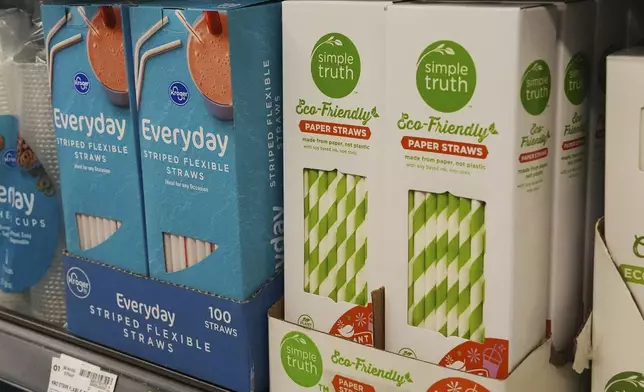
Plastic straws, left, sit next to paper straws on display for sale in Cincinnati on Tuesday, Feb. 11, 2025. (AP Photo/Joshua A. Bickel)

Plastic straws, left, sit next to paper straws on display for sale in Cincinnati on Tuesday, Feb. 11, 2025. (AP Photo/Joshua A. Bickel)

A plastic straw is displayed in a glass of milk, Tuesday, Feb. 11, 2025, in Cincinnati. (AP Photo/Joshua A. Bickel)
A plastic straw is displayed in a glass of milk, Tuesday, Feb. 11, 2025, in Cincinnati. (AP Photo/Joshua A. Bickel)

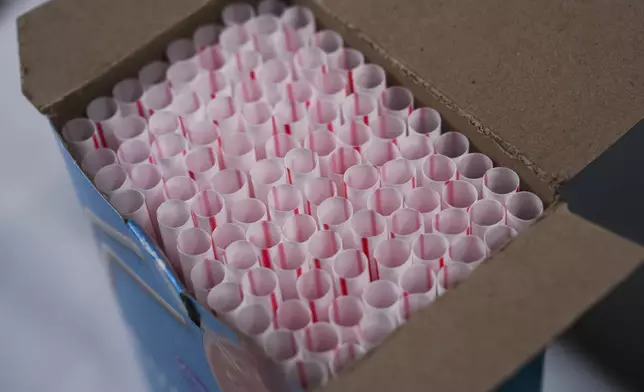
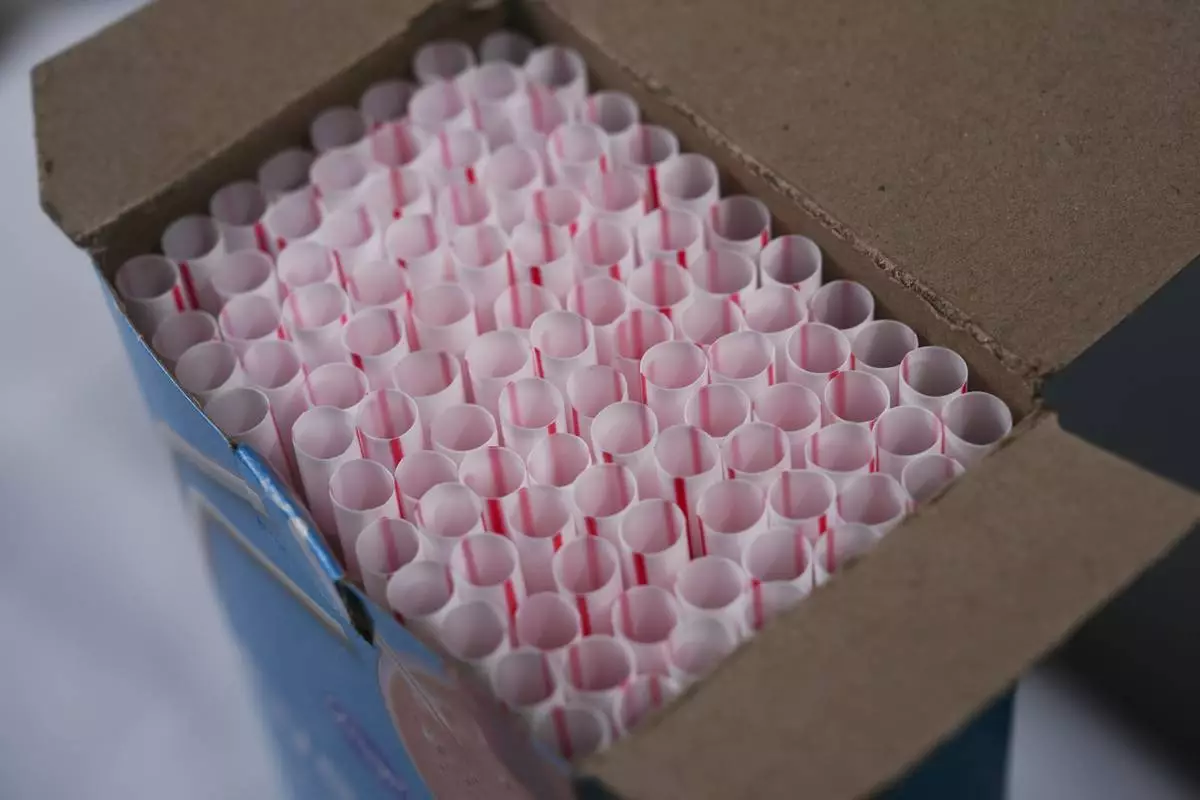
A box of plastic straws is displayed, Tuesday, Feb. 11, 2025, in Cincinnati. (AP Photo/Joshua A. Bickel)

A box of plastic straws is displayed, Tuesday, Feb. 11, 2025, in Cincinnati. (AP Photo/Joshua A. Bickel)

Plastic straws are displayed in a glass, Tuesday, Feb. 11, 2025, in Cincinnati. (AP Photo/Joshua A. Bickel)

Plastic straws are displayed in a glass, Tuesday, Feb. 11, 2025, in Cincinnati. (AP Photo/Joshua A. Bickel)

In 2015, video of a marine biologist pulling a plastic straw out of a turtle’s nose sparked outrage worldwide and countries and cities started banning them, starting with the Pacific Island nation Vanuatu and Seattle in 2018.

Here’s what to know about the larger fight over single-use plastics in the United States:

More than 390 million plastic straws are used every day in the United States, most for 30 minutes or less, according to advocacy group Turtle Island Restoration Network.

Plastic straws are usually thrown away after one use, going on to litter beaches and waterways and potentially killing marine animals that mistake them for food.

The straws are not recyclable because they are so small. They take at least 200 years to decompose, the network said.

They break down into incredibly tiny bits of plastic smaller than a fraction of a grain of rice. These microplastics have been found in a wide range of body tissues. Though research is still limited overall, there are growing concerns that microplastics in the body could potentially be linked to heart disease, Alzheimer’s and dementia, and other problems.

Trump's executive order claims that paper straws use chemicals that may carry risks to human health are more expensive to produce than plastic straws. Researchers from the University of Antwerp found forever chemicals known as PFAS to be present in paper, bamboo, glass and plastic straws, but not stainless steel ones, according to a 2023 study.

The advocacy group Beyond Plastics said that while plastics are often cheaper than paper products, the cheapest option is to skip the straw.

Judith Enck, a former Environmental Protection Agency regional administrator who now heads up Beyond Plastics, said she hopes that people react to the executive order by committing to using fewer plastic straws and that local and state governments do, too.

“It’s easy to just kind of almost poke fun of this, ignore it,” she said Tuesday. “But this is a moment that we as individuals and state and local policymakers can make a statement that they disagree with this executive order and are committed to using less plastic straws. It’s not that hard to do.”

Several states and cities have banned plastic straws and some restaurants no longer automatically give them to customers.

President Joe Biden administration’s had committed to phasing out federal purchases of single-use plastics, including straws, from food service operations, events and packaging by 2027, and from all federal operations by 2035.

The move was a way for the federal government to formally acknowledge the severity of the plastic pollution crisis and the scale of the response required to effectively confront it.

Erin Simon, an expert on plastics and packaging at the World Wildlife Fund, said at the time that it sent a message around the world: If we can make change happen at scale, so can you.

The declaration came in July, just a few months before negotiators met in South Korea to try to finish crafting a treaty to address the global crisis of plastic pollution. Negotiators didn’t reach an agreement late last year, but talks resume this year.

Under the Biden administration, the United States at first adopted a position viewed as favoring industry, stating that countries should largely develop their own plans instead of abiding by global rules. China, the United States and Germany are the biggest players in the global plastics trade.

The United States changed its position heading into South Korea. The delegation said it would support having an article in the treaty that addresses supply, or plastic production. More than 100 countries want an ambitious treaty that limits plastic production while tackling cleanup and recycling.

U.S. manufacturers have asked Trump to remain at the negotiating table but revert to the old position that focused on redesigning plastic products, recycling and reuse.

The environment is littered with single-use plastic food and beverage containers — water bottles, takeout containers, coffee lids, straws and shopping bags.

Every year, the world produces more than 400 million tons of new plastic. About 40% of all plastics are used in packaging, according to the United Nations.

In 2023, Ocean Conservancy volunteers collected more than 61,000 plastic straws and stirrers polluting beaches and waterways in the United States. There were even more cigarette butts, plastic bottles, bottle caps and food wrappers, the nonprofit said.

Most plastic is made from fossil fuels. Negotiators at the United Nations climate talks known as COP28 agreed in 2023 the world must transition away from planet-warming fossil fuels and triple the use of renewable energy.

As pressure to reduce fossil fuels has increased globally, oil and gas companies have been looking more to the plastics side of their business as a market that could grow. Trump strongly supports and gets support from the oil and gas industry.

The Associated Press’ climate and environmental coverage receives financial support from multiple private foundations. AP is solely responsible for all content. Find AP’s standards for working with philanthropies, a list of supporters and funded coverage areas at AP.org.
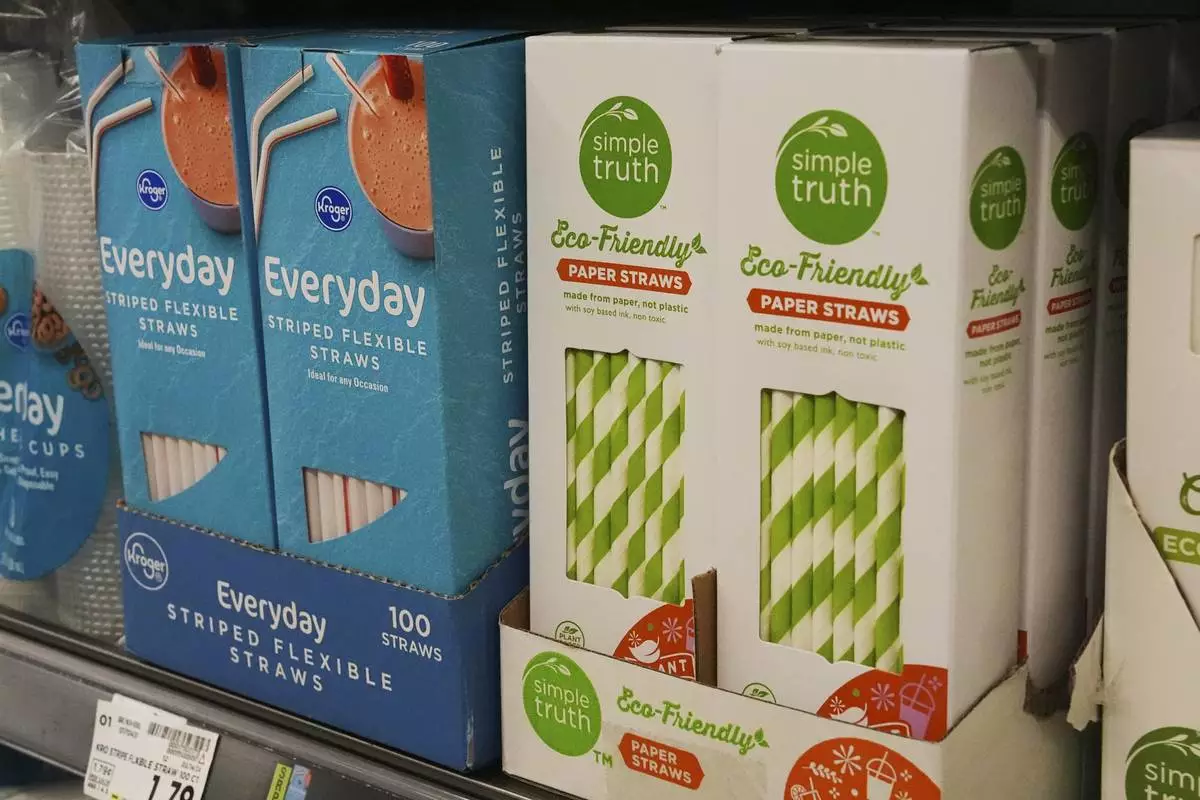
Plastic straws, left, sit next to paper straws on display for sale in Cincinnati on Tuesday, Feb. 11, 2025. (AP Photo/Joshua A. Bickel)

Plastic straws, left, sit next to paper straws on display for sale in Cincinnati on Tuesday, Feb. 11, 2025. (AP Photo/Joshua A. Bickel)

A plastic straw is displayed in a glass of milk, Tuesday, Feb. 11, 2025, in Cincinnati. (AP Photo/Joshua A. Bickel)
A plastic straw is displayed in a glass of milk, Tuesday, Feb. 11, 2025, in Cincinnati. (AP Photo/Joshua A. Bickel)

A box of plastic straws is displayed, Tuesday, Feb. 11, 2025, in Cincinnati. (AP Photo/Joshua A. Bickel)

A box of plastic straws is displayed, Tuesday, Feb. 11, 2025, in Cincinnati. (AP Photo/Joshua A. Bickel)

Plastic straws are displayed in a glass, Tuesday, Feb. 11, 2025, in Cincinnati. (AP Photo/Joshua A. Bickel)
Plastic straws are displayed in a glass, Tuesday, Feb. 11, 2025, in Cincinnati. (AP Photo/Joshua A. Bickel)
DUBAI, United Arab Emirates (AP) — U.S. President Donald Trump said Iran wants to negotiate with Washington after his threat to strike the Islamic Republic over its bloody crackdown on protesters, a move coming as activists said Monday the death toll in the nationwide demonstrations rose to at least 544.

Iran had no immediate reaction to the news, which came after the foreign minister of Oman — long an interlocutor between Washington and Tehran — traveled to Iran this weekend. It also remains unclear just what Iran could promise, particularly as Trump has set strict demands over its nuclear program and its ballistic missile arsenal, which Tehran insists is crucial for its national defense.

Meanwhile Monday, Iran called for pro-government demonstrators to head to the streets in support of the theocracy, a show of force after days of protests directly challenging the rule of 86-year-old Supreme Leader Ayatollah Ali Khamenei. Iranian state television aired chants from the crowd, who shouted “Death to America!” and “Death to Israel!”

Trump and his national security team have been weighing a range of potential responses against Iran including cyberattacks and direct strikes by the U.S. or Israel, according to two people familiar with internal White House discussions who were not authorized to comment publicly and spoke on condition of anonymity.

“The military is looking at it, and we’re looking at some very strong options,” Trump told reporters on Air Force One on Sunday night. Asked about Iran’s threats of retaliation, he said: “If they do that, we will hit them at levels that they’ve never been hit before.”

Trump said that his administration was in talks to set up a meeting with Tehran, but cautioned that he may have to act first as reports of the death toll in Iran mount and the government continues to arrest protesters.

“I think they’re tired of being beat up by the United States,” Trump said. “Iran wants to negotiate.”

He added: “The meeting is being set up, but we may have to act because of what’s happening before the meeting. But a meeting is being set up. Iran called, they want to negotiate.”

Iran through country's parliamentary speaker warned Sunday that the U.S. military and Israel would be “legitimate targets” if America uses force to protect demonstrators.

More than 10,600 people also have been detained over the two weeks of protests, said the U.S.-based Human Rights Activists News Agency, which has been accurate in previous unrest in recent years and gave the death toll. It relies on supporters in Iran crosschecking information. It said 496 of the dead were protesters and 48 were with security forces.

With the internet down in Iran and phone lines cut off, gauging the demonstrations from abroad has grown more difficult. The Associated Press has been unable to independently assess the toll. Iran’s government has not offered overall casualty figures.

Those abroad fear the information blackout is emboldening hard-liners within Iran’s security services to launch a bloody crackdown. Protesters flooded the streets in the country’s capital and its second-largest city on Saturday night into Sunday morning. Online videos purported to show more demonstrations Sunday night into Monday, with a Tehran official acknowledging them in state media.

In Tehran, a witness told the AP that the streets of the capital empty at the sunset call to prayers each night. By the Isha, or nighttime prayer, the streets are deserted.

Part of that stems from the fear of getting caught in the crackdown. Police sent the public a text message that warned: “Given the presence of terrorist groups and armed individuals in some gatherings last night and their plans to cause death, and the firm decision to not tolerate any appeasement and to deal decisively with the rioters, families are strongly advised to take care of their youth and teenagers.”

Another text, which claimed to come from the intelligence arm of the paramilitary Revolutionary Guard, also directly warned people not to take part in demonstrations.

“Dear parents, in view of the enemy’s plan to increase the level of naked violence and the decision to kill people, ... refrain from being on the streets and gathering in places involved in violence, and inform your children about the consequences of cooperating with terrorist mercenaries, which is an example of treason against the country,” the text warned.

The witness spoke to the AP on condition of anonymity due to the ongoing crackdown.

The demonstrations began Dec. 28 over the collapse of the Iranian rial currency, which trades at over 1.4 million to $1, as the country’s economy is squeezed by international sanctions in part levied over its nuclear program. The protests intensified and grew into calls directly challenging Iran’s theocracy.

Nikhinson reported from aboard Air Force One.

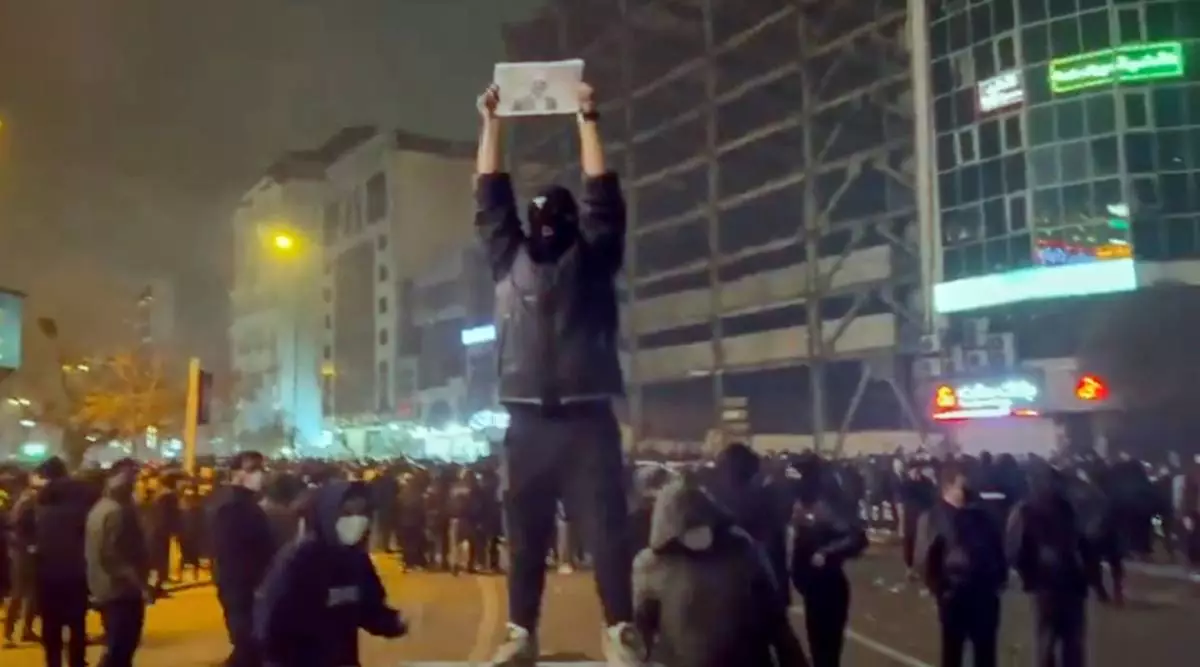
In this frame grab from video obtained by the AP outside Iran, a masked demonstrator holds a picture of Iran's Crown Prince Reza Pahlavi during a protest in Tehran, Iran, Friday, January. 9, 2026. (UGC via AP)

In this frame grab from video obtained by the AP outside Iran, a masked demonstrator holds a picture of Iran's Crown Prince Reza Pahlavi during a protest in Tehran, Iran, Friday, January. 9, 2026. (UGC via AP)

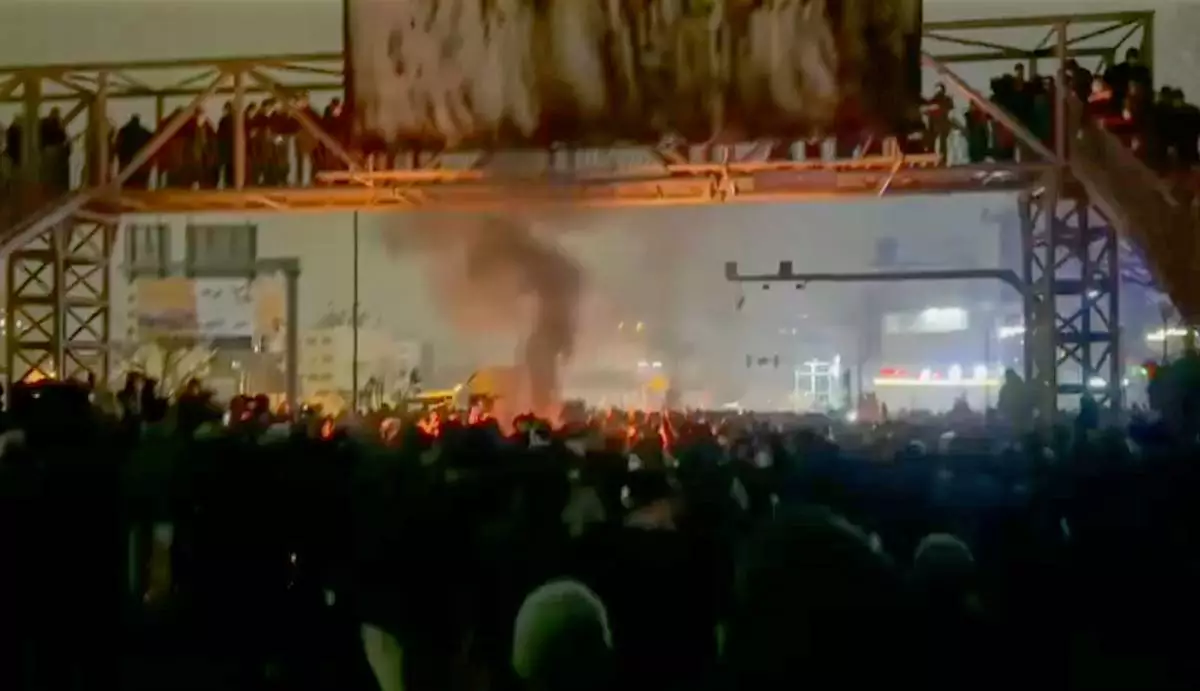
In this frame grab from footage circulating on social media from Iran shows protesters taking to the streets despite an intensifying crackdown as the Islamic Republic remains cut off from the rest of the world in Tehran, Iran, Friday, Jan. 9, 2026.(UGC via AP)

In this frame grab from footage circulating on social media from Iran shows protesters taking to the streets despite an intensifying crackdown as the Islamic Republic remains cut off from the rest of the world in Tehran, Iran, Friday, Jan. 9, 2026.(UGC via AP)

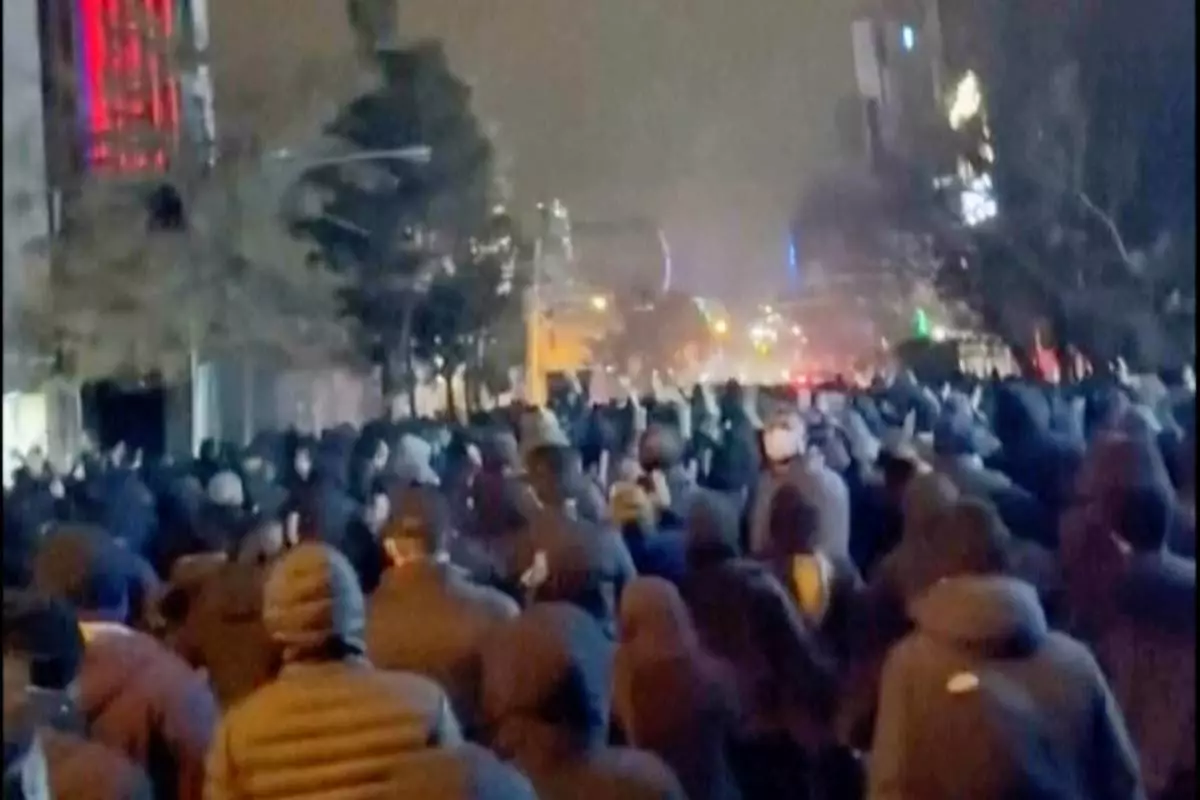
In this frame grab from footage circulating on social media from Iran showed protesters once again taking to the streets of Tehran despite an intensifying crackdown as the Islamic Republic remains cut off from the rest of the world in Tehran, Iran, Saturday Jan. 10, 2026. (UGC via AP)

In this frame grab from footage circulating on social media from Iran showed protesters once again taking to the streets of Tehran despite an intensifying crackdown as the Islamic Republic remains cut off from the rest of the world in Tehran, Iran, Saturday Jan. 10, 2026. (UGC via AP)

Recommended Articles