PARIS (AP) — French President Emmanuel Macron urged Syria's interim government to cooperate with a U.S.-led coalition fighting against extremist groups in that region as he hosted a conference Thursday on the Mideast country's future.
Macron’s comments come amid uncertainty over the United States’ commitment to the region. Thursday's conference in Paris among European and Arab nations was the third on Syria since the repressive government of Bashar Assad was ousted in December, and was attended by Syria's interim Foreign Minister Asaad al-Shibani.
Click to Gallery

France's President Emmanuel Macron greets participants as he arrives at the International Conference on Syria at the Ministerial Conference Center, in Paris, France, Thursday, Feb. 13, 2025. (Ludovic Marin, Pool Photo via AP)
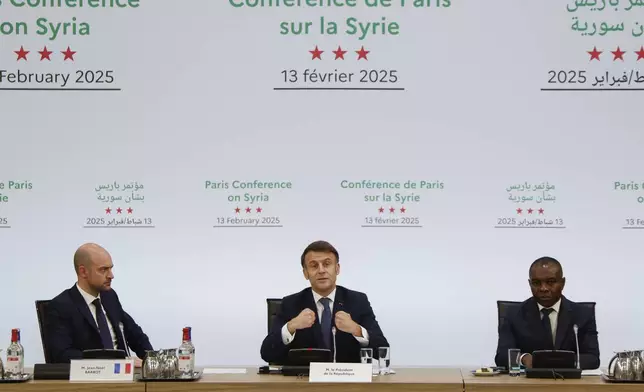
France's President Emmanuel Macron, center, delivers a speech during the International Conference on Syria at the Ministerial Conference Center, in Paris, France, Thursday, Feb. 13, 2025. (Ludovic Marin, Pool Photo via AP)
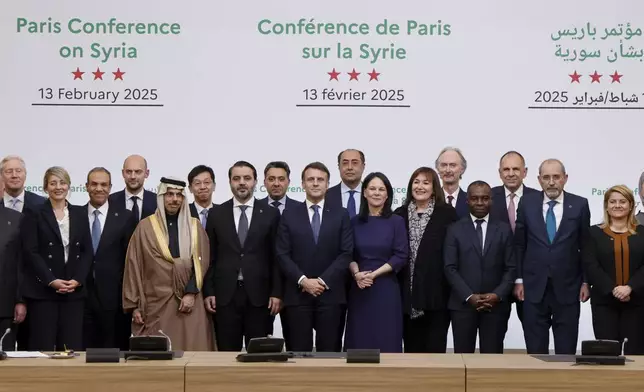
France's President Emmanuel Macron, center left, and on his side Syria's Interim Foreign Minister Asaad Al-Shibani pose for a photo with participants during the International Conference on Syria at the Ministerial Conference Center, in Paris, France, Thursday, Feb. 13, 2025. (Ludovic Marin, Pool Photo via AP)
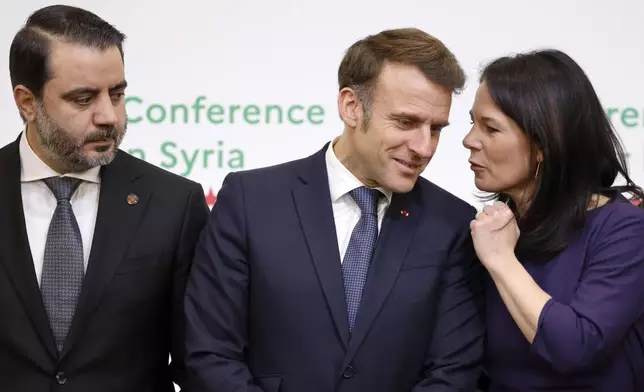
France's President Emmanuel Macron, center, Syria's Interim Foreign Minister Asaad Al-Shibani, left, and German Foreign Minister Annalena Baerbock pose for a photo during the International Conference on Syria at the Ministerial Conference Center, in Paris, France, Thursday, Feb. 13, 2025. (Ludovic Marin, Pool Photo via AP)
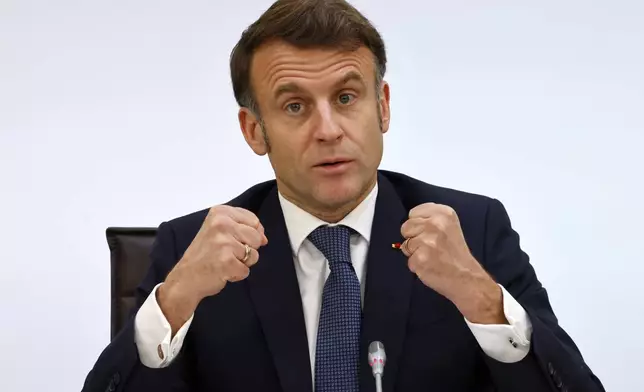
France's President Emmanuel Macron gestures as he delivers a speech during the International Conference on Syria at the Ministerial Conference Center, in Paris, France, Thursday, Feb. 13, 2025. (Ludovic Marin, Pool Photo via AP)
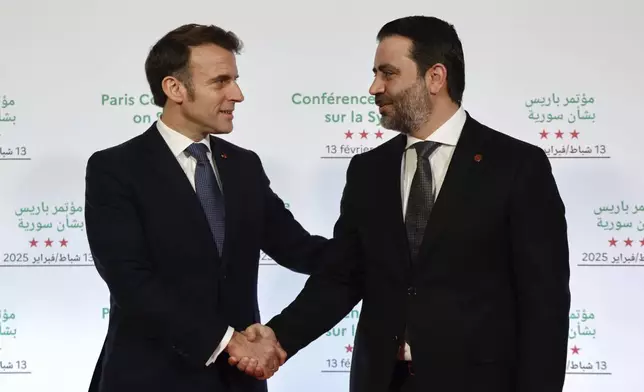
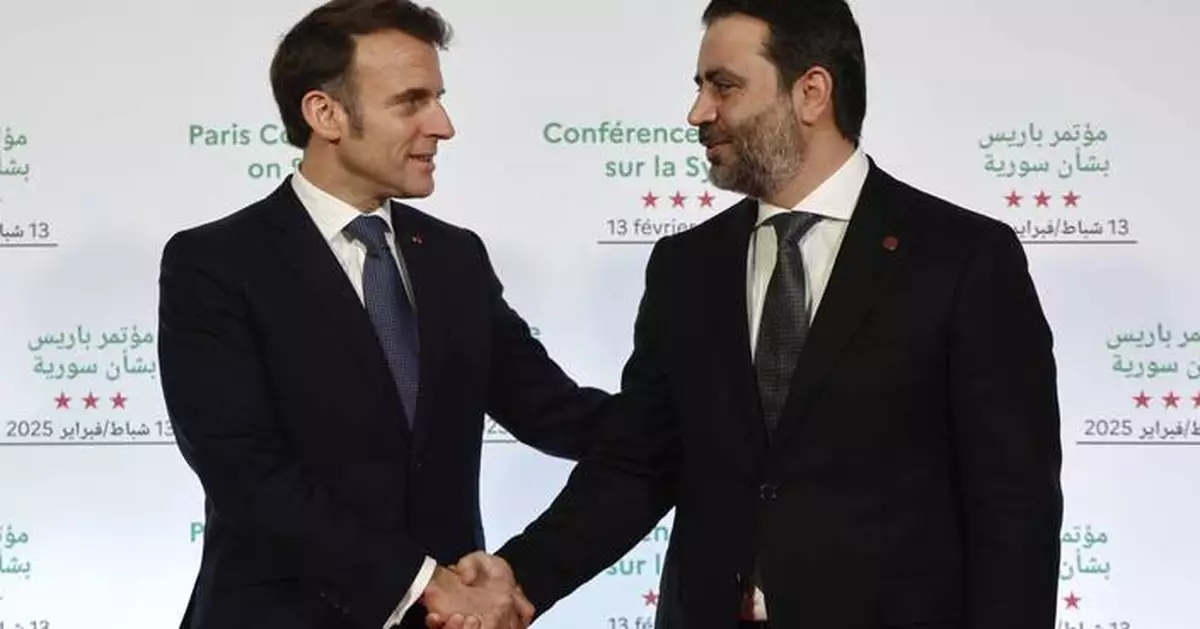
France's President Emmanuel Macron, left, greets Syria's Interim Foreign Minister Asaad Al-Shibani during the International Conference on Syria at the Ministerial Conference Center, in Paris, France, Thursday, Feb. 13, 2025. (Ludovic Marin, Pool Photo via AP)
“Syria must very clearly continue to fight against all the terrorist organizations that are spreading chaos,” Macron said. “If Syria decides to offer cooperation” with the international coalition Inherent Resolve, France would support the move, he added.
The Paris conference of foreign ministers and other officials from participating countries was meant to coordinate efforts to support a peaceful transition, as the new government in Damascus underlines its desire to improve relations with the West
Macron also called on the Syrian interim government to “fully integrate” the U.S.-backed, Kurdish-led Syrian Democratic Forces (SDF) into the Syrian transition, calling them “precious allies.”
“I think your responsibility today is to integrate them and also to allow these forces to join in,” he said.
On Thursday, Syrian organizers of a conference in Damascus to chart the country’s political future said those talks will include all segments of Syrian society except for the Kurdish-led administration in the northeast and Assad loyalists.
Most of the country's former insurgent factions have agreed to dissolve and join the new Syrian army and security services, but the Kurdish-led SDF so far has so far refused to do the same. SDF forces have been clashing with Turkish-backed groups in northern Syria, and the Kurds are concerned about losing political and cultural gains they have made since carving out their own enclave in the northeast during the country’s civil war.
Discussions are ongoing between the SDF and the government in Damascus.
More aid is crucial to achieve a peaceful reconstruction during the post-Assad transition. The country needs to rebuild housing, electricity, water and transportation infrastructure after nearly 14 years of war. The United Nations in 2017 estimated that it would cost at least $250 billion, while some experts now say the number could reach at least $400 billion.
With few productive sectors and government employees making wages equivalent to about $20 per month, Syria has grown increasingly dependent on remittances and humanitarian aid. But the flow of aid was throttled after the Trump administration halted U.S. foreign assistance last month.
The effects were particularly dire in the country’s northwest, a formerly rebel-held enclave that hosts millions of people displaced from other areas by the country’s civil war. Many of them live in sprawling tent camps.
The freeze on USAID funding forced clinics serving many of those camps to shut down, and nonprofits laid off local staff. In northeastern Syria, a camp housing thousands of family members of Islamic State fighters was thrown into chaos when the group providing services there was forced to briefly stop work.
A workshop bringing together key donors from the Group of Seven leading industrialized nations, the United Nations and key agencies from Arab countries will be held alongside the conference to coordinate international aid to Syria.
Uncertainty also surrounds the future of U.S. military support in the region.
In 2019 during his first term, Trump decided on a partial withdrawal of U.S. troops from the northeast of Syria before he halted the plans. And in December last year, when rebels were on their way to topple Assad, Trump said the United States should not “ dive into the middle of a Syrian civil war.”
Now that Syria’s new leader Ahmad al-Sharaa is trying to consolidate his power, the U.S. intentions in the region remain unclear. A U.S. official attended Thursday's conference in Paris.
Asked about the U.S. position, “I’m not going to play guessing games,” French Foreign Minister Jean-Noël Barrot said.
Given Trump’s diplomatic doctrine “to only make decisions that make America safer ... These are the words we used to address our interlocutors in the new administration,” Barrot said.
The commander of the main U.S.-backed force in Syria recently said that U.S. troops should stay in Syria because the Islamic State group will benefit from a withdrawal.
Since Damascus fell on Dec. 8 and Assad fled to Moscow, the new leadership has yet to lay out a clear vision of how the country will be governed.
The Islamic militant group Hayat Tahrir al-Sham, or HTS – a former al-Qaida affiliate that the EU and U.N. consider to be a terrorist organization – has established itself as Syria’s de facto rulers after coordinating with the southern fighters during the offensive late last year.
Sewell reported from Beirut.
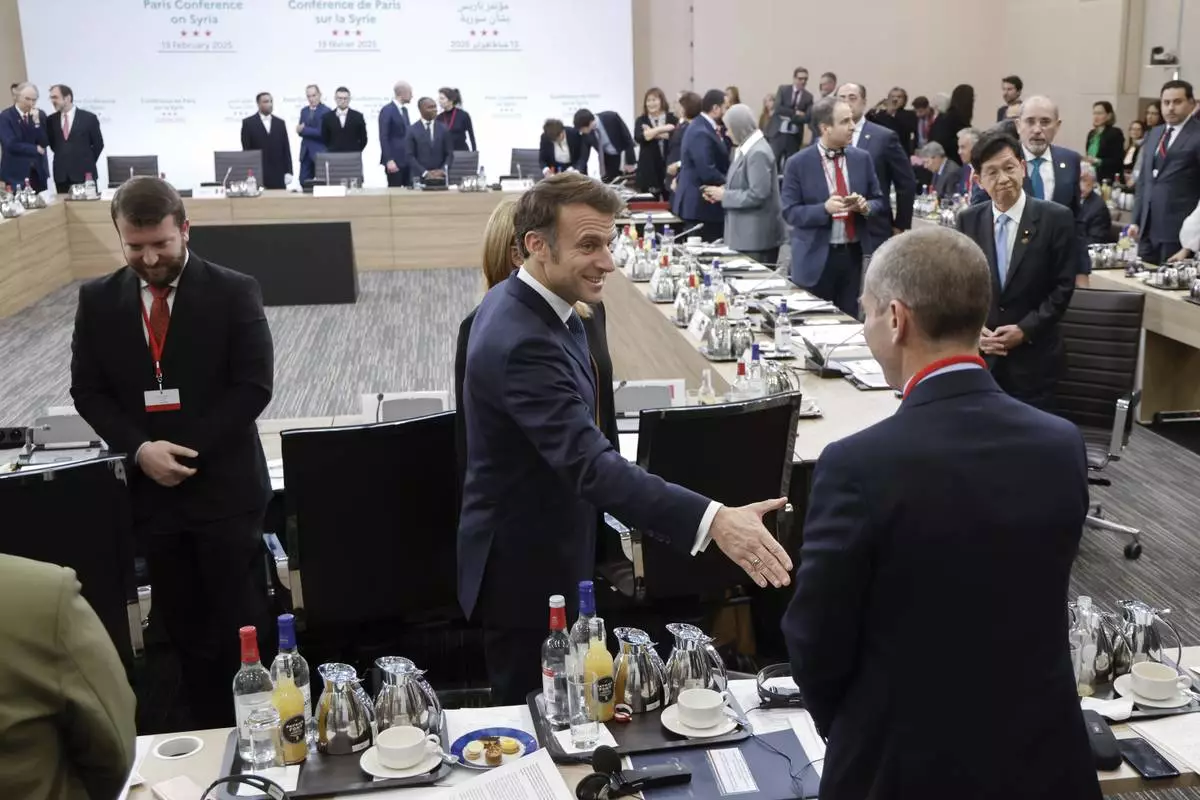
France's President Emmanuel Macron greets participants as he arrives at the International Conference on Syria at the Ministerial Conference Center, in Paris, France, Thursday, Feb. 13, 2025. (Ludovic Marin, Pool Photo via AP)
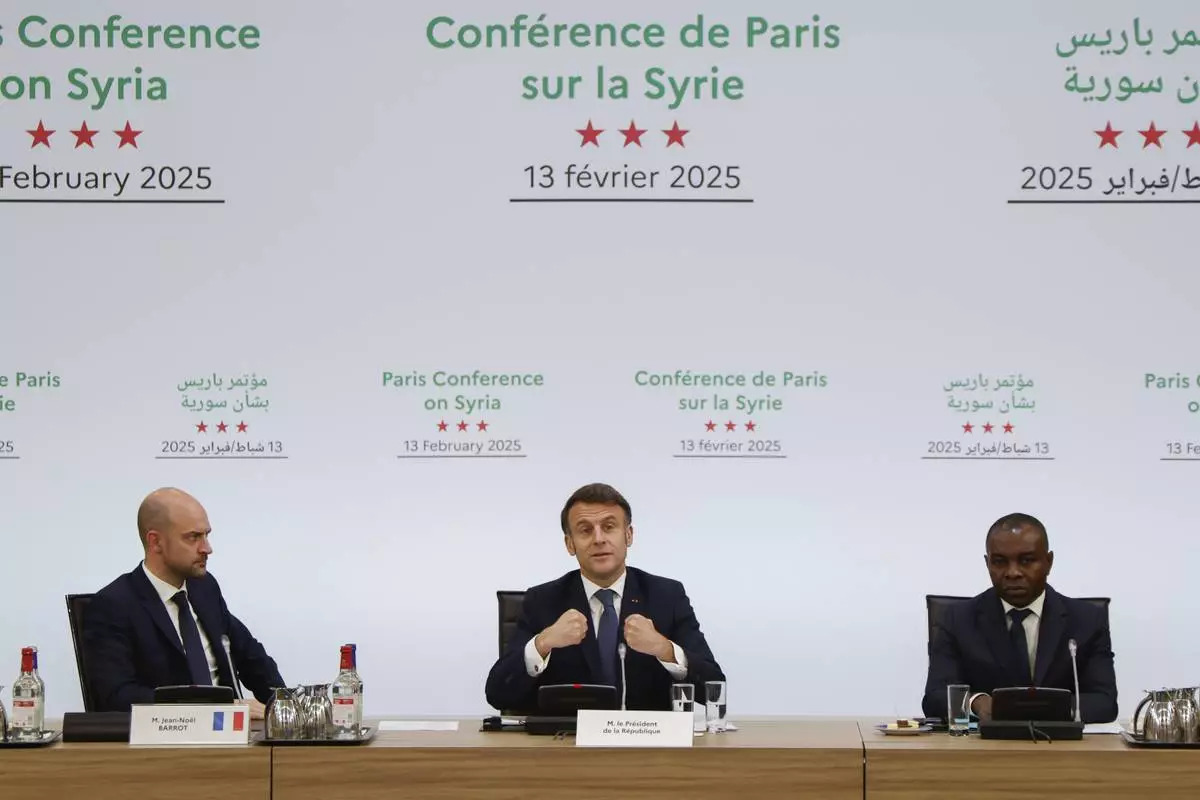
France's President Emmanuel Macron, center, delivers a speech during the International Conference on Syria at the Ministerial Conference Center, in Paris, France, Thursday, Feb. 13, 2025. (Ludovic Marin, Pool Photo via AP)
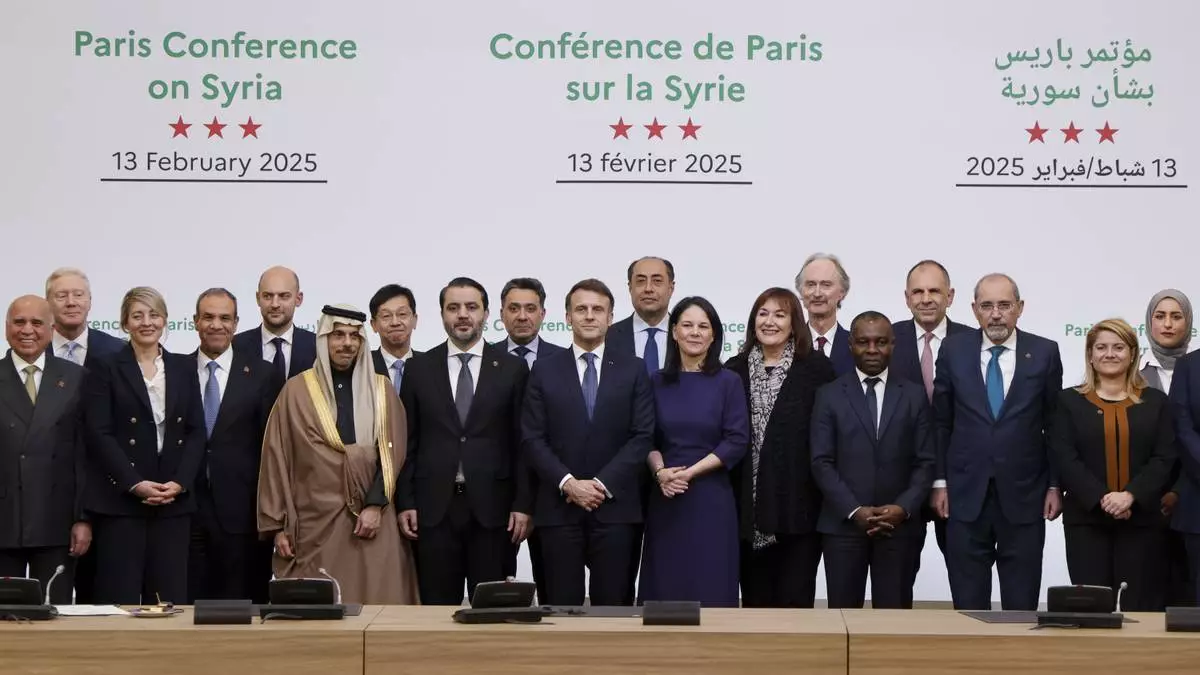
France's President Emmanuel Macron, center left, and on his side Syria's Interim Foreign Minister Asaad Al-Shibani pose for a photo with participants during the International Conference on Syria at the Ministerial Conference Center, in Paris, France, Thursday, Feb. 13, 2025. (Ludovic Marin, Pool Photo via AP)
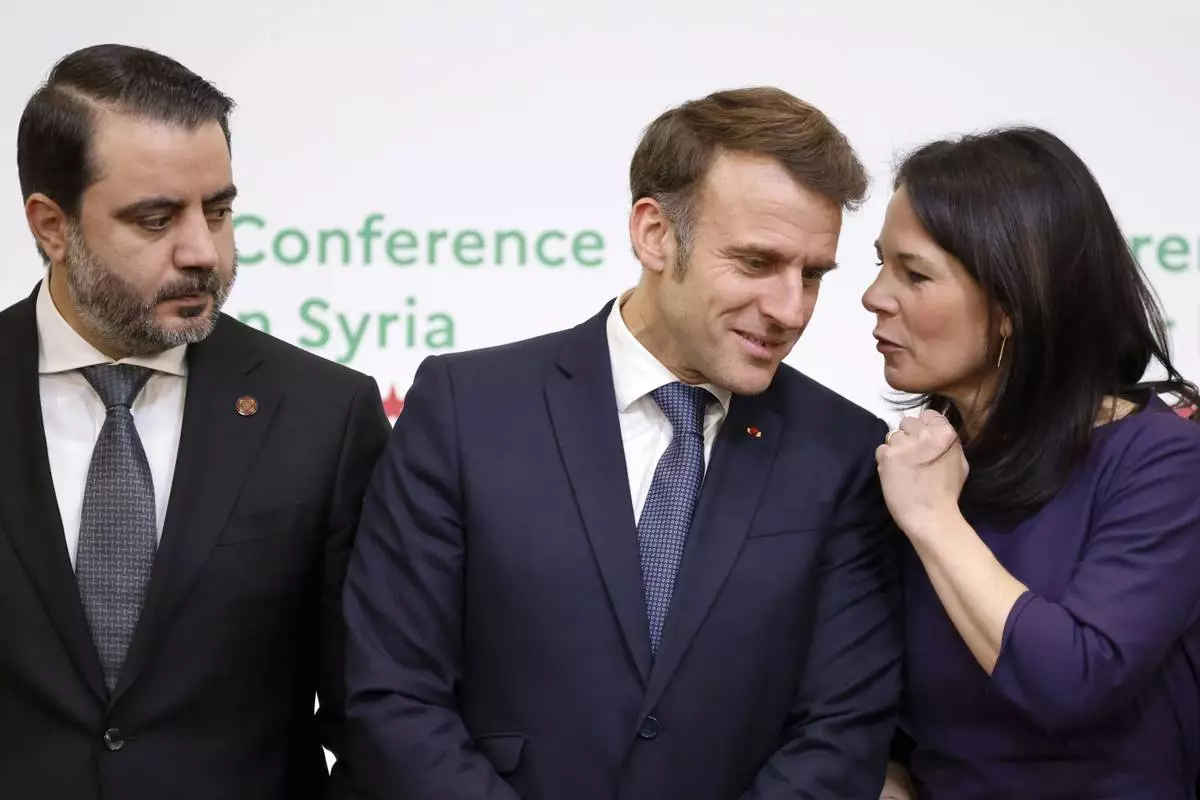
France's President Emmanuel Macron, center, Syria's Interim Foreign Minister Asaad Al-Shibani, left, and German Foreign Minister Annalena Baerbock pose for a photo during the International Conference on Syria at the Ministerial Conference Center, in Paris, France, Thursday, Feb. 13, 2025. (Ludovic Marin, Pool Photo via AP)
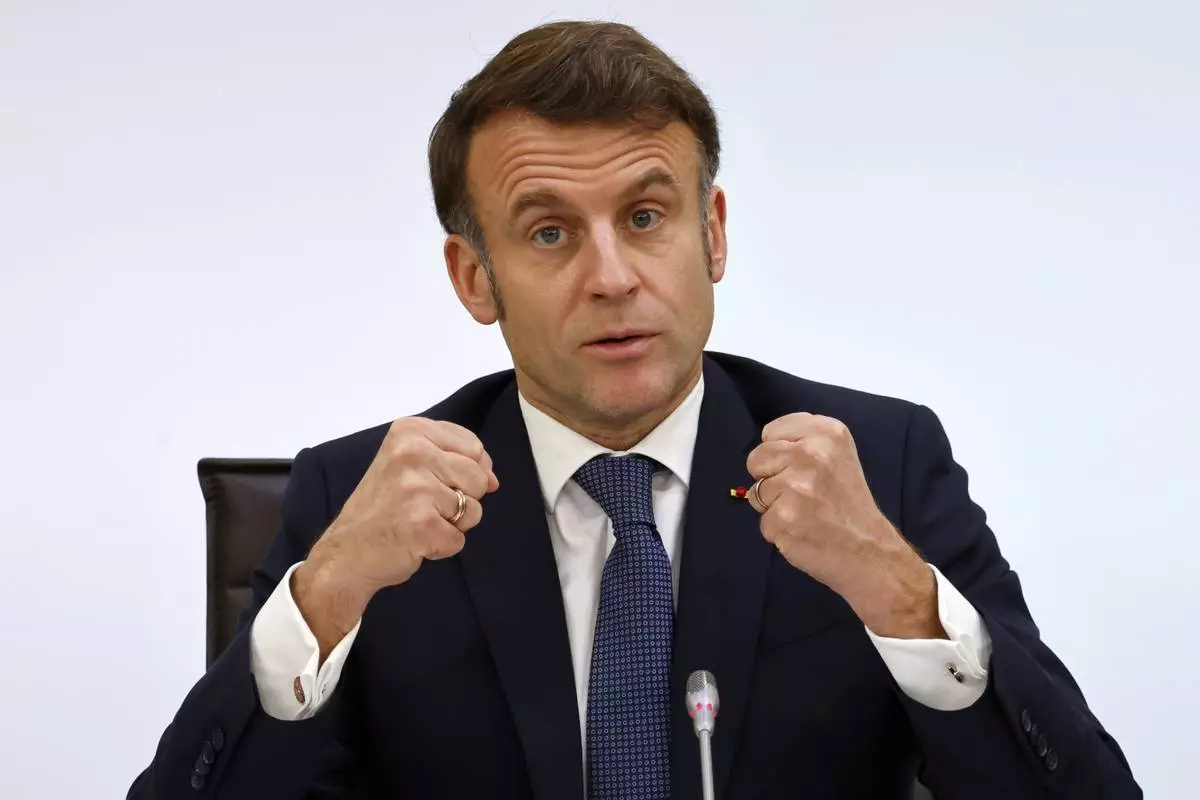
France's President Emmanuel Macron gestures as he delivers a speech during the International Conference on Syria at the Ministerial Conference Center, in Paris, France, Thursday, Feb. 13, 2025. (Ludovic Marin, Pool Photo via AP)
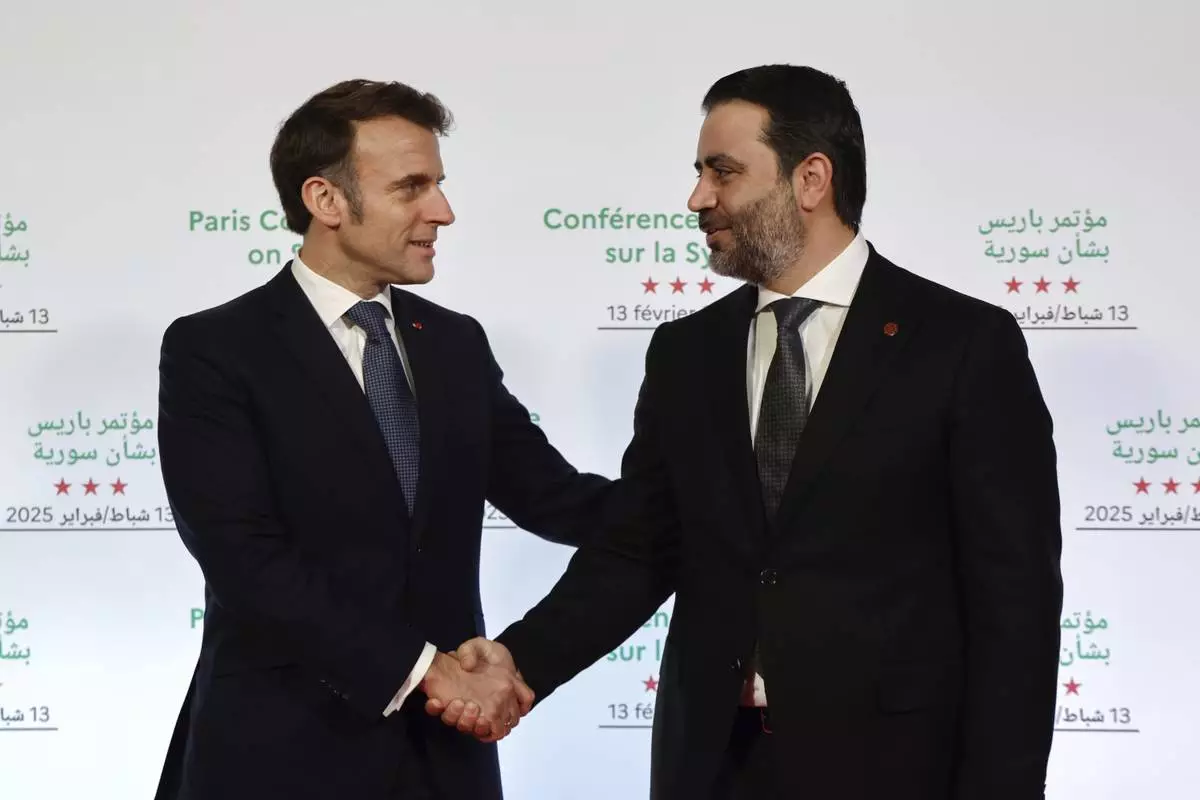
France's President Emmanuel Macron, left, greets Syria's Interim Foreign Minister Asaad Al-Shibani during the International Conference on Syria at the Ministerial Conference Center, in Paris, France, Thursday, Feb. 13, 2025. (Ludovic Marin, Pool Photo via AP)