China's three major telecom operators have fully accessed the DeepSeek open-source large model, according to the Ministry of Industry and Information Technology.
Released on Jan 20, DeepSeek had quickly soared to the top of Apple app store's free charts by Jan 27, surpassing OpenAI's ChatGPT.
China Telecom's Tianyi Cloud has become the first telecom operator-level cloud platform in China to integrate DeepSeek. By connecting its video conferencing system to DeepSeek, the platform can now synchronize conference content, including participant speeches and presentation materials, to automatically generate meeting minutes and produce concise summaries.
"After DeepSeek gained widespread popularity, we gained a unique advantage. Our computing power is distributed nationwide, allowing many users to access it nearby, ensuring ultra-low latency responses," said Lin Binghuai, chief research and development expert of Tianyi Cloud.
Industry insiders said that DeepSeek makes it possible for users to access more AI services at lower costs.
"By leveraging our CN Brain platform, the DeepSeek model can be automatically deployed based on our computing power, reducing construction, operation, and maintenance costs. Ultimately, this lowers service costs for users," said Sun Shaoling, deputy director of China Mobile's Cloud Capability Center.
On China Unicom's cloud platform, the programming assistant can rapidly generate more than ten lines of codes from a single instruction, while the DeepSeek model also provides detailed explanation and optimization of the generated codes.
"It can be said that DeepSeek's open-source model is truly a revolution for the AI industry ecosystem. It also enhances our capabilities in independent and controllable technology," said Feng Qiang, deputy general manager of cloud computing division of China Unicom Digital Technology.
Beyond operator cloud platforms, hardware manufacturers such as mobile phone and PC producers are also actively adopting DeepSeek, and several local governments have also begun to integrate it into their administrative systems.
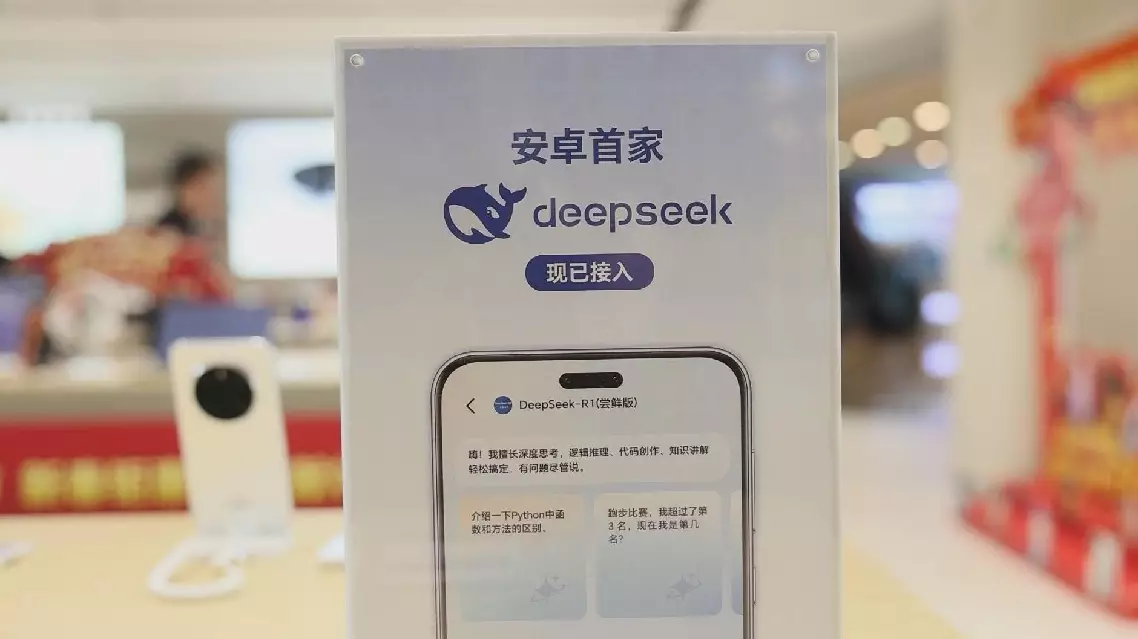
China's first Android smartphone equipped with the DeepSeek AI model has achieved a breakthrough in both AI task efficiency and user interaction. The integration of DeepSeek enables advanced functionalities such as deep analytical capabilities and personalized services, significantly enhancing the consumer experience.
""Since integrating DeepSeek, the accuracy of AI-generated responses has risen by an average of 15 percent, with specific scenarios witnessing an 85 percent surge in precision," said Bai Chen, Honor's AI expert.
Industry analysts emphasized that DeepSeek's open-source framework has dramatically lowered barriers to AI adoption across sectors, catalyzing rapid growth in government and enterprise related applications.
"At the beginning of the year, we deepened our collaboration with DeepSeek and developed an all-in-one device based on DeepSeek and other technologies. Demand has surged across sectors, including government, manufacturing, healthcare, and education, with stakeholders actively exploring tailored technological applications," said Wei Dong, general manager of Lenovo Baiying.
China's 3 major telecom operators fully access DeepSeek open-source large model