A research team from Fudan University in Shanghai has achieved a breakthrough in green hydrogen production that could dramatically reduce costs and accelerate the adoption of this clean energy source.
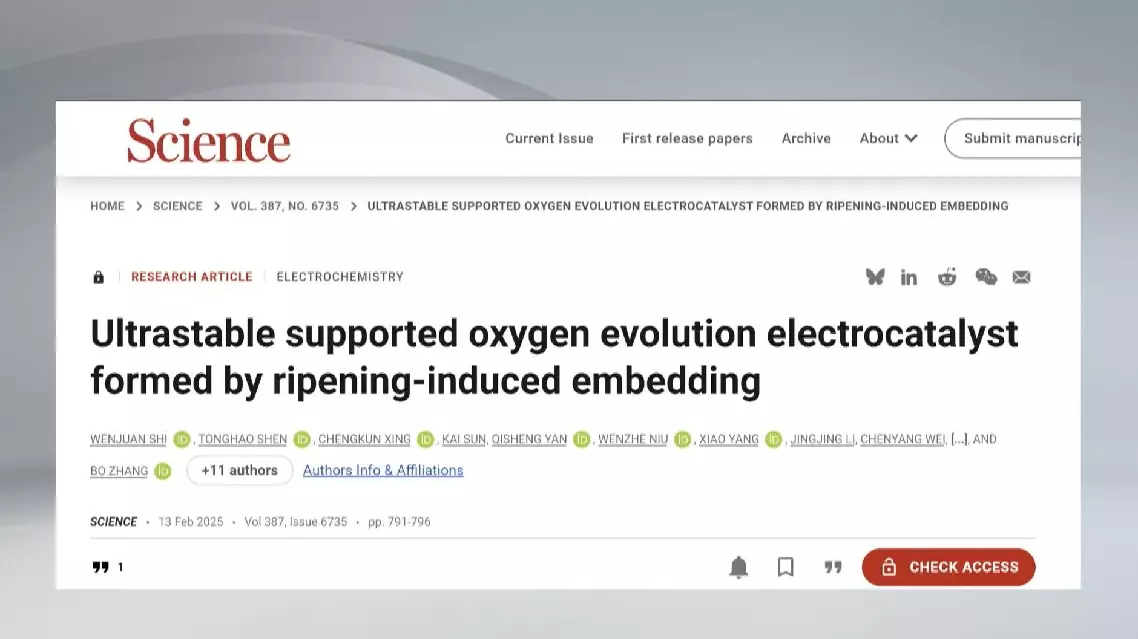
Their findings, published in the latest issue of journal Science on Feb 14, detail the development of a novel embedded catalyst that significantly enhances the stability and performance of Proton Exchange Membrane Water Electrolyzer (PEMWE) technology, a cornerstone for generating green hydrogen.
Green hydrogen, produced with renewable energies like wind and solar power, is believed to be a prospective clean energy source for decarbonization efforts in various industries such as agriculture, chemical engineering and transportation. However, its high production costs have hindered widespread application.
The Fudan team's novel catalyst uses far less expensive metals like iridium and platinum, which currently dominate green hydrogen production. Iridium, priced at approximately 1,295 yuan (about 178.34 U.S. dollars) per gram, is a key component in existing catalysts. The new catalyst significantly reduces iridium usage, cutting costs while maintaining efficiency.
The inspiration for this innovation came from an unexpected source: a traditional Chinese snack called "maqiu" (sesame balls). The researchers likened the catalyst to a maqiu, where a low-cost core is coated with the active metal, just like the sesame seeds on the outside of a maqiu. Using cryogenic electron tomography, the team magnified the catalyst structure 10 million times, revealing a design that maximizes surface area while minimizing precious metal usage.
"Traditional catalysts are like a ball, with only its surface truly having an effect. This dawned on us how the maqiu is made. What if we turn the sesame seeds on the surface into iridium oxide, and change what's inside into a low-cost material? Sesame seeds are easy to drop off, but once they are planted or embedded on the surface of maqiu, they would not detach. So we could reduce the usage of iridium oxide. For the same catalyst, the conventional technology would use 20 grams of iridium oxide for every square meter of the equipment, but using our new technology, every square meter needs just 3 grams," explained Professor Zhang Bo of Fudan University's Department of Macromolecular Science. The new catalyst also reduces energy consumption during water electrolysis, the most mature method for green hydrogen production. For every cubic meter of hydrogen produced, the technology saves 1 kilowatt-hour of electricity.
"Calculated according to the global demand of 100 million tons of green hydrogen throughout 2050, this technology could save 1.12 trillion kilowatt-hours of electricity every year," Zhang said.
The development of the novel catalyst brings down both the production costs and energy consumption. With the technology now entering industrial testing, it is promising to enable large-scale, cost-effective green hydrogen production.
Fudan researchers make breakthrough in green hydrogen production