Skip to Content Facebook Feature Image

Paradise’s Sterling K. Brown Gets Real on ‘Difficult’ — and Transformative — Conversations in Parade’s Exclusive Cover Story

News

Paradise’s Sterling K. Brown Gets Real on ‘Difficult’ — and Transformative — Conversations in Parade’s Exclusive Cover Story
News

News

Paradise’s Sterling K. Brown Gets Real on ‘Difficult’ — and Transformative — Conversations in Parade’s Exclusive Cover Story

2025-02-14 21:29 Last Updated At:21:41

NEW YORK--(BUSINESS WIRE)--Feb 14, 2025--

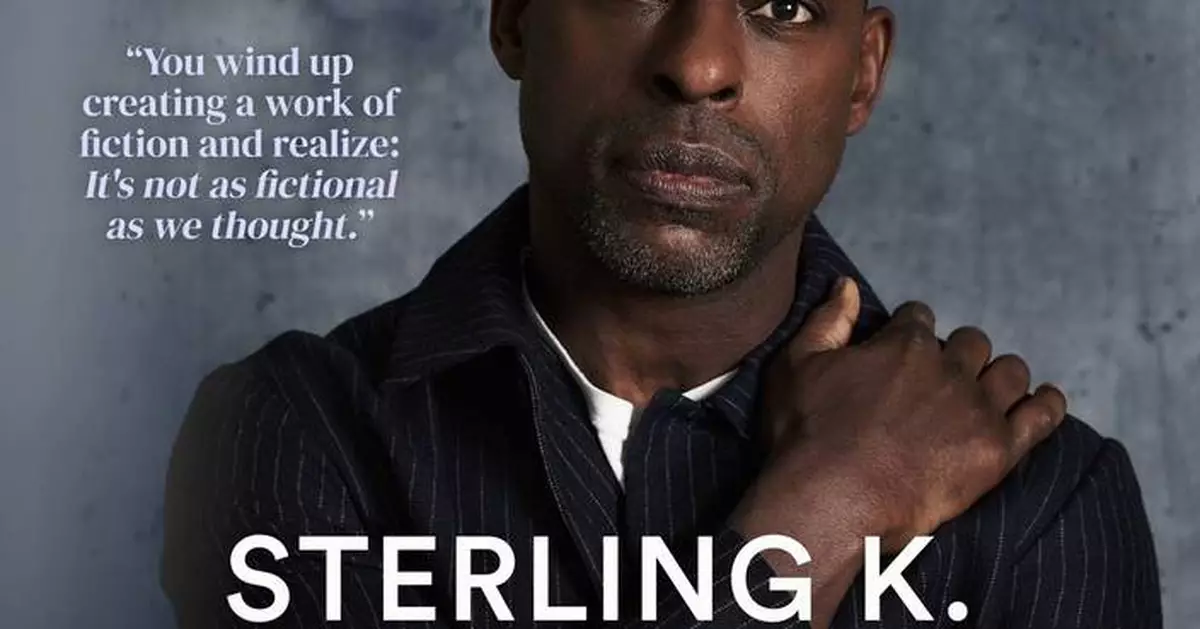
Parade, the premium legacy entertainment and lifestyle brand, released its latest cover story featuring a candid and exclusive interview with actor and producer Sterling K. Brown. In the interview, the Emmy Award winner opens up about Paradise, the political thriller on Hulu that he co-produces and stars in, race in the entertainment industry, how being a father was “what I’ve been waiting for,” his close relationship with his wife and two sons and more.

This press release features multimedia. View the full release here: https://www.businesswire.com/news/home/20250214848143/en/

Read the full interview here. Video link here. Notable quotes are below.

On race in the entertainment industry: “I think the industry has moved to race-consciousness [casting] rather than race-blindness. I think race-blindness was a good place to start, to open it up to all ethnicities. Being considered is a wonderful thing. But now, when you're writing with an ethnicity, with a minority in mind, there's something about that person's background you want to use to highlight the story you want to tell. That's a way more powerful thing.”

“I try to have these conversations with the writers, with the director, and be like, ‘O.K., I see how this was conceived, and now, how do we make it for me?’ so it doesn't feel like I'm generically there, but specifically there.”

On supporting his ‘This Is Us’ co-stars through the L.A. wildfires: “There's been all kinds of community. We've been talking to each other, to Milo [Ventimiglia], to Mandy [Moore]. I see Mandy all the time. We've been doing the [‘This Was Us’] podcast together—me, her and Chris Sullivan. It's so heartbreaking, bro. She just had her third baby girl. And then she loses her home, her husband's family['s home] in the Palisades. She's starting over and figuring out what to do next.”

In these situations, he says, “You just make yourself available in whatever way you can. We've talked a couple of times since it all went down, but you give her space, too, because it is such a devastating thing to figure out. She’s just taking it one day at a time.”

On 18-year marriage to actress Ryan Michelle Bathe: “We’ve grown so much through the years. Ryan would agree. We used to have some fights that were just awful, absolutely terrible. I'm so happy with the evolution of our relationship and our ability to express ourselves—our needs, our desires, our wants—without offending the other person. We've come a long way, and honestly, I did not know if we would get to this place at certain points in time in the relationship. I'm very thankful that I have my partner in life to go through everything I have with her. I love her very much.”

On raising a teenager (Andrew, age 13): “Teenage boys, I don't know if they're different than girls. I have nothing to compare it to except for This Is Us. He has a tendency to be very close to the vest, my oldest son. I want to give him his privacy and his autonomy, but I need to let him know that your dad cares about every facet of your life, right? So, if and when you want to share with me, you can share whatever you want. He's a great student. The kid makes straight As. He's a great athlete. He plays soccer like nobody's business. And he's a great friend. The people that he's close to, he is ride or die. I have no real horror stories to report with regards to raising a teenager other than I just want him to talk to me more.”

On fatherhood: “Fatherhood has changed me in ways I thought it would and in ways I could not have possibly imagined. I always felt like I was put on the planet to be a dad. And then I got a chance to be a dad, and I was like, ‘Yeah, this is what I've been waiting for.’”

On his career trajectory: “I was an economics major at Stanford University. My mom took out loans to put me through high school and made a lot of sacrifices so my trajectory could be what it was at that point in time. To make the decision to be a starving actor wasn't necessarily like, ‘Oh, man, that's the way to go.’ It was God being like, ‘Look at what happens to you when you get to do this thing. Look at how you light up. Why would you question whether I've given this to you or not? Who cares what everybody else has to say about it? Listen to what happens inside of your soul when you get to do it.’ That's what's important. The money, whatever else, will come when it comes. But this feeling you get of connectivity with the universe, with God, with everything… You're doing something that feels bigger than you.”

On Paradise’s similarities to current events:Paradise in no way is a reflection of the world in which we live. It is a work of fiction. Similarities to characters that you see in real life are just by chance. You wind up creating a work of fiction, and then life happens, and you realize, ‘Oh, it's not as fictional as we thought it was going to be.’”

To read this story, or any of previous Parade cover stories, click here.

About Parade

Parade, the premium legacy entertainment and lifestyle brand, has been enlightening, delighting and inspiring audiences for more than 80 years. Parade is owned and operated by The Arena Group (NYSE American: AREN), an innovative technology platform and media company with a proven cutting-edge playbook that transforms media brands. Arena’s unified technology platform empowers creators and publishers with tools to publish and monetize their content, while also leveraging quality journalism of anchor brands like TheStreet, Parade, Men’s Journal and Athlon Sports to build their businesses. The company aggregates content across a diverse portfolio of brands, reaching over 100 million users monthly. Visit us at thearenagroup.net and discover how we are revolutionizing the world of digital media.

Paradise’s Sterling K. Brown Gets Real on ‘Difficult’ — and Transformative — Conversations in Parade’s Exclusive Cover Story (Photo: Business Wire)

Paradise’s Sterling K. Brown Gets Real on ‘Difficult’ — and Transformative — Conversations in Parade’s Exclusive Cover Story (Photo: Business Wire)
RHO, Italy (AP) — No ice is colder and harder than speedskating ice. The precision it takes has meant that Olympic speedskaters have never competed for gold on a temporary indoor rink – until the 2026 Milan Cortina Winter Games.

In the pursuit of maximum glide and minimum friction, Olympic officials brought on ice master Mark Messer, a veteran of six previous Olympic speedskating tracks and the ice technician in charge of the Olympic Oval in Calgary, Canada — one of the fastest tracks in the world with over 300 records.

Messer has been putting that experience to work one thin layer of ice at a time since the end of October at the new Speed Skating Stadium, built inside adjacent trade fair halls in the city of Rho just north of Milan.

“It’s one of the biggest challenges I’ve had in icemaking,’’ Messer said during an interview less than two weeks into the process.

If Goldilocks were a speedskater, hockey ice would be medium hard, for fast puck movement and sharp turns. Figure skating ice would be softer, allowing push off for jumps and so the ice doesn’t shatter on landing. Curling ice is the softest and warmest of all, for controlled sliding.

For speedskating ice to be just right, it must be hard, cold and clean. And very, very smooth.

“The blades are so sharp, that if there is some dirt, the blade will lose the edge,’’ Messer said, and the skater will lose speed.

Speedskater Enrico Fabris, who won two Olympic golds in Turin in 2006, has traded in his skates to be deputy sports manager at the speedskating venue in Rho. For him, perfect ice means the conditions are the same for all skaters — and then if it's fast ice, so much the better.

"It's more of a pleasure to skate on this ice,'' he said.

Messer’s first Olympics were in Calgary in 1988 — the first time speedskating was held indoors. “That gave us some advantages because we didn’t have to worry about the weather, wind blowing or rain,’’ he said. Now he is upping the challenge by becoming the first ice master to build a temporary rink for the Olympics.

Before Messer arrived in Italy, workers spent weeks setting up insulation to level the floor and then a network of pipes and rubber tubes that carry glycol — an antifreeze — that is brought down to minus 7 or minus 8 degrees Celsius (17.6 to 19.4 degrees Fahrenheit) to make the ice.

Water is run through a purification system — but it can’t be too pure, or the ice that forms will be too brittle. Just the right amount of impurities “holds the ice together,’’ Messer said.

The first layers of water are applied slowly, with a spray nozzle; after the ice reaches a few centimeters it is painted white — a full day’s work — and the stripes are added to make lanes.

“The first one takes about 45 minutes. And then as soon as it freezes, we go back and do it again, and again and again. So we do it hundreds of times,’’ Messer said.

As the ice gets thicker, and is more stable, workers apply subsequent layers of water with hoses. Messer attaches his hose to hockey sticks for easier spreading.

What must absolutely be avoided is dirt, dust or frost — all of which can cause friction for the skaters, slowing them down. The goal is that when the skaters push “they can go as far as possible with the least amount of effort,’’ Messer said.

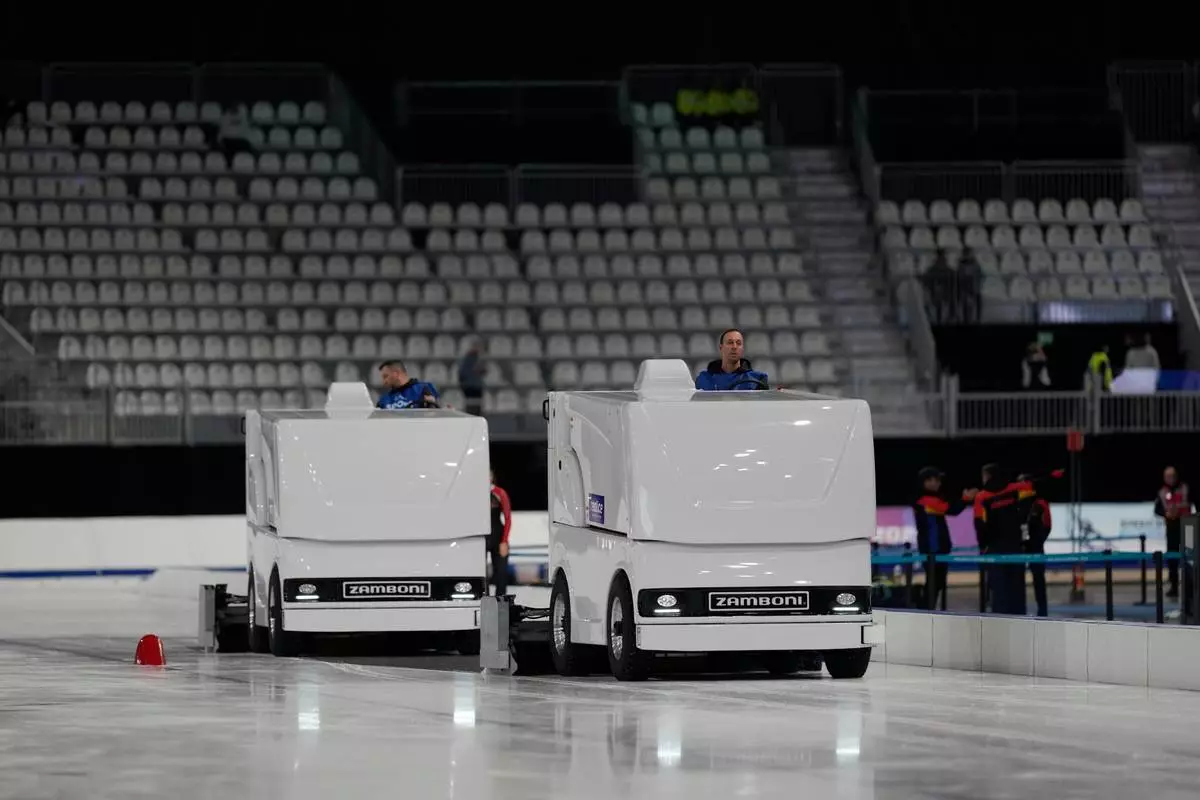
The Zamboni ice resurfacing machine plays a key role in keeping the track clean, cutting off a layer and spraying water to make a new surface.

One challenge is gauging how quickly the water from the resurfacing machine freezes in the temporary rink.

Another is getting the ice to the right thickness so that the Zamboni, weighing in at six tons, doesn’t shift the insulation, rubber tubing or ice itself.

“When you drive that out, if there’s anything moving it will move. We don’t want that,’’ Messer said.

The rink got its first big test on Nov. 29-30 during a Junior World Cup event. In a permanent rink, test events are usually held a year before the Olympics, leaving more time for adjustments. “We have a very small window to learn,’’ Messer acknowledged.

Dutch speedskater Kayo Vos, who won the men’s neo-senior 1,000 meters, said the ice was a little soft — but Messer didn’t seem too concerned.

“We went very modest to start, now we can start to change the temperatures and try to make it faster and still maintain it as a safe ice,’’ he said.

Fine-tuning the air temperature and humidity and ice temperature must be done methodically — taking into account that there will be 6,000 spectators in the venue for each event. The next real test will be on Jan. 31, when the Olympians take to the ice for their first training session.

“Eighty percent of the work is done but the hardest part is the last 20 percent, where we have to try to find the values and the way of running the equipment so all the skaters get the same conditions and all the skaters get the best conditions,’’ Messer said.

AP Winter Olympics: https://apnews.com/hub/milan-cortina-2026-winter-olympics

Serpentines are set on the ice of the stadium where speed skating discipline of the Milan Cortina 2026 Winter Olympics will take place, in Rho, outskirt of Milan, Tuesday, Nov. 11, 2025. (AP Photo/Luca Bruno)

Serpentines are set on the ice of the stadium where speed skating discipline of the Milan Cortina 2026 Winter Olympics will take place, in Rho, outskirt of Milan, Tuesday, Nov. 11, 2025. (AP Photo/Luca Bruno)

Ice Master Mark Messer poses in the stadium where speed skating discipline of the Milan Cortina 2026 Winter Olympics will take place, in Rho, outskirt of Milan, Tuesday, Nov. 11, 2025. (AP Photo/Luca Bruno)

Ice Master Mark Messer poses in the stadium where speed skating discipline of the Milan Cortina 2026 Winter Olympics will take place, in Rho, outskirt of Milan, Tuesday, Nov. 11, 2025. (AP Photo/Luca Bruno)

Workers clean the ice surface during a peed skating Junior World Cup and Olympic test event, in Rho, near Milan, Italy, Saturday, Nov. 29, 2025. (AP Photo/Luca Bruno)

Workers clean the ice surface during a peed skating Junior World Cup and Olympic test event, in Rho, near Milan, Italy, Saturday, Nov. 29, 2025. (AP Photo/Luca Bruno)

Ice Master Mark Messer poses in the stadium where speed skating discipline of the Milan Cortina 2026 Winter Olympics will take place, in Rho, outskirt of Milan, Tuesday, Nov. 11, 2025. (AP Photo/Luca Bruno)

Ice Master Mark Messer poses in the stadium where speed skating discipline of the Milan Cortina 2026 Winter Olympics will take place, in Rho, outskirt of Milan, Tuesday, Nov. 11, 2025. (AP Photo/Luca Bruno)

Ice Master Mark Messer poses in the stadium where speed skating discipline of the Milan Cortina 2026 Winter Olympics will take place, in Rho, outskirt of Milan, Tuesday, Nov. 11, 2025. (AP Photo/Luca Bruno)

Ice Master Mark Messer poses in the stadium where speed skating discipline of the Milan Cortina 2026 Winter Olympics will take place, in Rho, outskirt of Milan, Tuesday, Nov. 11, 2025. (AP Photo/Luca Bruno)

Recommended Articles