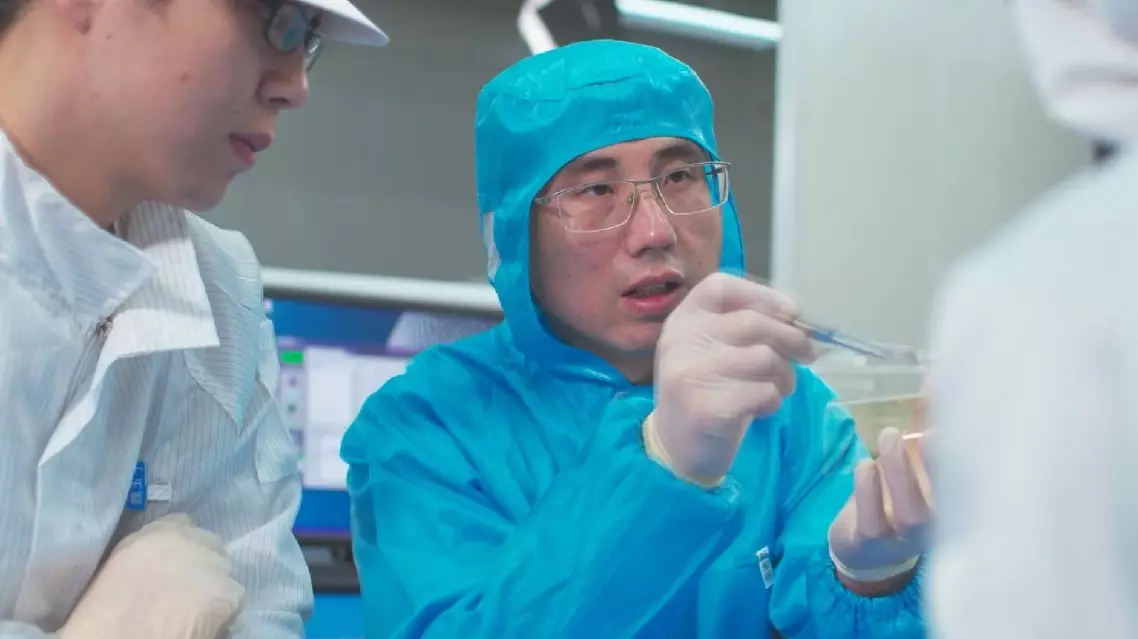
As China's annual two sessions approach, Sun Dongming, a scientist and a deputy to the 14th National People's Congress (NPC), has said he is set to submit a motion aimed at advancing scientific and technological (sci-tech) innovation in the private sector, on the basis of his firsthand experiences and extensive field research.
The 14th NPC, China's national legislature, will open its third annual session in Beijing on March 5, while the third session of the 14th Chinese People's Political Consultative Conference (CPPCC) National Committee, China's top political advisory body, is scheduled to begin on March 4. The two sessions are one of the most important events on the Chinese political calendar, where NPC deputies and CPPCC members gather to submit motions and offer proposals for national development.
Sun, a researcher at the Institute of Metal Research, the Chinese Academy of Sciences and recipient of the National Science Fund for Distinguished Young Scholars, has led his team to making significant breakthroughs in semiconductor science and technology. Over the past year, as an NPC deputy, Sun has conducted over ten research activities and visited more than 20 private small and medium-sized enterprises (SMEs). Recently, he visited a private tech company specializing in fine chemicals in Shenyang, northeast China's Liaoning Province. The company has more than 600 employees, one-third of whom are researchers, positioning itself as a tech-driven firm.
"With the two sessions around the corner, I want to bring forward suggestions on how private enterprises, especially SMEs and those that excel in sci-tech innovation, can be more involved in the country's major sci-tech projects," he said.
As a lawmaker in the sci-tech field, Sun has recognized the vital role that "major national science and technology projects" play in sic-tech innovation. Over the years, policies have been introduced at both the national and provincial levels to support private enterprises, particularly SMEs, in participating in these major initiatives. However, Sun found out that the 39,000 tech-driven SMEs in Liaoning, including many possessing core technologies, may face obstacles in applying for eligibility to undertake national projects, often due to non-technical factors.
"We're a company [with an annual output] of just over the threshold of 100 million yuan (about 13.8 million U.S. dollars). For us enterprises of such a size, when we apply for national projects, financial audits will become a major hurdle. Financial experts might think our revenue is too small," explained Liu Yang, technical director at Shenyang Hoper Group Company.
On top of financial entry criteria, smaller enterprises also face challenges with fund raising to undertake such major projects. In some cases, they find themselves in a situation where they get project approval but struggle to raise enough funds to implement them.
"We know some national projects require a 1:3 funding ratio, meaning for every unit of national funding, we must raise three times the amount in our own research and development funds," Sun explained.
"For example, if we want to apply for three million yuan (about 413,600 U.S. dollars) to fund our project, the matching funds required would be nearly 10 million yuan (about 1.38 million U.S. dollars) in total. For a private enterprise, securing such a large amount of funding is very stressful, and it puts significant [pressure] on the company's operation," Liu said.
Through his year-long research and deep reflection, Sun has formulated targeted suggestions to improve the "access mechanisms, funding support, evaluation systems, and industrial application" for major national sci-tech projects. He plans to present his reports at this year's two sessions.
"While making suggestions to the state, we must also be responsible to the country, ensuring that the national sci-tech funds are used effectively to truly boost sci-tech innovation," Sun emphasized.
NPC deputy to submit motion on driving innovation in private sector