OMAHA, Neb.--(BUSINESS WIRE)--Feb 17, 2025--
Union Pacific Railroad is celebrating Presidents Day with the unveiling of its newest commemorative locomotive honoring President Abraham Lincoln, who created the railroad and connected the nation through the transcontinental railroad. This rolling tribute highlights the pivotal role rail played and continues to play in the global economy and the transformative contributions of our nation’s 16 th president.
This press release features multimedia. View the full release here: https://www.businesswire.com/news/home/20250217258995/en/
“America’s history is Union Pacific’s history,” said Union Pacific CEO Jim Vena. “By signing the Pacific Railway Act of 1862, President Lincoln created our railroad and ignited The Great Race to connect the country and fuel the economy – roles our industry still plays today.”
Railroads move about 59 tons of goods annually for every American across more than 140,000 miles of privately owned tracks. At Union Pacific, on top of money spent to operate the railroad, an additional $10 million in capital is invested every day into infrastructure, technology and network expansion to provide the safe, reliable service American businesses and families rely on.
“President Lincoln wanted to unite the nation, and through his actions, railroads were a catalyst for national growth, representing major advances in innovation and technology,” Vena said. “We’re proud to be part of an industry that is still a major part of the central nervous system of the North American economy and continues to provide innovative solutions that unleash economic innovation.”
No. 1616 is the second presidential locomotive in Union Pacific’s Heritage Fleet, joining No. 4141, created to honor President George H.W. Bush. On Dec. 6, 2018, Union Pacific was honored to participate in President Bush’s funeral train, led by No. 4141, from Spring to College Station, Texas, where the locomotive is on permanent display at the George Bush Presidential Library and Museum.
The Lincoln locomotive is being painted by proud Union Pacific employees and will be officially unveiled at a celebration this spring. The paint scheme has the unique colors of Lincoln’s era and serves as a nod to locomotive No. 119, one of the two locomotives present at Promontory Summit, Utah, marking the completion of the first transcontinental railroad, officially uniting the eastern and western parts of the nation.
This year marks Lincoln’s 216 th birthday and the locomotive will travel the rails, serving as a traveling ambassador and participating in community events and educational programs that highlight the historic role of railroads in America’s growth and its continued contribution to our country, communities and economy. Future dates will be announced at UP.com.
A limited-edition commemorative poster is available for sale at the Union Pacific Store.
ABOUT UNION PACIFIC
Union Pacific (NYSE: UNP) delivers the goods families and businesses use every day with safe, reliable and efficient service. Operating in 23 western states, the company connects its customers and communities to the global economy. Trains are the most environmentally responsible way to move freight, helping Union Pacific protect future generations. More information about Union Pacific is available at www.up.com.

Union Pacific No. 1616 - The Lincoln Locomotive (Photo: Business Wire)
WASHINGTON (AP) — President Donald Trump's decision to order federal immigration agents to U.S. airports to help with security during a budget impasse is drawing concerns that their presence may escalate tensions among air travelers frustrated over hourslong waits and screeners angry about missed paychecks.
Trump made clear on Sunday that he was going ahead with the plan to have immigration enforcement officers assist the Transportation Security Administration by guarding exit lanes or checking passenger IDs unless Democrats agreed to fund the Department of Homeland Security. Democrats are demanding major changes to federal immigration operations and showing no sign of backing down.
Hundreds of thousands of homeland security workers, including from the TSA, U.S. Secret Service and Coast Guard, have worked without pay since Congress failed to renew DHS funding last month.
“Bad idea,” said Sen. Lisa Murkowski, R-Alaska, about the new airport security plan, which Trump said would start Monday.
"What we need to do is, we need to get the DHS issues resolved, we need to get the TSA agents paid,” she told reporters at the Capitol, where the Senate held a rare weekend session. “Do you really want to have even additional tensions on top of what we are already facing?”
Senators advanced the nomination of Sen. Markwayne Mullin, R-Okla., to be Trump’s next homeland security secretary by a largely party-line vote, 54-37, with two Democrats joining most Republicans. A vote on the confirmation could come as early as Monday. Mullin has tried to make the case that he would be a steady hand after the tumultuous tenure of Kristi Noem, Trump’s first DHS secretary.
White House border czar Tom Homan, named by Trump to lead the new airport security effort, has also been meeting with a bipartisan group of senators over the partial shutdown. While he characterized those sessions as “good conversations,” he said they were “not at a point yet where we’re in total agreement.”
Meanwhile, Homan said in Sunday news show interviews that the increased role of U.S. Immigration and Customs Enforcement at airports — its specific duties and numbers — was subject to discussions with the leadership of TSA and ICE. DHS spokeswoman Lauren Bis said “hundreds” of ICE officers would be deployed, but she would not disclose the airports where they would go, citing security reasons.
"It’s a work in progress,” Homan said. The priority, he said, was “the large airports where there’s a long wait, like three hours.”
Atlanta Mayor Andre Dickens issued a statement Sunday night saying officers from ICE and Homeland Security Investigations would be deployed to the Hartsfield-Jackson Atlanta International Airport starting Monday morning.
At the airport on Sunday, some travelers waited in line for nearly six hours at the main security checkpoint, where only two TSA agents were on hand midafternoon to check IDs. Many missed their flights and scrambled to book later flights or add themselves to standby lists that were already dozens of names long.
Dickens said all federal personnel would report to TSA and be assigned tasks such as line management and crowd control. “Federal officials have indicated that this deployment is not intended to conduct immigration enforcement activities,” his statement said.
Homan said immigration officers, as an example, could cover exits currently monitored by TSA agents, freeing them to work screening lines. Another option, he said, was having ICE agents check identification before people enter screenings areas.
"We’re going to be a force multiplier,” Homan said, while also acknowledging there were limits.
“I don’t see an ICE agent looking at an X-ray machine, because we’re not trained in that,” he said. He pledged to have “a plan by the end of today, where we’re sending -- what airports we’re starting with and where we’re sending them.”
But Everett Kelley, president of the American Federation of Government Employees, which represents more than 50,000 TSA employees, condemned Trump’s plan, saying in a statement that ICE agents are not trained or certified in aviation security.
“Our members at TSA have been showing up every day, without a paycheck, because they believe in the mission of keeping the flying public safe,” Kelley said Sunday. “They deserve to be paid, not replaced by untrained, armed agents who have shown how dangerous they can be.”
Democrats have said they are willing to fund TSA and most other parts of DHS as they press for changes to immigration operations after the deaths of two U.S. citizens at the hands of federal agents in Minneapolis during an immigration enforcement operation. ICE officers are largely being paid during the partial shutdown, thanks to an influx of cash from Trump’s big tax breaks bill last year.
“There are lots of ideas swirling right now,” said Senate Majority Leader John Thune, R-S.D. “The good news in all that is people realizing this has to get fixed, it has to get solved.”
As budget talks stayed behind closed doors Sunday, senators said they had few details of which airports or how many immigration officers were being dispatched. Some welcomed the effort.
“I don’t think it can hurt,” said Sen. Mike Rounds, R-S.D. “They can help relieve some of the pressure."
Trump said in a social media post that on Monday, “ICE will be going to airports to help our wonderful TSA Agents who have stayed on the job" despite the partial government shutdown. He further criticized Democrats.
Travelers at some airports worried about reaching their gates Sunday.
At Atlanta’s airport, lines wrapped from one end of the airport to the other.
The scene appeared more chaotic at John F. Kennedy International Airport in New York. Large crowds of anxious travelers piled toward security checkpoints, and TSA staff shouted through megaphones to tell people not to push one another.
For Transportation Secretary Sean Duffy, one concern is the uncertainty that passengers are facing over possible wait times at any airport on any given day.
“Do I have to come an hour and a half early? Do I have to come four hours early? They don’t know until the day of or the afternoon of their flight,” he said. “So if we can alleviate that, again, the president wants to take away that leverage point for Democrats and make travel easier for the American people.”
Associated Press writers Collin Binkley in West Palm Beach, Fla., Anthony Izaguirre in Lindenhurst, N.Y., Yuki Iwamura in New York, Nicholas Riccardi in Denver, Kate Brumback in Atlanta, Margery Beck in Omaha, Neb. and Rebecca Santana in Washington contributed to this report.
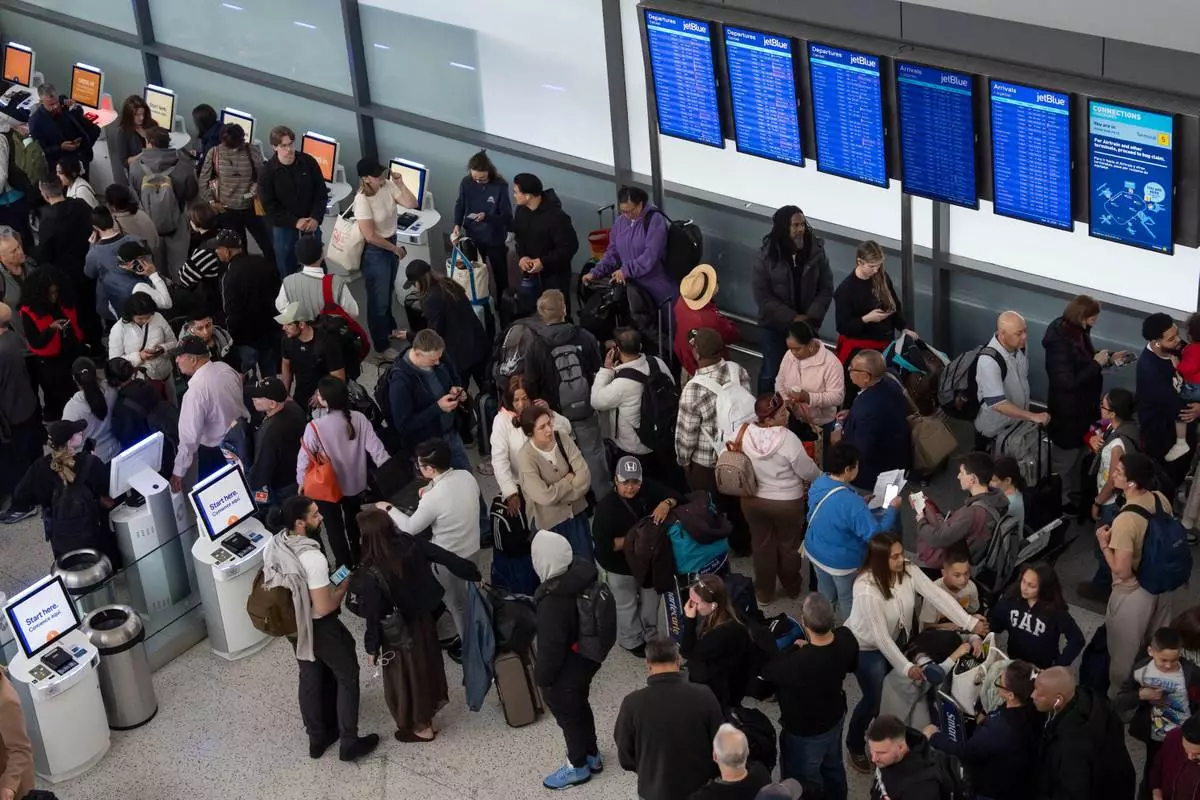
People wait in a TSA line at the John F. Kennedy International Airport, Sunday, March 22, 2026, in New York. (AP Photo/Yuki Iwamura)
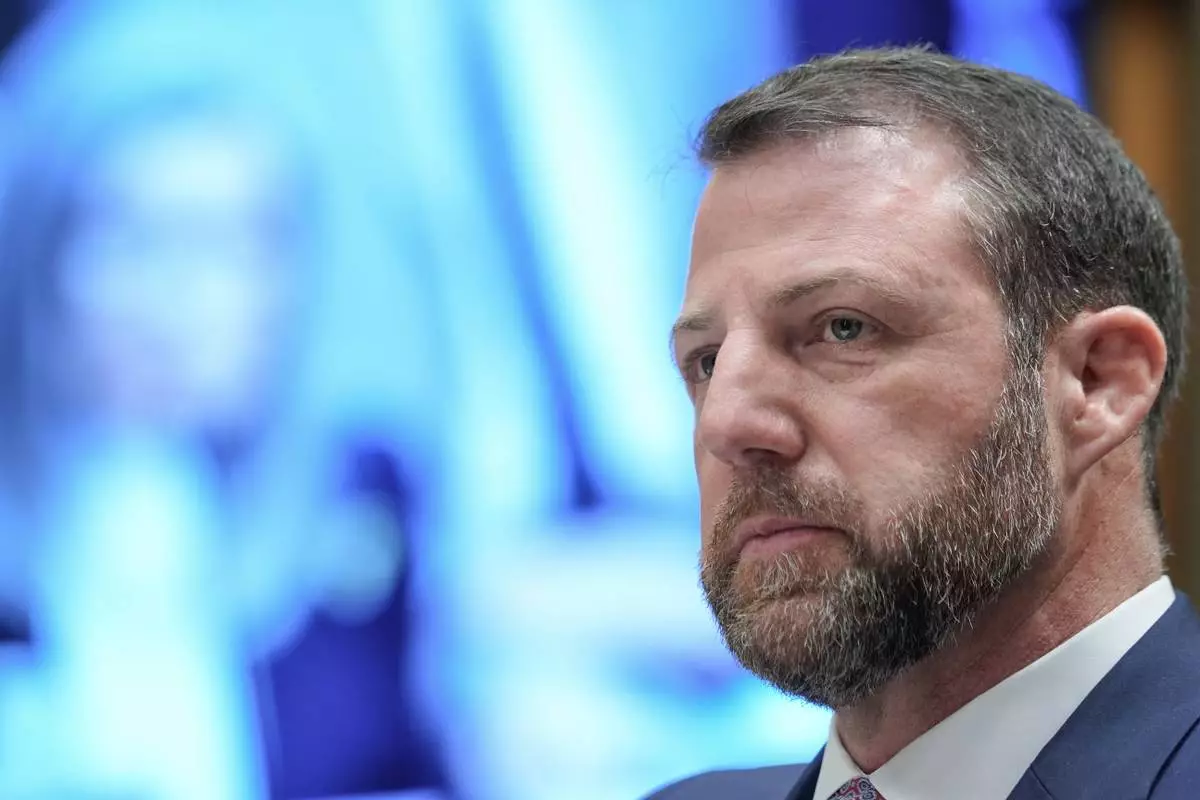
Sen. Markwayne Mullin, R-Okla., the White House pick for homeland security secretary, testifies during Senate Committee on Homeland Security and Governmental Affairs hearing, Wednesday, March 18, 2026 on Capitol Hill in Washington. (AP Photo/Mariam Zuhaib)
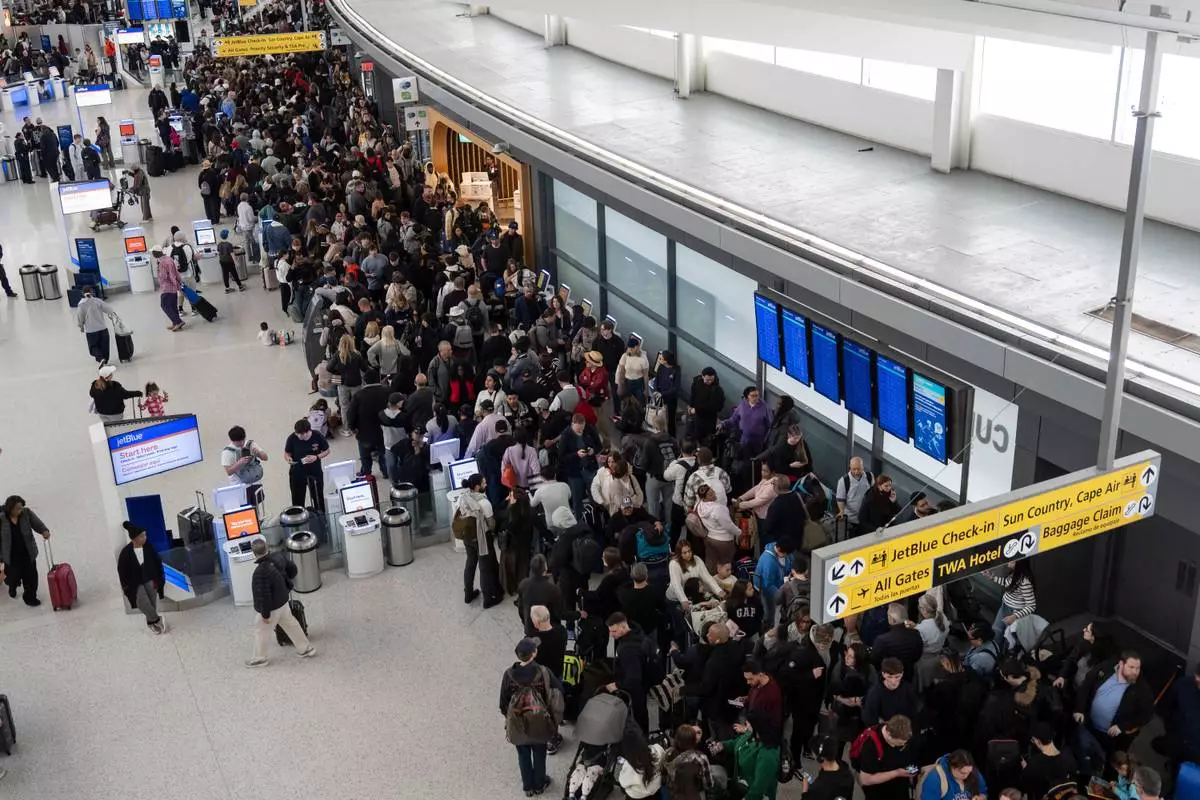
People wait in a TSA line at the John F. Kennedy International Airport, Sunday, March 22, 2026, in New York. (AP Photo/Yuki Iwamura)
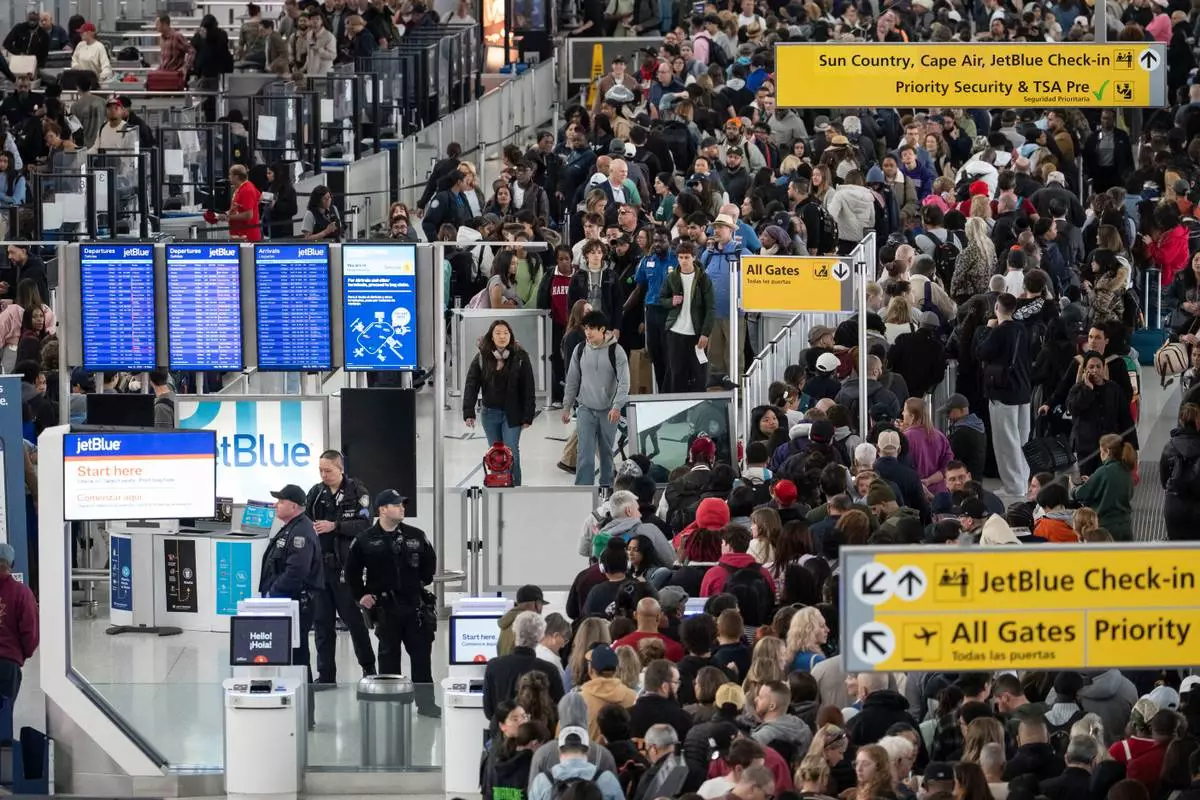
People wait in a TSA line at the John F. Kennedy International Airport, Sunday, March 22, 2026, in New York. (AP Photo/Yuki Iwamura)
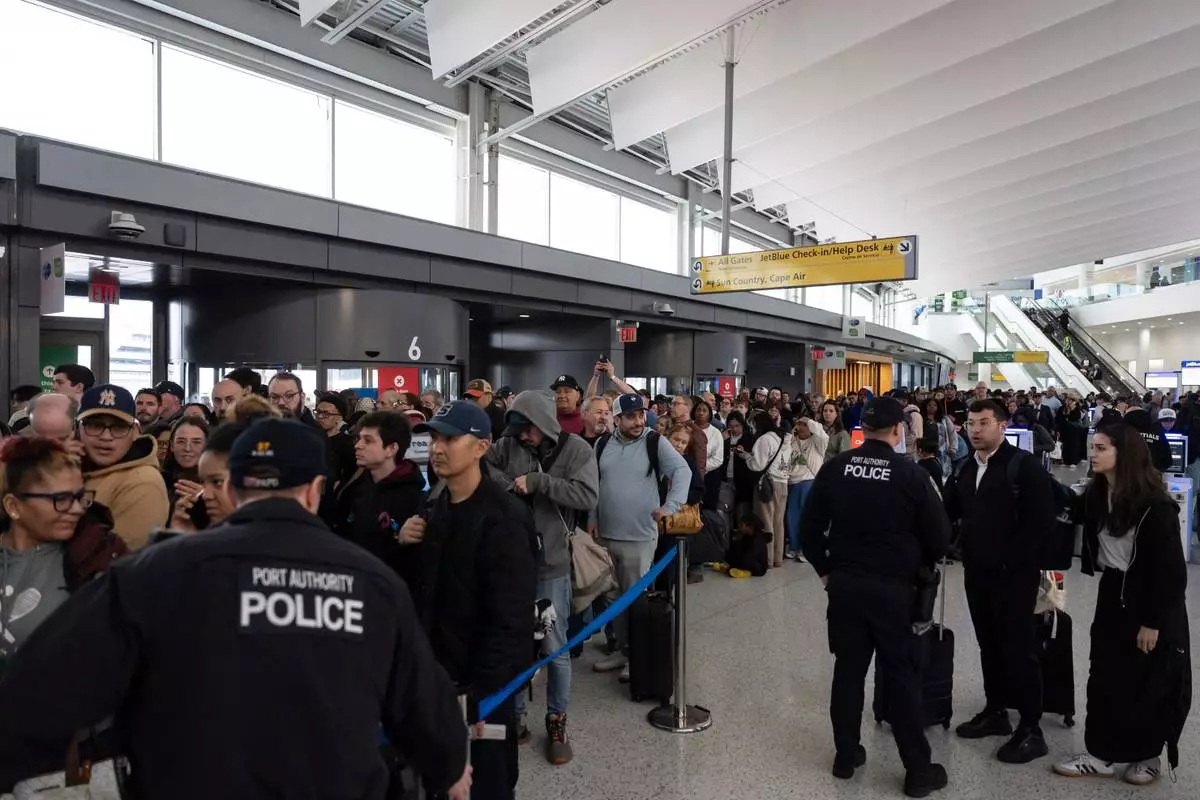
People wait in a TSA line at the John F. Kennedy International Airport, Sunday, March 22, 2026, in New York. (AP Photo/Yuki Iwamura)
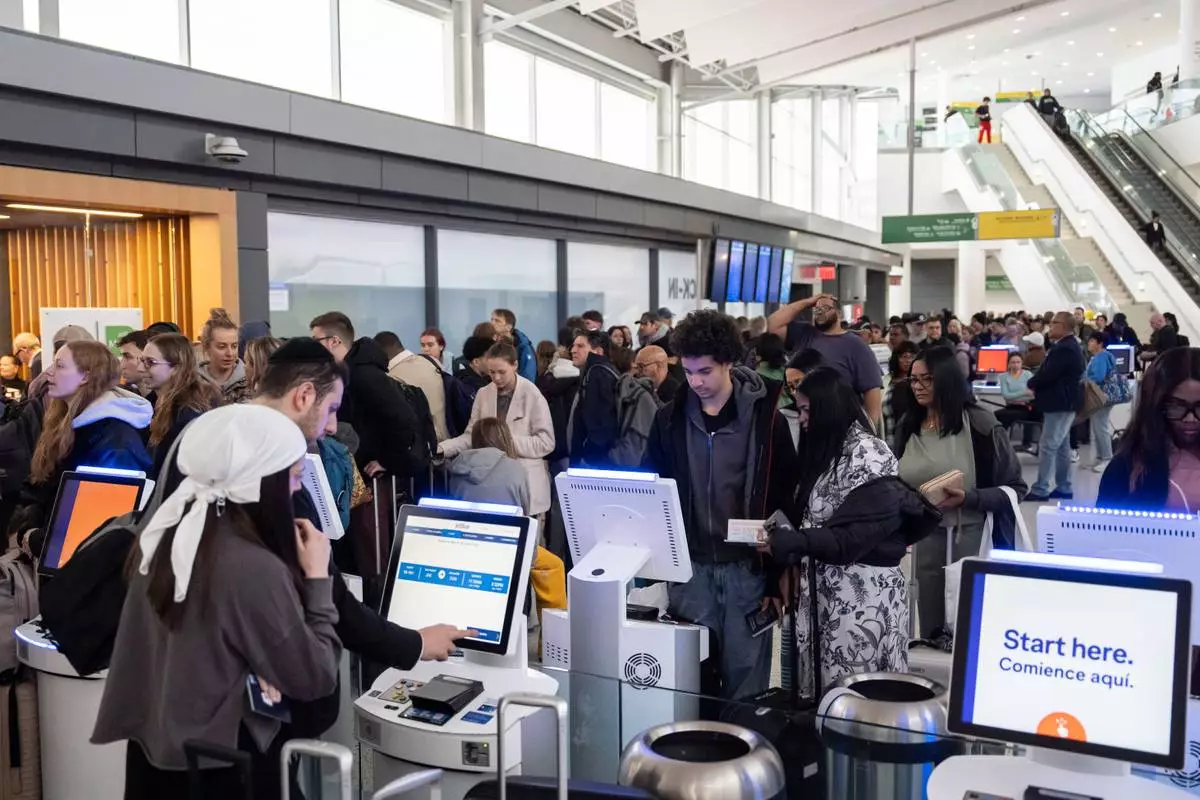
People wait in a TSA line at the John F. Kennedy International Airport, Sunday, March 22, 2026, in New York. (AP Photo/Yuki Iwamura)
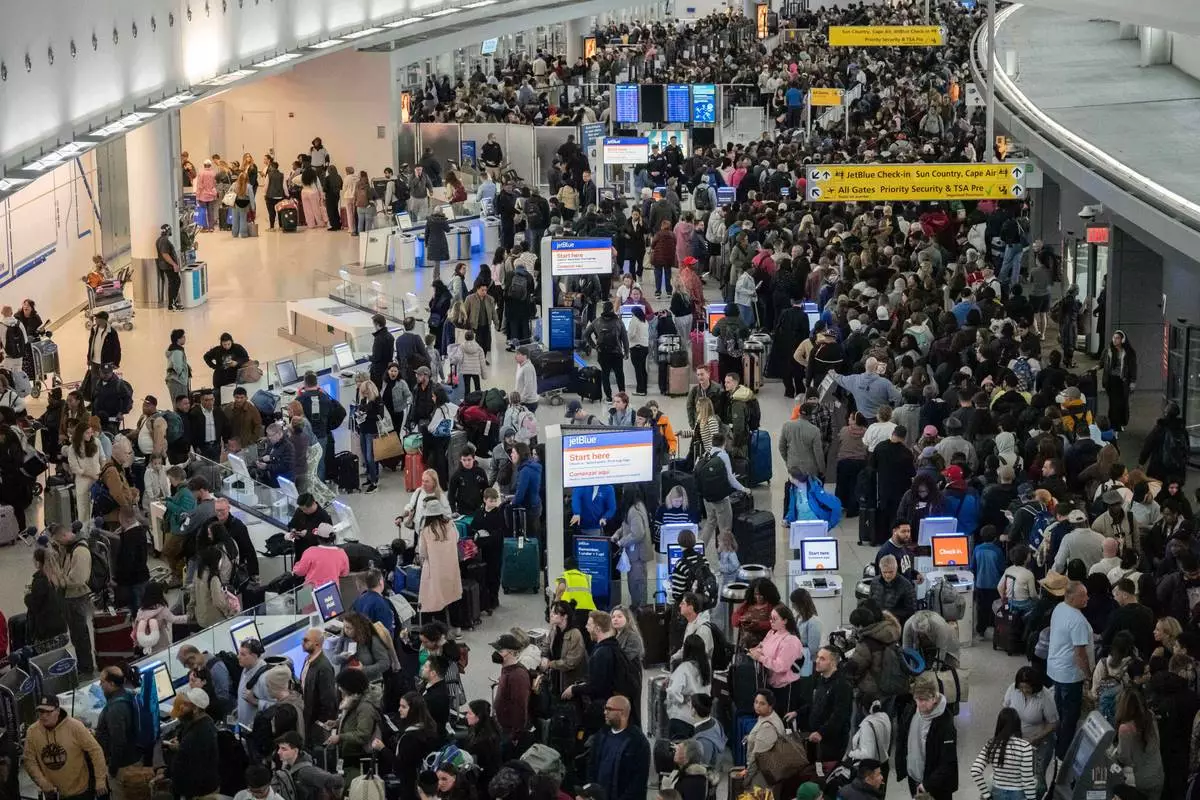
People wait in a TSA line at the John F. Kennedy International Airport, Sunday, March 22, 2026, in New York. (AP Photo/Yuki Iwamura)