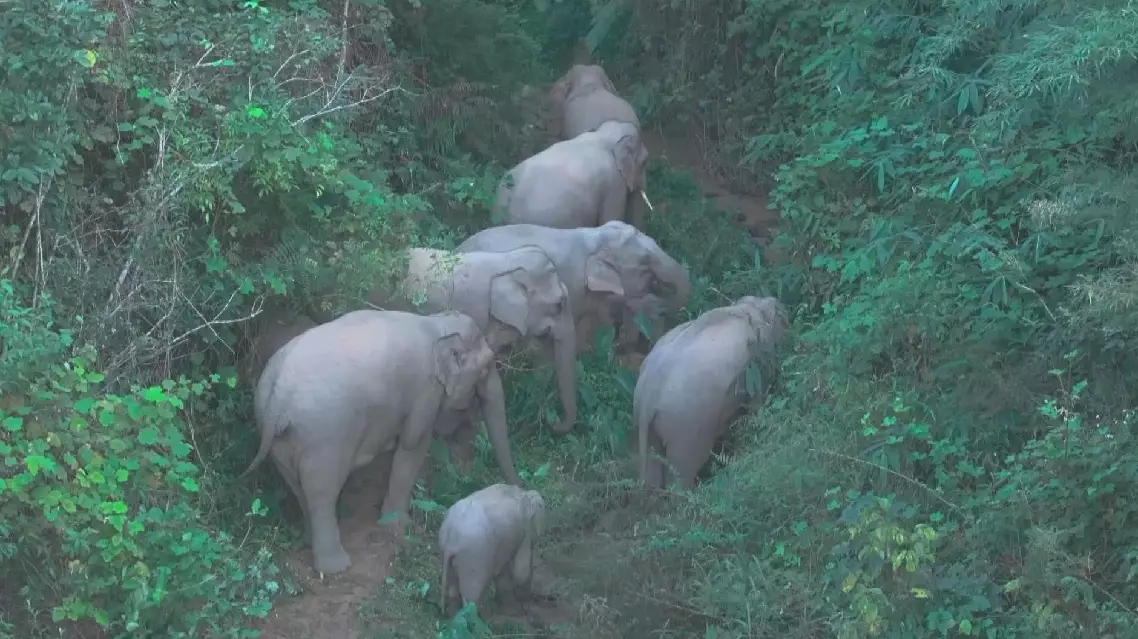
China's famous herd of wandering elephants has recently increased in population with a notable rise in the number of baby elephants, according to the Pu'er Forest Fire Brigade of Yunnan Province.
In video footage taken by firefighters on a recent patrol near the Guanping station in the Xishuangbanna National Nature Reserve, a large group of wild Asian elephants can be seen moving through the forest. They sometimes form a long line along a creek while, at other times, they can be seen foraging, with adults helping the youngsters find their feet.
The baby elephants were also frequently observed snuggling close to their mothers or nursing.
"There were 16 elephants in 2021. Now, they live with other herds, making a total of 28 elephants. We recently observed seven baby elephants," said Hong Guanghua, a firefighter with the Xishuangbanna detachment of the Yunnan Forest Fire Brigade.
The herd gained global attention four years ago when they traveled north from the Xishuangbanna tropical rainforest to the outskirts of Kunming, Yunnan's capital, before returning to their traditional habitat in the southern parts of the province with human assistance.
Asian elephants receive first class protection in China and their population in the country has doubled from about 150 in the 1980s to more than 300 today, thanks to the country's increased conservation efforts.
China's famous wandering elephant herd grows larger
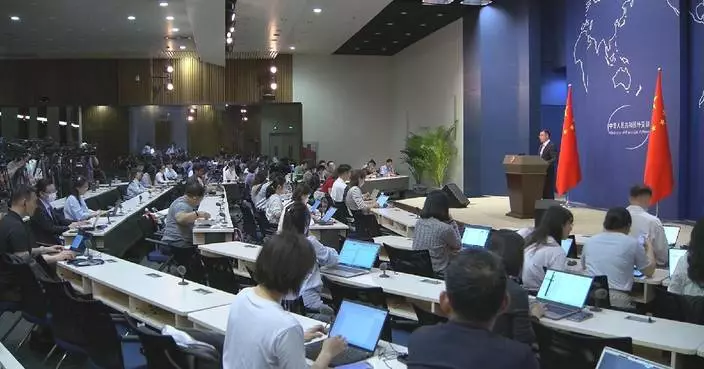
China and the United States have maintained close communication and practical cooperation in counter-narcotics efforts and achieved significant results since the two heads of state met in Busan of the Republic of Korea last October, a Chinese anti-drug official said on Wednesday.
At a press conference held by the Office of the China National Narcotics Control Commission, Wei Xiaojun, executive deputy director of the office and head of the Ministry of Public Security's narcotics control bureau, said the two countries have continued to advance cooperation in areas including substance scheduling, chemical control, intelligence exchange, joint investigation, removal of illegal online information, capture and transfer of fugitives, drug-related anti-money laundering, and drug testing technology exchange.
"Both sides have carried out a great deal of institutional exchanges and practical cooperation. We maintain communication with U.S. policy departments such as the Office of National Drug Control Policy, regularly brief each other on work progress, and discuss priorities for next-step cooperation. With U.S. law enforcement agencies such as the Drug Enforcement Administration, the Federal Bureau of Investigation, and Immigration and Customs Enforcement, we have jointly handled multiple cases and cooperated on the repatriation of drug-related fugitives," Wei said.
China has also taken active steps to address problems involving the diversion of non-scheduled precursor chemicals into illicit drug manufacturing channels in North America.
In November 2025, China added 13 types of precursors of fentanyl-related substances to the export control list, and added the United States, Mexico and Canada to the Catalogue of Specific Countries (Regions), Wei said. In May this year, three types of precursors of fentanyl-related substances were added to the list regarding the three aforementioned countries.
Chinese customs authorities have strengthened export supervision and risk assessments of relevant chemical products.
To combat the trafficking of controlled and non-scheduled precursor chemicals, new psychoactive substances, and other sensitive chemicals, China has carried out multiple nationwide enforcement campaigns targeting illegal smuggling of such materials overseas, Wei added.
The U.S. side has spoken positively about bilateral counter-narcotics cooperation on several occasions, according to the official, adding that China has also investigated a number of cases based on information and leads provided by the U.S. side.

China, U.S. maintain close counter-narcotics communication, cooperation