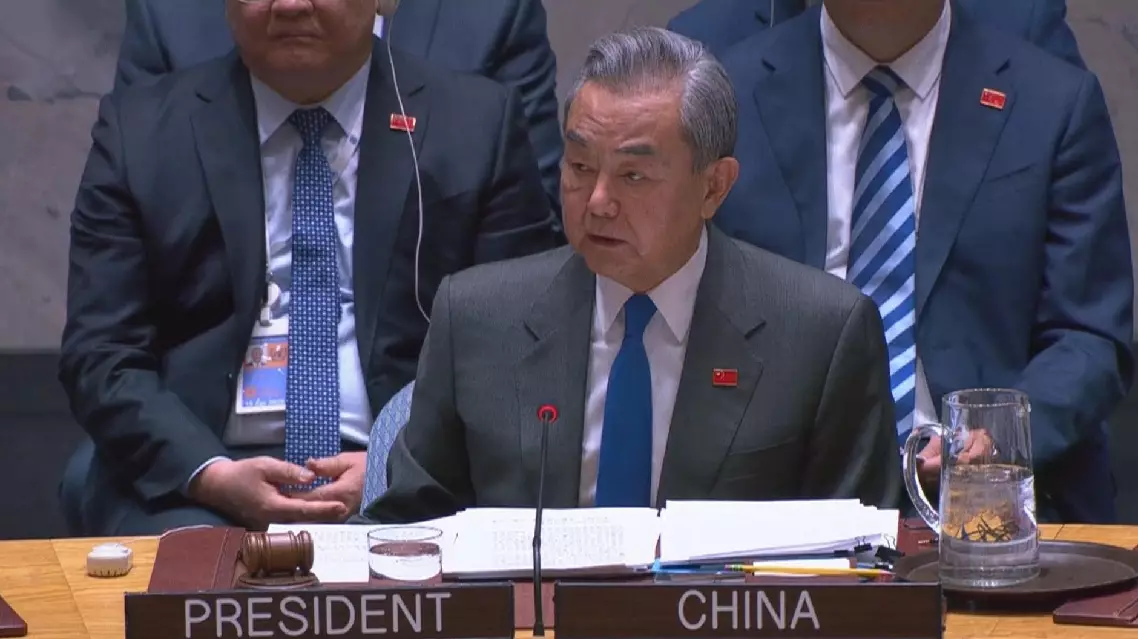
The world needs to speed up the efforts to build a more just and equitable global governance system more than ever, Chinese Foreign Minister Wang Yi said at a United Nations Security Council meeting in New York City on Tuesday.
Wang, also a member of the Political Bureau of the Communist Party of China Central Committee, made the remarks while chairing the UN Security Council's high-level meeting on practicing multilateralism, reforming and improving global governance.
"The past 80 years is a period of accelerated advancement in world multipolarity and economic globalization, a period that has witnessed people across the world forging ahead and meeting challenges together, and also a period during which the Global South has been rising and growing in strength. Meanwhile, although human society has emerged from the shadows of the Cold War and moved beyond the bipolar standoff, comprehensive peace and shared prosperity remain elusive. In the third decade of the 21st century, peace and development remains a long-term, arduous task. The 80 years of history is enlightenment enough: In the face of the turbulent and changing international landscape, the UN-centered international system provides important safeguards for the cause of human progress," he said.
The vision of multilateralism with coordination and cooperation as its cornerstone is the best solution to global issues, Wang said.
In a time of intensifying turbulence and transformation, we need, more than ever, to remind ourselves of the founding mission of the UN, reinvigorate true multilateralism, and speed up the efforts to build a more just and equitable global governance system, he noted.
He put forth four points of China's proposals in this connection:
First, upholding sovereign equality. All countries are equal, regardless of size or strength. This is the foremost principle in the UN Charter. In advancing global governance, all countries have the right to participate as equals, make decisions as equals, and benefit as equals. We must respect the development paths chosen independently by people of all countries, uphold the principle of non-interference in internal affairs, and not impose one's will upon others. We must practice international rule of law, ensure the effective implementation of international law, and reject double standards and selective application. Resolutions of the Security Council are binding, and should be observed by all countries. The Security Council is entrusted with authority, and such authority should be upheld by all countries. Any act of bullying, trickery or extortion is a flagrant violation of the basic norms of international relations. Any unilateral sanction that circumvents Security Council authorization lacks legal basis, defies justification and contradicts common sense.
Second, upholding fairness and justice. A critical part of global governance is to ensure that justice prevails. Since the end of World War II, a large number of countries in the Global South have emerged on the world stage, which has revealed growing incompatibility and irrationality in the global governance structure. Under the new circumstances, international affairs should no longer be monopolized by a small number of countries. Countries in the Global South have the right to speak up for and defend their legitimate rights and interests. The fruits of development should no longer be taken by just a few countries. People of all countries have the right to a happy life. The reform of the Security Council should continue to emphasize democratic consultation, increase the representation and say of developing countries, especially African countries, and effectively redress historical injustice.
Third, upholding solidarity and coordination. Promoting international cooperation is an important purpose of the UN Charter, and a sure path toward improving global governance. Countries should commit to the principle of extensive consultation and joint contribution for shared benefit, replace confrontation with coordination, prevent a lose-lose situation through win-win cooperation, and break down small circles with greater solidarity. Members cannot just sit by and watch multilateral institutions become dysfunctional and ineffective due to their own failure to cooperate. The Security Council must rise above narrow-minded geopolitical considerations, champion the spirit of solidarity and cooperation, fulfill its duties conferred by the UN Charter, and effectually play its role in the maintenance of international peace and security.
Fourth, upholding an action-oriented approach. Global governance has to be improved, not through words but through actions. In the face of protracted wars, loss of innocent lives, and challenges brought by new technologies, U.N. agencies should seek solutions rather than chant slogans. The Pact for the Future was adopted at the Summit of the Future last September. It is important to follow that up with coordinated efforts of implementation, i.e. to turn the road map into a construction plan and a wonderful vision into substantive actions.
Wang emphasized that, since the restoration of the lawful seat of the People's Republic of China in the UN, China has remained steadfast in making contributions to global governance.
China pursues peace and security in global governance. As a major country with the best track record on peace and security, China is committed to following a path of peaceful development, to resolving disputes and differences by peaceful means, and to constructively promoting the settlement of hotspot issues.
China advances common development in global governance, advocates a universally beneficial and inclusive economic globalization and promotes high-quality Belt and Road cooperation, as part of its contribution to the prosperity and development of countries around the world, he added.
China champions openness and inclusiveness in global governance, respects cultural diversity, and advocates humanity's common values. China promotes exchanges, dialog, and peaceful and harmonious coexistence among civilizations with a broad mind, in a bid to provide fresh impetus to the progress of human civilization, he continued.
China upholds multilateral cooperation in global governance. China is a member of almost all universal intergovernmental organizations and a party to over 600 international conventions and their amendments. China supports the UN in playing a central role in international affairs and makes continuous contribution to the UN cause, he added.
Wang also met with UN Secretary-General Antonio Guterres and his counterparts of Pakistan, Hungary, Uganda, Somalia, and Bolivia. He also had discussions with Americans from all walks of life.
Chinese FM on just, equitable global governance system