In the rapidly evolving landscape of commercial space, satellite internet is emerging as a pivotal frontier, utilizing extensive constellations of low Earth orbit satellites to establish a global network.
Leading this charge is Zhou Bin, chief engineer at the Greater Bay's Aerospace Information Research Institute under the Chinese Academy of Sciences, who is spearheading the development of terahertz receiver chips.
As a deputy in the country's top legislative body, he is advocating for greater policy support, having witnessed its impact firsthand.
"While communication networks on the ground, such as 4G and 5G, are highly developed, they still leave many areas uncovered - mountains and deserts," said Zhou.
Satellite internet is crucial for today's digital economy, powering offshore farms, guiding autonomous vehicles, and ensuring communication in remote areas.
China's mega-constellations could see tens of thousands of satellites launched in the coming years. Yet, production lags behind demand, and costs remain high.
Zhou's team is working to close that gap with the terahertz receiver chip, designed using CMOS (complementary metal-oxide-semiconductor) technology for low-cost mass production.
"Terahertz waves sit between microwaves and infrared. They are safe for humans, as many are used in biomedical applications as well. We've completed the process of comprehensive testing and evaluation. The next step is full-scale production," said Zhou.
His team moved from research to near-production in just one year - progress fueled by strong funding and a deep talent pool.
These researchers are among the brilliant minds driving the growing space industry of the Guangdong-Hong Kong-Macao Greater Bay.
However, a significant gap remains between small satellite demand and production capacity. The challenge is not only about scaling up but also about standing out in a fiercely competitive global market.
Achieving this will require both technological breakthroughs and strategic planning.
China is leveraging its robust manufacturing base and open business environment along the southern coast, with Guangdong aiming to develop a 300-billion-yuan commercial space sector by 2026, advancing key technologies such as reusable heavy-lift rockets.
Zhou Bin is also looking beyond China, targeting markets along the Maritime Silk Road, from Southeast Asia to the Middle East and North Africa.
With cutting-edge technology, strategic investments, and access to global markets through Hong Kong and Macao, the Greater Bay Area is truly reaching for the stars.

China advances satellite internet development with innovative terahertz tech
The U.S. military strike against Venezuela and capture of its president, Nicolas Maduro, has shocked the international community, triggering a steady stream of condemnation and serious concerns worldwide.
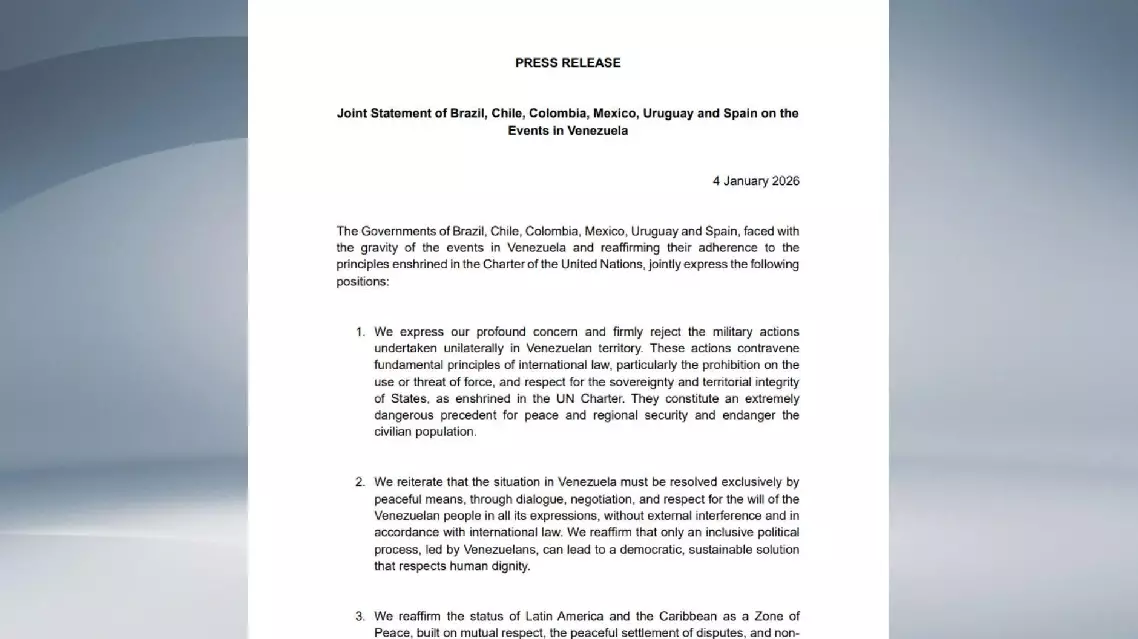
Brazil, Chile, Colombia, Mexico, Uruguay and Spain issued a joint statement on Sunday, expressing serious concern about and firm opposition to the U.S. unilateral military operations in Venezuela.
The U.S. actions contravene fundamental principles of international law, particularly the prohibition on the use or threat of force, and respect for the sovereignty and territorial integrity of States, as enshrined in the UN Charter, constituting an extremely dangerous precedent against peace and regional security, according to the statement.
In expressing profound concern and firm rejection, the six countries stressed in the statement that the situation in Venezuela must be resolved exclusively by peaceful means, and through dialogue, negotiation and respect for the will of the Venezuelan people in all its expressions, without external interference and in accordance with international law.
Only an inclusive political process, led by Venezuelans, can lead to a democratic, sustainable solution that respects human dignity, according to the statement.
Spanish Prime Minister Pedro Sanchez condemned the U.S. raid in Venezuela as a violation of international law, adding that the Spanish government always advocates and defends international law and peaceful resolution of conflicts.
Addressing a meeting of the Community of Latin American and Caribbean States (CELAC), Cuban Foreign Minister Bruno Rodriguez demanded the unconditional and immediate release of Maduro and his wife.
Noting that Latin America and the Caribbean are a zone of peace, he expressed his firm opposition to the use of force, which is an unshakable principle.
Any aggression against Venezuela shall be regarded as an attack against all CELAC member states, and nations must collectively oppose it, he stressed.
The South African government denounced the U.S. attack on Venezuela as a violation of international law, according to a statement released on Sunday.
History has repeatedly demonstrated that military invasions against sovereign states yield only instability and deepening crisis, the statement said.
South Africa calls on the UN Security Council to urgently convene a session to address this situation, according to the statement.
Serbian President Aleksandar Vucic said what happened in Venezuela demonstrates that international law and the UN Charter are losing their practical effectiveness.
U.S. military action against Venezuela marks a dangerous precedent, as similar actions could be taken against any other nations, he said.
In addition, the foreign ministries of Namibia, Singapore, Oman and Pakistan also issued statements on the same day, expressing grave concern over U.S. interference in Venezuela's internal affairs.
They emphasized the need to uphold international law and the principles of the UN Charter while respecting Venezuela's sovereignty.
They also called on all parties to exercise restraint and resolve the crisis through peaceful dialogue.
U.S. move against Venezuela sparks condemnation, concerns worldwide