China has overtaken the United Kingdom to take second place on the 2025 Brand Finance Global Soft Power Index, which was released on Thursday.
While the United States retained the top position, China took second spot for the first time with a score of 72.8 out of 100, according to the report published by the British consulting firm Brand Finance.
The annual index, based on a survey of more than 170,000 respondents across 100 countries, assesses the global image of the 193 UN member states and provides an in-depth analysis of 'soft power' across multiple dimensions.
The agency has divided the building blocks of 'soft power' into eight key pillars: business and trade, international relations, education and science, culture and heritage, governance, media and communication, sustainable future, and people and values.
The report also noted that since 2024 China has made significant progress in six of the eight soft power pillars and two-thirds of measured attributes.
This stems from strategic efforts such as the Belt and Road Initiative, an increased focus on sustainability, and stronger domestic brands moving in to global markets, said David Haigh, Chairman of Brand Finance.
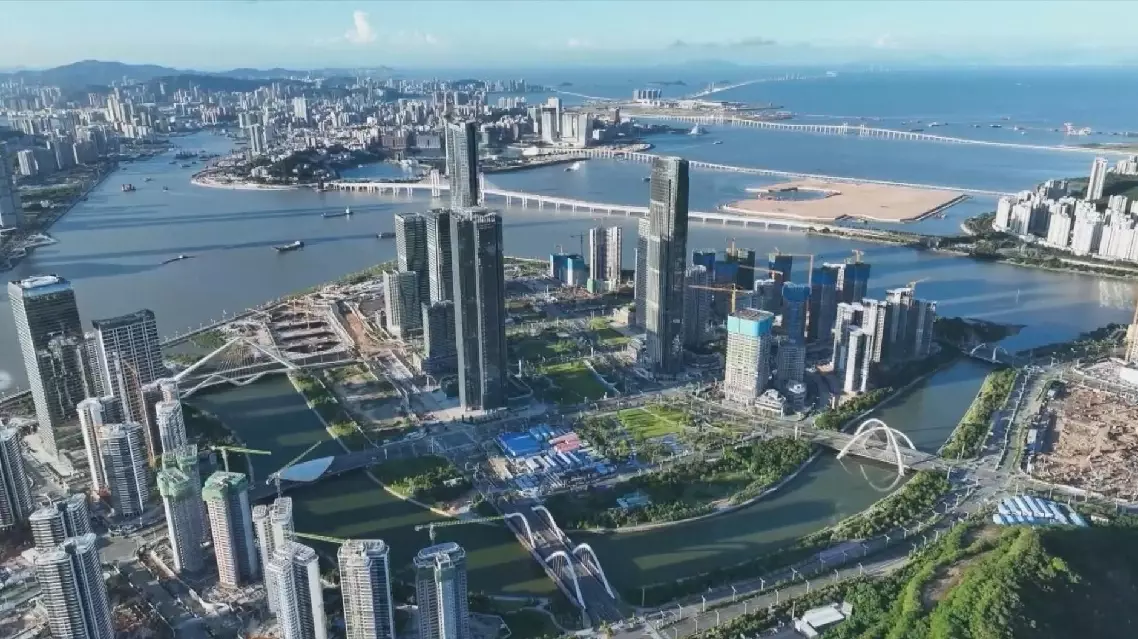
China ranked second in global soft power index
China unveiled a large wind-assisted propulsion system for ships in the coastal city of Dalian, northeast China's Liaoning Province, on Friday, marking a major leap forward for the country in the field of high-end vessel marine environmental protection equipment.
The wind-assisted propulsion system - rotating sail system (WAPS-RSS), is developed by Luoyang Ship Material Research Institute of China State Shipbuilding Corporation Limited (CSSC).
The system's rotor has diameter of 5 meters, is 35 meters high, and weighs 150 tons.
Experts say that the system can efficiently capture wind energy while the ship is sailing, providing additional thrust for the vessel.
On average, it can save fuel consumption by 5 to 25 percent for large ocean-going vessels, and lower carbon emissions accordingly.
It relies on the Magnus effect, which is much like a loop in table tennis, featuring a rapidly spinning sphere that causes the surrounding air to rotate. Pressure decreases on the side with faster airflow and increases on the side with slower airflow, creating a lateral pressure difference that generates lateral thrust.
"Standing on the deck, the powerful thrust generated by its rotation assists the ship's sailing. Our system - the world's largest rotary sail - reaches a maximum rotational speed of 180 revolutions per minute and can generate a maximum of 355 kilonewtons of thrust. Additionally, the system's intelligent control integrates multiple sensors to detect real-time wind and ship conditions. Through smart algorithms, it automatically adjusts to maintain optimal performance at all times, maximizing the utilization of wind energy," said Guo Yu, vice president of SunRui Marine Environment Engineering Company Limited under Luoyang Ship Material Research Institute.
Not only does the system's performance meet international advanced standards, but the project team has also overcome a series of engineering challenges, including the fabrication of giant composite structures, complex system integration, and intelligent coordinated control.
Compared with mainstream international technological approaches, it offers greater production efficiency and cost advantages.
Currently, the system has secured its first batch of orders and will complete actual vessel applications as scheduled.
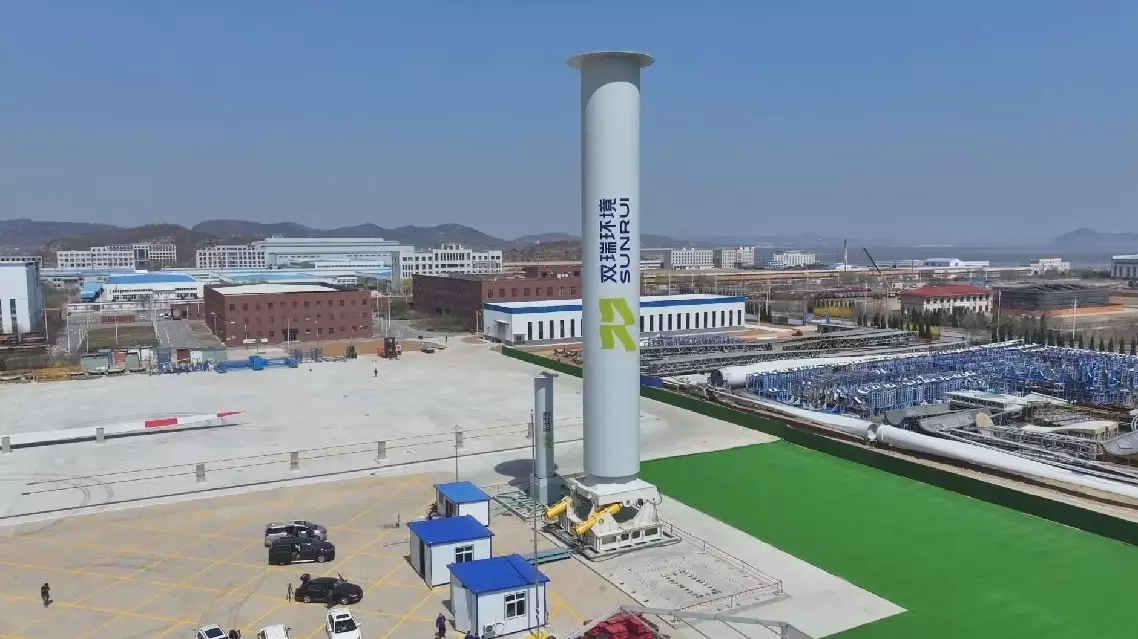
China unveils large wind-assisted propulsion system for ships