NEW YORK (AP) — U.S. stocks fell sharply Friday after reports showed that worries among consumers and businesses about President Donald Trump’s policies may be hitting the U.S. economy.
The S&P 500 sank 1.7% for its worst day in two months. The Dow Jones Industrial Average dropped 748 points, or 1.7%, and the Nasdaq composite tumbled 2.2%.
The losses accelerated through the day following several weaker-than-expected reports on the economy. One suggested U.S. business activity is close to stalling, with growth slowing to a 17-month low. The preliminary report from S&P Global said activity unexpectedly shrank for U.S. services businesses, and many in the survey reported slumping optimism because of worries about Washington.
“Companies report widespread concerns about the impact of federal government policies, ranging from spending cuts to tariffs and geopolitical developments,” said Chris Williamson, chief business economist at S&P Global Market Intelligence. “Sales are reportedly being hit by the uncertainty caused by the changing political landscape, and prices are rising amid tariff-related price hikes from suppliers.”
A separate report said U.S. consumers are also preparing for higher inflation, in part because of potential tariffs that could raise prices for all kinds of imports. They’re broadly expecting prices to be 4.3% higher 12 months from now, which is a big jump from their forecast of 3.3% inflation last month, according to a survey by the University of Michigan. That fits with preliminary data in the survey earlier this month.
Among U.S. households, though, a divide is evident underneath the surface. Expectations for inflation are rising for political independents and Democrats, while falling slightly for Republicans.
A third economic report, meanwhile, said sales of previously occupied homes were weaker last month than economists expected. Relatively high mortgage rates, along with expensive prices for homes, have been hurting sales.
To be sure, the U.S. stock market is still up for the young year so far and is not far from its all-time high set earlier this week. Virtually no one on Wall Street is forecasting a recession anytime soon. But Friday’s reports raise concerns about what’s been a remarkably resilient economy, and the losses on Wall Street were widespread.
Stocks of the smallest companies, whose profits can be more closely tied to the strength of the U.S. economy than big multinational rivals, fell more than the rest of the market. The Russell 2000 index of small stocks dropped a market-leading 2.9%.
Within the big companies of the S&P 500 index, 3 out of every 4 stocks fell. Everything from Big Tech stocks that have been bid up amid the artificial-intelligence frenzy to airlines to metals companies dropped. Nvidia sank 4.1%. United Airlines lost 6.4%, and Newmont Mining fell 5.7%.
Akamai Technologies had the sharpest drop in the S&P 500, even though the cybersecurity and cloud computing company reported stronger profit for the latest quarter than analysts expected. It lost a fifth of its value and fell 21.7% as investors focused instead on its forecasts for revenue and other financial measures this upcoming year, which fell short of analysts’ expectations.
On the winning side of Wall Street was Celsius Holdings, which sells “better-for-you” energy drinks. It leaped 27.8% after saying it agreed to buy Alani Nu, a beverage company that focuses on female customers. Analysts called the purchase price, $1.65 billion net of tax effects, reasonable and said the deal should quickly add to profits for Celsius, which also reported its latest quarterly results.
Other winners included stocks of companies that can provide steadier profits regardless of the U.S. economy's strength. Water utility American Water Works rose 3.1%, for example.
All told, the S&P 500 fell 104.39 points to 6,013.13. The Dow Jones Industrial Average dropped 748.63 to 43,428.02, and the Nasdaq composite sank 438.36 points to 19,524.01.
Before Friday’s sharp drop, the S&P 500 had been heading for a week of almost zero movement. Helping to lift stocks had been a steady parade of better-than-expected profit reports. That helped offset worries about stubbornly high inflation, which could prevent the Federal Reserve from delivering more relief for the economy and financial markets through lower interest rates.
The Fed has been holding its main interest rate steady after sharply cutting it through the end of last year. At their last policy meeting in January, Fed officials suggested they may stay on hold for a while given worries about how Trump’s proposed tariffs and mass deportations of migrants, along with other factors, could push upward on inflation.
While lower rates can boost the economy, they can also encourage spending that puts upward pressure on inflation.
Treasury yields fell in the bond market following Friday’s weaker-than-expected economic reports. The yield on the 10-year Treasury sank to 4.42 % from 4.51% late Thursday.
In stock markets abroad, indexes were mixed in Europe after rising across much of Asia.
Hong Kong’s Hang Seng jumped 4% for one of the world’s largest moves,, boosted by a surge for e-commerce firm Alibaba, which reported stronger profit for the end of last year than expected. It also talked up its artificial-intelligence developments.
AP Business Writers Yuri Kageyama and Matt Ott contributed.
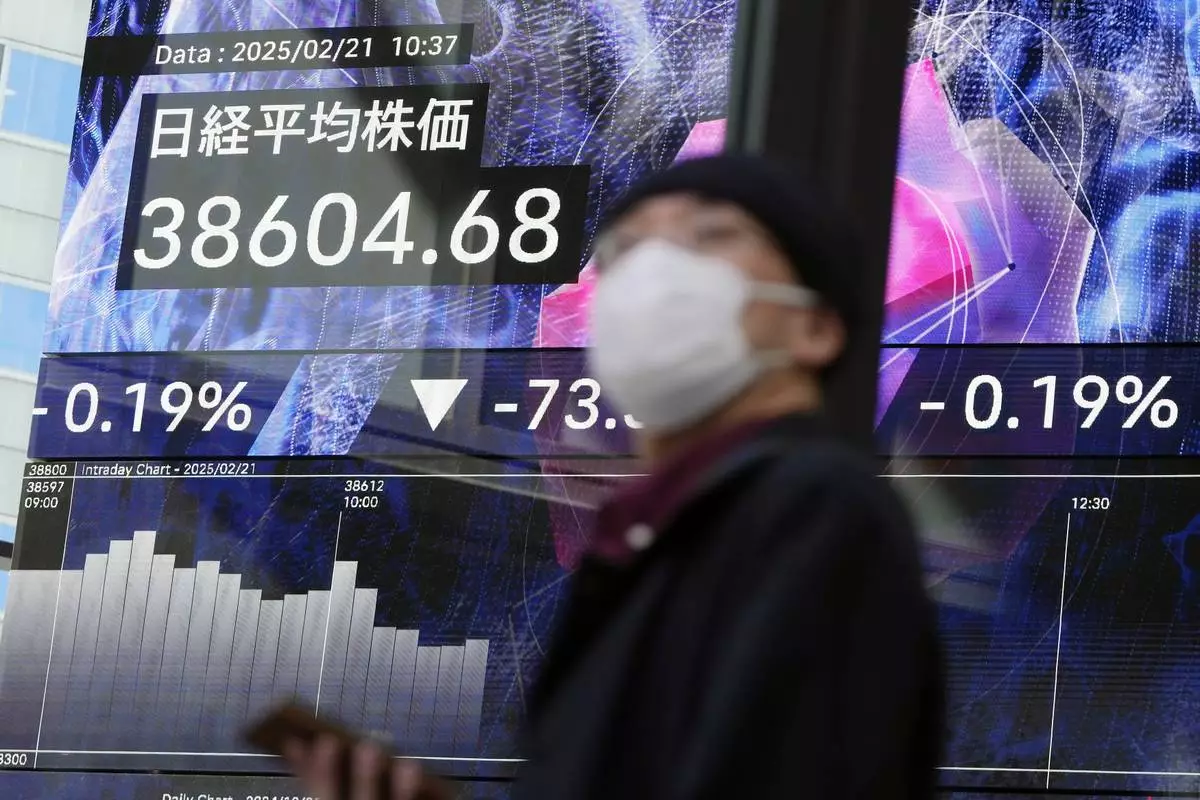
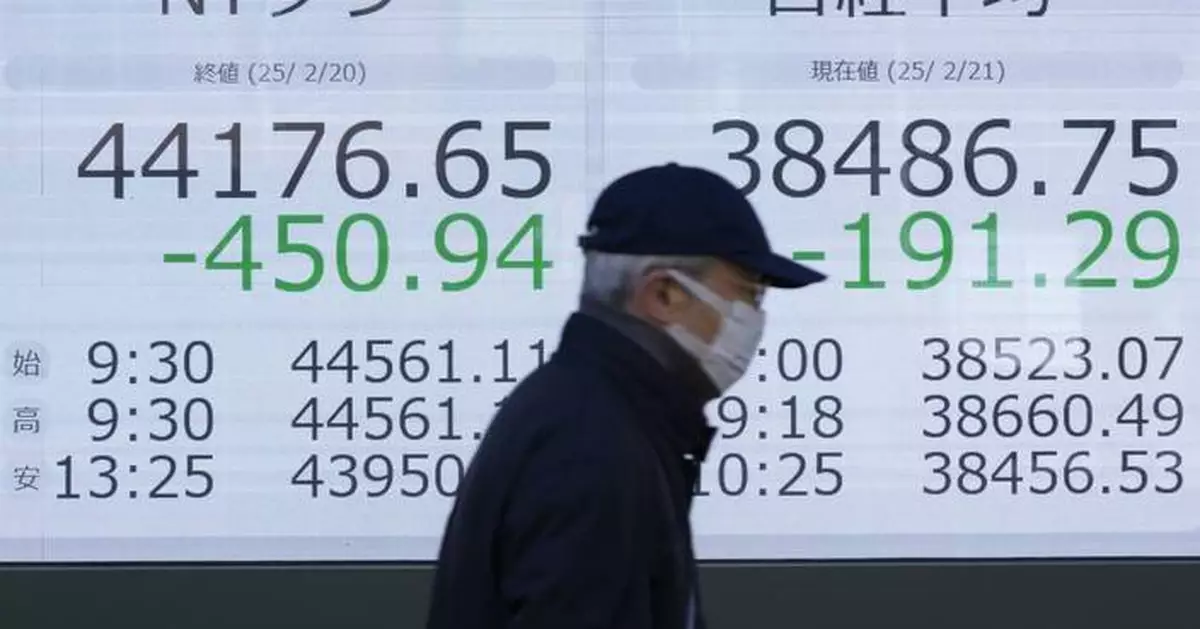
A person walks in front of an electronic stock board showing Japan's Nikkei index at a securities firm Friday, Feb. 21, 2025, in Tokyo. (AP Photo/Eugene Hoshiko)
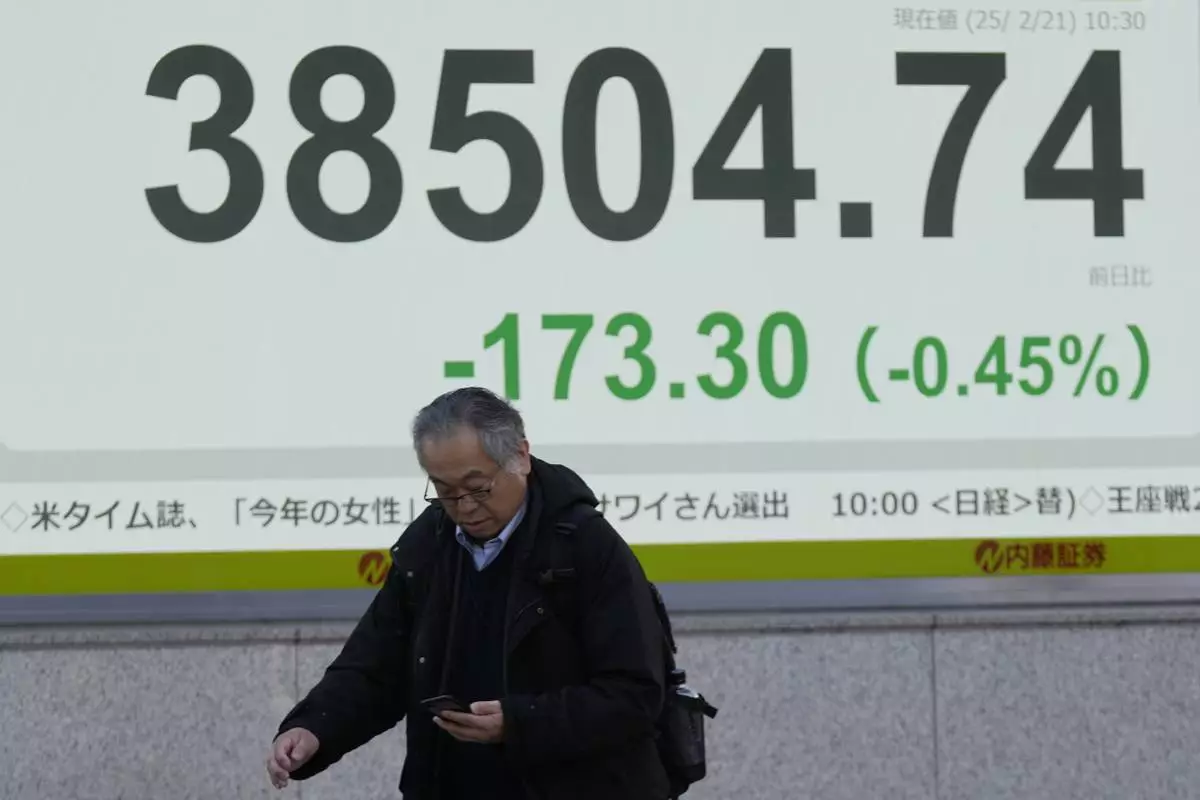
A person walks in front of an electronic stock board showing Japan's Nikkei index at a securities firm Friday, Feb. 21, 2025, in Tokyo. (AP Photo/Eugene Hoshiko)
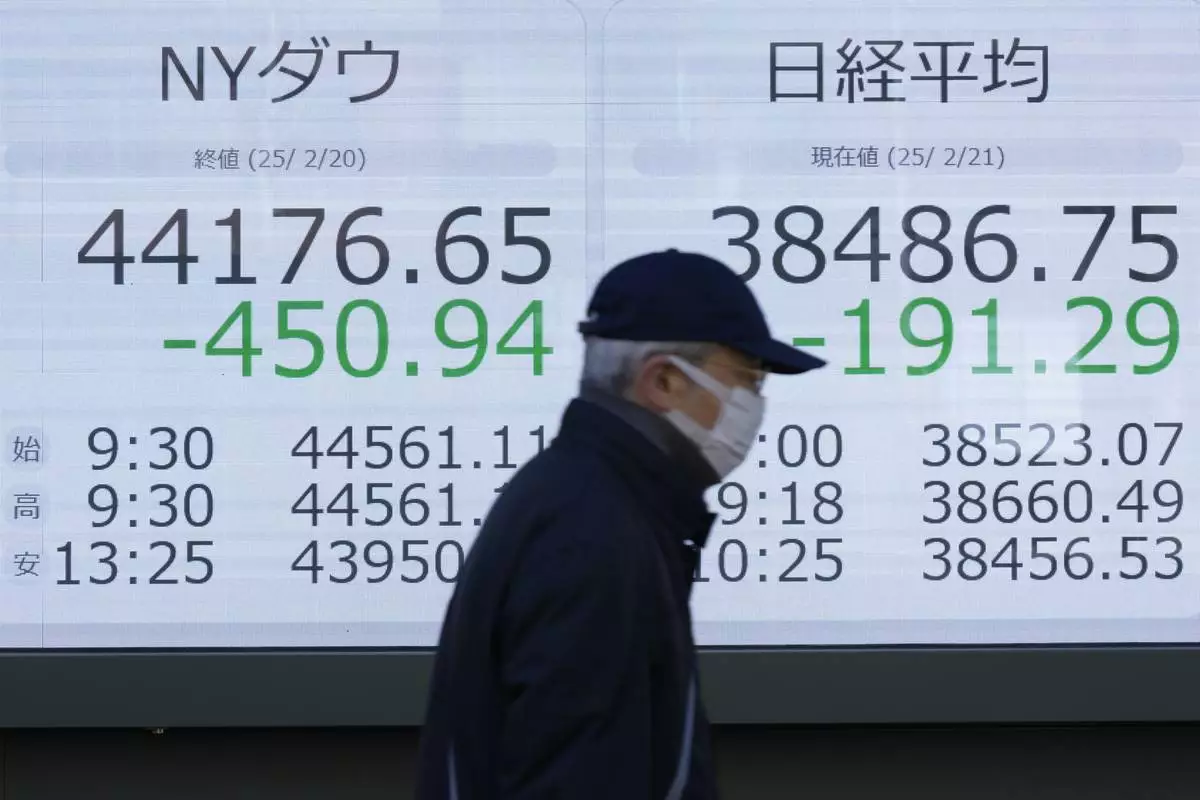
A person walks in front of an electronic stock board showing New York Dow, left, and Japan's Nikkei indexes at a securities firm in Tokyo Friday, Feb. 21, 2025. (AP Photo/Eugene Hoshiko)