Skip to Content Facebook Feature Image

China's new rapeseed variety increases yield, enhances food security

China

China

China

China's new rapeseed variety increases yield, enhances food security

2025-02-24 02:57 Last Updated At:06:17

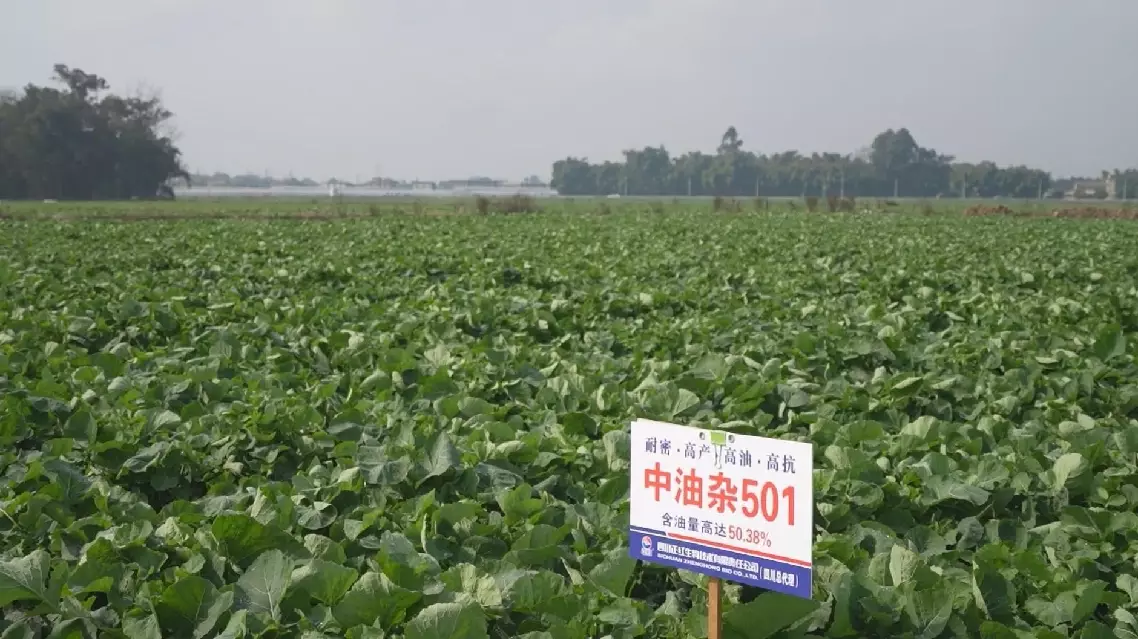
A new rapeseed variety developed by the Chinese Academy of Agricultural Sciences (CAAS) has been widely planted in Meishan City of southwest China's Sichuan Province, reporting a significant increase in yield per unit, further enhancing China's food security.

In 2024, China launched a national initiative aiming to improve per-unit yield for grain and oil crops. According to the annual statistics, the average food yield per hectare in 2024 has increased by 76.5 kilograms compared with 2023.

To further ensure domestic food security, China's "No. 1 central document" for 2025, unveiled on Sunday, reiterated the need to promote the large-scale yield improvement initiative, expand the implementation scale, and further advocate high-yield and efficient farming models. By introducing new varieties and high-density planting techniques, the rapeseed field in Meishan is among the leading models.

Compared with ordinary rapeseed plant varieties, whose best plant density is around 225,000 plants per hectare, the new variety requires a tighter row spacing from 33 to 35 centimeters to 27, thus nearly doubling the density, raising the number to 450,000.

The oil content of its seeds also reached over 50 percent, ranking among the top compared with major rapeseed varieties planted across China.

In 2024, the National Development and Reform Commission announced a new initiative to increase grain production by 50 million metric tons by 2030. Improving the per unit yield of grains and oil crops is vital to achieving the 2030 goal, while developing new varieties, and adopting new techniques, equipment, and agriculture models are critical approaches, said an expert.

"We need to increase the per unit yield, and we are capable of doing it. In view of our practical results, we should speed up efforts to sum up the experiences from the past two years of pilot projects, form a set of effective technological integration models and best practices, and transform these experiences into systematic methodologies for broader application. This will play a significant role in ensuring national food security and firmly securing China's food supply," said Zhong Yu from the Agricultural Economy Institute, CAAS.
China's new rapeseed variety increases yield, enhances food security
China's new rapeseed variety increases yield, enhances food security
The United States cannot legitimize an operation that attacked Venezuela and captured its president, a Chinese scholar said Sunday.

On Saturday, the United States launched a large-scale strike on Venezuela, during which Venezuelan President Nicolas Maduro and his wife were 'captured and flown out of Venezuela' according to a post by U.S. President Donald Trump on his Truth Social account.

Teng Jianqun, director of the Center for Diplomatic Studies at Hunan Normal University, said in an interview with China Global Television Network (CGTN) that the aim of this operation is to take full control of Venezuela’s natural resources.

"I don't think the United States can legitimize this operation to take custody of the president of Venezuela. And also I don't think the United States can legitimize its any action in taking the oil reserves of that country. This is actually a very dangerous game played by the Trump administration. And of course, the United States would like to take full control of that country and to take full control of the natural resources, especially the large reserve of oil in Venezuela," said Teng.

Teng said Venezuela is not an isolated case but a common practice by the United States. The United States launched an invasion of Panama on Dec. 20, 1989, which continued until January 1990, with the stated objective of capturing Panamanian strongman Manuel Noriega on charges of drug trafficking and organized crime.

"We still remember the so-called sentence of the former president of Panama in the late 1980s. And this time, the president of Venezuela will be under some judicial condition (judicial proceedings) for the so-called drug trafficking and some other crimes. So I think this is not a single case for the Venezuela country, but also this is actually a practice by the United States -- to use force, to use so-called justice under law against any leaders in Latin America and the Caribbean waters," he said.

US cannot legitimize operation against Venezuela: Chinese scholar

US cannot legitimize operation against Venezuela: Chinese scholar

Recommended Articles