BRUSSELS--(BUSINESS WIRE)--Feb 26, 2025--
Anheuser-Busch InBev (Brussel:ABI) (BMV:ANB) (JSE:ANH) (NYSE:BUD):
This press release features multimedia. View the full release here: https://www.businesswire.com/news/home/20250225267454/en/
Regulated and inside information 1
“Beer is a passion point for consumers and a vibrant category globally. The strength of our 2024 results is a testament to the consistent execution of our strategy and the hard work and dedication of our people. We delivered EBITDA growth at the top-end of our outlook and a step change in our free cash flow generation. We are investing for the long-term and are confident in our ability to lead and grow the category.” – Michel Doukeris, CEO, AB InBev
The 2024 Full Year Financial Report is available on our website atwww.ab-inbev.com
Management comments
Consistent execution of our strategy
We made consistent progress across the 3 pillars of our strategy in 2024 and delivered another year of reliable compounding growth. The combination of our megabrands, mega platforms and our focus on innovation to meet consumer trends with both balanced choices and superior value is a winning proposition. While our overall volume performance this year was constrained by the soft consumer environments in China and Argentina, the global beer category remains vibrant with our volumes growing in the majority of our markets and by 0.9% overall when excluding these two countries.
We advanced our digital transformation, with 75% of our revenue now transacted through B2B digital platforms. The momentum of BEES marketplace accelerated, with the gross merchandise value (GMV) growing by 57% versus FY23 to reach 2.5 billion USD.
As we continue to optimize our business we delivered a high-quality set of financial results. USD revenues increased to an all-time high, EBITDA grew at the top-end of our outlook, Underlying EPS increased by 15.4% in USD and free cash flow generation increased by 2.5 billion USD. We enhanced the efficiency of our resource allocation and delivered an important milestone in our capital allocation journey with our net debt to EBITDA ratio reaching 2.89x as of 31 December 2024, below 3x for the first time since 2015.
The beer category is large and profitable, continues to gain share of alcohol globally and our footprint has structural tailwinds for long-term volume growth with favorable demographics, economic growth and opportunities to increase category participation.
Continued global momentum
Our top-line increased by 2.7% in FY24, with revenue growth in 75% of our markets. Revenue per hl increased by 4.3%, accelerating sequentially through the year, as we continued to make disciplined revenue management choices and drive premiumization, while investing in our brands to provide value to our consumers. Excluding China and Argentina our volumes globally grew by 0.9% but overall performance was significantly constrained by these two countries, resulting in a total volume decline of 1.4%.
EBITDA increased by 8.2% with production cost efficiencies and disciplined overhead management driving EBITDA margin expansion of 179bps. Underlying EPS was 3.53 USD, a 15.4% increase versus FY23, driven primarily by USD EBIT growth and optimization of our net finance costs.
Progressing our strategic priorities
Delivering reliable compounding growth
2024 also marked three years since we introduced our 3-pillar strategy and medium-term growth ambition and reoriented the business to drive long-term value creation through organic growth. While the operating environment over this time has been dynamic, we are encouraged when we look back and evaluate the resilience of our business, consistency of our performance and the progress we have made in the execution of our strategy.
Since FY21, we have increased our revenue by 5.5 billion USD, EBITDA by 1.7 billion USD and free cash flow by 2.0 billion USD. Our Underlying EPS has increased by a CAGR of 7% in USD. Our financial performance has been consistent, with organic EBITDA growth within or above our medium-term growth ambition in every quarter over the last 3 years. We have been disciplined in our capital allocation choices, reducing net debt by 15.5 billion USD to reach 2.89x net debt to EBITDA, progressively increased our dividend each year and announced 3.2 billion USD of share buybacks. We have advanced our digital transformation, with the GMV captured by BEES more than doubling from approximately 20 billion USD in FY21 to 49 billion USD in FY24, and we have built a fast-growing Marketplace of third-party products from a standing start to a 2.5 billion USD GMV business.
We are encouraged by the progress we have made over the last three years and will continue to work towards consistently compounding our growth over the long-term to unlock our full value creation potential. Our performance would not have been possible without the hard work and dedication of our people and we thank our colleagues globally for their passion and commitment.
Looking forward
Looking ahead to 2025, we are committed to investing for long-term growth. While the operating environment remains dynamic in certain markets, we are confident in our ability to deliver on our outlook and energized about the opportunities ahead to grow the category. Consumers are passionate about beer and our iconic brands. We are well-positioned to lead category growth with our industry-leading portfolio of beer, beyond beer and no-alcohol beverages, diversified geographic footprint and unique leadership advantages.
2025 Outlook
(i) Overall Performance: We expect our EBITDA to grow in line with our medium-term outlook of between 4-8%. The outlook for FY25 reflects our current assessment of inflation and other macroeconomic conditions.
(ii) Net Finance Costs: Net pension interest expenses and accretion expenses are expected to be in the range of 190 to 220 million USD per quarter, depending on currency and interest rate fluctuations. We expect the average gross debt coupon in FY25 to be approximately 4%.
(iii) Effective Tax Rates (ETR): We expect the normalized ETR in FY25 to be in the range of 26% to 28%. The ETR outlook does not consider the impact of potential future changes in legislation.
(iv) Net Capital Expenditure: We expect net capital expenditure of between 3.5 and 4.0 billion USD in FY25.
Key Market Performances
United States: Increased investment driving momentum and improved market share trend, led by the #1 and #2 volume share growth brands in the industry in Q4
Mexico: Record high volumes with market share gain and margin expansion
Colombia: Record high volumes delivered double-digit top- and bottom-line growth
Brazil: Market share gain and margin expansion drove double-digit bottom-line growth
Europe: Market share gain and margin recovery drove double-digit bottom-line growth
South Africa: Market share gain and margin expansion drove double digit top- and bottom-line growth
China: Revenue declined by double-digits, impacted by soft industry
Highlights from our other markets
Consolidated Income Statement
In FY24, Ambev recognized 49 million USD income in other operating income related to tax credits (FY23: 44 million USD). The year-over-year change is presented as a scope change and does not affect the presented organic growth rates.
Non-underlying items above EBIT & Non-underlying share of results of associates
EBIT excludes positive non-underlying items of 269 million USD in 4Q24 and 25 million USD in FY24. Business and asset disposal (including impairment losses) for FY24 mainly comprised a gain of 437 million USD recognized upon the sale of our share in associate Ghost Beverages LLC, partially offset by impairment losses of intangible assets and other non-core assets sold in the period.
Non-underlying share of results from associates of FY24 includes the impact from our associate Anadolu Efes’ adoption of IAS 29 hyperinflation accounting on their 2023 results.
Net finance income/(cost)
Non-underlying net finance income/(cost)
Non-underlying net finance cost in FY24 includes mark-to-market losses on derivative instruments entered into in order to hedge our share-based payment programs and shares issued in relation to the combination with Grupo Modelo and SAB.
The number of shares covered by the hedging of our share-based payment program, the deferred share instrument and the restricted shares are shown in figure 7, together with the opening and closing share prices.
Income tax expense
The FY23, 4Q24 and FY24 effective tax rates were negatively impacted by non-deductible losses from derivatives related to the hedging of share-based payment programs and of the shares issued in a transaction related to the combination with Grupo Modelo and SAB, while the 4Q23 effective tax rate was positively impacted by non-taxable gains from these derivatives.
The increase in normalized ETR in 4Q24 compared to 4Q23 and the increase in FY24 compared to FY23 is driven mainly by changes in tax legislation in Brazil effective 1 January 2024, partially offset by country mix.
Basic and Underlying EPS
Reconciliation between normalized EBITDA and profit attributable to equity holders
Normalized EBITDA and normalized EBIT are measures utilized by AB InBev to demonstrate the company’s underlying performance.
Normalized EBITDA is calculated excluding the following effects from profit attributable to equity holders of AB InBev: (i) non-controlling interest; (ii) income tax expense; (iii) share of results of associates; (iv) non-underlying share of results of associates; (v) net finance income or cost; (vi) non-underlying net finance income or cost; (vii) non-underlying items above EBIT; and (viii) depreciation, amortization and impairment.
Normalized EBITDA and normalized EBIT are not accounting measures under IFRS and should not be considered as an alternative to profit attributable to equity holders as a measure of operational performance, or an alternative to cash flow as a measure of liquidity. Normalized EBITDA and normalized EBIT do not have a standard calculation method and AB InBev’s definition of normalized EBITDA and normalized EBIT may not be comparable to that of other companies.
Financial position
Our free cash flow (defined as cash flow from operating activities less net capex) increased by 2 537 million USD to reach 11 320 million USD. FY24 recorded an increase in cash and cash equivalents of 1 942 million USD compared to an increase of 315 million USD in FY23 with the following movements:
Our net debt decreased to 60.6 billion USD as of 31 December 2024 from 67.6 billion USD as of 31 December 2023.
Our net debt to normalized EBITDA ratio was 2.89x as of 31 December 2024. Our optimal capital structure is a net debt to normalized EBITDA ratio of around 2x.
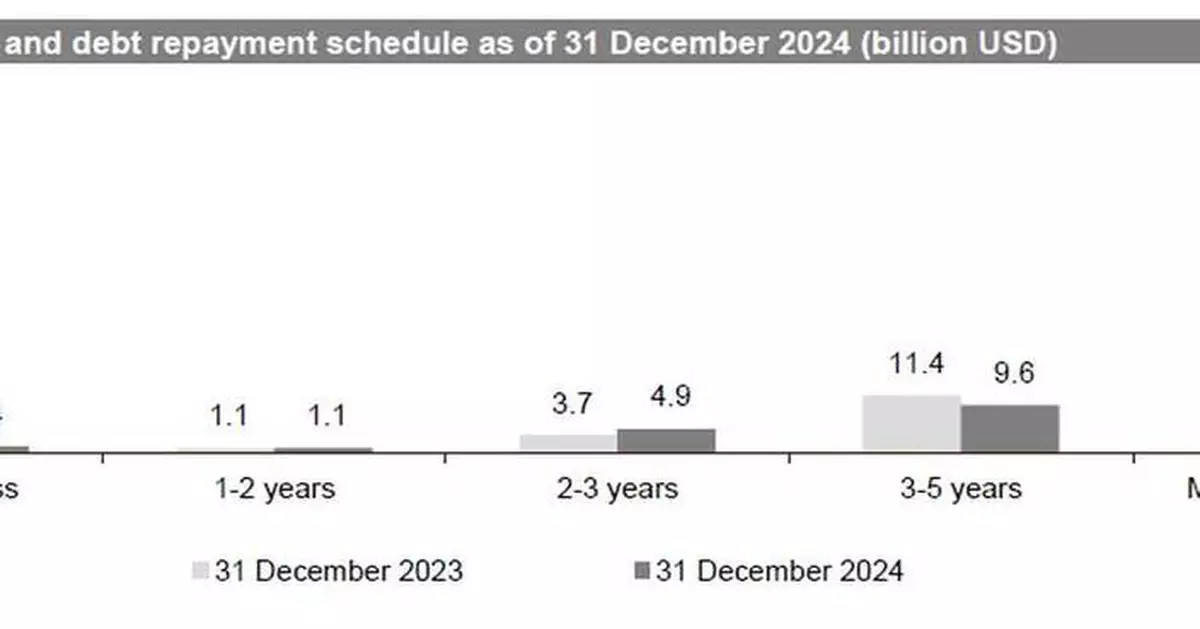
We continue to proactively manage our debt portfolio. After bond repurchases of 9 billion USD and issuances of 5 billion USD in FY24, 97% of our bond portfolio holds a fixed-interest rate, 47% is denominated in currencies other than USD and maturities are well-distributed across the next several years.
In addition to a very comfortable debt maturity profile and strong cash flow generation, as of 31 December 2024, we had total liquidity of 21.5 billion USD, which consisted of 10.1 billion USD available under committed long-term credit facilities and 11.4 billion USD of cash, cash equivalents and short-term investments in debt securities less bank overdrafts.
Proposed full year 2024 dividend
The AB InBev Board proposes a full year 2024 dividend of 1.00 EUR per share, subject to shareholder approval at the AGM on 30 April 2025. In line with the Company’s financial discipline and deleveraging objectives, the recommended dividend balances the Company’s capital allocation priorities and dividend policy while returning cash to shareholders. A timeline showing the ex-dividend, record and payment dates can be found below:
Notes
To facilitate the understanding of AB InBev’s underlying performance, the analyses of growth, including all comments in this press release, unless otherwise indicated, are based on organic growth and normalized numbers. In other words, financials are analyzed eliminating the impact of changes in currencies on translation of foreign operations, and scope changes. Since 1Q24, the definition of organic revenue growth has been amended to cap the price growth in Argentina to a maximum of 2% per month (26.8% year-over-year). Corresponding adjustments are made to all income statement related items in the organic growth calculations through scope changes. Scope changes also represent the impact of acquisitions and divestitures, the start or termination of activities or the transfer of activities between segments, curtailment gains and losses and year over year changes in accounting estimates and other assumptions that management does not consider as part of the underlying performance of the business. The organic growth of our global brands, Budweiser, Stella Artois, Corona and Michelob Ultra, excludes exports to Australia for which a perpetual license was granted to a third party upon disposal of the Australia operations in 2020. All references per hectoliter (per hl) exclude US non-beer activities. Whenever presented in this document, all performance measures (EBITDA, EBIT, profit, tax rate, EPS) are presented on a “normalized” basis, which means they are presented before non-underlying items. Non-underlying items are either income or expenses which do not occur regularly as part of the normal activities of the Company. They are presented separately because they are important for the understanding of the underlying sustainable performance of the Company due to their size or nature. Normalized measures are additional measures used by management and should not replace the measures determined in accordance with IFRS as an indicator of the Company’s performance. We are reporting the results from Argentina applying hyperinflation accounting since 3Q18. The IFRS rules (IAS 29) require us to restate the year-to-date results for the change in the general purchasing power of the local currency, using official indices before converting the local amounts at the closing rate of the period. In FY24, we reported a negative impact from hyperinflation accounting on the profit attributable to equity holders of AB InBev of 145 million USD. The impact in FY24 Basic EPS was -0.07 USD. Values in the figures and annexes may not add up, due to rounding. 4Q24 and FY24 EPS is based upon a weighted average of 2 003 million shares compared to a weighted average of 2 016 million shares for 4Q23 and FY23.
Legal disclaimer
This release contains “forward-looking statements”. These statements are based on the current expectations and views of future events and developments of the management of AB InBev and are naturally subject to uncertainty and changes in circumstances. The forward-looking statements contained in this release include statements other than historical facts and include statements typically containing words such as “will”, “may”, “should”, “believe”, “intends”, “expects”, “anticipates”, “targets”, “ambition”, “estimates”, “likely”, “foresees” and words of similar import. All statements other than statements of historical facts are forward-looking statements. You should not place undue reliance on these forward-looking statements, which reflect the current views of the management of AB InBev, are subject to numerous risks and uncertainties about AB InBev and are dependent on many factors, some of which are outside of AB InBev’s control. There are important factors, risks and uncertainties that could cause actual outcomes and results to be materially different, including, but not limited to the risks and uncertainties relating to AB InBev that are described under Item 3.D of AB InBev’s Annual Report on Form 20-F filed with the SEC on 11 March 2024. Many of these risks and uncertainties are, and will be, exacerbated by any further worsening of the global business and economic environment, including as a result of foreign currency exchange rate fluctuations and ongoing geopolitical conflicts. Other unknown or unpredictable factors could cause actual results to differ materially from those in the forward-looking statements. The forward-looking statements should be read in conjunction with the other cautionary statements that are included elsewhere, including AB InBev’s most recent Form 20-F and other reports furnished on Form 6-K, and any other documents that AB InBev has made public. Any forward-looking statements made in this communication are qualified in their entirety by these cautionary statements and there can be no assurance that the actual results or developments anticipated by AB InBev will be realized or, even if substantially realized, that they will have the expected consequences to, or effects on, AB InBev or its business or operations. Except as required by law, AB InBev undertakes no obligation to publicly update or revise any forward-looking statements, whether as a result of new information, future events or otherwise. The full year 2024 (FY24) financial data set out in Figure 1 (except for the volume information), Figures 3 to 5, 6, 8, 9,12 and 13 of this press release have been extracted from the group’s audited consolidated financial statements as of and for the twelve months ended 31 December 2024, which have been audited by our statutory auditors PwC Réviseurs d’Entreprises SRL / PwC Bedrijfsrevisoren BV. The fourth quarter 2024 (4Q24) financial data set out in Figure 1 (except for the volume information), Figures 3 to 5, 6, 8, 9, 12 and 13 and the financial data included in Figures 7, 10, 11 and 14 have been extracted from the underlying accounting records as of and for the twelve months ended 31 December 2024. References in this document to materials on our websites, such as www.ab-inbev.com, are included as an aid to their location and are not incorporated by reference into this document.
Conference call and webcast
Investor Conference call and webcast on Wednesday, 26 February 2025:
1.00pm Brussels / 12.00pm London / 7.00am New York
Registration details:
Webcast (listen-only mode):
AB InBev 4Q24 Results Webcast
To join by phone, please use one of the following two phone numbers:
Toll-Free: +1-877-407-8029
Toll: +1-201-689-8029
About AB InBev
Anheuser-Busch InBev (AB InBev) is a publicly traded company (Euronext: ABI) based in Leuven, Belgium, with secondary listings on the Mexico (MEXBOL: ANB) and South Africa (JSE: ANH) stock exchanges and with American Depositary Receipts on the New York Stock Exchange (NYSE: BUD). As a company, we dream big to create a future with more cheers. We are always looking to serve up new ways to meet life’s moments, move our industry forward and make a meaningful impact in the world. We are committed to building great brands that stand the test of time and to brewing the best beers using the finest ingredients. Our diverse portfolio of well over 500 beer brands includes global brands Budweiser®, Corona®, Stella Artois® and Michelob Ultra®; multi-country brands Beck’s®, Hoegaarden® and Leffe®; and local champions such as Aguila®, Antarctica®, Bud Light®, Brahma®, Cass®, Castle®, Castle Lite®, Cristal®, Harbin®, Jupiler®, Modelo Especial®, Quilmes®, Victoria®, Sedrin®, and Skol®. Our brewing heritage dates back more than 600 years, spanning continents and generations. From our European roots at the Den Hoorn brewery in Leuven, Belgium. To the pioneering spirit of the Anheuser & Co brewery in St. Louis, US. To the creation of the Castle Brewery in South Africa during the Johannesburg gold rush. To Bohemia, the first brewery in Brazil. Geographically diversified with a balanced exposure to developed and developing markets, we leverage the collective strengths of approximately 144 000 colleagues based in nearly 50 countries worldwide. For 2024, AB InBev’s reported revenue was 59.8 billion USD (excluding JVs and associates).
Annex 1: Segment reporting (4Q)
Annex 2: Segment reporting (FY)
Annex 3: Consolidated statement of financial position
Annex 4: Consolidated statement of cash flows
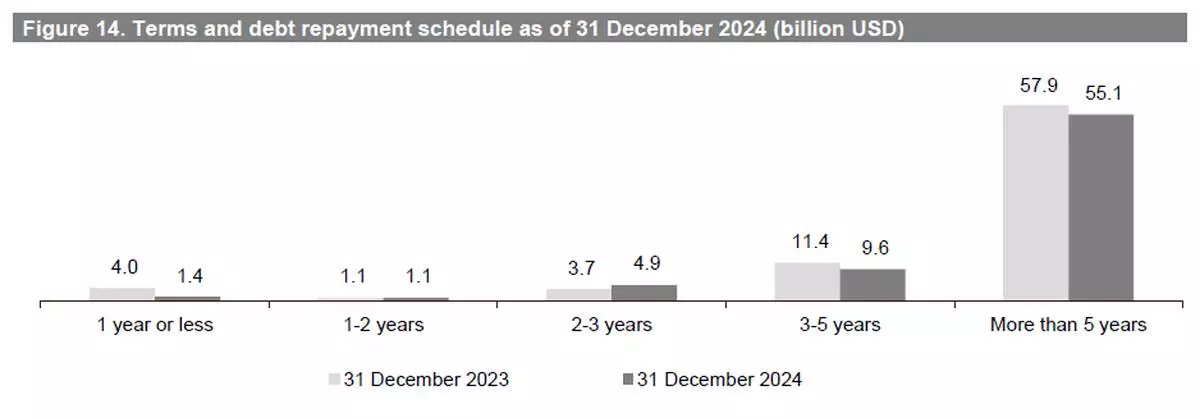
Figure 14. Terms and debt repayment schedule as of 31 December 2024 (billion USD) (Graphic: Business Wire)