In a bold move to enhance food security, a political advisor proposed high-protein corn as a sustainable alternative to imported soybeans, which has great potential to reshape China's agricultural landscape and reduce dependency on foreign sources.
As global demand for animal products surges, China's dependence on imported soybeans for animal feed has become a vulnerability in its food security strategy. Yan Jianbing, president of Huazhong Agricultural University, is leading efforts to replace soybean feed with high-protein corn. His extensive research has taken him across the country, from experimental corn fields to technology application enterprises, resulting in notable advancements in both protein content and yield.
As a member of the National Committee of the Chinese People's Political Consultative Conference (CPPCC), Yan has presented his proposals to the top political advisory body's annual session for two consecutive years, drawing attention from the Ministry of Agriculture and Rural Affairs and other key stakeholders. This year, he returns to the national stage with his latest findings, aiming to drive meaningful change in China's approach to sustainable agriculture.
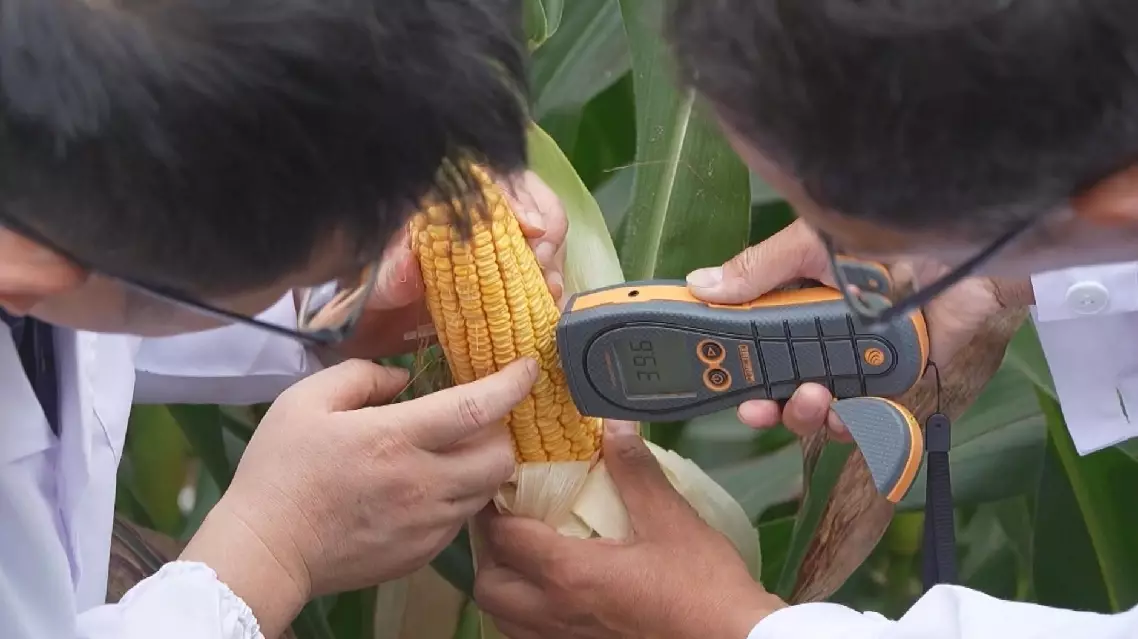
His team's decade-long commitment has culminated in the development of high-protein corn varieties, with an average protein content of 10 percent, surpassing standard corn by 2 percentage points, and these varieties are already being rolled out on a larger scale.
"China cultivates corn on a third of its arable land, with last year's total production exceeding 290 million tons. For every percentage increase in corn protein content, we can provide an additional 2.9 million tons of protein annually -- equivalent to the protein yield of 8 million tons of soybeans," Yan said.
Recently, Yan's team identified a crucial gene that reduces moisture content in corn kernels, enabling rapid dehydration during harvest. This innovation significantly enhances the efficiency of mechanized harvesting, potentially saving farmers up to about 310 U.S. dollars per hectare.
"We are not satisfied with single advancement. High protein is a very important goal, but it's not enough. It also has to be high-yielding, suitable for mechanized harvesting, and resilient to various stresses. It should integrate multiple desirable traits into one," Yan said.
Yan's research extends beyond laboratories. He recently visited China's southernmost island province of Hainan to address challenges in promoting high-protein corn and expanding the related industrial chain. Despite the potential benefits, significant hurdles to widespread adoption persist.
"Farmers often mix different crops when planting, harvesting, and storing. By the time it reaches feed mills, it's blended together. All of these are hiding the value of high-protein corn. This leads to lower motivation among farmers. We want to create a standardized closed-loop system for planting, storage, and processing," said Xu Jieting, chairman of Weimi Biotechnology Co., Ltd.
This year, Yan intends to focus on the industrial application of high-protein corn, aiming to translate research achievements into tangible benefits for everyday citizens.
"We have recently established an innovation research institute and a national industrial innovation development alliance centered on high-yield, high-protein corn. Our goal is to create a synergy between scientific and industrial innovations, and conduct research, development and application concurrently to drive collaborative breakthroughs and expedite results across the entire industry chain, thereby contributing to the stability of China's food supply," he said.
Identifying himself as a "farmer" at the forefront of global corn research, Yan juxtaposes the precision instruments of the laboratory with the practical realities of farming. He acknowledged that while scientific breakthroughs are crucial, the real challenge lies in ensuring that farmers are willing to plant, enterprises are prepared to harvest, and policies are supportive of this "protein freedom" initiative.
The third session of the 14th CPPCC National Committee is scheduled to begin on Tuesday, while the 14th National People's Congress (NPC), China's national legislature, will open its third annual session in Beijing on Wednesday. The two sessions are one of the most important events on the Chinese political calendar, where NPC deputies and CPPCC members gather to submit motions and offer proposals for national development.
Political advisor proposes high-protein corn as key safeguard for China's food security