As advanced technologies like 5G and artificial intelligence (AI) continue to drive transformative changes in agriculture, Chinese policymakers and researchers are working to make these innovations not only accessible but also practical for farmers, ensuring that the benefits of smart farming are felt across China.
Ahead of the upcoming "two sessions" in Beijing, some policymakers are preparing to submit motions aimed at lowering the cost of advanced agricultural technologies and making them more user-friendly.
The "two sessions" refer to the third session of the 14th National People's Congress (NPC) and the third session of the 14th National Committee of the Chinese People's Political Consultative Conference (CPPCC), which will kick off on Wednesday and Tuesday, respectively.
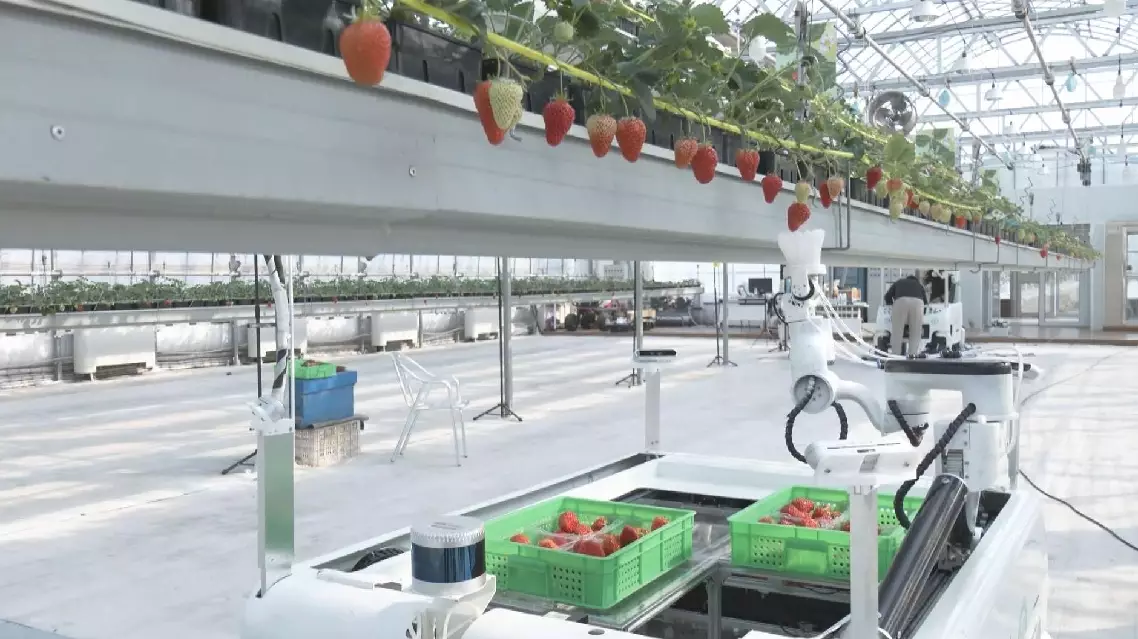
At a 5G-enabled strawberry farm in Beijing's Haidian District, a variety of advanced technologies, including a 5G communications platform, AI-powered robots, and intelligent greenhouse control systems, are being utilized to enhance farming efficiency.
"We use AI algorithms to identify ripe strawberries and unripe ones, which helps us to determine which strawberries to pick first and the most efficient harvesting path," said Xiong Ya, a researcher at the intelligent equipment and technology research center of the Beijing Academy of Agriculture and Forestry Sciences.
Xiong, an agricultural engineering expert with eight years of study and work experience in Europe, was deeply impressed by the high level of agricultural mechanization he observed there. Two years ago, he returned to China with the goal of developing domestically produced agricultural robots.
The strawberry-picking robot is the latest achievement from Xiong's team. He hopes that, in the near future, the robot will be mass-produced, reducing costs and making it accessible to more farmers across the country.
"My dream is to see agricultural robots working in the fields, handling all the farm tasks. I believe that would be a beautiful sight," Xiong said.
Both agricultural technicians and policymakers place great importance on making high-tech tools cheaper and more accessible to ordinary farmers.
Wu Jiejun, an NPC deputy and chief engineer at Hunan Chenzhou Grain and Oil Machinery, has been working in agricultural machinery for over 30 years. He believes that the first step in advancing smart farming is to reduce the cost of acquiring such technologies.
"Government policies and subsidies should be introduced to support the development of smart agricultural equipment that meets the needs of small and medium-sized farming households. We should also promote higher domestic production rates and establish platforms for sharing smart agricultural technologies to encourage exchange and lower acquisition costs," said Wu.
Over the past year, Ru Zhengang, another NPC deputy and professor at the wheat research center of the Henan Institute of Science and Technology, conducted extensive research and spoke with over 1,000 farmers in rural areas across Henan. He emphasized that for farmers to embrace new technologies, the key is making them simple and user-friendly.
"Don't complicate things for farmers. Technology should come as assembled products, demonstrated right at their doorstep. Farmers need to see it to believe it. Once they realize it works, they'll want to use it, and soon everyone will be on board," Ru said.
NPC deputies propose making smart agricultural tech more accessible to farmers