Brazil's central and southern regions are experiencing a scorching heatwave, with temperatures reaching as high as 43 degrees Celsius in some parts.
The heatwave, which began on Friday, is forecast to persist until March 9, according to Brazil's national meteorological agency.
In Porto Alegre, southern Brazil, temperatures are expected to hit 39 degrees Celsius, while the eastern region of Rio Grande do Sul, the country's southernmost state, is forecast to reach a scorching 43 degrees Celsius, according to the forecast.
Meanwhile, the Sao Paulo carnival has brought relief and joy to the city's residents, who refuse to let the scorching temperatures dampen their spirits.

Brazil's central, southern regions swelter in scorching heatwave
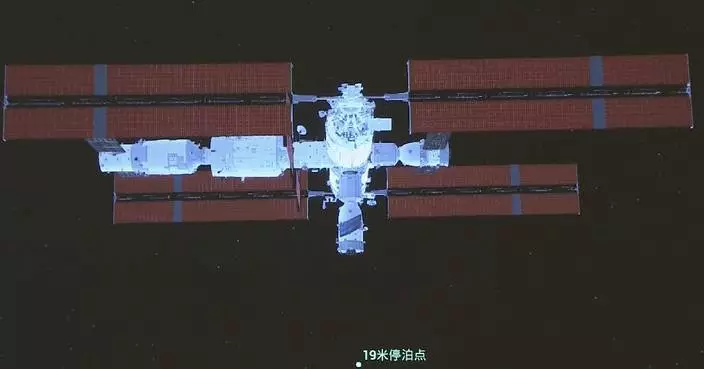
The three astronauts aboard China's Shenzhou-23 spaceship have entered the country's Tiangong space station and met with their astronaut colleagues early Monday morning, as they now begin an in-orbit crew handover.
Mission commander Zhu Yangzhu and fellow astronauts Zhang Zhiyuan and Lai Ka-ying successfully entered the station's core module Tianhe after the spaceship made a fast automated rendezvous and docked with the Tianhe module at 02:45 (Beijing Time) on Monday.
The three Shenzhou-21 crew members opened the hatch at 05:13 (Beijing Time) and greeted the new arrivals, according to the China Manned Space Agency (CMSA).
The six astronauts then took group pictures for the eighth in-orbit get-together in China's aerospace history.
Notably, one of the Shenzhou-23 crew members is set to undertake a year-long stay aboard the space station, double the usual duration of previous Shenzhou missions.
The Shenzhou-23 spaceship, atop a Long March-2F carrier rocket, blasted off from the Jiuquan Satellite Launch Center in northwest China at 23:08 (Beijing Time) on Sunday.
Shenzhou-23 marks the 40th flight of China's manned spaceflight program and the seventh manned flight mission since the Tiangong space station entered its application and development phase in late 2022.

Shenzhou-23 astronauts enter Tiangong space station, meet Shenzhou-21 crew