China should employ its fast-growing artificial intelligence (AI) to further empower the development of new quality productive forces in various fields, according to two experts and a deputy to the 14th National People's Congress (NPC).
DeepSeek and AI were buzzwords at this year's "two sessions," which refer to the annual meetings of China's highest organ of state power, the National People's Congress (NPC), and the country's top political advisory body, the National Committee of the Chinese People's Political Consultative Conference (CPPCC).
Many software companies in Dalian City of northeast China's Liaoning Province have fully integrated with DeepSeek's AI models, and the improvement in production efficiency and the optimization of resource allocation have become evident.
"DeepSeek's open-source advantage and cost advantage have been highly recognized, forming a phenomenon of getting very popular around the world. Now, there is another dark horse, Manus, gaining widespread attention. These are achievements of the innovation-driven strategy and the pursuit of sci-tech self-reliance and strength. Through embracing new sci-techs, we hope that these advancements can accelerate technological iterations to upgrade our industries and change our lives," said Hong Xianghua, a professor with the Party School of Communist Party of China (CPC) Central Committee (National Academy of Governance).
From software companies to manufacturing plants and then to education and healthcare, AI has been empowering various industries.
So far, Dalian has built more than 10 benchmarking factories combining "5G and Industrial Internet," spanning across sectors such as automotive parts, shipbuilding, and biopharmaceuticals.
"In the data center of software park, which is a national A-level data center in China, we have built around 160 petaflops of computing power infrastructure. In Lyushun's data lake, we also plan to invest one billion yuan (about 0.14 billion U.S. dollars) to establish an intelligent computing center capable of supporting 2,000 petaflops of computing power," said Zhang Jiazhi, vice president of China Unicom Dalian Industrial Internet Research Institute.
"In terms of industrial empowerment, we should support the development and application of large models in various fields such as industry, agriculture, and the service industry. As for terminal utilization, we should vigorously develop intelligent connected vehicles. Additionally, applications in various areas such as low-altitude economy, education and training, healthcare, and others need to be accelerated," said Xu Xiao, an NPC deputy.
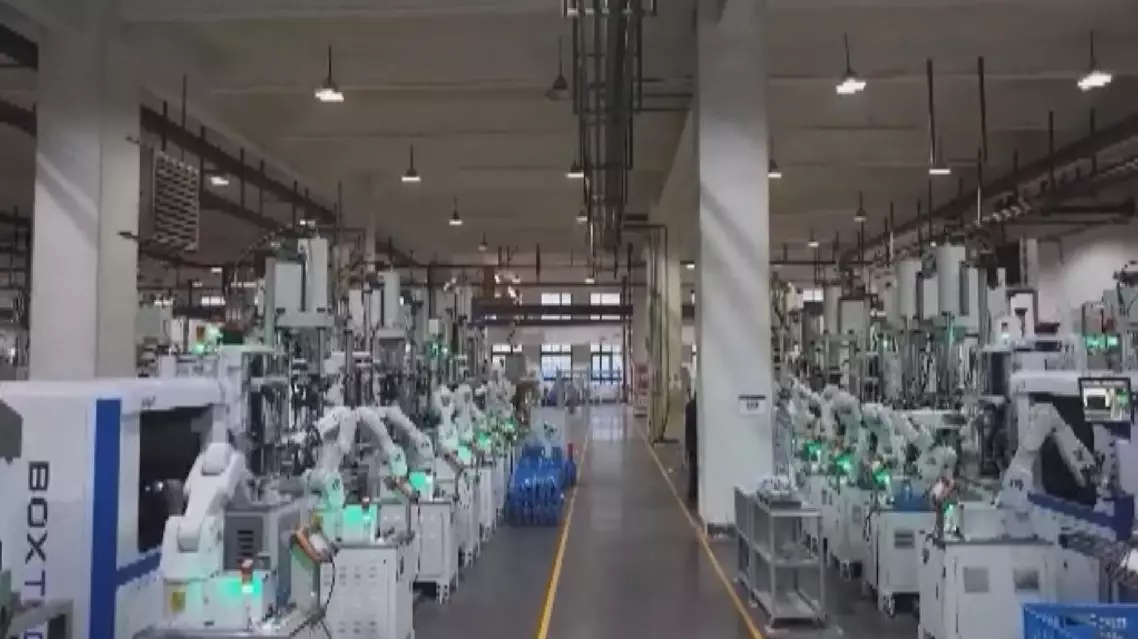
China should employ AI to empower development of new quality productive forces: experts