Chinese researchers have made a significant breakthrough in materials science by successfully producing the world's first large sheets of single-atom-layer metals, with a thickness only one two-hundred-thousandth the width of a human hair.
This achievement, published on Wednesday by a team from the Chinese Academy of Sciences' Institute of Physics in the prestigious science journal Nature, marks a major milestone in the study of two-dimensional (2D) metals.
Most materials seen in people's daily lives are three-dimensional that have length, width, and height. When one of these dimensions is reduced to an atomic scale, the material becomes two-dimensional.
For example, a single sheet of paper, appearing incredibly thin to the naked eye, can be loosely considered as a 2D material. But under magnification, it still has some measurable thickness. In scientific terms, true 2D materials are just one or a few atoms thick, roughly one-millionth the thickness of a paper.
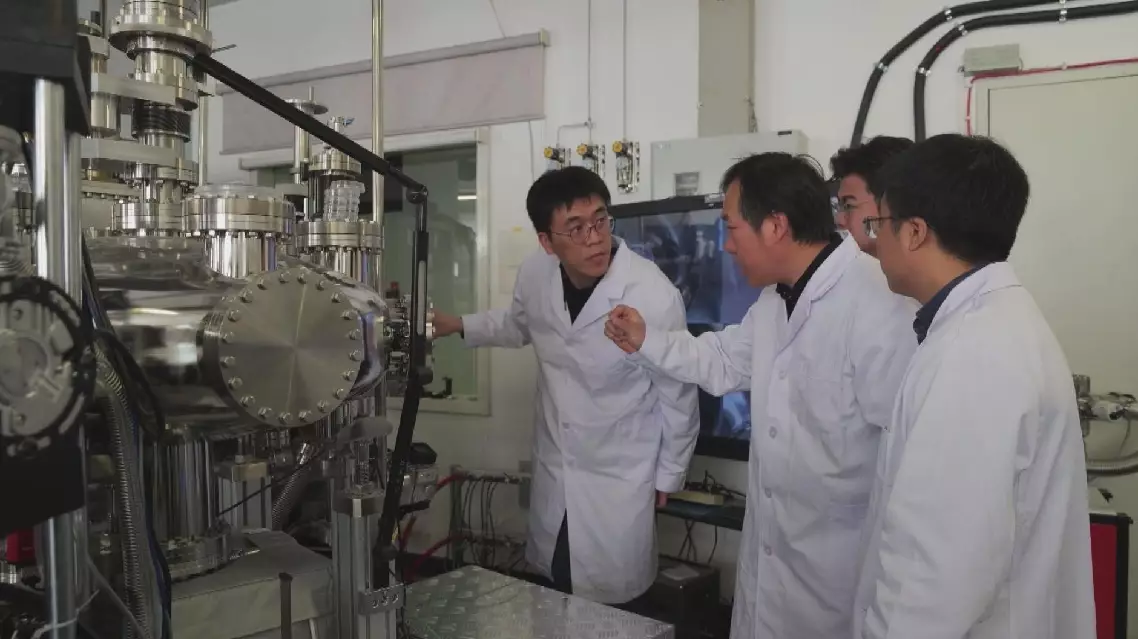
To create the 2D metal, the research team melted bismuth at a temperature of 280 degrees Celsius and applied an original technique called van der Waals (vdW) squeezing. Over several hours, a single-atom-layer metal is yielded.
"Here's a single-atom-layer 2D bismuth metal created via our vdW squeezing technique. To observe it clearly, we placed it under an optical microscope, which magnified the sample about 1,000 times. The bismuth is encapsulated by a single layer of molybdenum disulfide, with the darker color indicating the presence of the bismuth metal sample in the middle," said Du Luojun, a distinguished researcher with the Institute of Physics.
The team has already successfully produced five types of 2D metals including bismuth, tin and lead, paving the way for transformative applications in multiple cutting-edge fields.
"2D metals hold immense potential for future applications. For example, it can be used in potential application scenarios including application in miniaturized devices, quantum information processing and storage, or ultra-sensitive detectors. They could also serve as wiring or other core materials for chips," said Zhang Guangyu, another researcher at the institute.
Chinese scientists develop 2D metals 200,000 times thinner than human hair
The Iranian government is focusing on public concerns and maintaining stable supplies of essential goods amid recent protests, Iranian President Masoud Pezeshkian said in a televised interview on Sunday.
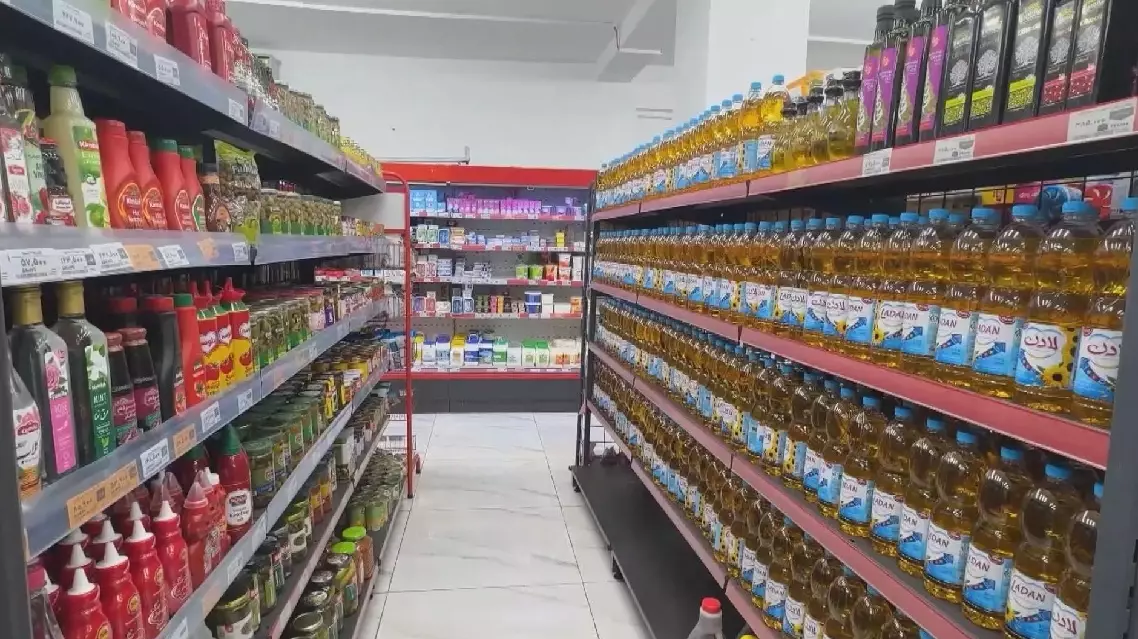
In the city of Karaj, northwest of the capital Tehran, daily life has largely continued as normal. A video filmed by a local resident on Sunday shows food stores open and grocery shelves fully stocked.
"This is the block near my home, and there are some food stores here. Daily life continues here. Last night we did not see many protests in Karaj. Right now the city is very safe. This is a grocery store close to my home. All the food is available; nothing is in shortage. Here are noodles and different types of beans. Here are dairy products, cheese, and yogurt. I also checked other grocery stores and didn't see any shortages. Everything is available," said local resident Ali Reza.
Iranian officials have described recent disturbances as acts orchestrated by the "enemy," including some carried out by well-trained and armed "terrorists." The incidents have caused casualties among security personnel and civilians, as well as property damage.
The Secretary of Iran's Supreme National Security Council Ali Larijani has directed authorities to severely punish the "terrorists."
Meanwhile, Iran's police chief Ahmad-Reza Radan said on Sunday that the police had raised alert levels and arrested several leaders of the troublemakers during the operations on Saturday.
President Pezeshkian noted in the interview that the normal demands of the Iranian people are reasonable and justified, but they must realize that triggering riots and carrying out terrorist acts are the enemy's attempts to undermine the country. He urged the public to remain vigilant.
Also on Sunday, Iranian Parliament Speaker Mohammad Baqer Qalibaf warned that Tehran would regard U.S. and Israeli bases and facilities in the Middle East as "legitimate targets" if Washington takes military action against Iran. His remarks followed media reports saying U.S. President Donald Trump is "seriously considering authorizing a strike" against Iran.
Iranian state media reported that at least 109 members of Iran's security forces have been killed in clashes since the protests began 14 days ago. Meanwhile, human rights groups based outside the country said the number of protesters killed has exceeded 200, though the figure could not be independently verified.
The protests initially erupted over a sharp depreciation of the rial and sweeping subsidy reforms. Iranian authorities have blamed the unrest on foreign-linked agents and sanctions imposed by the United States.
Iranian president says government focusing on ensuring supplies amid protests