Scientists in China are preparing space mining robots to operate in extreme environments, from microgravity to freezing temperatures, using advanced simulations that replicate the surfaces of asteroids and the Moon.
Space mining robots face a daunting set of challenges when operating on asteroids, moons, and other celestial bodies. They must contend with microgravity, extreme temperature fluctuations, vacuum conditions, space radiation, and strict weight and size limitations.
To prepare these robots for such demanding tasks, researchers at China University of Mining and Technology (CUMT) have built specialized training grounds to simulate extraterrestrial environments.
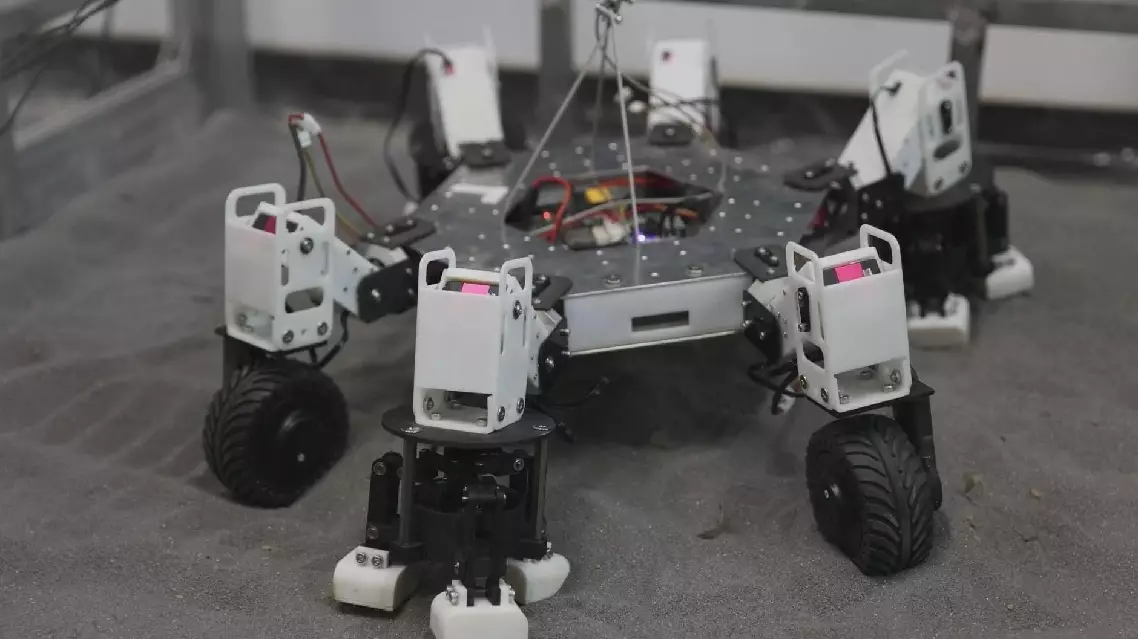
In Professor Liu Xinhua's lab, a meticulously designed sandbox serves as the primary training arena for these robots.
"Our setup simulates two key aspects of near-Earth asteroids: the surface composition, which is primarily loose soil and some hard rocks, and the microgravity environment. We've developed a suspension system that counteracts gravity vertically, creating a realistic microgravity effect," said Hua Dezheng, associate professor at the School of Mechatronic Engineering of CUMT.
Through rigorous training in this simulated environment, the robots have learned to adapt to complex terrains. Equipped with a six-legged differential suspension system and clutches, they can now adjust their structure and shape to navigate uneven surfaces and extract resources efficiently.
For more advanced training, the robots are sent to CUMT's State Key Laboratory of Deep Geotechnical Engineering and Intelligent Construction and Operation. Here, they face simulations of the Moon's extreme conditions.
Li Ruilin, an associate professor at the lab, described the setup, "Our equipment replicates the Moon's environment, including its one-sixth gravity, ultra-high vacuum, and extreme temperatures. During the lunar day, temperatures can reach 130 degrees Celsius, while at night, they can drop to -180 degrees Celsius, and even -250 degrees Celsius in polar regions."
The lab's high-precision simulations allow researchers to conduct long-term experiments under conditions nearly identical to those on the Moon.
Currently, two key projects are underway, namely "in-situ detection methods and equipment for lunar resource characteristics and reservoir properties" and "temperature-controlled penetration mining and in-situ hydrogen production methods and equipment for lunar polar water ice resources."
"By using simulated lunar soil that closely matches the properties of real Moon soil, we can recreate the lunar surface with high fidelity. This ensures that our experimental data is highly accurate and comparable to what we would expect on the Moon itself," Liu said.
As space mining technology continues to evolve, these robots are poised to play a pivotal role in humanity's quest to explore and utilize the resources in space.
Chinese scientists train space mining robots for extreme challenges on alien worlds