China's venture into space mining has made remarkable strides with the introduction of its first multifunctional space mining robot, developed by experts at the China University of Mining and Technology (CUMT).
As Earth's resources continue to deplete, scientists are turning their attention to extraterrestrial mining on the Moon, Mars, and near-Earth asteroids.
The new robot, designed to operate in microgravity environment, could pave the way for future "interstellar miners."
Developed by a research team led by Professor Liu Xinhua at CUMT, the space mining robot differs from the widely known humanoid robots and robotic dogs.
Instead, it adopts a six-legged design, featuring three wheel legs and three claw legs, which allows it to function efficiently in microgravity conditions.
"In space, objects do not stay in place like they do on Earth due to the lack of gravity. If you push something, it will float away, just like astronauts inside a space station," explained Professor Liu.
One of the biggest challenges in space mining is drilling into surfaces under low gravity.
On Earth, the weight of a robot provides the necessary force to push a drill into the ground. However, with the Moon's gravity being only one-sixth of Earth's and asteroids having even weaker gravitational fields, stabilizing a drill becomes a significant challenge.
To address this, the research team took inspiration from insect claws and designed a special claw structure to improve the robot's grip.
"This claw system is an array-type structure that enhances adhesion and gripping ability in microgravity environments. It allows the robot to stay anchored while collecting samples and move efficiently based on the terrain," said Professor Liu.
Beyond maintaining stability, the space mining robot is equipped with a biomimetic six-legged movement system. Each leg has wheel and anchor configurations, enabling the robot to traverse rough and uneven surfaces on asteroids.
The prototype has already undergone preliminary testing and has been submitted for a patent.
"We successfully conducted microgravity simulation experiments. The robot was able to walk, anchor itself, and even collect samples in a simulated lunar soil environment, validating our initial design," said Professor Liu.
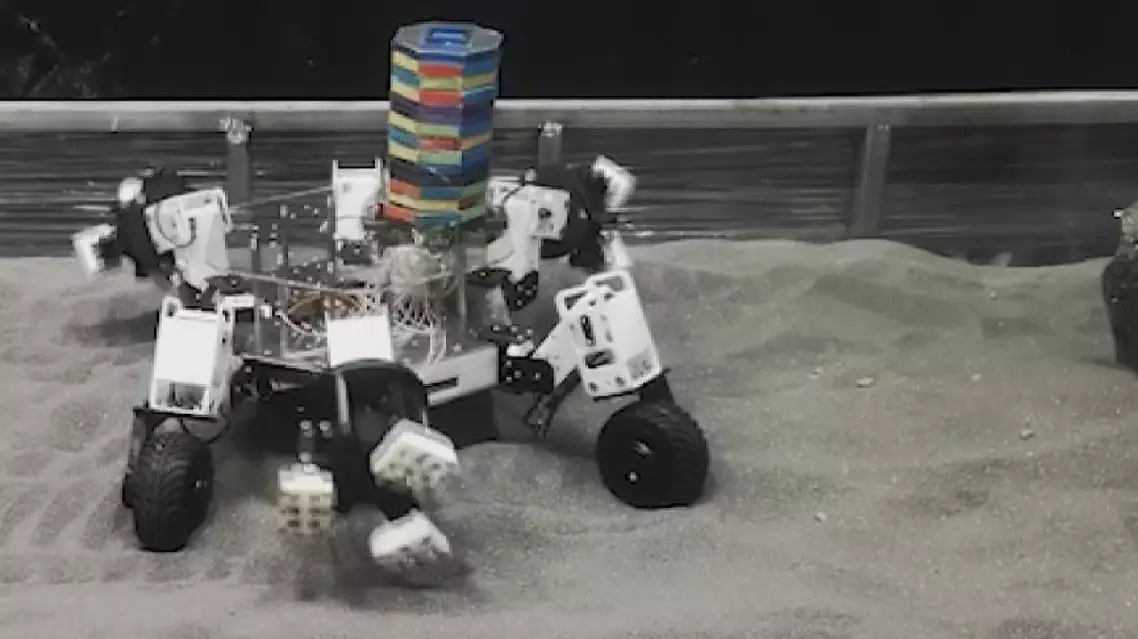
China develops multifunctional space mining robot to tackle microgravity challenges