Thematic Household Survey Report No. 81 published
The Thematic Household Survey Report No. 81 is published by the Census and Statistics Department (C&SD) today (March 17).
This publication contains key findings on employment benefits in the present job as well as characteristics and working conditions of workers of the food and goods delivery digital platforms based on the Thematic Household Survey conducted from December 2023 to March 2024.
Employment benefits in the present job
The survey results showed that among employees in the non-government sector at the time of enumeration, males and females shared similar proportions (at 51.1% and 48.9% respectively). The majority (87.5%) of them had signed a written employment contract. About half (48.3%) of employees in the non-government sector were entitled to employment benefits at a level higher than that stipulated in the Employment Ordinance, while more than half (56.9%) enjoyed extra items of employment benefits which were not required under the Employment Ordinance in their present job. Furthermore, about one-tenth (10.6%) enjoyed flexible work arrangement in their present job.
Characteristics and working conditions of workers of the food and goods delivery digital platforms
Findings of the survey also showed that some 12 900 persons had engaged in the food and goods delivery digital platforms during the 12 months before enumeration (hereafter referred to as "platform workers"). About half (52.5%) were in younger age group (aged 15-39). Some platform workers engaged in more than one platform company. Around 18 100 work in the food and goods delivery digital platforms were taken up by the 12 900 platform workers during the 12 months before enumeration. Analysed by mode of work, the two most common roles performed by those platform workers were cyclist (29.1%) and walker (26.5%).
Other information
The survey successfully enumerated target respondents in some 10 000 households in accordance with a scientific sampling scheme to represent the population of Hong Kong.
Detailed findings of the survey, together with the population coverage and concepts/definitions of key terms, are presented in the publication. Users can browse and download the publication at the website of the C&SD (www.censtatd.gov.hk/en/EIndexbySubject.html?pcode=B1130201&scode=453)
Enquiries about the survey findings can be directed to the Social Surveys Section (2) of the C&SD (Tel: 2887 0592 or email: thematic@censtatd.gov.hk).
DH reminds public to take precautions against heat-related illnesses during very hot weather
The Centre for Health Protection (CHP) of the Department of Health (DH) today (September 8) reminded members of the public to take appropriate precautions against heat-related illnesses, such as heat cramps, heat exhaustion and heat stroke, during very hot weather.
In a high-temperature environment, excessive sweating and difficulty in heat dissipation can cause stress to the body. Members of the public should take the following precautions:
- Hydrate in a timely manner to prevent dehydration;
- Wear light-coloured, loose-fitting and breathable clothing to minimise heat absorption and facilitate perspiration and heat dissipation;
- Keep indoor areas well ventilated and maintain appropriate temperature and humidity, e.g. by opening windows or using a fan or air-conditioning;
- Avoid strenuous exercise and prolonged activities such as hiking or trekking;
- Arrange outdoor activities in the morning or the late afternoon, if possible, and bring enough water; and
- Avoid beverages containing caffeine, such as coffee and tea, as well as alcoholic beverages, which may speed up water loss through the urinary system.
In addition, infants and children, the elderly, pregnant women, individuals with chronic illnesses such as heart disease or high blood pressure, overweight people and outdoor/manual workers are more susceptible to heat stroke. These groups should pay special attention to the following:
- Infants and young children: Avoid going outside when the temperature is high. If they must go outside, adults should ensure they stay in places with moderate temperatures and good ventilation or air-conditioning. Infants and young children should never be left unattended in a confined space such as a vehicle;
- The elderly, pregnant women, individuals with chronic illnesses and overweight people: Pay close attention to health conditions and seek help as soon as possible if experiencing any abnormalities in health indicators such as blood pressure, heart rate, etc or if there are fluctuations in health conditions. Avoid going out when the temperature is high. Make sure there is good ventilation, or turn on a fan or air-conditioner to keep an appropriate temperature indoors. High temperatures can also worsen the condition of people with chronic illnesses (such as cardiovascular and respiratory diseases). Therefore, they should have an ample supply of their usual medication and keep in contact with family members, neighbours and the community. People should seek immediate help if they feel unwell.
- Outdoor/manual workers: Reschedule work to cooler hours as far as feasible. If working in a hot environment is unavoidable, provide shade where practicable and use ventilation and heat dissipation equipment. Once work has begun, gradually adjust the pace of work and take breaks in the shade to regain strength.
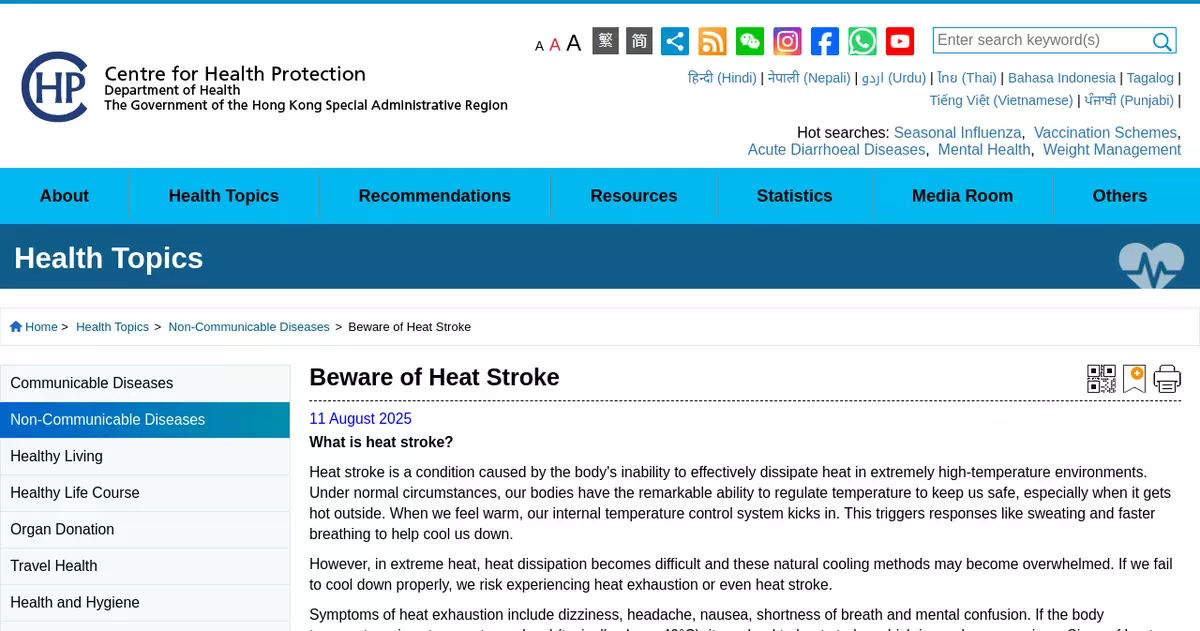
The DH reminded the public that heat stroke is one of the most common health risks in hot weather. Over the past five years, there have been over 200 hospital admissions due to heat stroke each year in Hong Kong, with two to five fatal cases occurring mainly during the summer months from May to September. Vulnerable groups are more susceptible to heat stroke. Symptoms include dizziness, headache, nausea, shortness of breath or confusion. In severe cases, patients may suffer from convulsions or become unconscious, which can be life-threatening if they are not cooled down and resuscitated in a timely manner.
Members of the public are also advised to pay attention to the latest weather, as well as the real-time and forecasted ultraviolet (UV) index released by the Hong Kong Observatory (HKO). When the UV index is high (6 or above), the public should note the following:
- Avoid direct sunlight exposure to the skin and the eyes;
- Apply broad-spectrum, water-resistant sunscreen liberally, with a sun protection factor (SPF) of at least 30 or higher, when participating in outdoor activities. Reapply every two hours if staying outdoors for long periods, or after swimming, sweating or towelling off;
- While using DEET-containing insect repellents for personal protection against mosquito-borne diseases, apply sunscreen before insect repellent;
- Seek shade;
- Wear UV-blocking sunglasses;
- Wear loose-fitting clothing with long-sleeves; and
- Wear a wide-brimmed hat or use an umbrella.
If symptoms develop, such as dizziness, headache, nausea, shortness of breath or confusion, rest and seek help immediately, and seek medical advice as soon as possible.
For more health information, the public may visit theCHP's heat strokepage andUV radiation page; the HKO's Dial-a-Weather (1878 200),latestweather report and forecast,UV Indexand weather information forhiking and mountaineering; andpress releasesof the Labour Departmenton precautions against heat stroke for outdoor workers and their employers when the Heat Stress at Work Warning is in force.
Source: AI-found images