LOS ANGELES & BENGALURU, India--(BUSINESS WIRE)--Mar 18, 2025--
Pixxel, a space technology company building the world's highest-resolution hyperspectral satellite constellation, today announced that its three Firefly satellites have successfully captured and downlinked their ‘First Light’ images - setting a new benchmark as the world’s highest-resolution hyperspectral images!
This press release features multimedia. View the full release here: https://www.businesswire.com/news/home/20250318411214/en/
With all three satellites having completed commissioning successfully and in perfect working condition, this marks a significant milestone in the company’s aim to deliver cutting-edge Earth observation capabilities. Launched in January 2025 aboard SpaceX’s Transporter-12, the three Firefly satellites are beaming down images at an unprecedented 5-meter resolution across 150+ spectral bands with 40 km swath width. The released images highlight unseen details of three areas, one from each satellite.
The newly-released First Light images highlight three ecologically and economically significant regions, each captured by a different Firefly satellite:
By capturing far more detail than traditional satellites and spanning a comprehensive range of spectral bands, Pixxel’s Firefly satellites unlock transformative new applications. Agriculture operators can pinpoint nutrient deficiencies, detect early signs of crop stress, and minimize water usage by monitoring evapotranspiration rates. Climate monitoring agencies can observe shifts in carbon capture by forests, detect emissions hotspots like methane leaks, and track deforestation in near real time. Mining companies can use spectral signatures to locate mineral-rich deposits or monitor tailing ponds for environmental compliance. And disaster response teams can rapidly assess flood- or fire-damaged areas, enabling swifter, better-targeted relief efforts.
"We’re proud to unveil these pioneering images from Firefly, each pixel a vital clue in our quest to decode the Earth’s complexities," said Awais Ahmed, Founder and CEO, Pixxel. "With each new hyperspectral satellite, we are making the invisible visible, bringing planetary-scale intelligence to industries that need it most. By illuminating invisible signals—whether it’s detecting pollutants in the atmosphere or providing early warning of crop diseases in far-flung fields — we can now act with foresight and precision. These images are proof that the future of Earth observation, and our planet's wellbeing, is brilliantly within reach.”
Pixxel’s recent partnerships span diverse sectors, with leading organizations such as NASA and the National Reconnaissance Office (NRO) collaborating on the company’s next-generation Earth observation technology. This solidifies Pixxel’s broader mission to create a “health monitor for the planet” by equipping stakeholders with high-fidelity, real-time insights into Earth’s surface and atmosphere.
The success of the first three Firefly satellites accelerates Pixxel’s roadmap toward deploying a full-scale hyperspectral constellation by 2026. Three additional Firefly satellites are scheduled to launch before mid 2025. High-fidelity images from these satellites will spectrally fingerprint the Earth and set a new standard in hyperspectral intelligence, reinforcing Pixxel’s mission of building a health monitor for the planet and transforming critical decision-making.
About Pixxel
Pixxel is a space data company and spacecraft manufacturer redefining Earth observation with hyperspectral imaging. With the successful launch of its first three commercial hyperspectral satellites ‘Fireflies,’ Pixxel is building a constellation of a total of 18-24 satellites designed for a daily revisit frequency anywhere on Earth. This constellation will deliver the world’s highest-resolution hyperspectral imagery, enabling industries to detect, monitor, and predict critical global phenomena across agriculture, oil and gas, mining, environment, and other sectors with 5m resolution and 50x richer detail compared to conventional satellites.
Beyond Earth observation, Pixxel is also manufacturing satellites, advancing cutting-edge spacecraft technology for various applications. Its in-house Earth Observation Studio, Aurora, is helping users seamlessly analyze satellite imagery, making hyperspectral data more accessible and actionable.
Pixxel has raised $95 million from M&G Catalyst, Glade Brook Capital Partners, Aditya Birla Ventures, Google, Lightspeed, Radical Ventures and others. For more information, visit www.pixxel.space or follow Pixxel on Twitter and LinkedIn.

FF1 | Sundarbans, India
RHO, Italy (AP) — No ice is colder and harder than speedskating ice. The precision it takes has meant that Olympic speedskaters have never competed for gold on a temporary indoor rink – until the 2026 Milan Cortina Winter Games.
In the pursuit of maximum glide and minimum friction, Olympic officials brought on ice master Mark Messer, a veteran of six previous Olympic speedskating tracks and the ice technician in charge of the Olympic Oval in Calgary, Canada — one of the fastest tracks in the world with over 300 records.
Messer has been putting that experience to work one thin layer of ice at a time since the end of October at the new Speed Skating Stadium, built inside adjacent trade fair halls in the city of Rho just north of Milan.
“It’s one of the biggest challenges I’ve had in icemaking,’’ Messer said during an interview less than two weeks into the process.
If Goldilocks were a speedskater, hockey ice would be medium hard, for fast puck movement and sharp turns. Figure skating ice would be softer, allowing push off for jumps and so the ice doesn’t shatter on landing. Curling ice is the softest and warmest of all, for controlled sliding.
For speedskating ice to be just right, it must be hard, cold and clean. And very, very smooth.
“The blades are so sharp, that if there is some dirt, the blade will lose the edge,’’ Messer said, and the skater will lose speed.
Speedskater Enrico Fabris, who won two Olympic golds in Turin in 2006, has traded in his skates to be deputy sports manager at the speedskating venue in Rho. For him, perfect ice means the conditions are the same for all skaters — and then if it's fast ice, so much the better.
"It's more of a pleasure to skate on this ice,'' he said.
Messer’s first Olympics were in Calgary in 1988 — the first time speedskating was held indoors. “That gave us some advantages because we didn’t have to worry about the weather, wind blowing or rain,’’ he said. Now he is upping the challenge by becoming the first ice master to build a temporary rink for the Olympics.
Before Messer arrived in Italy, workers spent weeks setting up insulation to level the floor and then a network of pipes and rubber tubes that carry glycol — an antifreeze — that is brought down to minus 7 or minus 8 degrees Celsius (17.6 to 19.4 degrees Fahrenheit) to make the ice.
Water is run through a purification system — but it can’t be too pure, or the ice that forms will be too brittle. Just the right amount of impurities “holds the ice together,’’ Messer said.
The first layers of water are applied slowly, with a spray nozzle; after the ice reaches a few centimeters it is painted white — a full day’s work — and the stripes are added to make lanes.
“The first one takes about 45 minutes. And then as soon as it freezes, we go back and do it again, and again and again. So we do it hundreds of times,’’ Messer said.
As the ice gets thicker, and is more stable, workers apply subsequent layers of water with hoses. Messer attaches his hose to hockey sticks for easier spreading.
What must absolutely be avoided is dirt, dust or frost — all of which can cause friction for the skaters, slowing them down. The goal is that when the skaters push “they can go as far as possible with the least amount of effort,’’ Messer said.
The Zamboni ice resurfacing machine plays a key role in keeping the track clean, cutting off a layer and spraying water to make a new surface.
One challenge is gauging how quickly the water from the resurfacing machine freezes in the temporary rink.
Another is getting the ice to the right thickness so that the Zamboni, weighing in at six tons, doesn’t shift the insulation, rubber tubing or ice itself.
“When you drive that out, if there’s anything moving it will move. We don’t want that,’’ Messer said.
The rink got its first big test on Nov. 29-30 during a Junior World Cup event. In a permanent rink, test events are usually held a year before the Olympics, leaving more time for adjustments. “We have a very small window to learn,’’ Messer acknowledged.
Dutch speedskater Kayo Vos, who won the men’s neo-senior 1,000 meters, said the ice was a little soft — but Messer didn’t seem too concerned.
“We went very modest to start, now we can start to change the temperatures and try to make it faster and still maintain it as a safe ice,’’ he said.
Fine-tuning the air temperature and humidity and ice temperature must be done methodically — taking into account that there will be 6,000 spectators in the venue for each event. The next real test will be on Jan. 31, when the Olympians take to the ice for their first training session.
“Eighty percent of the work is done but the hardest part is the last 20 percent, where we have to try to find the values and the way of running the equipment so all the skaters get the same conditions and all the skaters get the best conditions,’’ Messer said.
AP Winter Olympics: https://apnews.com/hub/milan-cortina-2026-winter-olympics

Serpentines are set on the ice of the stadium where speed skating discipline of the Milan Cortina 2026 Winter Olympics will take place, in Rho, outskirt of Milan, Tuesday, Nov. 11, 2025. (AP Photo/Luca Bruno)

Ice Master Mark Messer poses in the stadium where speed skating discipline of the Milan Cortina 2026 Winter Olympics will take place, in Rho, outskirt of Milan, Tuesday, Nov. 11, 2025. (AP Photo/Luca Bruno)
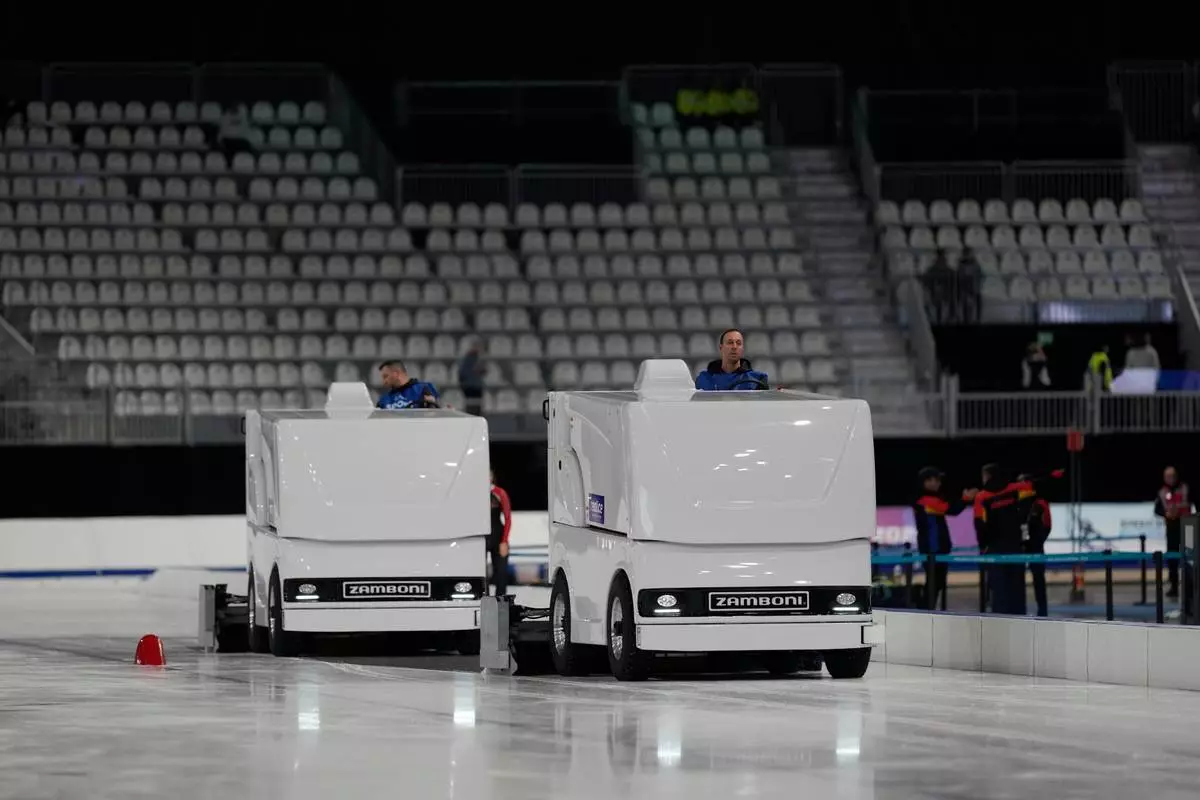
Workers clean the ice surface during a peed skating Junior World Cup and Olympic test event, in Rho, near Milan, Italy, Saturday, Nov. 29, 2025. (AP Photo/Luca Bruno)

Ice Master Mark Messer poses in the stadium where speed skating discipline of the Milan Cortina 2026 Winter Olympics will take place, in Rho, outskirt of Milan, Tuesday, Nov. 11, 2025. (AP Photo/Luca Bruno)

Ice Master Mark Messer poses in the stadium where speed skating discipline of the Milan Cortina 2026 Winter Olympics will take place, in Rho, outskirt of Milan, Tuesday, Nov. 11, 2025. (AP Photo/Luca Bruno)