BUDAPEST, Hungary (AP) — A new anti-LGBTQ+ law banning Pride events and allowing authorities to use facial recognition software to identify those attending the festivities was passed in Hungary on Tuesday, leading to a large demonstration on the streets of Budapest.
Several thousand protesters chanting anti-government slogans gathered after the vote outside Hungary’s parliament. They later staged a blockade of the Margaret Bridge over the Danube, blocking traffic and disregarding police instructions to leave the area.
Click to Gallery
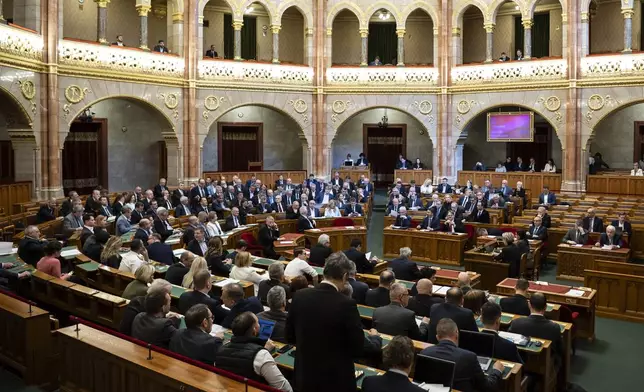
Representatives vote during the plenary session of the Hungarian parliament in Budapest, Hungary, Tuesday, March 18, 2025. (Boglarka Bodnar/MTI via AP)
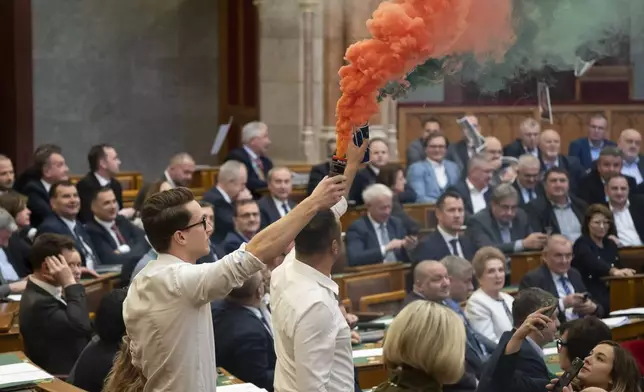
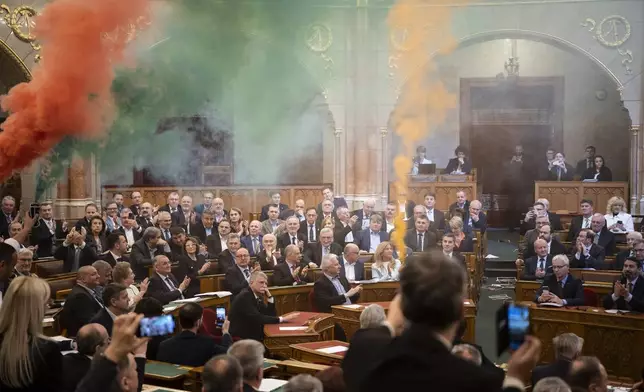
MPs of Momentum protest with flares during the plenary session of the Hungarian parliament in Budapest, Hungary, Tuesday, March 18, 2025. (Boglarka Bodnar/MTI via AP)
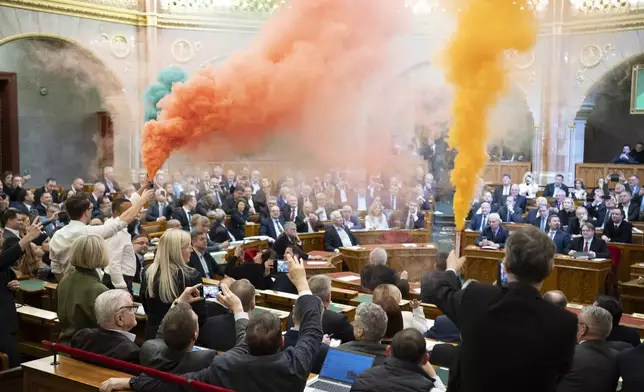
MPs of Momentum protest with flares during the plenary session of the Hungarian parliament in Budapest, Hungary, Tuesday, March 18, 2025. (Boglarka Bodnar/MTI via AP)
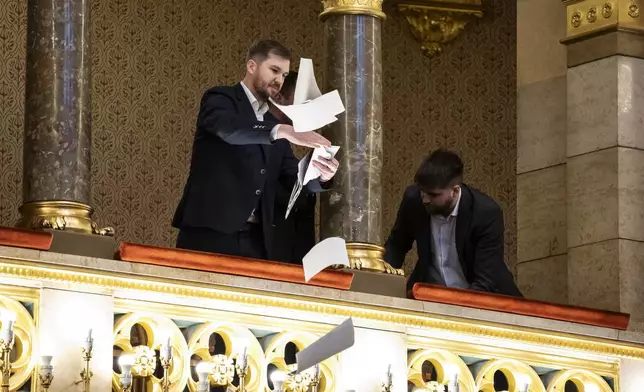
Ferenc Gelencser of Momentum, left, throws pamphlets from the balcony during the plenary session of the Hungarian parliament in Budapest, Hungary, Tuesday, March 18, 2025. (Boglarka Bodnar/MTI via AP)
MPs of Momentum protest with flares during the plenary session of the Hungarian parliament in Budapest, Hungary, Tuesday, March 18, 2025. (Boglarka Bodnar/MTI via AP)
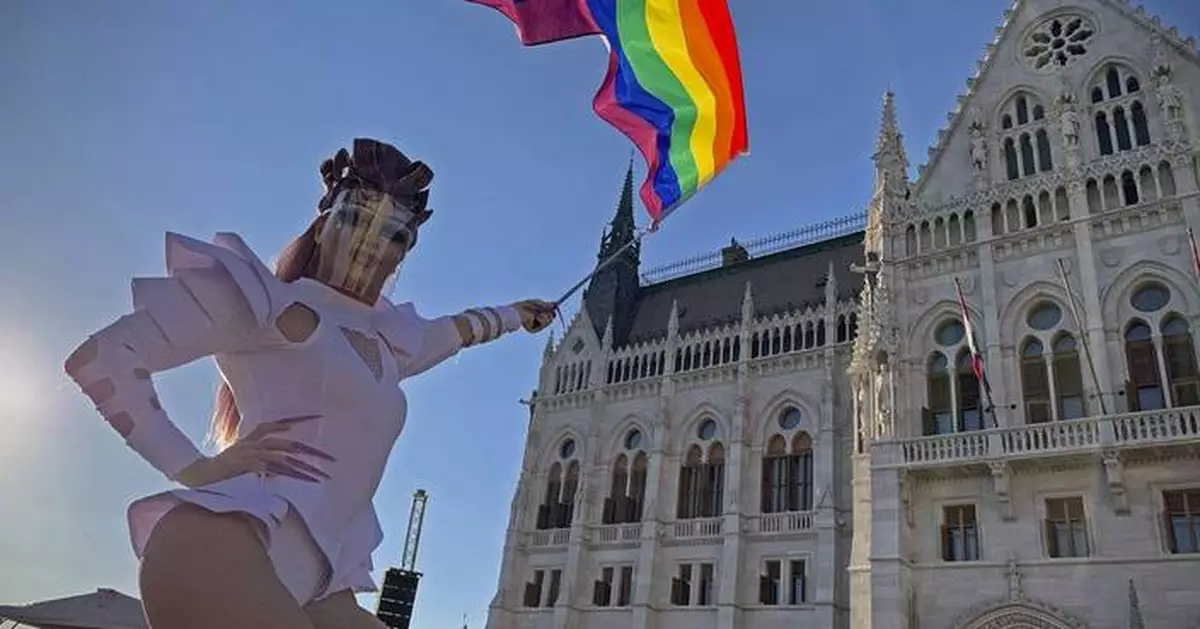
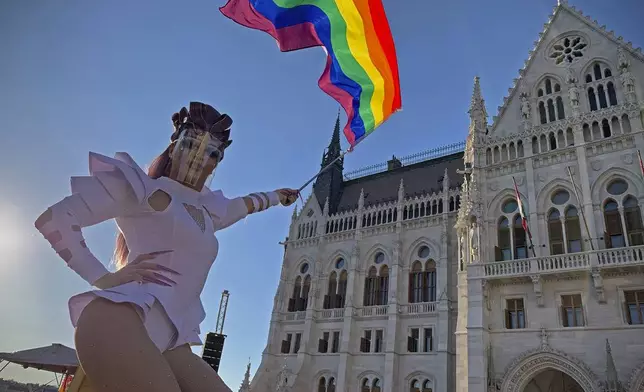
FILE - A participant waves a rainbow flag during an LGBT rights demonstration in front of the Hungarian Parliament building in Budapest, Hungary on June 14, 2021. (AP Photo/Bela Szandelszky, File)
The move by Hungarian lawmakers is part of a crackdown on the country's LGBTQ+ community by the nationalist-populist party of Prime Minister Viktor Orbán, who is an ally of Russian President Vladimir Putin and U.S. President Donald Trump.
The measure, which is reminiscent of similar restrictions against sexual minorities in Russia, was passed in a 136-27 vote. The law, supported by Orbán’s Fidesz party and their minority coalition partner the Christian Democrats, was pushed through parliament in an accelerated procedure after being submitted on Monday.
Opposing legislators led a vivid protest in the legislature involving rainbow-colored smoke bombs.
At the protest outside parliament, Evgeny Belyakov, a Russian citizen who immigrated to Hungary after facing repression in Russia, said the legislation went at the heart of people's rights to peacefully assemble.
“It's quite terrifying to be honest, because we had the same in Russia. It was building up step by step, and I feel like this is what is going on here,” he said. “I just only hope that there will be more resistance like this in Hungary, because in Russia we didn’t resist on time and now it’s too late.”
The bill amends Hungary’s law on assembly to make it an offense to hold or attend events that violate Hungary’s contentious “child protection” legislation, which prohibits the “depiction or promotion” of homosexuality to minors under 18.
Attending a prohibited event will carry fines up to 200,000 Hungarian forints ($546), which the state must forward to “child protection,” according to the text of the law. Authorities may use facial recognition tools to identify individuals attending a prohibited event.
In a statement on Monday after lawmakers first submitted the bill, Budapest Pride organizers said the aim of the law was to “scapegoat” the LGBTQ+ community in order to silence voices critical of Orbán’s government.
“This is not child protection, this is fascism,” wrote the organizers of the event, which attracts thousands each year and celebrates the history of the LGBTQ+ movement while asserting the equal rights of the gay, lesbian, bisexual and transgender community.
Following the law's passage Tuesday, Budapest Pride spokesperson Jojó Majercsik told The Associated Press that despite Orbán's yearslong effort to stigmatize LGBTQ+ people, the organization had received an outpouring of support since the Hungarian leader hinted in February that his government would take steps to ban the event.
"Many, many people have been mobilized," Majercsik said. “It's a new thing, compared to the attacks of the last years, that we've received many messages and comments from people saying, ‘Until now I haven’t gone to Pride, I didn't care about it, but this year I'll be there and I'll bring my family.'”
The new legislation is the latest step against LGBTQ+ people taken by Orbán, whose government has passed other laws that rights groups and other European politicians have decried as repressive against sexual minorities.
In 2022, the European Union’s executive commission filed a case with the EU’s highest court against Hungary’s 2021 child protection law. The European Commission argued that the law “discriminates against people on the basis of their sexual orientation and gender identity.”
Hungary’s “child protection” law — aside from banning the “depiction or promotion” of homosexuality in content available to minors, including in television, films, advertisements and literature — also prohibits the mention of LGBTQ+ issues in school education programs, and forbids the public depiction of “gender deviating from sex at birth.”
Booksellers in Hungary have faced hefty fines for failing to wrap books that contain LGBTQ+ themes in closed packaging. Critics have argued Orbán's campaign amounts to an attempt to cut LGBTQ+ visibility, and that by tying it to child protection, it falsely conflates homosexuality with pedophilia.
Hungary’s government argues that its policies are designed to protect children from “sexual propaganda.”
Hungary's methods resemble tactics by Putin, who in December 2022 expanded Russia's ban on “propaganda of nontraditional sexual relations” from minors to adults, effectively outlawing any public endorsement of LGBTQ+ activities.
Orbán, in power since 2010, faces an unprecedented challenge from a rising opposition party as Hungary’s economy struggles to emerge from an inflation and cost of living crisis and an election approaches in 2026.
Tamás Dombos, a project coordinator at Hungarian LGBTQ+ rights group Háttér Society, said that Orbán's assault on minorities was a tactic to distract voters from more important issues facing the country. He said allowing the use of facial recognition software at prohibited demonstrations could be used against other protests the government chooses to deem unlawful.
“It's a very common strategy of authoritarian governments not to talk about the real issues that people are affected by: the inflation, the economy, the terrible condition of education and health care,” Dombos said.
Orbán, he continued, “has been here with us for 15 years lying into people's faces, letting the country rot basically, and then coming up with these hate campaigns.”
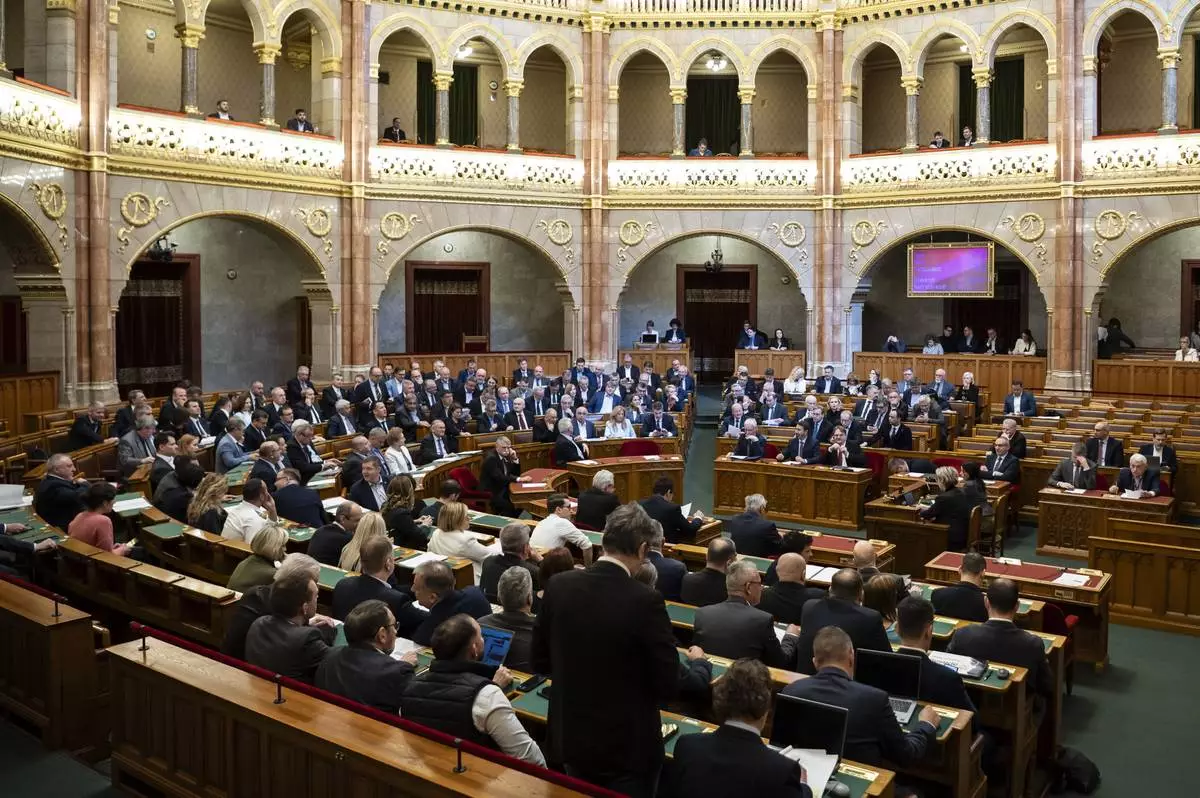
Representatives vote during the plenary session of the Hungarian parliament in Budapest, Hungary, Tuesday, March 18, 2025. (Boglarka Bodnar/MTI via AP)
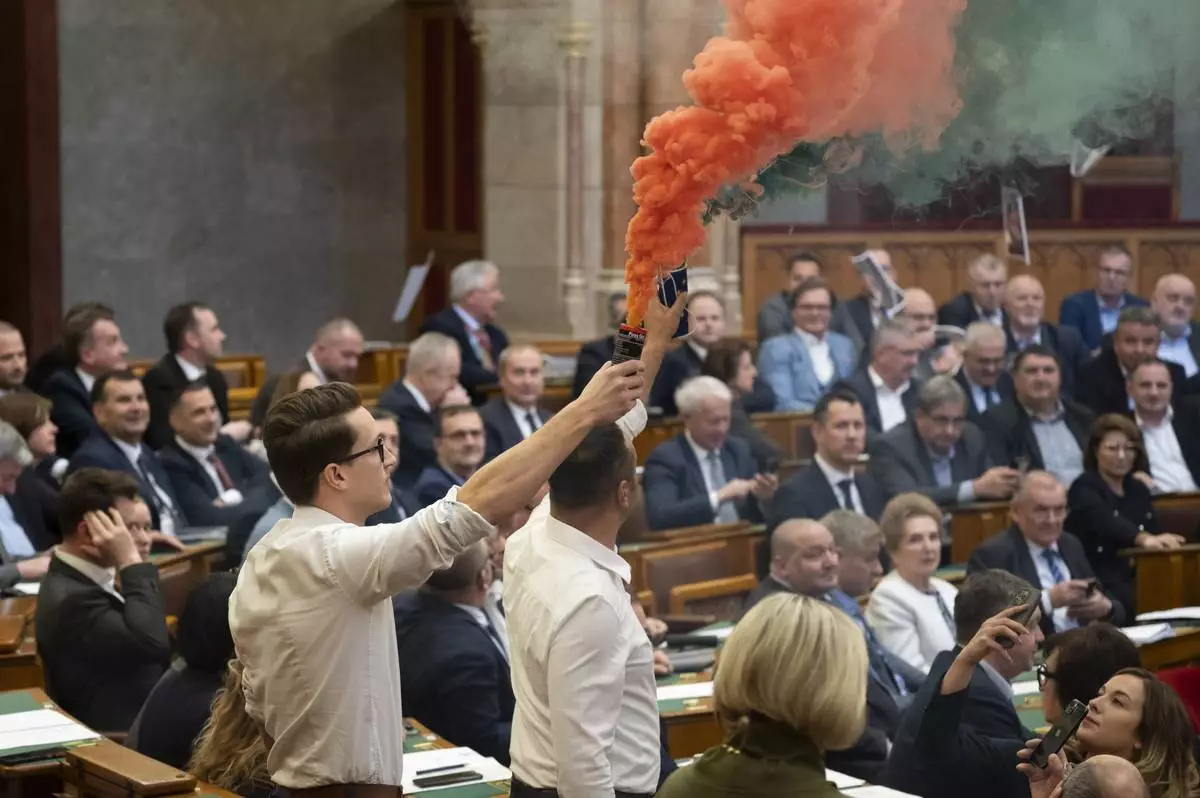
MPs of Momentum protest with flares during the plenary session of the Hungarian parliament in Budapest, Hungary, Tuesday, March 18, 2025. (Boglarka Bodnar/MTI via AP)
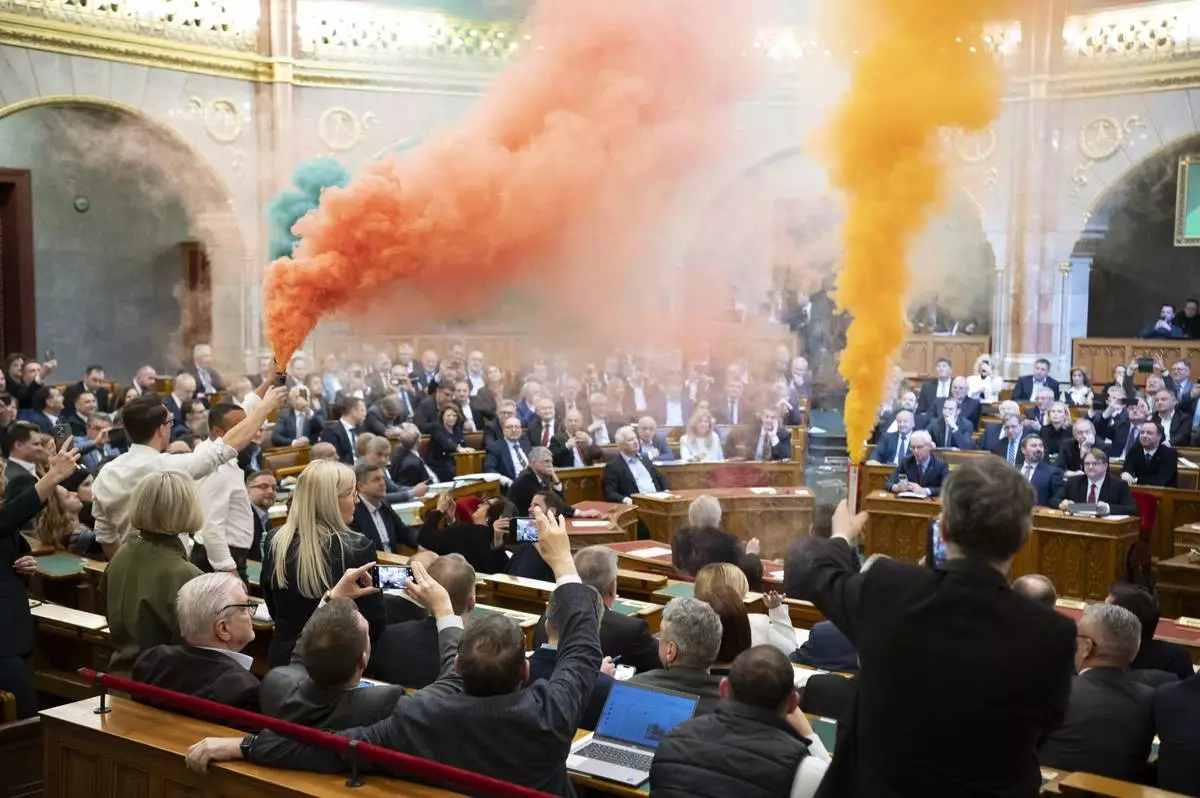
MPs of Momentum protest with flares during the plenary session of the Hungarian parliament in Budapest, Hungary, Tuesday, March 18, 2025. (Boglarka Bodnar/MTI via AP)
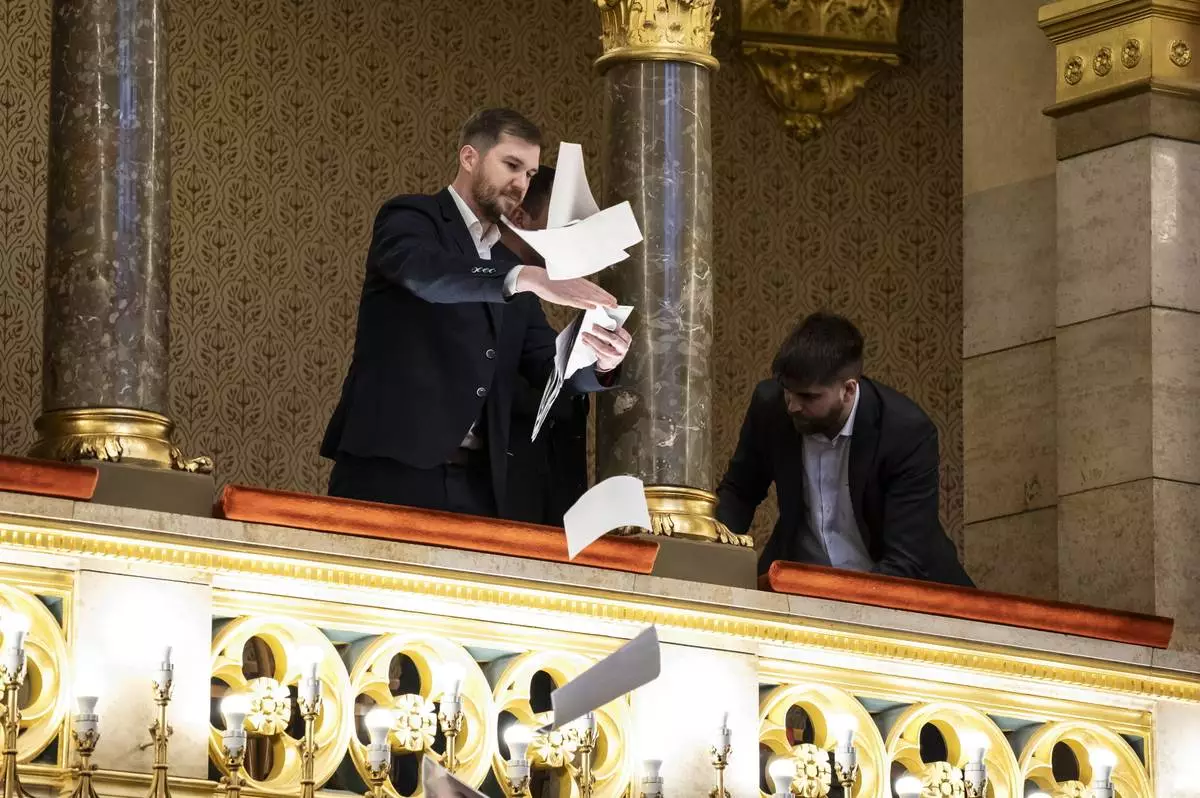
Ferenc Gelencser of Momentum, left, throws pamphlets from the balcony during the plenary session of the Hungarian parliament in Budapest, Hungary, Tuesday, March 18, 2025. (Boglarka Bodnar/MTI via AP)
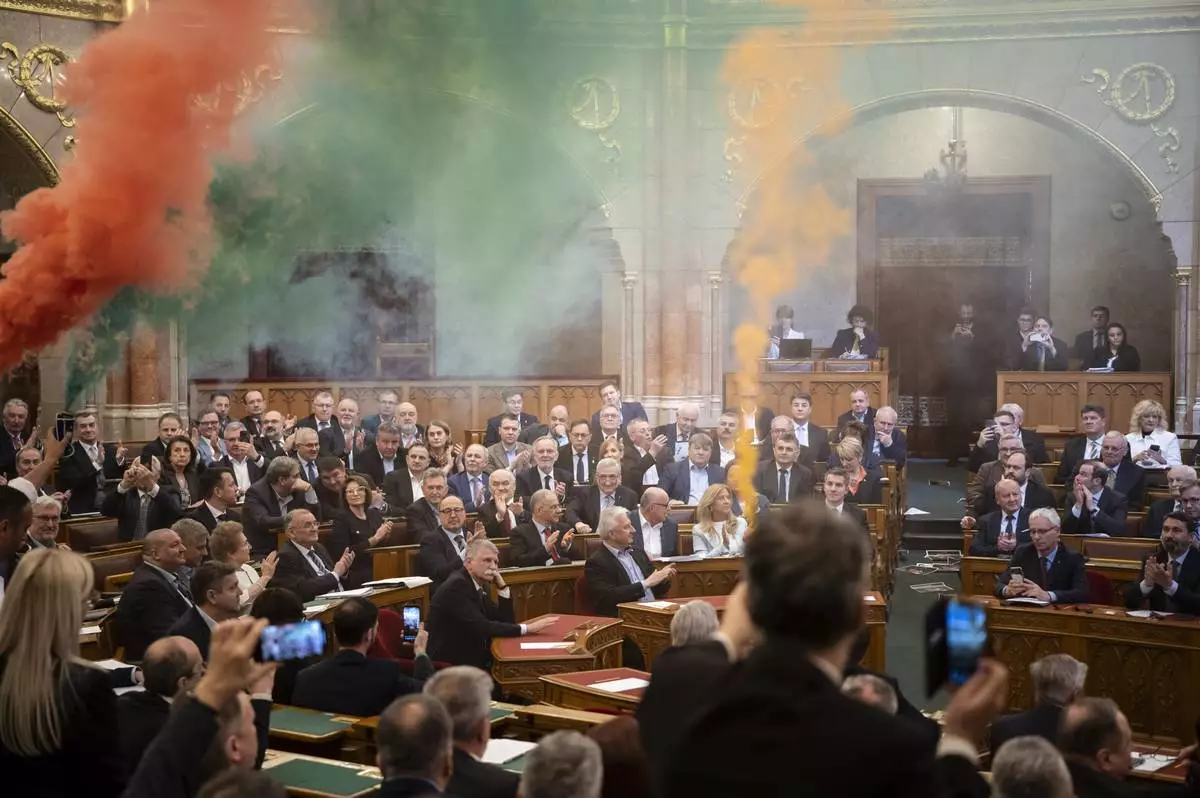
MPs of Momentum protest with flares during the plenary session of the Hungarian parliament in Budapest, Hungary, Tuesday, March 18, 2025. (Boglarka Bodnar/MTI via AP)
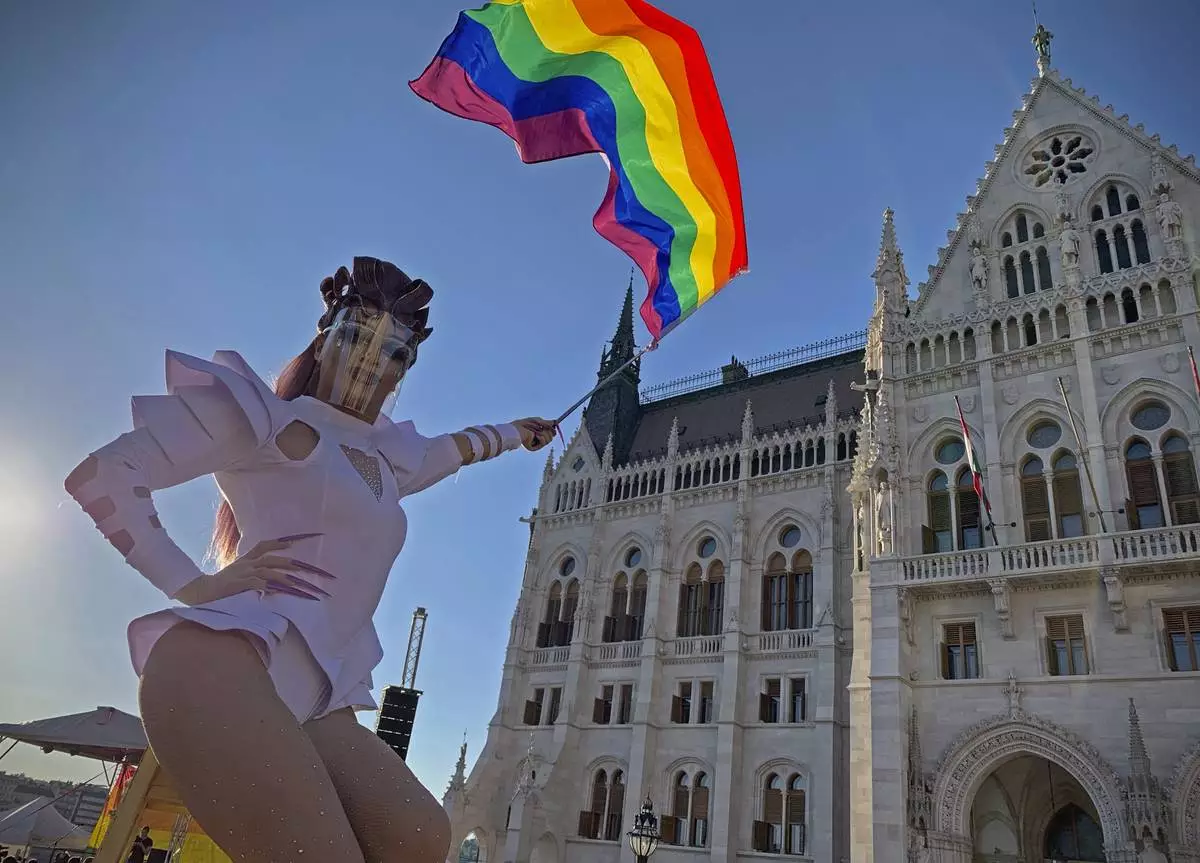
FILE - A participant waves a rainbow flag during an LGBT rights demonstration in front of the Hungarian Parliament building in Budapest, Hungary on June 14, 2021. (AP Photo/Bela Szandelszky, File)
U.S. President Donald Trump says Iran has proposed negotiations after his threat to strike the Islamic Republic as an ongoing crackdown on demonstrators has led to hundreds of deaths.
Trump said late Sunday that his administration was in talks to set up a meeting with Tehran, but cautioned that he may have to act first as reports mount of increasing deaths and the government continues to arrest protesters.
“The meeting is being set up, but we may have to act because of what’s happening before the meeting. But a meeting is being set up. Iran called, they want to negotiate,” Trump told reporters on Air Force One on Sunday night.
Iran did not acknowledge Trump’s comments immediately. It has previously warned the U.S. military and Israel would be “legitimate targets” if America uses force to protect demonstrators.
The U.S.-based Human Rights Activists News Agency, which has accurately reported on past unrest in Iran, gave the death toll. It relies on supporters in Iran cross checking information. It said at least 544 people have been killed so far, including 496 protesters and 48 people from the security forces. It said more than 10,600 people also have been detained over the two weeks of protests.
With the internet down in Iran and phone lines cut off, gauging the demonstrations from abroad has grown more difficult. Iran’s government has not offered overall casualty figures.
The Latest:
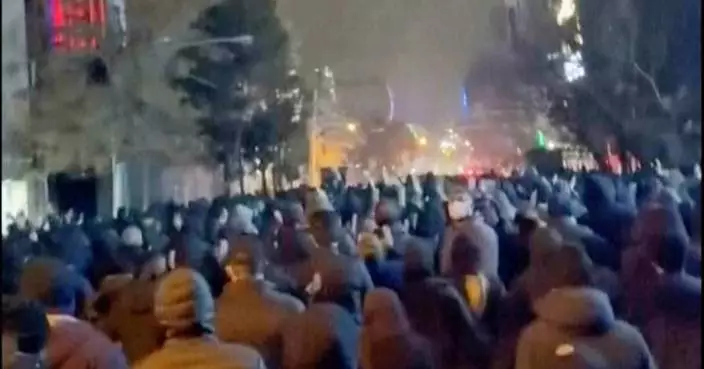
A witness told the AP that the streets of Tehran empty at the sunset call to prayers each night.
Part of that stems from the fear of getting caught in the crackdown. Police sent the public a text message that warned: “Given the presence of terrorist groups and armed individuals in some gatherings last night and their plans to cause death, and the firm decision to not tolerate any appeasement and to deal decisively with the rioters, families are strongly advised to take care of their youth and teenagers.”
Another text, addressed “Dear parents,” which claimed to come from the intelligence arm of the paramilitary Revolutionary Guard, also directly warned people not to take part in demonstrations.
The witness spoke to the AP on condition of anonymity due to the ongoing crackdown.
—- By Jon Gambrell in Dubai, United Arab Emirates
Iran drew tens of thousands of pro-government demonstrators to the streets Monday in a show of power after nationwide protests challenging the country’s theocracy.
Iranian state television showed images of demonstrators thronging Tehran toward Enghelab Square in the capital.
It called the demonstration an “Iranian uprising against American-Zionist terrorism,” without addressing the underlying anger in the country over the nation’s ailing economy. That sparked the protests over two weeks ago.
State television aired images of such demonstrations around the country, trying to signal it had overcome the protests, as claimed by Iranian Foreign Minister Abbas Araghchi earlier in the day.
China says it opposes the use of force in international relations and expressed hope the Iranian government and people are “able to overcome the current difficulties and maintain national stability.”
Chinese Foreign Ministry spokesperson Mao Ning said Monday that Beijing “always opposes interference in other countries’ internal affairs, maintains that the sovereignty and security of all countries should be fully protected under international law, and opposes the use or threat of use of force in international relations.”
German Chancellor Friedrich Merz condemned “in the strongest terms the violence that the leadership in Iran is directing against its own people.”
He said it was a sign of weakness rather than strength, adding that “this violence must end.”
Merz said during a visit to India that the demonstrators deserve “the greatest respect” for the courage with which “they are resisting the disproportional, brutal violence of Iranian security forces.”
He said: “I call on the Iranian leadership to protect its population rather than threatening it.”
Iran’s Foreign Ministry spokesman on Monday suggested that a channel remained open with the United States.
Esmail Baghaei made the comment during a news conference in Tehran.
“It is open and whenever needed, through that channel, the necessary messages are exchanged,” he said.
However, Baghaei said such talks needed to be “based on the acceptance of mutual interests and concerns, not a negotiation that is one-sided, unilateral and based on dictation.”
The semiofficial Fars news agency in Iran, which is close to the paramilitary Revolutionary Guard, on Monday began calling out Iranian celebrities and leaders on social media who have expressed support for the protests over the past two weeks, especially before the internet was shut down.
The threat comes as writers and other cultural leaders were targeted even before protests. The news agency highlighted specific celebrities who posted in solidarity with the protesters and scolded them for not condemning vandalism and destruction to public property or the deaths of security forces killed during clashes. The news agency accused those celebrities and leaders of inciting riots by expressing their support.
Canada said it “stands with the brave people of Iran” in a statement on social media that strongly condemned the killing of protesters during widespread protests that have rocked the country over the past two weeks.
“The Iranian regime must halt its horrific repression and intimidation and respect the human rights of its citizens,” Canada’s government said on Monday.
Iran’s foreign minister claimed Monday that “the situation has come under total control” after a bloody crackdown on nationwide protests in the country.
Abbas Araghchi offered no evidence for his claim.
Araghchi spoke to foreign diplomats in Tehran. The Qatar-funded Al Jazeera satellite news network, which has been allowed to work despite the internet being cut off in the country, carried his remarks.
Iran’s foreign minister alleged Monday that nationwide protests in his nation “turned violent and bloody to give an excuse” for U.S. President Donald Trump to intervene.
Abbas Araghchi offered no evidence for his claim, which comes after over 500 have been reported killed by activists -- the vast majority coming from demonstrators.
Araghchi spoke to foreign diplomats in Tehran. The Qatar-funded Al Jazeera satellite news network, which has been allowed to work despite the internet being cut off in the country, carried his remarks.
Iran has summoned the British ambassador over protesters twice taking down the Iranian flag at their embassy in London.
Iranian state television also said Monday that it complained about “certain terrorist organization that, under the guise of media, spread lies and promote violence and terrorism.” The United Kingdom is home to offices of the BBC’s Persian service and Iran International, both which long have been targeted by Iran.
A huge crowd of demonstrators, some waving the flag of Iran, gathered Sunday afternoon along Veteran Avenue in LA’s Westwood neighborhood to protest against the Iranian government. Police eventually issued a dispersal order, and by early evening only about a hundred protesters were still in the area, ABC7 reported.
Los Angeles is home to the largest Iranian community outside of Iran.
Los Angeles police responded Sunday after somebody drove a U-Haul box truck down a street crowded with the the demonstrators, causing protesters to scramble out of the way and then run after the speeding vehicle to try to attack the driver. A police statement said one person was hit by the truck but nobody was seriously hurt.
The driver, a man who was not identified, was detained “pending further investigation,” police said in a statement Sunday evening.
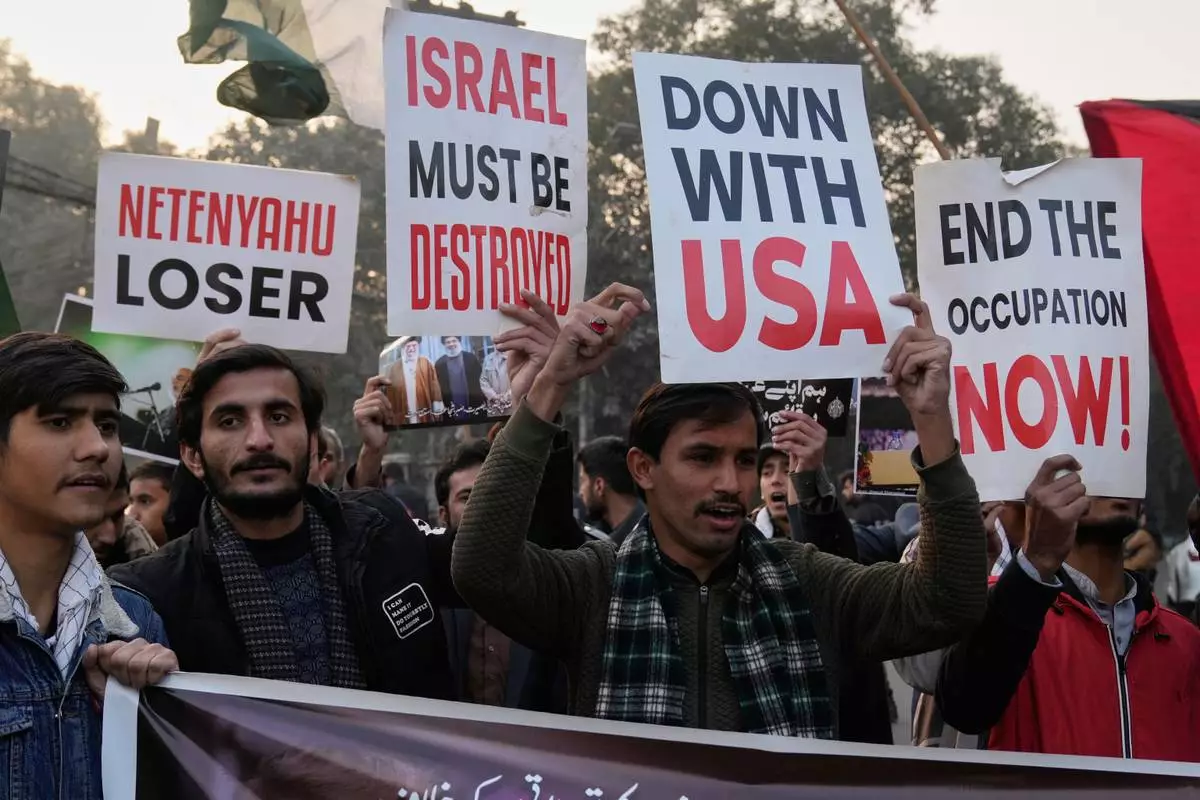
Shiite Muslims hold placards and chant slogans during a protest against the U.S. and show solidarity with Iran in Lahore, Pakistan, Sunday, Jan. 11, 2026. (AP Photo/K.M. Chaudary)
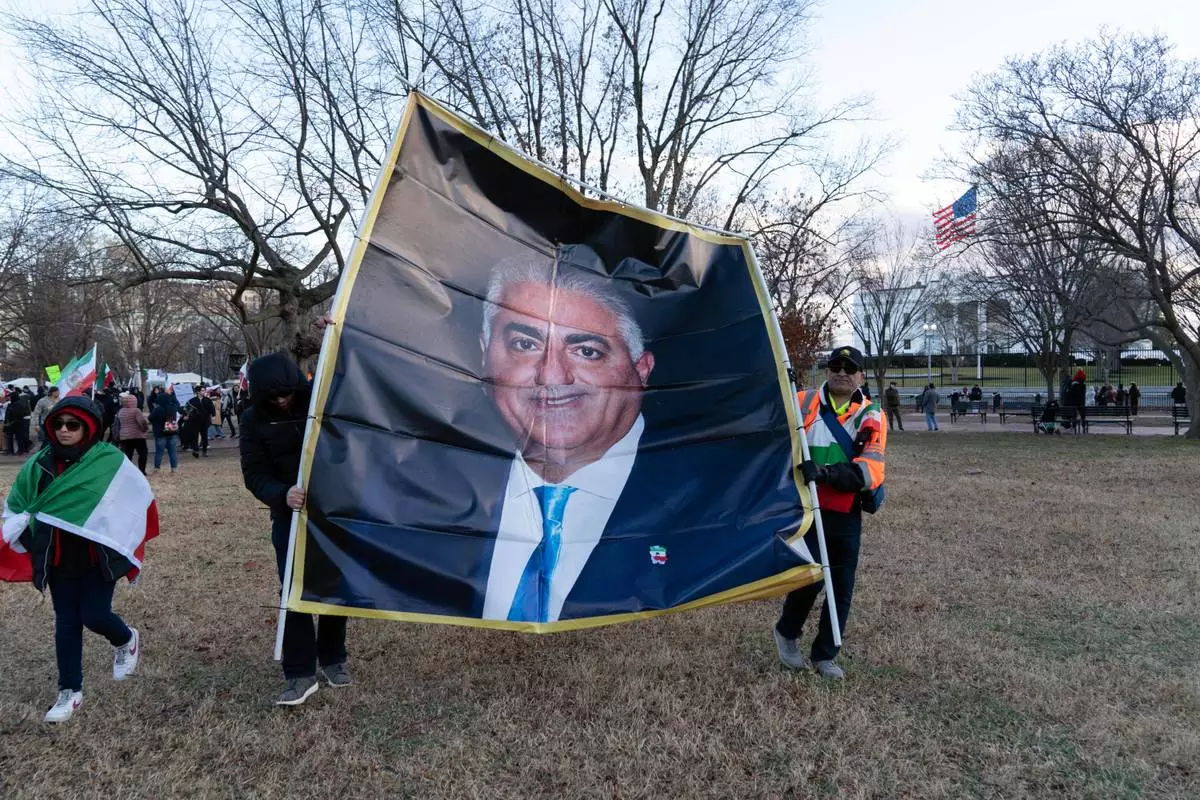
Activists carrying a photograph of Reza Pahlavi take part in a rally supporting protesters in Iran at Lafayette Park, across from the White House, in Washington, Sunday, Jan. 11, 2026. (AP Photo/Jose Luis Magana)
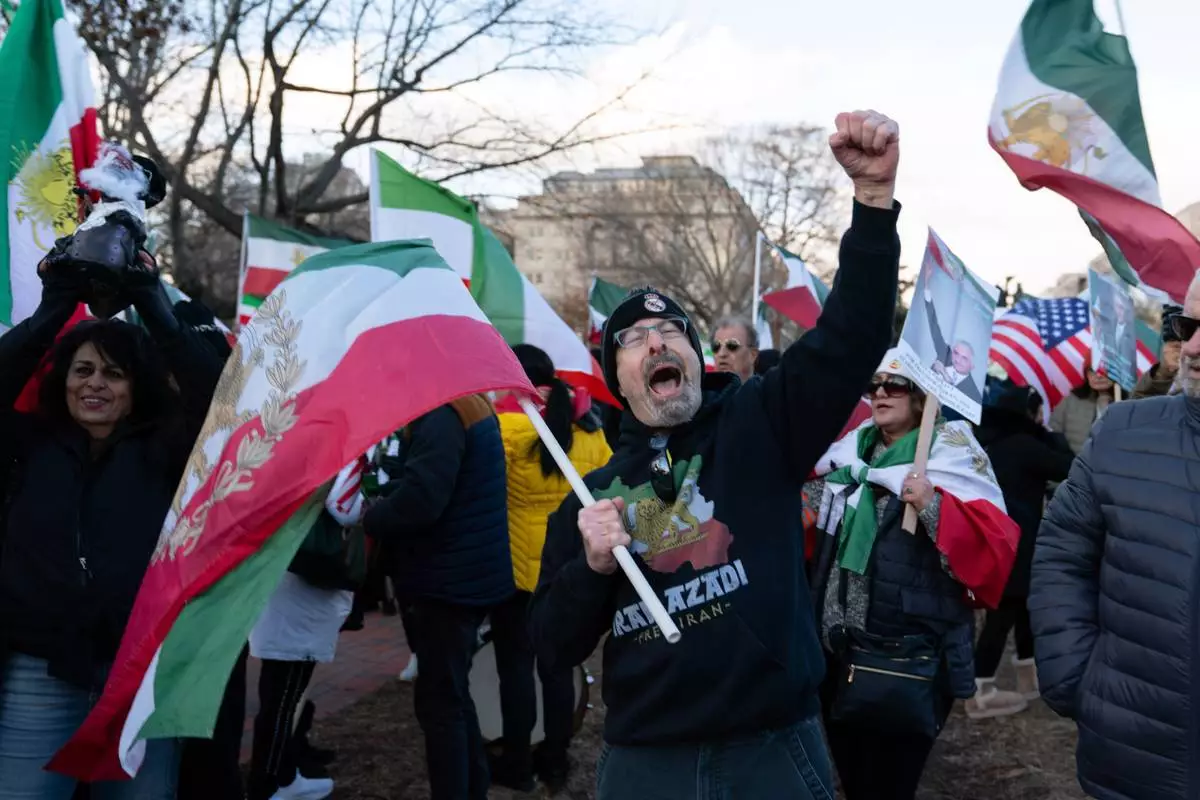
Activists take part in a rally supporting protesters in Iran at Lafayette Park, across from the White House in Washington, Sunday, Jan. 11, 2026. (AP Photo/Jose Luis Magana)
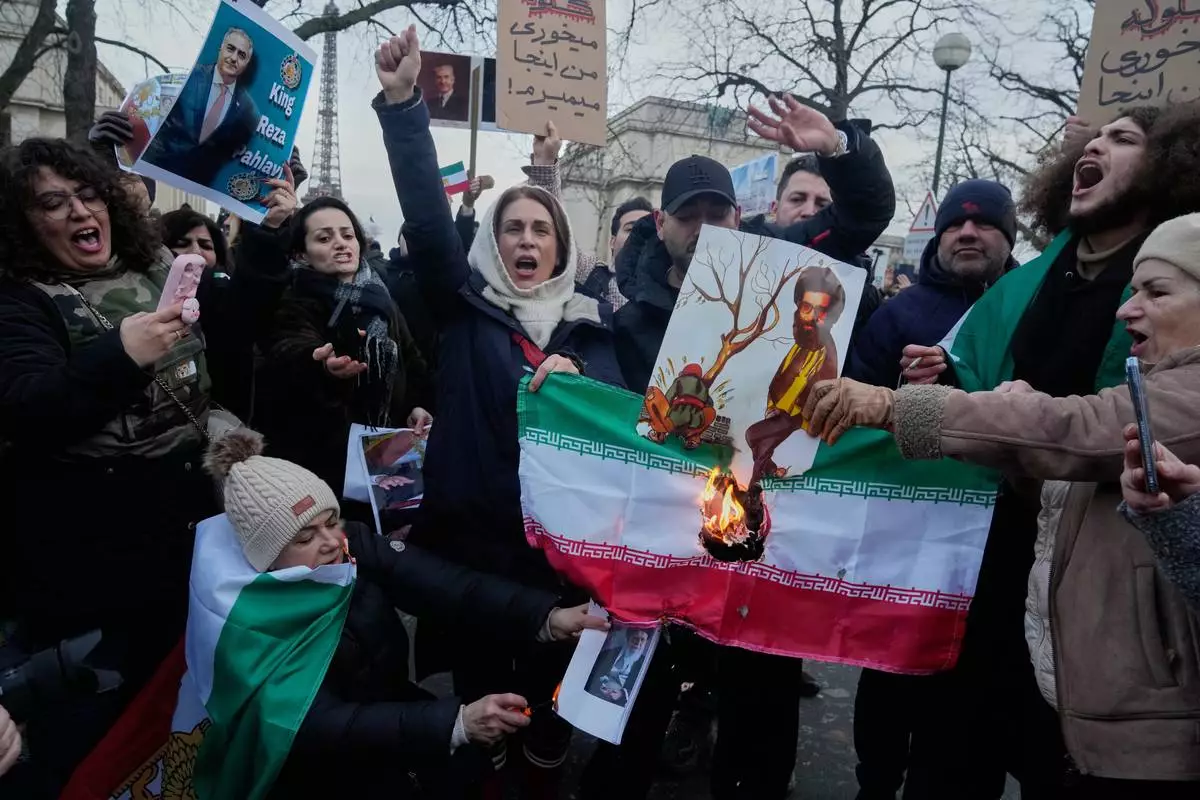
Protesters burn the Iranian national flag during a rally in support of the nationwide mass demonstrations in Iran against the government in Paris, Sunday, Jan. 11, 2026. (AP Photo/Michel Euler)