Skip to Content Facebook Feature Image

Crimea has been a battleground and a playground. Why it's coveted by both Russia and Ukraine

ENT

Crimea has been a battleground and a playground. Why it's coveted by both Russia and Ukraine
ENT

ENT

Crimea has been a battleground and a playground. Why it's coveted by both Russia and Ukraine

2025-03-19 23:58 Last Updated At:03-20 00:01

Russia's illegal seizure of the Crimean Peninsula from Ukraine exactly 11 years ago on March 18, 2014, was quick and bloodless, but it sent Moscow's relations with the West into a downward spiral unseen since the Cold War.

It also paved the way for Russia’s full-scale invasion of Ukraine in 2022, during which Moscow annexed more land from the war-torn country.

More Images
FILE - Youths mark the ninth anniversary of the annexation of Crimea from Ukraine with a banner reading, "Russia doesn't start wars, it ends them," next to an image of Russian President Vladimir Putin in Yalta, Crimea, on March 17, 2023. (AP Photo, File)
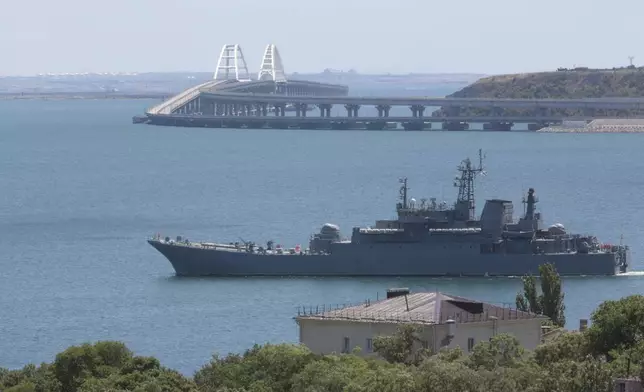
FILE - Youths mark the ninth anniversary of the annexation of Crimea from Ukraine with a banner reading, "Russia doesn't start wars, it ends them," next to an image of Russian President Vladimir Putin in Yalta, Crimea, on March 17, 2023. (AP Photo, File)

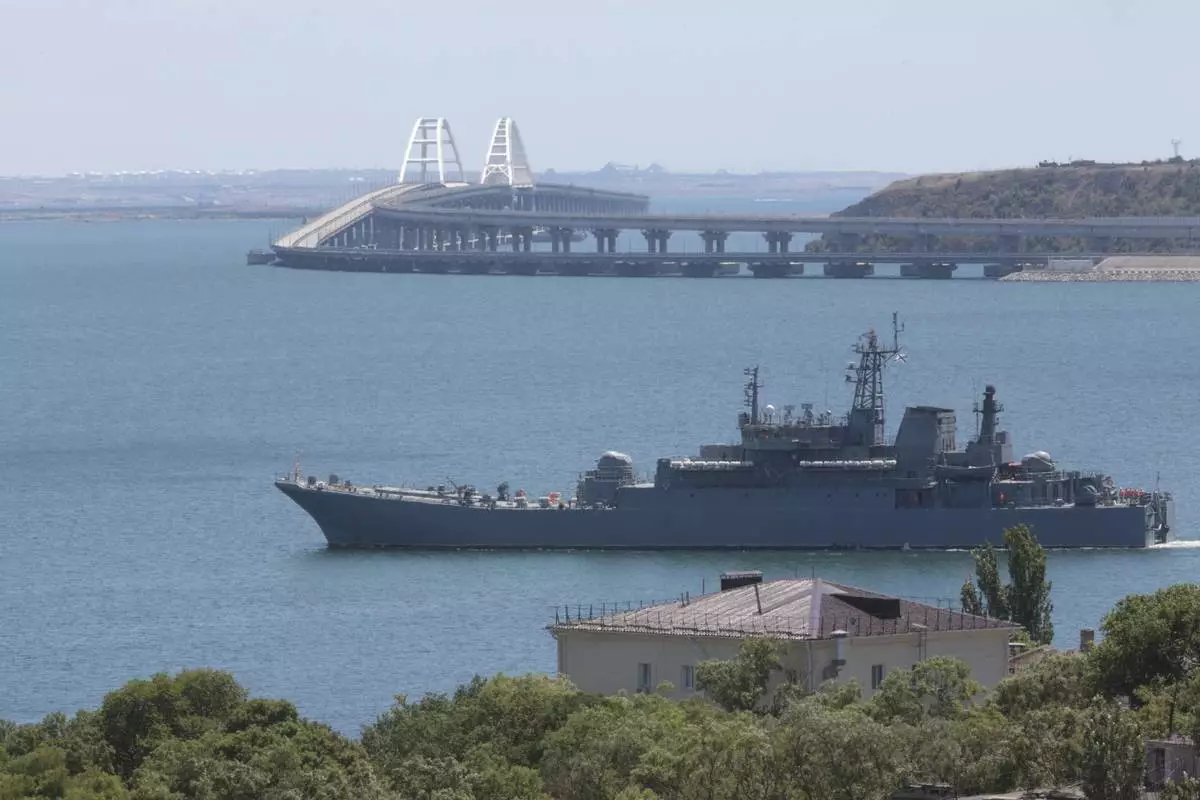
FILE - A Russian military landing ship sails near Kerch, Crimea, on July 17, 2023. (AP Photo, File)
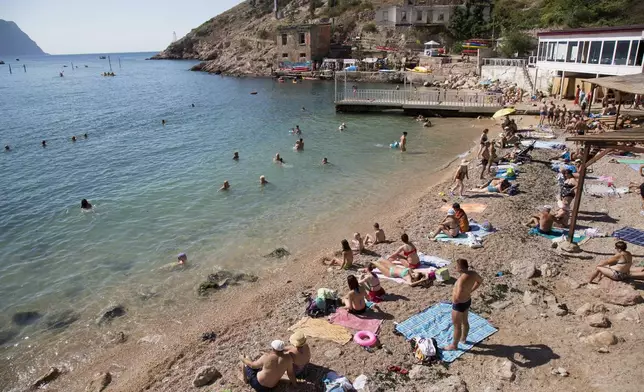
FILE - A Russian military landing ship sails near Kerch, Crimea, on July 17, 2023. (AP Photo, File)

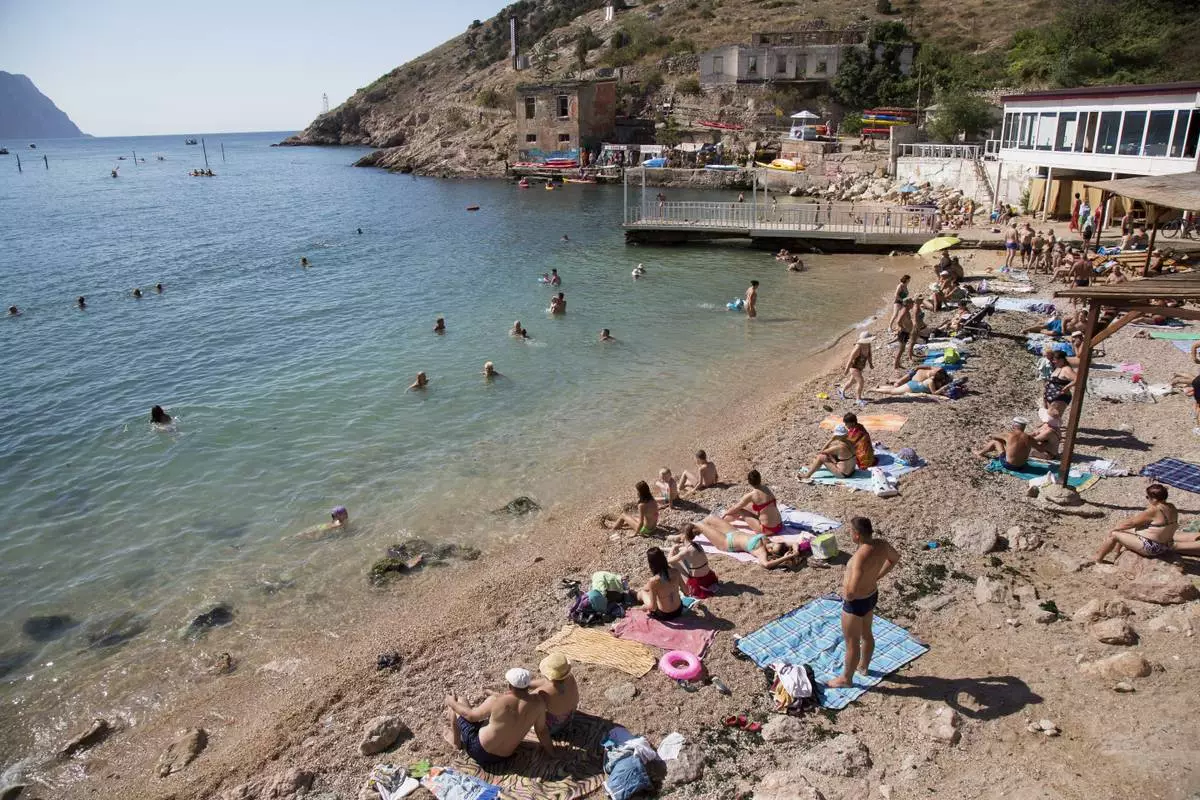
FILE - People gather at a beach in Balaklava Bay, part of Sevastopol on the Crimean Peninsula, Aug. 9, 2015. (AP Photo, File)
FILE - People gather at a beach in Balaklava Bay, part of Sevastopol on the Crimean Peninsula, Aug. 9, 2015. (AP Photo, File)

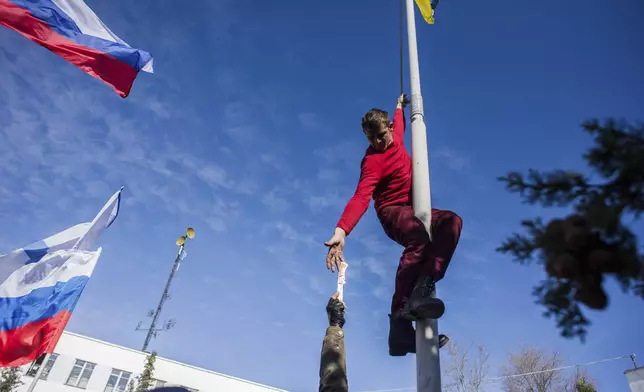
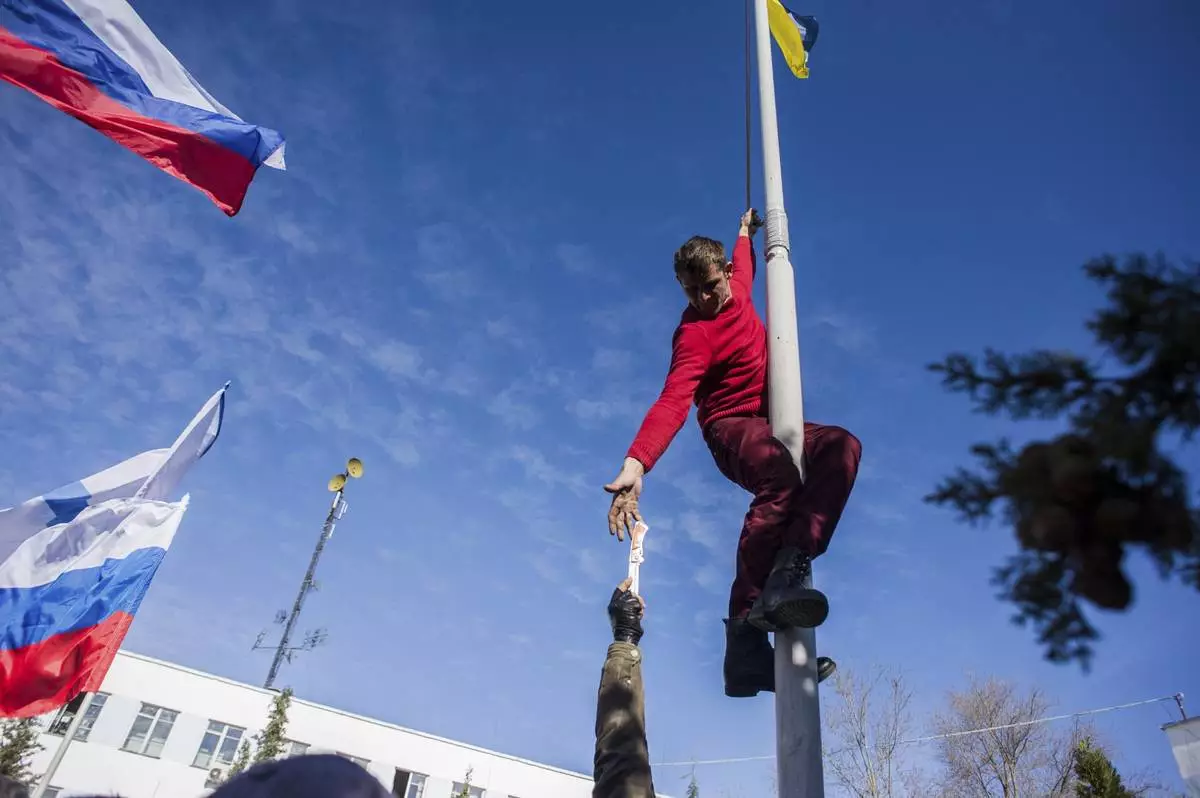
FILE - A member of a pro-Russian self-defense force reaches for a knife to take down a Ukrainian navy flag at the Ukrainian naval headquarters in Sevastopol, Crimea, March 19, 2014. (AP Photo, File)
FILE - A member of a pro-Russian self-defense force reaches for a knife to take down a Ukrainian navy flag at the Ukrainian naval headquarters in Sevastopol, Crimea, March 19, 2014. (AP Photo, File)

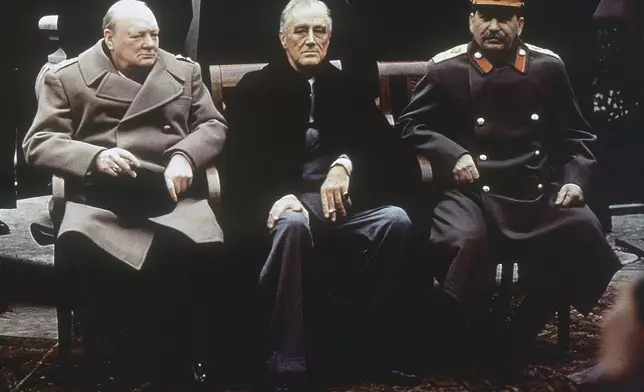
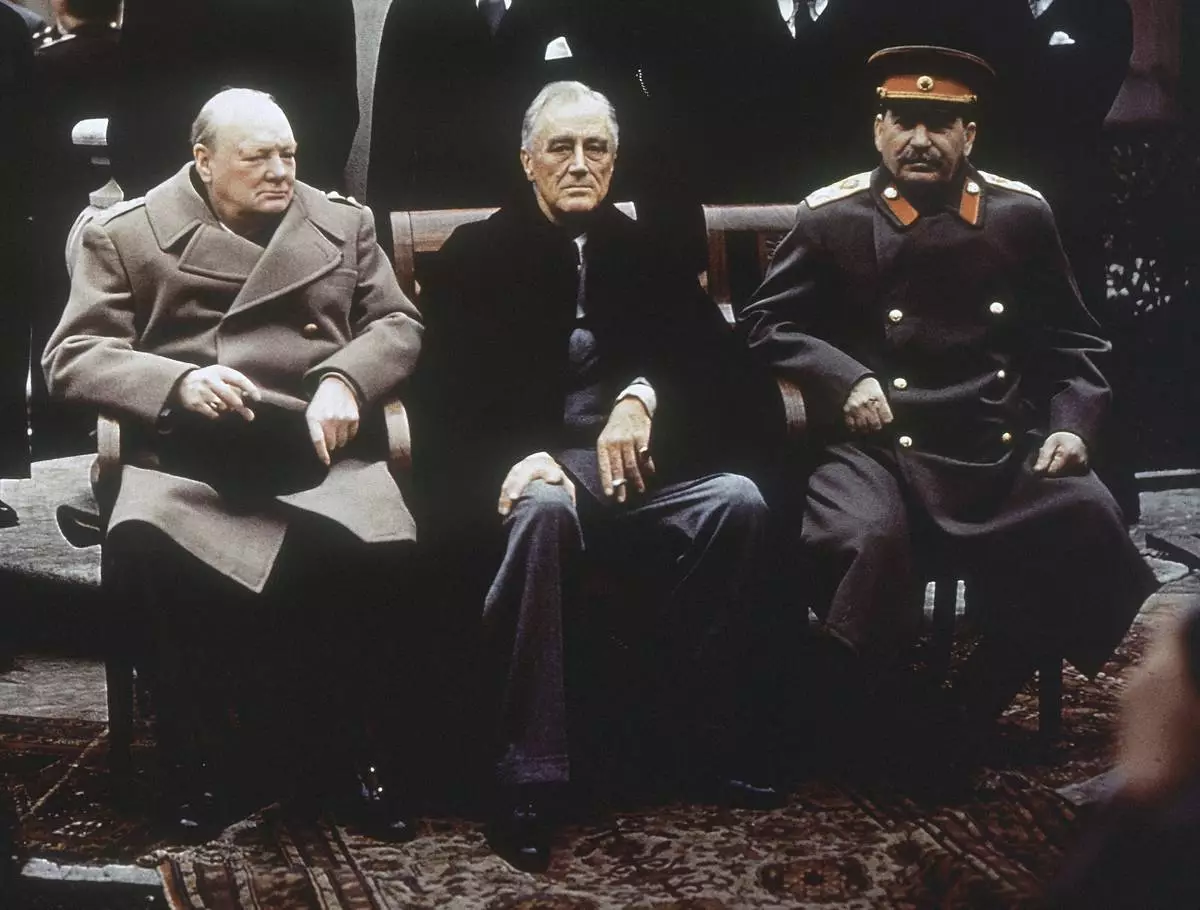
FILE - From left, British Prime Minister Winston Churchill, U.S. President Franklin Roosevelt and Soviet leader Josef Stalin sit on the patio of the Livadia Palace, in Yalta, Crimea, on Feb. 4, 1945. (AP Photo, File)
FILE - From left, British Prime Minister Winston Churchill, U.S. President Franklin Roosevelt and Soviet leader Josef Stalin sit on the patio of the Livadia Palace, in Yalta, Crimea, on Feb. 4, 1945. (AP Photo, File)

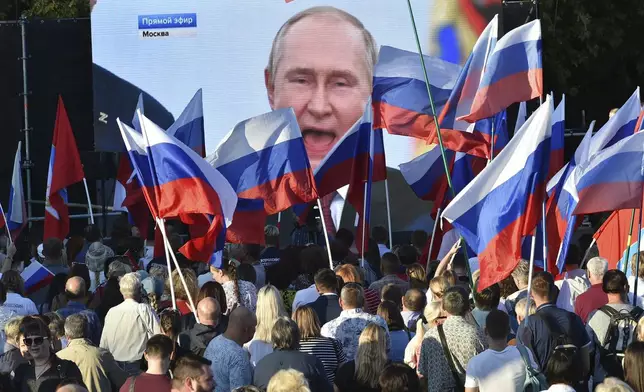
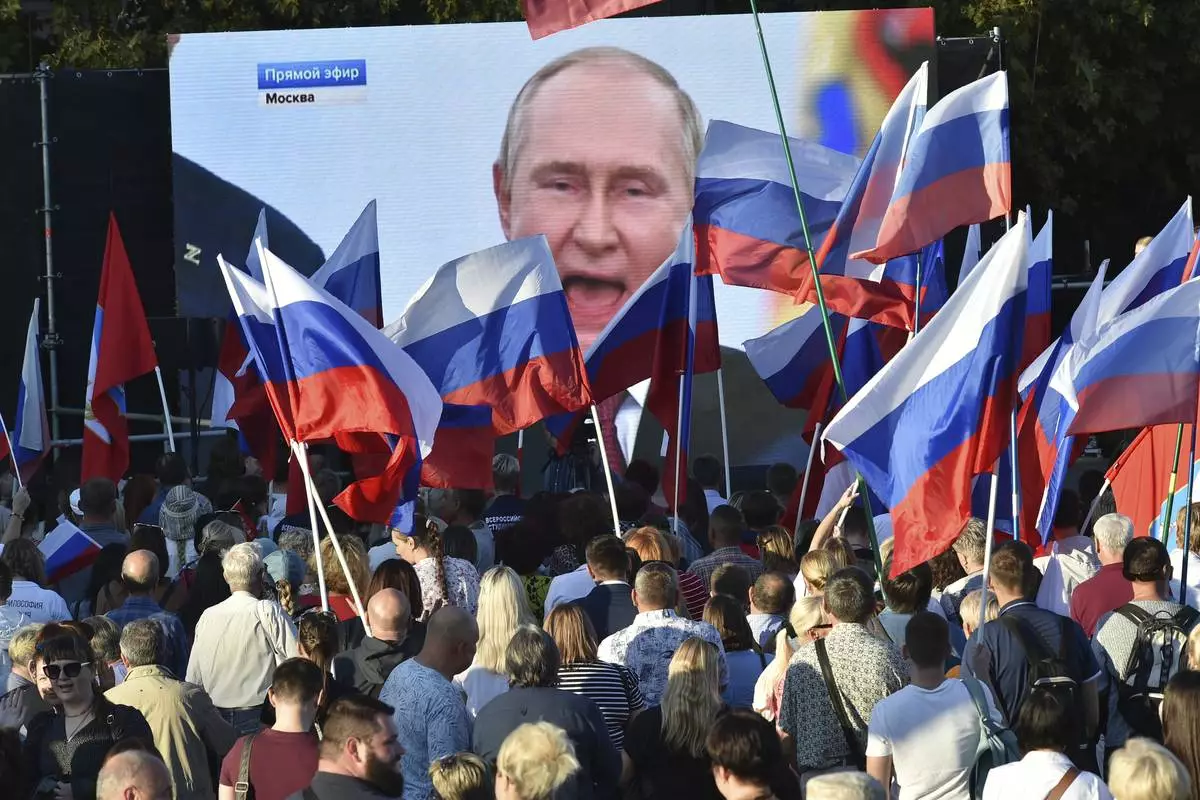
FILE - People watch as Russian President Vladimir Putin delivers a speech after signing treaties for four regions of Ukraine to join Russia in the Moscow's Kremlin, during a meeting in Sevastopol, Crimea, on Sept. 30, 2022. (AP Photo, File)

FILE - People watch as Russian President Vladimir Putin delivers a speech after signing treaties for four regions of Ukraine to join Russia in the Moscow's Kremlin, during a meeting in Sevastopol, Crimea, on Sept. 30, 2022. (AP Photo, File)

A look at the diamond-shaped peninsula in the Black Sea, coveted by both Russia and Ukraine for its naval bases and beaches:

Crimea’s unique location makes it a strategically important asset, and Russia has spent centuries fighting for it.

Crimea was home to Turkic-speaking Tatars when the Russian empire first annexed it in the 18th century. It briefly regained independence two centuries later before being swallowed by the Soviet Union.

In 1944, Soviet dictator Josef Stalin deported nearly 200,000 Tatars, or about a third of Crimea’s population, to Central Asia, 3,200 kilometers (2,000 miles) to the east. Stalin had accused them of collaborating with Nazi Germany — a claim widely dismissed by historians. An estimated half of them died in the next 18 months of hunger and harsh conditions.

Soviet leader Nikita Khrushchev transferred the peninsula from Russia to Ukraine in 1954, when both were part of the USSR, to commemorate the 300th anniversary of the unification of Moscow and Kyiv. In 1991, when the Soviet Union collapsed, the peninsula became part of newly independent Ukraine.

Russia kept a foot in the door, however: Its Black Sea Fleet had a base in the city of Sevastopol, and Crimea — as part of Ukraine — continued to host it.

Sevastopol also was a preferred holiday destination for Nicholas II, the last Russian czar. The southern town of Yalta was a prime holiday destination in Soviet times, with many sanatoriums there. It drew worldwide renown when Stalin, U.S. President Franklin D. Roosevelt and British Prime Minister Winston Churchill met there in 1945 to discuss the fate of Germany and Europe after World War II.

For Kyiv, Crimea had been a strategic asset, too. By the time Russia annexed it in 2014, it had been a part of Ukraine for 60 years and had become part of the country’s identity.

Leonid Kravchuk, the first president of independent Ukraine, said Kyiv had invested some $100 billion into the peninsula between 1991 and 2014.

From a security perspective, Ukraine needs Crimea in order to have control over activities in the Black Sea.

In 2014, a massive popular uprising in Ukraine forced pro-Moscow President Victor Yanukovich from office.

Putin responded by sending troops to overrun Crimea — they appeared on the peninsula in uniforms without insignia — and calling a plebiscite on joining Russia that Ukraine and the West dismissed as illegal.

Russia's illegal annexation of Crimea was recognized internationally only by countries such as North Korea and Sudan. In Russia, it touched off a wave of patriotism, and “Krym nash!” — or “Crimea is ours!” — became a rallying cry.

This move sent Putin’s popularity soaring. His approval rating, which had declined to 65% in January 2014, shot to 86% in June, according to the Levada Center, an independent Russian pollster.

Putin has called Crimea “a sacred place,” and has prosecuted those who publicly argue it is part of Ukraine. Repressions against the Crimean Tatars continued under Putin, despite Moscow’s denials of discrimination. They strongly opposed the annexation, and an estimated 30,000 of them fled the peninsula between 2014 and 2021.

Ukrainian President Volodymyr Zelenskyy vowed to retake it and said that Russia “won’t be able to steal” the peninsula.

Russia’s relations with the West plummeted to new lows. The United States, the European Union and other countries imposed sanctions on Moscow and its officials.

Weeks after the annexation, fighting broke out in eastern Ukraine between pro-Kremlin militias and Kyiv’s forces. Moscow threw its weight behind the insurgents, even though the Kremlin denied supporting them with troops and weapons. There was abundant evidence to the contrary, including a Dutch court’s finding that a Russia-supplied air defense system shot down a Malaysia Airlines passenger jet over eastern Ukraine in July 2014, killing all 298 people aboard.

Russian hard-liners later criticized Putin for failing to capture all of Ukraine that year, arguing it was easily possible at a time when the government in Kyiv was in disarray and its military in shambles.

The fighting in eastern Ukraine continued, on and off, until February 2022, when Putin recognized the two war-torn Ukrainian regions of Donetsk and Luhansk as independent states and several days later launched a full-scale invasion of Ukraine.

In its assault on Ukraine, Moscow deployed troops and weapons to Crimea, allowing Russian forces to quickly seize large parts of southern Ukraine in the first weeks of the war.

A top Russian military official later said that securing a land corridor to Crimea by holding the occupied parts of the Donetsk, Luhansk, Zaporizhzhia and Kherson regions was among the key goals of what the Kremlin insisted on calling its “special military operation” in Ukraine.

Before the invasion, Zelenskyy focused on diplomatic efforts to get Crimea back, but after Russian troops rolled across the border, Kyiv started publicly contemplating retaking the peninsula by force.

The peninsula soon became a battleground, with Ukraine launching drone attacks and bombing it to try to dislodge Moscow’s hold on the territory.

The attacks targeted the Russian Black Sea Fleet there, as well as ammunition depots, air fields and Putin’s prized asset — the Kerch Bridge linking Crimea to Russia, which was struck in October 2022 and again in July 2023.
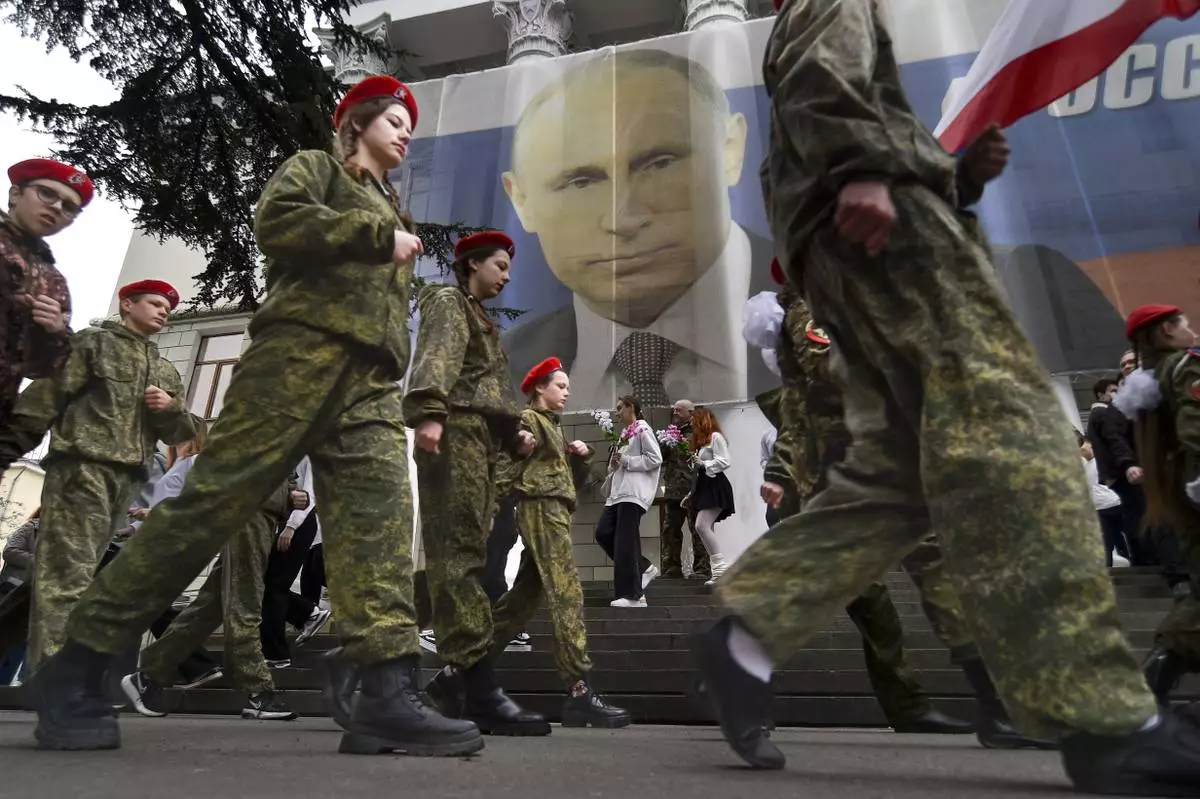
FILE - Youths mark the ninth anniversary of the annexation of Crimea from Ukraine with a banner reading, "Russia doesn't start wars, it ends them," next to an image of Russian President Vladimir Putin in Yalta, Crimea, on March 17, 2023. (AP Photo, File)
FILE - Youths mark the ninth anniversary of the annexation of Crimea from Ukraine with a banner reading, "Russia doesn't start wars, it ends them," next to an image of Russian President Vladimir Putin in Yalta, Crimea, on March 17, 2023. (AP Photo, File)

FILE - A Russian military landing ship sails near Kerch, Crimea, on July 17, 2023. (AP Photo, File)
FILE - A Russian military landing ship sails near Kerch, Crimea, on July 17, 2023. (AP Photo, File)

FILE - People gather at a beach in Balaklava Bay, part of Sevastopol on the Crimean Peninsula, Aug. 9, 2015. (AP Photo, File)
FILE - People gather at a beach in Balaklava Bay, part of Sevastopol on the Crimean Peninsula, Aug. 9, 2015. (AP Photo, File)

FILE - A member of a pro-Russian self-defense force reaches for a knife to take down a Ukrainian navy flag at the Ukrainian naval headquarters in Sevastopol, Crimea, March 19, 2014. (AP Photo, File)
FILE - A member of a pro-Russian self-defense force reaches for a knife to take down a Ukrainian navy flag at the Ukrainian naval headquarters in Sevastopol, Crimea, March 19, 2014. (AP Photo, File)

FILE - From left, British Prime Minister Winston Churchill, U.S. President Franklin Roosevelt and Soviet leader Josef Stalin sit on the patio of the Livadia Palace, in Yalta, Crimea, on Feb. 4, 1945. (AP Photo, File)
FILE - From left, British Prime Minister Winston Churchill, U.S. President Franklin Roosevelt and Soviet leader Josef Stalin sit on the patio of the Livadia Palace, in Yalta, Crimea, on Feb. 4, 1945. (AP Photo, File)

FILE - People watch as Russian President Vladimir Putin delivers a speech after signing treaties for four regions of Ukraine to join Russia in the Moscow's Kremlin, during a meeting in Sevastopol, Crimea, on Sept. 30, 2022. (AP Photo, File)

FILE - People watch as Russian President Vladimir Putin delivers a speech after signing treaties for four regions of Ukraine to join Russia in the Moscow's Kremlin, during a meeting in Sevastopol, Crimea, on Sept. 30, 2022. (AP Photo, File)
U.S. forces have boarded another oil tanker in the Caribbean Sea. The announcement was made Friday by the U.S. military. The Trump administration has been targeting sanctioned tankers traveling to and from Venezuela.

The pre-dawn action was carried out by U.S. Marines and Navy, taking part in the monthslong buildup of forces in the Caribbean, according to U.S. Southern Command, which declared “there is no safe haven for criminals” as it announced the seizure of the vessel called the Olina.

Navy officials couldn’t immediately provide details about whether the Coast Guard was part of the force that took control of the vessel as has been the case in the previous seizures. A spokesperson for the U.S. Coast Guard said there was no immediate comment on the seizure.

The Olina is the fifth tanker that has been seized by U.S. forces as part of a broader effort by Trump’s administration to control the distribution of Venezuela’s oil products globally following the U.S. ouster of President Nicolás Maduro in a surprise nighttime raid.

The latest:

Richard Grenell, president of the Kennedy Center, says a documentary film about first lady Melania Trump will make its premiere later this month, posting a trailer on X.

As the Trumps prepared to return to the White House last year, Amazon Prime Video announced a year ago that it had obtained exclusive licensing rights for a streaming and theatrical release directed by Brett Ratner.

Melania Trump also released a self-titled memoir in late 2024.

Some artists have canceled scheduled Kennedy Center performances after a newly installed board voted to add President Donald Trump’s to the facility, prompting Grenell to accuse the performers of making their decisions because of politics.

Mexico President Claudia Sheinbaum says that she has asked her foreign affairs secretary to reach out directly to U.S. Secretary of State Marco Rubio or Trump regarding comments by the American leader that the U.S. cold begin ground attacks against drug cartels.

In a wide-ranging interview with Fox News aired Thursday night, Trump said, “We’ve knocked out 97% of the drugs coming in by water and we are going to start now hitting land, with regard to the cartels. The cartels are running Mexico. It’s very sad to watch.”

As she has on previous occasions, Sheinbaum downplayed the remarks, saying “it is part of his way of communicating.” She said she asked her Foreign Affairs Secretary Juan Ramón de la Fuente to strengthen coordination with the U.S.

Sheinbaum has repeatedly rebuffed Trump’s offer to send U.S. troops after Mexican drug cartels. She emphasizes that there will be no violation of Mexico’s sovereignty, but the two governments will continue to collaborate closely.

Analysts do not see a U.S. incursion in Mexico as a real possibility, in part because Sheinbaum’s administration has been doing nearly everything Trump has asked and Mexico is a critical trade partner.

Trump says he wants to secure $100 billion to remake Venezuela’s oil infrastructure, a lofty goal going into a 2:30 meeting on Friday with executives from leading oil companies. His plan rides on oil producers being comfortable in making commitments in a country plagued by instability, inflation and uncertainty.

The president has said that the U.S. will control distribution worldwide of Venezuela’s oil and will share some of the proceeds with the country’s population from accounts that it controls.

“At least 100 Billion Dollars will be invested by BIG OIL, all of whom I will be meeting with today at The White House,” Trump said Friday in a pre-dawn social media post.

Trump is banking on the idea that he can tap more of Venezuela’s petroleum reserves to keep oil prices and gasoline costs low.

At a time when many Americans are concerned about affordability, the incursion in Venezuela melds Trump’s assertive use of presidential powers with an optical spectacle meant to convince Americans that he can bring down energy prices.

Trump is expected to meet with oil executives at the White House on Friday.

He hopes to secure $100 billion in investments to revive Venezuela’s oil industry. The goal rides on the executives’ comfort with investing in a country facing instability and inflation.

Since a U.S. military raid captured former Venezuelan leader Nicolás Maduro on Saturday, Trump has said there’s a new opportunity to use the country’s oil to keep gasoline prices low.

The full list of executives invited to the meeting has not been disclosed, but Chevron, ExxonMobil and ConocoPhillips are expected to attend.

Attorneys general in five Democratic-led states have filed a lawsuit against President Donald Trump’s administration after it said it would freeze money for several public benefit programs.

The Trump administration has cited concerns about fraud in the programs designed to help low-income families and their children. California, Colorado, Minnesota, Illinois and New York states filed the lawsuit Thursday in the U.S. District Court for the Southern District of New York.

The lawsuit asks the courts to order the administration to release the funds. The attorneys general have called the funding freeze an unconstitutional abuse of power.

Iran’s judiciary chief has vowed decisive punishment for protesters, signaling a coming crackdown against demonstrations.

Iranian state television reported the comments from Gholamhossein Mohseni-Ejei on Friday. They came after Supreme Leader Ayatollah Ali Khamenei criticized Trump’s support for the protesters, calling Trump’s hands “stained with the blood of Iranians.”

The government has shut down the internet and is blocking international calls. State media has labeled the demonstrators as “terrorists.”

The protests began over Iran’s struggling economy and have become a significant challenge to the government. Violence has killed at least 50 people, and more than 2,270 have been detained.

Trump questions why a president’s party often loses in midterm elections and suggests voters “want, maybe a check or something”

Trump suggested voters want to check a president’s power and that’s why they often deliver wins for an opposing party in midterm elections, which he’s facing this year.

“There’s something down, deep psychologically with the voters that they want, maybe a check or something. I don’t know what it is, exactly,” he said.

He said that one would expect that after winning an election and having “a great, successful presidency, it would be an automatic win, but it’s never been a win.”

Hiring likely remained subdued last month as many companies have sought to avoid expanding their workforces, though the job gains may be enough to bring down the unemployment rate.

December’s jobs report, to be released Friday, is likely to show that employers added a modest 55,000 jobs, economists forecast. That figure would be below November’s 64,000 but an improvement after the economy lost jobs in October. The unemployment rate is expected to slip to 4.5%, according to data provider FactSet, from a four-year high of 4.6% in November.

The figures will be closely watched on Wall Street and in Washington because they will be the first clean readings on the labor market in three months. The government didn’t issue a report in October because of the six-week government shutdown, and November’s data was distorted by the closure, which lasted until Nov. 12.

FILE - President Donald Trump dances as he walks off stage after speaking to House Republican lawmakers during their annual policy retreat, Tuesday, Jan. 6, 2026, in Washington. (AP Photo/Evan Vucci, File)

FILE - President Donald Trump dances as he walks off stage after speaking to House Republican lawmakers during their annual policy retreat, Tuesday, Jan. 6, 2026, in Washington. (AP Photo/Evan Vucci, File)

Recommended Articles