The director of a Chinese-made documentary about a sunken ship during World War II has highlighted the pain that the war inflicts on individuals and their families.
"The Sinking of the Lisbon Maru", a documentary about a little-known WWII tragedy involving Japanese Imperial forces and British prisoners of war (POWs), highlighted the impact of war on British families and brought into light the courage and humanity of Chinese fishermen.
In October 1942, the "Lisbon Maru," a cargo vessel requisitioned by the Japanese army to carry more than 1,800 British POWs from Hong Kong to Japan, was mistakenly struck by a U.S. submarine off the Zhoushan Islands in east China's Zhejiang Province.
Some of the prisoners managed to escape and jumped into the water only to face a hail of machine-gun fire from other Japanese ships that had come to rescue their compatriots.
Local Chinese fishermen rescued 384 prisoners, who would otherwise have been drowned or shot by the Japanese army, from the sea.
The Chinese-made historical documentary made its highly-anticipated UK premiere in London on Monday night, leading audience members through the heroic rescue.
"I think the uniqueness of 'The Sinking of the Lisbon Maru' is that it focuses on the lives of the people who suffered during the war, and how their loved ones suffered together, so I think that's the humanistic value of the movie. Most war documentaries were about the war itself, while this documentary is more about the people in the war -- their experiences, their emotions, their love, their family," said Fang Li, the movie's director, in an interview with China Global Television Network (CGTN).
The film production came about only by chance, after Fang, who is also an expert in geophysical exploration and marine technology, became fascinated with the tale of the Lisbon Maru after hearing it from some fishermen in the Zhoushan archipelago in Zhejiang back in 2014, and then started to search for the location of the sunken ship.
Using seabed imaging devices, Fang's company later found a large sunken ship near the Dongji Islands in 2016. In September the next year, Fang's team proved, through ultra-low altitude magnetic detection, that the wreckage was a steel ship weighing thousands of tons and then obtained a three-dimensional image of the sunken vessel with sonars, which perfectly matched with the blueprint of the Lisbon Maru.
Curiosity drove Fang to find the wreck, but as he learned more about the Lisbon Maru, the filmmaker wanted to do more to document this nearly forgotten history.
"When I heard that there were only two surviving witnesses to the event -- Dennis Morley, a British veteran who was 98 years old in 2017, and Lin Agen, a fisherman who participated in the rescue, who was 94 years old, I had an instinct to salvage the oral histories. (After interviewing Dennis Morley,) we interviewed two families every day (for around 10 days), one in the morning and one in the afternoon. We went to more than 10 cities in the UK," said the director.
Initially, Fang had only planned to produce a television documentary to be completed in just a few months rather than a feature-length movie.
To find as many people as possible connected to the event that took place over 80 years ago during the war, Fang heavily advertised in British media including the Sunday Times, Daily Telegraph, and The Guardian. After the adverts, the BBC also invited Fang to share the story on live broadcasts. Eventually, the director found 380 POW families and also discovered another survivor, veteran William Beningfield, who lived in the Midlands of Canada.
Given the depth of this rich material and the intensity of the human story, Fong decided to bring this story to the big screen to better represent the history.
"After you interviewed each of the families, including families of the Chinese fishermen, especially families of these POWs, you would never forget the tears in their eyes, their sobs, their sighs, their sadness. One of them waited for 77 years not knowing where her father was. I found the boat so that she knew her dad was there. So I wanted to fulfill their wish to know what their fathers had been through, to know where their fathers were, so it was no longer a responsibility, it was a personal emotional commitment. I had never done a thing that would involve 2,071 families, so this commitment was too sacred. It was like we saw the pains of friends and relatives and wanted to uncover the truth and reveal what their predecessors suffered. That was just unstoppable," said Fang.
Talking about why audiences should know about the story of a shipwreck more than 80 years ago, the director said that the universal emotions conveyed by the story can be understood across any barrier.
"The documentary is not about the war, but the family, affection, and love behind the war, which is universal regardless of time, space, or nation, it is the real emotion -- a daughter missing her father, a wife missing her husband, a mother missing her son. It is human empathy and universal emotion which touches all people. Until today, I have held almost 160 road shows, and every viewer has been moved, because it's true feelings, regardless of differences of countries or nations," said Fang.
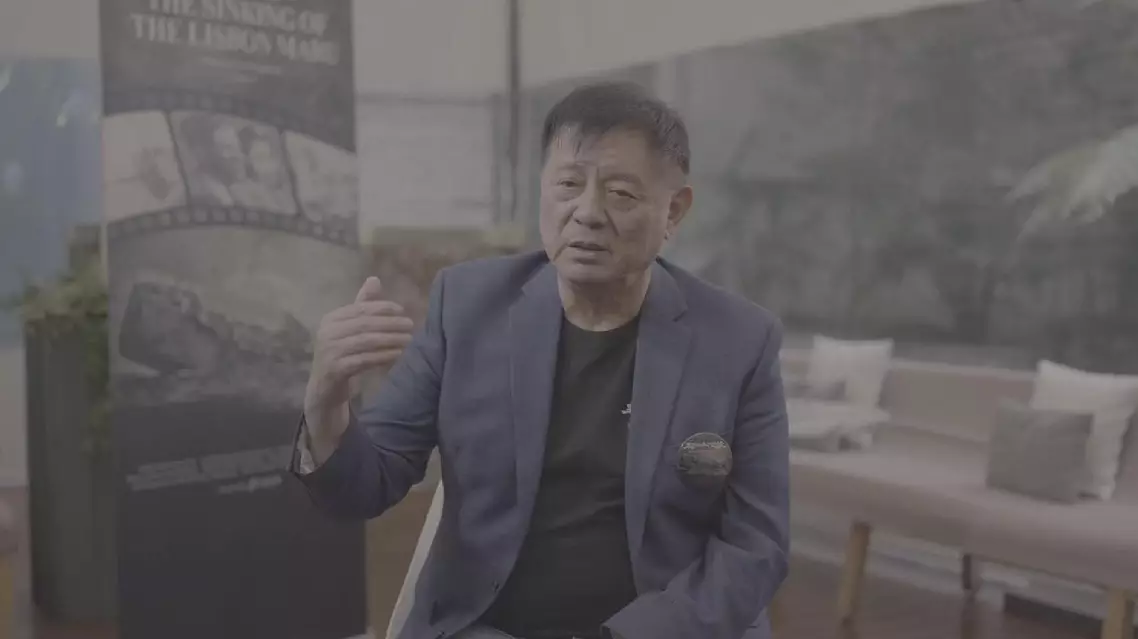
Lisbon Maru documentary maker highlights individual sufferings during war