EDITORS/NEWS DIRECTORS:
President Donald Trump plans to sign an executive order Thursday calling for the U.S. Education Department to be shut down. The White House says the order will direct Secretary Linda McMahon to facilitate the process, returning education decision-making to the states while preserving the 46-year-old agency's key services.
The move would follow an action earlier in March to lay off half the Education Department's staff, part of a dramatic downsizing directed by Trump as he moves to reduce the footprint of the federal government.
The agency's abolishment has long been a priority of some Republicans and a campaign promise of Trump, who's accused it of bureaucratic bloat and federal overreach. The process, however, will face legal and legislative hurdles: Much of the department’s work, and its very existence, comes from congressional action that would require further legislation to undo. Lawsuits are also expected.
Still, the implications for schools and universities — and especially the vulnerable students they serve — could be significant. Despite assurances that core services will remain, many are worried about the prospect of cuts or changes to vital funding sources like Title I, the largest source of federal money to America’s K-12 campuses. Families are also concerned about their rights including those protected by the Individuals With Disabilities Education Act, which supports students with special needs. Initiatives that enable the department to promote equal access for students — one of its founding missions — could be eroded. As part of the latest layoffs affecting 1,300 staff, the department — once comprising a workforce of roughly 4,200 people — has already seen major changes to programs such as those run through its Office for Civil Rights. Other cuts were already underway, including to an agency arm that tracks students’ academic progress.
Below are some background information, tips and resources to help you cover the local impacts of this news.
READ AP’S COVERAGE AND RELATED ‘LOCALIZE IT’ GUIDES
STORIES
— Education Department cuts half its staff as Trump vows to wind the agency down
— The Education Department was created to ensure equal access. Who would do that in its absence?
— Trump wants to dismantle the Education Department. Here’s what it does
— Education Department staff cuts could limit options for families of kids with disabilities
— Education Department layoffs gut its civil rights office, leaving discrimination cases in limbo
LOCALIZE IT GUIDES
Check these out for local data points and publishable lines for various states/districts that reporters can plug into their stories.
— LOCALIZE IT: Schools in GOP-led states rely more heavily on federal education funding (view it in a Google Doc here )
— LOCALIZE IT: Trump’s DEI deadline for schools is looming. How could they lose federal money? (Google Doc here )
— LOCALIZE IT: A freeze in US disability rights investigations stalled progress for students (Google Doc here )
WHAT THE DEPARTMENT DOES
Eliminating the department altogether would be a cumbersome task, likely requiring an act of Congress.
The Education Department’s main role is financial: It distributes billions in federal funds each year to schools and colleges and manages the federal student loan portfolio. The department also regulates services for vulnerable students and oversees civil rights enforcement. If the department were closed, these duties would likely be redistributed to other agencies.
Here’s an overview of the department’s key functions historically, and how Trump has said he would change things:
— Student loans and financial aid: It manages approximately $1.6 trillion in student loan debt for over 40 million borrowers. It also oversees the Pell Grant, which provides aid to students below a certain income threshold, and administers the Free Application for Federal Student Aid (FAFSA), which universities use to allocate financial aid. Trump’s plan for student debt is uncertain — he has not detailed his intentions — though in recent weeks applications for certain repayment plans have been taken down, and for hours earlier this month the main federal student loan website experienced an outage.
— Civil rights enforcement: The department investigates and issues civil rights guidance through its Office for Civil Rights. The guidance deals with issues involving students of color, students with disabilities and LGBTQ+ students, among others. Trump has suggested a different interpretation of the office’s civil rights role: targeting antisemitism and transgender athletes while undoing diversity, equity and inclusion policies.
— College accreditation: The department reviews federally recognized accrediting agencies, which effectively determine which colleges and universities can receive federal financial aid funding. Trump said during his campaign he would fire “radical left accreditors” and welcome new accrediting agencies that, for example, defend “the American tradition” and remove “Marxist” diversity administrators.
— School funding: Much of the department’s money for K-12 education goes through large programs such as Title I for low-income schools and the Individuals with Disabilities Education Act. Those programs support special-needs services, smaller class sizes and pay for non-teaching staff like social workers. During his campaign, Trump called for shifting those functions to the states. He has not offered details on how the agency’s core functions of sending federal money to local districts and schools would be handled.
— Equity: While a more abstract part of its mission, the Education Department has served to level the outcomes for students despite local education systems' inherent inequities. It does this through some of the functions mentioned above, like grant money and enforcement authorities, and by acting as a signpost for the kinds of programs and policies that should be prioritized. Trump has said he wants to return control to states, though he's also tried to expand some of the federal government's education responsibilities — specifically by undoing certain equity initiatives and doubling down on complaints involving antisemistism and trans rights.
You can also review this primer from the Congressional Research Service on the Education Department's functions.
WHY TRUMP WANTS THE DEPARTMENT GONE
Republicans have long flirted with the idea of closing the Education Department, saying it’s a waste of taxpayer money and amounts to federal government overreach. More recently, conservative parents have latched onto the concept as part of efforts to gain more control over their kids’ schooling.
On the campaign trail, Trump promised to close the department and send education “back to the states, where it belongs.” The president has argued the agency comprises “radicals, zealots and Marxists.”
The department’s closure was a key tenet of the Heritage Foundation’s Project 2025 blueprint, which Trump has largely disavowed despite parallels with his own platform. (That plan proposed moving Title I and special education to the Department of Human Services and making them no-strings block grant programs. The Office for Civil Rights would move to the Justice Department.)
IMPORTANT CAVEATS
There will surely be anxiety and speculation about what a department shutdown means. Keep these pointers in mind:
— Just because Trump has ordered the department to go away, fully abolishing it requires Congressional action. The effort is politically controversial even among conservatives. The House in 2023 considered an amendment to close the agency, but 60 Republicans joined Democrats in opposing it.
— Even if the department is gutted, that doesn’t mean core programs such as Title I are being axed. It could just be that they’re reorganized or relocated. McMahon told lawmakers at her confirmation hearing she intends not to defund core programs, but rather to make them more efficient, and some conservatives have pushed to provide federal funding to states in the form of “block grants” they can use at their discretion. On the flip side, the block-granting approach has raised questions about the impact on rural schools and whether states would be held accountable for distributing the money fairly.
— Federal funding makes up a relatively small portion of public school budgets — roughly 13%. (See our below resource to find how much federal education money your state receives.) Colleges and universities are more reliant on it, through research grants and federal financial aid for students.
— States and local districts set most education priorities for their schools, including curriculum. It's important to clarify what's already under states' and/or districts' control versus what depends on federal oversight.
— Even as Trump moves to dismantle the department, he has leaned on it to promote elements of his agenda. Monitor how those efforts play out, especially if and when the department apparatuses for enabling them are hampered.
RELEVANT DATA RESOURCES
— In a recent Localize It, AP outlined how much states and certain local school systems depend on the federal government to keep their public schools running. AP cleaned up federal data and created a spreadsheet showing the percentage of education funding from the federal government for each state and 100 large school districts, for 2018-19, 2021-22 and 2022-23.
Here's a publishable line on a key takeaway: Red- or red-leaning states are likely to see the greatest impact. Mississippi, South Dakota, Montana, Alaska, Arkansas and North Carolina all got over 20% of their K-12 budget from federal sources in 2021-22, the highest of any state, according to the Census Bureau.
See the Localize It for detailed guidance on using more granular data related to education funding.
— In another guide, we looked at what’s at stake if the Trump administration were to overhaul the Office for Civil Rights, whose primary role historically has been to enforce protections for students with disabilities. The AP compiled a list of all cases resolved by the Office of Civil Rights by state since 2014. Use this spreadsheet to find how many cases investigating disability and other types of discrimination occurred in your state each year, and go here to see a list of open investigations (this data hasn’t been updated since Trump took office). The number of students with disabilities covered under IDEA — by state, age, disability, race and educational environment — can be found here.
QUESTIONS TO ASK
— What federal programs have been cut so far in your district or state (e.g., staff recruitment initiatives, special opportunities for students of color, certain exams, etc.)? Ask your district or state what other programs could be at further risk with the department's shutdown.
— How are students, parents and educators responding to and navigating the news? What are they most concerned about?
— What types of students could be most affected? How could this affect their outcomes?
— What civil rights complaints in your locale could be affected by department changes?
— What would happen to local college students if federal loans or grants were disrupted?
— What about homeless students? The McKinney-Vento program, which works to ensure these kids enroll in school and have educational stability, accounts for a key chunk of the federal funding districts receive.
— States and districts already make many if not most education policy decisions. So what specific authorities or responsibilities would actually change if the Education Department is dismantled? How would oversight and enforcement change?
— How will Trump's efforts to crack down on DEI, antisemitism and transgender athletes play out without the Education Department?
The Associated Press’ education coverage receives financial support from multiple private foundations. AP is solely responsible for all content. Find AP’s standards for working with philanthropies, a list of supporters and funded coverage areas at AP.org.
Localize It is a reporting resource produced by The Associated Press for its customers’ use. Questions can be directed to Katie Oyan at koyan@ap.org.
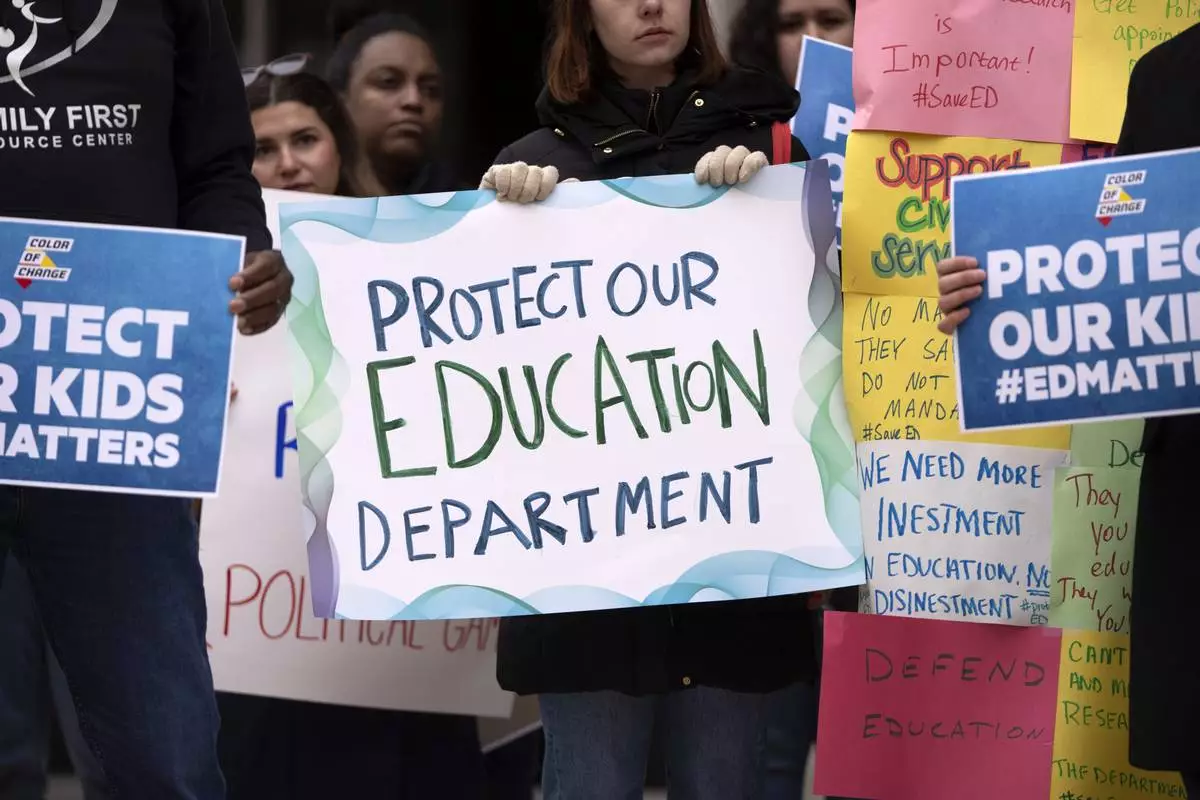
Protestors gather during a demonstration at the headquarters of the Department of Education, Friday, March 14, 2025, in Washington. (AP Photo/Mark Schiefelbein)