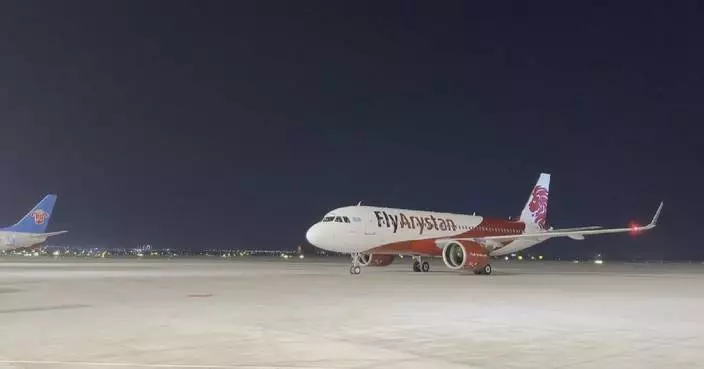
China's extended visa-free transit policy, implemented in December last year, has significantly increased inbound tourism trips, with airports and border crossings reporting substantial growth.
Since December 17, 2024, China's National Immigration Administration has extended the visa-free transit period for foreigners to 240 hours or ten days.
Three months into the new policy, airports across the country are seeing a surge in international arrivals. Guangzhou Baiyun International Airport in south China's Guangdong Province, for example, saw over 4,700 travelers utilize the extended visa-free transit policy up until March 17, a 75 percent increase compared to the previous 72/144-hour policy, with most of the visitors coming from Russia, the United States, and the United Kingdom.
"To support and promote cross-regional travel, we are innovating our transit services. We've established a multilingual volunteer service team, and our officers are available on-site to provide consultation services for international travelers," said Zhou Yi, a police officer with the Baiyun Border Inspection Station.
The policy change has been a boon for tourism services, dining, and accommodation. In January alone, Guangzhou registered 378,800 overnight stays by foreigners, generating 273 million U.S. dollars in tourism revenue.
Wuhan City, in central China's Hubei Province, has also experienced a tourism boom, particularly during its famed cherry blossom season.
Statistics from the Wuhan Immigration Inspection Station show that in the first 17 days of March, 11,600 foreign nationals entered and exited through Wuhan Tianhe International Airport, a 23.83 percent increase compared to the same period last year. The majority of these travelers came from South Korea, Malaysia, Singapore, the United States, and Japan. Of these, 4,200 individuals entered visa-free, representing a significant year-on-year increase of 158.83 percent.
Sightseeing was the primary purpose of entry for these travelers, with over 60 percent of visitors citing tourism as their reason for visiting. Popular destinations such as East Lake Cherry Blossom Park and Wuhan University have become the top choices for many foreign tourists during cherry blossom season.
"I like Wuhan very much. You can take a bike and go to all these beautiful places and learn about the culture," said an Italian tourist.
"It's a rare treat in America, but here it's beautiful to see the trees and the architecture as well. There's a nice combination of beautiful nature and a big beautiful city as well. I really do love Wuhan food. My favorite is Reganmian. I love Wuhan," said an American tourist, referring to a popular local noodle dish.
The visa-free policy has also brought economic benefits to China's land border regions. Since the implementation on February 10 of a visa-free policy for ASEAN tour groups entering Xishuangbanna Dai Autonomous Prefecture, a popular tourist destination in southwest China's Yunnan Province, the Mohan border checkpoint has processed over 156,000 entries and exits from ten ASEAN countries, a 27 percent year-on-year increase.
"This is my second time visiting Xishuangbanna. After the visa-free policy, it's cheaper and more convenient, and the experience is also very good," said Khanbian, a tourist from Laos.
Khanbian was part of a tour group that recently completed a four-day trip to Xishuangbanna and departed for home via the China-Laos Railway through the Mohan railway port.
"We have Chinese-Lao-English trilingual guides on-site, and have dynamically adjusted inspection channels and strengthened coordination with public security, culture and tourism departments, and travel agencies. We are also working to improve pre-inspection procedures and real-time communication of border traffic to enhance passenger experience and efficiency," said Cao Shuting, a police officer at the Mohan Border Inspection Station.
Xishuangbanna plans to further boost tourism by integrating hotel resources, launching a convenient booking platform for ASEAN tourists, and fostering partnerships with tourism departments and businesses in ASEAN countries.
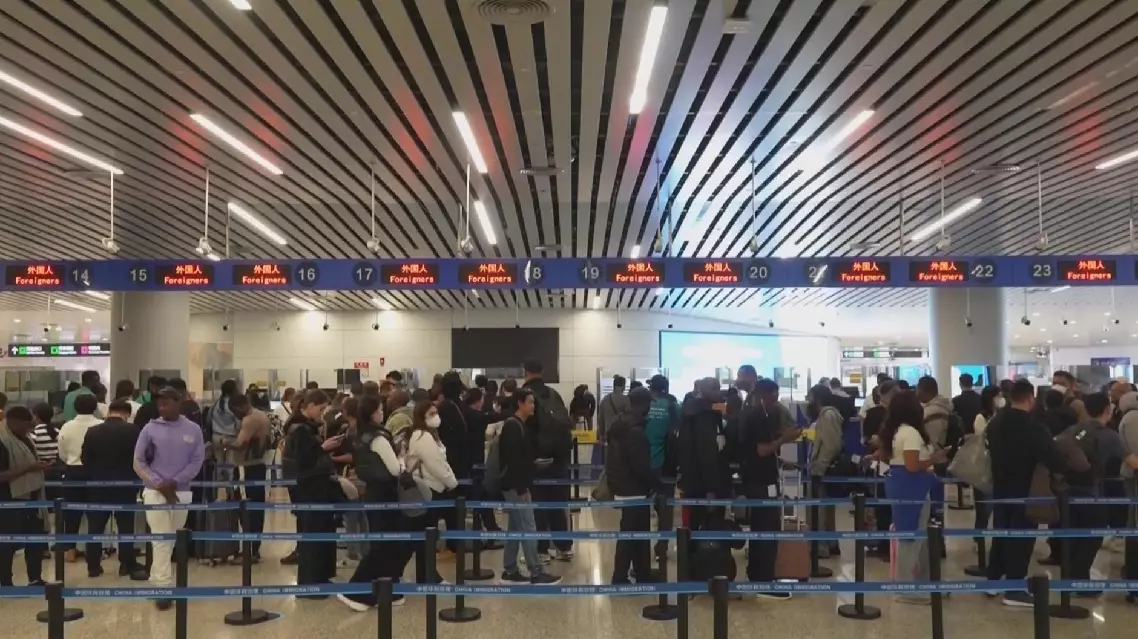
China's visa-free transit policy boosts inbound tourism