A modern flower industrial park in the city of Lijiang, southwest China's Yunnan Province, has set higher goals in developing modern industry following Chinese President Xi Jinping's visit on Wednesday.
The Lijiang Modern Flower Industrial Park, located in Lijiang's Gucheng District, sits at an altitude of approximately 2,300 meters, covering an area of about 1,100 mu (about 73.3 hectares).
It serves as a key hub for China's flower industry, cultivating 48 varieties of fresh-cut roses, with an annual output of 39.56 million stems.
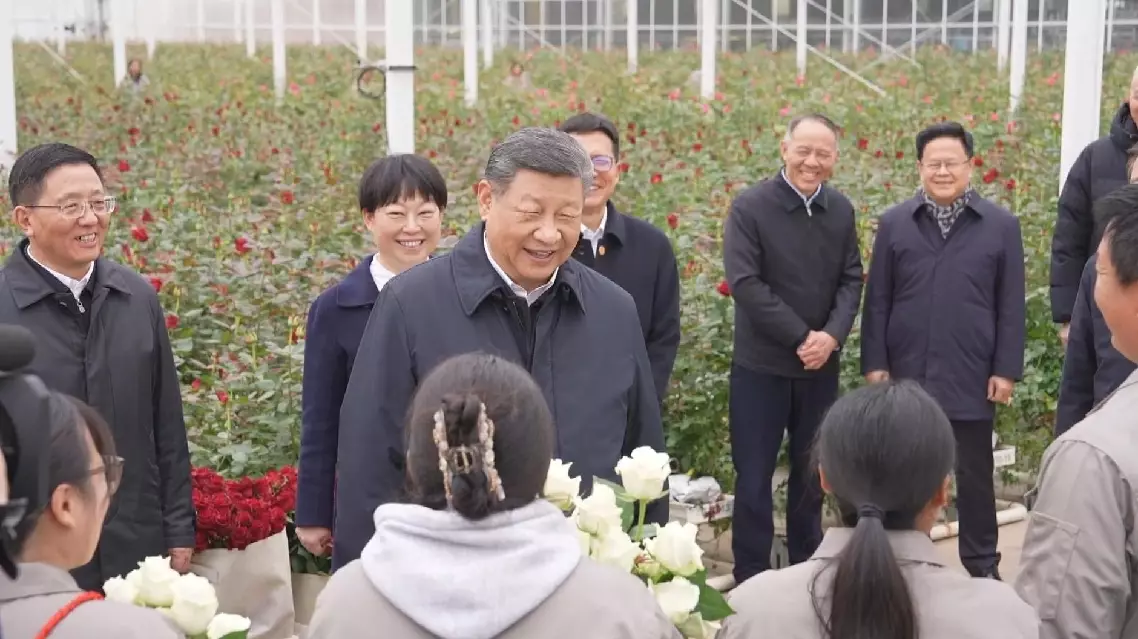
During the visit, Xi, also general secretary of the Communist Party of China Central Committee and chairman of the Central Military Commission, talked with the villagers and technicians working at the flower industrial park, learning about flower varieties, market sales and their incomes.
"President Xi walked up to me just as I was packaging fresh flowers, and he kindly talked to me about how to pack the flowers," said He Liqiong, a flower packer.
"He smiled warmly and seemed like a caring parent. I feel very warm," said Xiong Limei, a plant protection worker.
In the park, Xi also underscored the broad prospects of Yunnan's flower industry, emphasizing a comprehensive approach on the industry chain, focusing on seed production, cultivation, and market development, to transform this "beauty industry" into one that benefits the people.
"President Xi is well-versed in agriculture, showing care for the flowers and the distinctive agriculture unique to plateau areas in Yunnan Province," said Yang Jia, a technician.
"We have some self-crossbred, self-bred varieties. With Lijiang's exceptional sunlight exposure of nearly 2,500 hours annually, the flowers feature longer stems, larger heads and fuller blooms compared to others. The vase life of the flowers is longer than that of others, basically reaching 17 to 25 days, and it will be even longer in winter," said Zhang Lihui, the industry planning manager of the park.
In addition to roses, the park also produces 18 varieties of colored calla lilies, with an annual output of 900,000 stems, accounting for 90 percent of the national market, making the park the country's largest greenhouse-cultivated colored calla lily production site.
To better cultivate the flower crops, the park utilizes advanced agricultural techniques, including smart greenhouses and soil-less cultivation methods.
"With high altitude and significant temperature differences between day and night, Lijiang is very suitable for the production of bulbous flowers. This makes the quality of colored calla lilies produced here among the best. The entire park is equipped with an automated control system that creates an environment most conducive to the growth of our flowers. As you can see, the setup includes a layer of thermal insulation netting and a layer of shading netting, which automatically adjusts the temperature based on the sunlight received," said Yang.
Beyond flower cultivation, the flower industrial park also engages in cold-chain logistics, leisure tourism and multi-channel sales expanding into value-added sectors, such as producing rose essential oils, floral fragrances and edible flower products.
With its products reaching major cities like Beijing, Shanghai and Guangzhou, as well as international markets in Japan, Vietnam and Russia, the park has become a significant driver of local economic growth. It has also contributed to the country's rural development by creating jobs for over 300 people living in the surrounding areas.
"I have such a job right at my doorstep, and I am very satisfied with it because there has been a significant increase in income," said He Yuehua, a field manager in the park.
"Working here offers me more flexible hours. I can drop off and pick up my kid from school and take care of my family at home," said He Guozhen, a flower packer.
The managers and technicians said they were greatly encouraged by Xi's visit and pledged efforts to improve cultivation technologies for the industry.
"I think President Xi's visit to Lijiang Modern Flower Industrial Park is an encouragement to us. In the next step, we will improve flower varieties, extend the industry chain, offer more job opportunities for local residents and increase their incomes," said Zhang.
"President Xi said he hopes our lives will become more beautiful like the flowers. Following his advice, we will continue to improve the flower industry in Yunnan," said Yang.
Yunnan's flower industry aims for better future following Xi's visit