SUN VALLEY, Idaho (AP) — While his downhill rivals finish the World Cup season, Aleksander Aamodt Kilde is back in Innsbruck, Austria, with his left arm in a sling and limited to 30-minute walks.
It’s all the fresh air the injured Norwegian ski racing standout can manage as he finishes up a round of antibiotics to fight off potential infection in his shoulder. It’s pretty much all the walking his left hamstring can endure after doctors took a piece of the muscle so they could transplant it into his shoulder.
Kilde, who hasn’t competed since his ski crash on Jan. 13, 2024, is hoping to be back in the starting gate next season. Maybe not at the beginning but optimistically leading into the 2026 Milan-Cortina Olympics.
It’s just weeks like this that are challenging for him — his friends, competitors and his fiancee, Mikaela Shiffrin, have assembled in Sun Valley for the World Cup finals while he’s at home, recovering.
“It’s something that I really miss right now, being so far away,” Kilde said in a recent video interview with The Associated Press. “I’ve been around (the World Cup races) a little bit this winter, but it’s been so different because when you feel like your body is not capable of doing what you’re used to doing, it seems so far away."
Fourteen months ago, the 32-year-old Kilde crashed near the finish line in a downhill race in Wengen, Switzerland. He had surgery for a severe cut and nerve damage in his right calf, along with two torn ligaments in his shoulder.
Back on skis over the summer, Kilde suffered a setback because of an infection in his shoulder and announced that he wouldn’t compete this season. He said at the time he needed another surgery to attach two of the muscles in his shoulder.
About four weeks ago, a team of three doctors performed what Kilde described as a “very, very complicated surgery.”
To fix his shoulder, Kilde said, doctors needed a strand of his hamstring muscle. So he built up the hamstring in the gym, just to make sure it was nice and strong for his shoulder. The surgeons also took a graft from his lower trapezius muscle and attached them all together.
He’s been in a sling since the surgery with about two more weeks to go. He’s also on antibiotics — four pills, two times a day — to prevent infection.
“At the moment, I actually don’t know how it works,” Kilde said of his shoulder. “The only thing I know is that it’s not painful. It’s smaller than (the other shoulder) but it’s at least in the right position. So that’s a great feeling.
"I have a good gut feel of this being the right thing now. Just crossing the fingers for not any infection or anything to come back. But it looks promising.”
His mom has been in town to help with meals and keep him company.
“I’m good,” said Kilde, who moved to Innsbruck about five years ago. “With the hamstring, it’s very hard to walk uphill. But I’ve been walking outside and getting some fresh air. The sun is shining these days, and it’s kind of springtime here, so it’s nice to be able to be outside and enjoy the sun as much as I can.”
Shiffrin, of course, has been a huge emotional help — and he to her. Shiffrin was sidelined earlier this season after suffering a puncture wound when she fell in a giant slalom race.
They’ve leaned on each other for support.
“A lot of challenges, a lot of pain for both of us," Kilde said. "It’s nice to just have someone to talk to that really knows exactly what to talk about.”
Set a wedding date yet?
“We haven’t,” Kilde said with a laugh. “We will find a date.”
Kilde is a popular figure on the circuit, the charismatic ski racer who is always among the favorites in a downhill or super-G race. He has had many competitors, friends and fans reach out to him to offer support.
It’s meant the world.
“Every time I meet people and they say, ‘You need to fight back, because we need you back in the sport,’ it's just amazing," said Kilde, a two-time Olympic medalist and 2019-20 overall World Cup champion.
While he recovered from his injuries, Kilde enrolled in a real estate program through the London School of Economics. He recently has paused his learning, though, to give returning to health his full attention.
“I’ve used the time wisely, but I’ve also tried to just stay calm and easy and not stress about the situation I’m in,” Kilde said. “It’s been four weeks since my last operation, and honestly, it feels like yesterday.”
He's setting his sights on being ready for next season, but his ultimate goal is to be back for the Olympics. At the 2022 Beijing Games, Kilde won silver in the Alpine combined and bronze in the super-G.
“It’s very good motivation for me to say to myself, ‘This is what I’m going to be 100% ready for,'" Kilde said. "But honestly, I’m going to continue skiing for some more years. So just to be back is my biggest goal — and to be able to be competitive again.”
AP skiing: https://apnews.com/hub/alpine-skiing
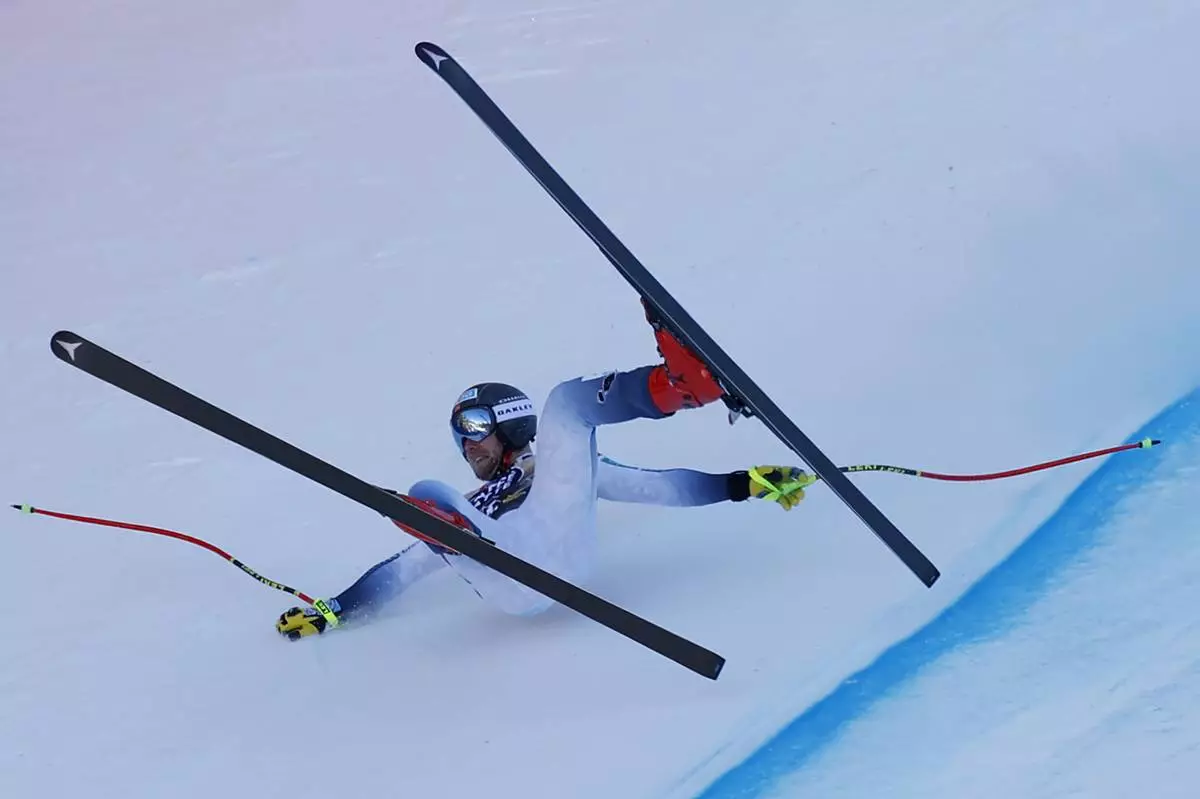
FILE - Norway's Aleksander Aamodt Kilde falls during an alpine ski, men's World Cup downhill race, in Wengen, Switzerland, Saturday, Jan. 13, 2024. (AP Photo/Alessandro Trovati, file)

FILE - Norway's Aleksander Aamodt Kilde attends an alpine ski, women's World Cup giant slalom, in Soelden, Austria, Saturday, Oct. 26, 2024. (AP Photo/Marco Trovati, file)
RHO, Italy (AP) — No ice is colder and harder than speedskating ice. The precision it takes has meant that Olympic speedskaters have never competed for gold on a temporary indoor rink – until the 2026 Milan Cortina Winter Games.
In the pursuit of maximum glide and minimum friction, Olympic officials brought on ice master Mark Messer, a veteran of six previous Olympic speedskating tracks and the ice technician in charge of the Olympic Oval in Calgary, Canada — one of the fastest tracks in the world with over 300 records.
Messer has been putting that experience to work one thin layer of ice at a time since the end of October at the new Speed Skating Stadium, built inside adjacent trade fair halls in the city of Rho just north of Milan.
“It’s one of the biggest challenges I’ve had in icemaking,’’ Messer said during an interview less than two weeks into the process.
If Goldilocks were a speedskater, hockey ice would be medium hard, for fast puck movement and sharp turns. Figure skating ice would be softer, allowing push off for jumps and so the ice doesn’t shatter on landing. Curling ice is the softest and warmest of all, for controlled sliding.
For speedskating ice to be just right, it must be hard, cold and clean. And very, very smooth.
“The blades are so sharp, that if there is some dirt, the blade will lose the edge,’’ Messer said, and the skater will lose speed.
Speedskater Enrico Fabris, who won two Olympic golds in Turin in 2006, has traded in his skates to be deputy sports manager at the speedskating venue in Rho. For him, perfect ice means the conditions are the same for all skaters — and then if it's fast ice, so much the better.
"It's more of a pleasure to skate on this ice,'' he said.
Messer’s first Olympics were in Calgary in 1988 — the first time speedskating was held indoors. “That gave us some advantages because we didn’t have to worry about the weather, wind blowing or rain,’’ he said. Now he is upping the challenge by becoming the first ice master to build a temporary rink for the Olympics.
Before Messer arrived in Italy, workers spent weeks setting up insulation to level the floor and then a network of pipes and rubber tubes that carry glycol — an antifreeze — that is brought down to minus 7 or minus 8 degrees Celsius (17.6 to 19.4 degrees Fahrenheit) to make the ice.
Water is run through a purification system — but it can’t be too pure, or the ice that forms will be too brittle. Just the right amount of impurities “holds the ice together,’’ Messer said.
The first layers of water are applied slowly, with a spray nozzle; after the ice reaches a few centimeters it is painted white — a full day’s work — and the stripes are added to make lanes.
“The first one takes about 45 minutes. And then as soon as it freezes, we go back and do it again, and again and again. So we do it hundreds of times,’’ Messer said.
As the ice gets thicker, and is more stable, workers apply subsequent layers of water with hoses. Messer attaches his hose to hockey sticks for easier spreading.
What must absolutely be avoided is dirt, dust or frost — all of which can cause friction for the skaters, slowing them down. The goal is that when the skaters push “they can go as far as possible with the least amount of effort,’’ Messer said.
The Zamboni ice resurfacing machine plays a key role in keeping the track clean, cutting off a layer and spraying water to make a new surface.
One challenge is gauging how quickly the water from the resurfacing machine freezes in the temporary rink.
Another is getting the ice to the right thickness so that the Zamboni, weighing in at six tons, doesn’t shift the insulation, rubber tubing or ice itself.
“When you drive that out, if there’s anything moving it will move. We don’t want that,’’ Messer said.
The rink got its first big test on Nov. 29-30 during a Junior World Cup event. In a permanent rink, test events are usually held a year before the Olympics, leaving more time for adjustments. “We have a very small window to learn,’’ Messer acknowledged.
Dutch speedskater Kayo Vos, who won the men’s neo-senior 1,000 meters, said the ice was a little soft — but Messer didn’t seem too concerned.
“We went very modest to start, now we can start to change the temperatures and try to make it faster and still maintain it as a safe ice,’’ he said.
Fine-tuning the air temperature and humidity and ice temperature must be done methodically — taking into account that there will be 6,000 spectators in the venue for each event. The next real test will be on Jan. 31, when the Olympians take to the ice for their first training session.
“Eighty percent of the work is done but the hardest part is the last 20 percent, where we have to try to find the values and the way of running the equipment so all the skaters get the same conditions and all the skaters get the best conditions,’’ Messer said.
AP Winter Olympics: https://apnews.com/hub/milan-cortina-2026-winter-olympics

Serpentines are set on the ice of the stadium where speed skating discipline of the Milan Cortina 2026 Winter Olympics will take place, in Rho, outskirt of Milan, Tuesday, Nov. 11, 2025. (AP Photo/Luca Bruno)

Ice Master Mark Messer poses in the stadium where speed skating discipline of the Milan Cortina 2026 Winter Olympics will take place, in Rho, outskirt of Milan, Tuesday, Nov. 11, 2025. (AP Photo/Luca Bruno)
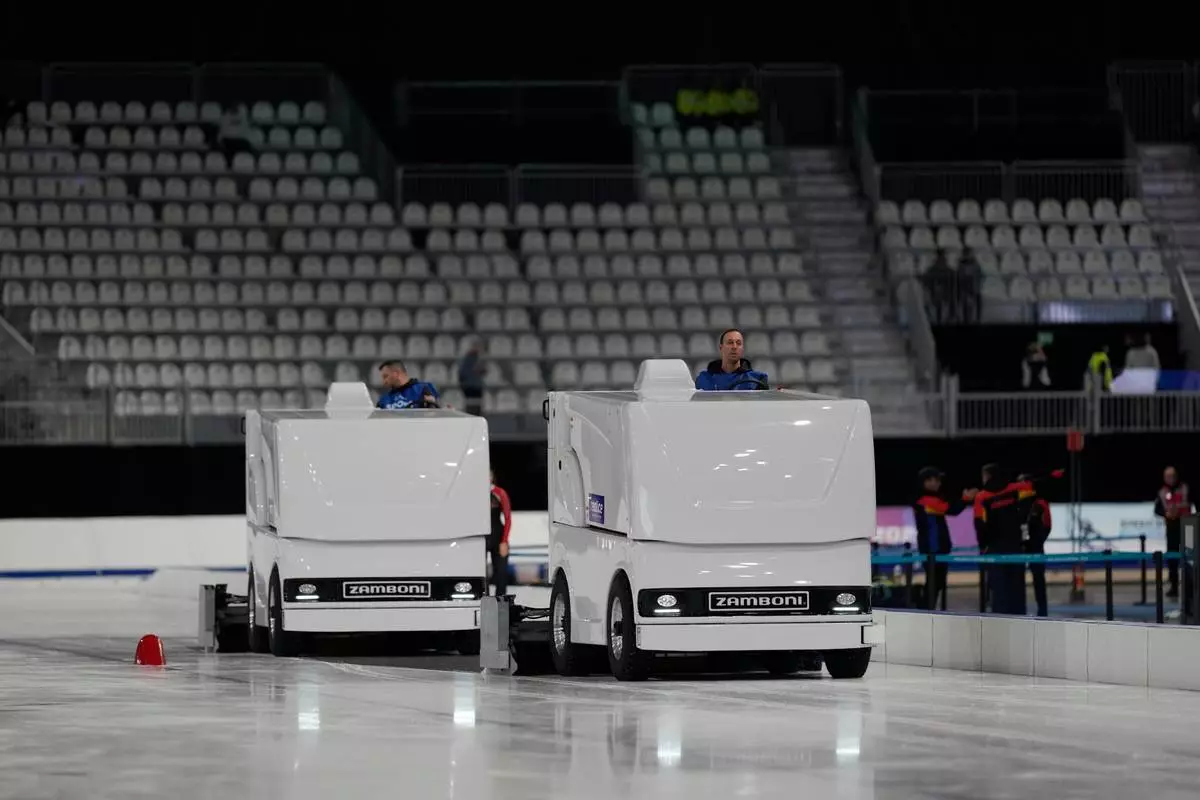
Workers clean the ice surface during a peed skating Junior World Cup and Olympic test event, in Rho, near Milan, Italy, Saturday, Nov. 29, 2025. (AP Photo/Luca Bruno)

Ice Master Mark Messer poses in the stadium where speed skating discipline of the Milan Cortina 2026 Winter Olympics will take place, in Rho, outskirt of Milan, Tuesday, Nov. 11, 2025. (AP Photo/Luca Bruno)

Ice Master Mark Messer poses in the stadium where speed skating discipline of the Milan Cortina 2026 Winter Olympics will take place, in Rho, outskirt of Milan, Tuesday, Nov. 11, 2025. (AP Photo/Luca Bruno)