Chinese Foreign Minister Wang Yi and his Japanese counterpart Takeshi Iwaya on Saturday co-chaired the sixth China-Japan High-Level Economic Dialogue in Tokyo.
Wang, also a member of the Political Bureau of the Communist Party of China Central Committee, said at the meeting that since the normalization of diplomatic relations between China and Japan, bilateral trade has increased more than 300 times and has remained at a high level of 300 billion U.S. dollars for 15 consecutive years, with the accumulative bilateral investment reaching nearly 140 billion U.S. dollars.
The economic outcomes proved that China and Japan are partners, not rivals, Wang stressed.
Amid profound adjustments in the global economic landscape, rising unilateral protectionism, and setbacks to economic globalization, China and Japan, as major world economies, should establish a correct understanding of each other, demonstrate responsibilities, seek development with innovative thinking, add momentum to cooperation and mutual benefit, and reduce obstacles and differences, Wang said.
He called for efforts on four key areas of cooperation, including accelerating the transformation and upgrading of economic and trade cooperation, achieving strong partnerships for mutual success, addressing each other's concerns in a balanced manner, and strengthening regional and multilateral cooperation.
The two countries should uphold the tradition of promoting political relations through economic cooperation, expand dialogue and exchanges across all sectors to cultivate new growth drivers, Wang said.
Enterprises from both countries should be encouraged to collaborate in artificial intelligence, the digital economy, energy conservation, environmental protection, and green trade.
Cooperation in medical and elderly care industries will be further strengthened to foster the "silver economy."
The two countries should expand third-market cooperation to benefit the Global South, support each other in the successful hosting of the Osaka Expo and the China International Import Expo, while promoting regional cooperation, Wang said.
With a forward-looking approach, China and Japan should leverage the China-Japan economic partnership consultation mechanism to enhance government-business communication, expand market access and eliminate discriminatory restrictions.
The two sides will work to avoid the politicization of economic security in order to maintain stable and smooth industrial and supply chains.
Upholding Asian values, the two countries should advocate openness over isolation, and promote inclusiveness over exclusiveness, Wang noted.
Negotiations for the China-Japan-Republic of Korea Free Trade Agreement should be resumed and the process of establishing an Asia-Pacific Free Trade Area should be advanced, according to Wang.
In conclusion, Wang said that the dialogue enhanced mutual understanding and confidence in cooperation.
At a time when unilateral protectionism is rampant, the dialogue has sent a strong signal in support of a free trade system, adherence to international trade rules, and alignment with economic globalization.
Both sides should further expand their horizons and explore new areas of cooperation to continuously enrich the China-Japan strategic relationship of mutual benefit, Wang said.
Officials from 15 government departments of both countries attended the meeting.
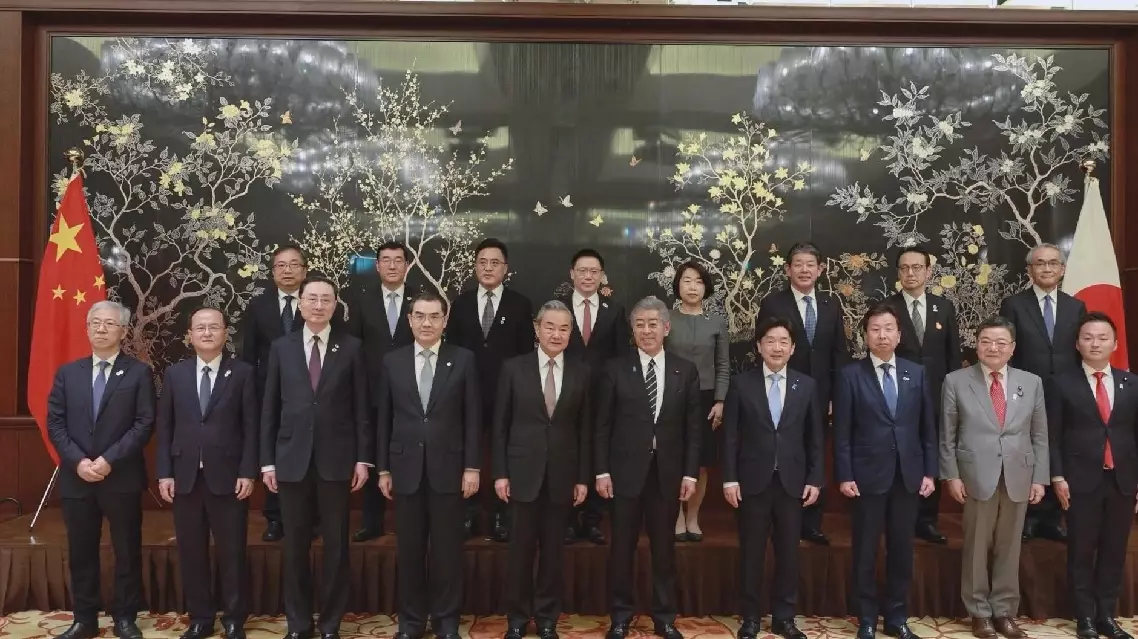
China, Japan hold sixth high-level economic dialogue