MILWAUKEE (AP) — Illinois coach Brad Underwood has looked all over the map for players.
The result has Illinois one win away from advancing beyond the NCAA Tournament’s opening weekend for a second straight year. The sixth-seeded Fighting Illini (22-12) face No. 3 seed Kentucky (23-11) on Sunday for a spot in the Midwest Region semifinals.
Illinois has gotten this far with a lineup featuring players from four countries. The Illini’s three leading scorers are all from outside the United States.
“Truthfully the basketball world is a pretty small network of people,” Underwood said. “And it’s not that big.”
Kasparas Jakucionis, a potential NBA lottery pick, is originally from Lithuania but had spent the last three years in Barcelona before coming to Illinois. Tomislav Ivisic, a 7-foot-1 center, is from Croatia. Will Riley grew up in Canada.
Underwood said he was quite familiar with Illinois’ two European additions well before he started recruiting them. Illinois needed to rebuild its roster because reserve guard Dra Gibbs-Lawhorn is its only available player who saw any game action during the Illini's NCAA Tournament run to a regional final last year.
“We’ve known about Kasparas for a couple of years,” Underwood said. “Even though he’s from Lithuania, he’s been in Barcelona and played on a big stage for a long time. And everybody knew about Tommy and his brother, the 7-1 twins.”
Ivisic is the twin brother of Zvonimir Ivisic, who plays for Arkansas and already is in the Sweet 16. He’s coming off a 20-point, 10-rebound performance in an 86-73 first-round victory over Xavier and is averaging 12.8 points and 7.7 boards this season.
Illinois’ most notable offseason addition was Jakucionis, a 6-6 guard who has a team-high 15 points per game.
“I got some offers from basically everywhere in the world – Australia, Europe and colleges,” Jakucionis said. “When I decided to go to college, I watched how their playing style is, how their coaching staff is, and I thought there’s very nice people working here. I saw their trust in me, and I felt like I could trust in them. I saw that it’s a winning program, they’re practicing hard. That’s what made me decide to come here.”
Jakucionis had 16 points, 10 assists and nine rebounds against Xavier. According to StatsPerform, Jakucionis became the first freshman to have at least 15 points, 10 assists and five rebounds in an NCAA Tournament game since Kenny Anderson did it for Georgia Tech in 1990.
The two Europeans have rewarded the international recruiting efforts of Underwood, who acknowledged that the ability for players to profit off their name, image and likeness had proved beneficial in that regard.
“Every month, every six weeks, we’re somewhere in Europe, our staff,” Underwood said. “It fits our university. We have a very diverse university with a lot of international students. I love coaching them.”
Underwood sees only one disadvantage to having a roster with players from so many different countries.
“It’s been much easier, other than probably those guys cussing at me in their foreign language and I don’t know what they’re saying, which I’m sure that’s happened a good amount,” Underwood quipped after the Xavier game.
The two Europeans aren't Illinois’ only international players to shine on the March Madness stage. Riley had a team-high 22 points in the Xavier game and went 8 of 12 while displaying the shooting touch that caused Illinois to pursue him.
Illinois’ offseason moves weren’t limited to international players. The Illini also went in the portal to get Tre White from Louisville, Kylan Boswell from Arizona and Ben Humrichous from Evansville. Boswell attended high school in California and Arizona but was born in Champaign, Illinois, and lived there through eighth grade.
But it’s the international guys who arguably have made the biggest difference. They’ve adapted well to college life while living in a new country.
“It was way easier than I expected, to be honest,” Ivisic said. “Every one of my teammates (is a) great guy, and we figured things out pretty quick. Started building on our chemistry and our game plan. I felt like everything clicked from the first week, and just we kept building on that.”
Jakucionis said the process was easier for him because he already had adapted to this kind of move before.
“I moved to Barcelona when I’d just turned 15,” Jakucionis said. “That was the biggest adaptation process. Now I think I can just go anywhere, and I will adapt pretty quick.”
It hasn’t been entirely smooth sailing for Illinois.
The Illini went through multiple illnesses and injuries last month as they capped a three-game skid with an embarrassing 110-67 loss to Duke. But they’ve won five of six since, with the international guys leading the way.
“We definitely have faced a lot of adversity this year, being young and also with illness and injury,” Riley said. “We faced a lot, but we’ve picked up from that. There really hasn’t been anything we haven’t seen. Right now is the perfect time to peak, and I feel like that’s what we’re doing.”
AP March Madness bracket: https://apnews.com/hub/ncaa-mens-bracket and coverage: https://apnews.com/hub/march-madness. Get poll alerts and updates on the AP Top 25 throughout the season. Sign up here.
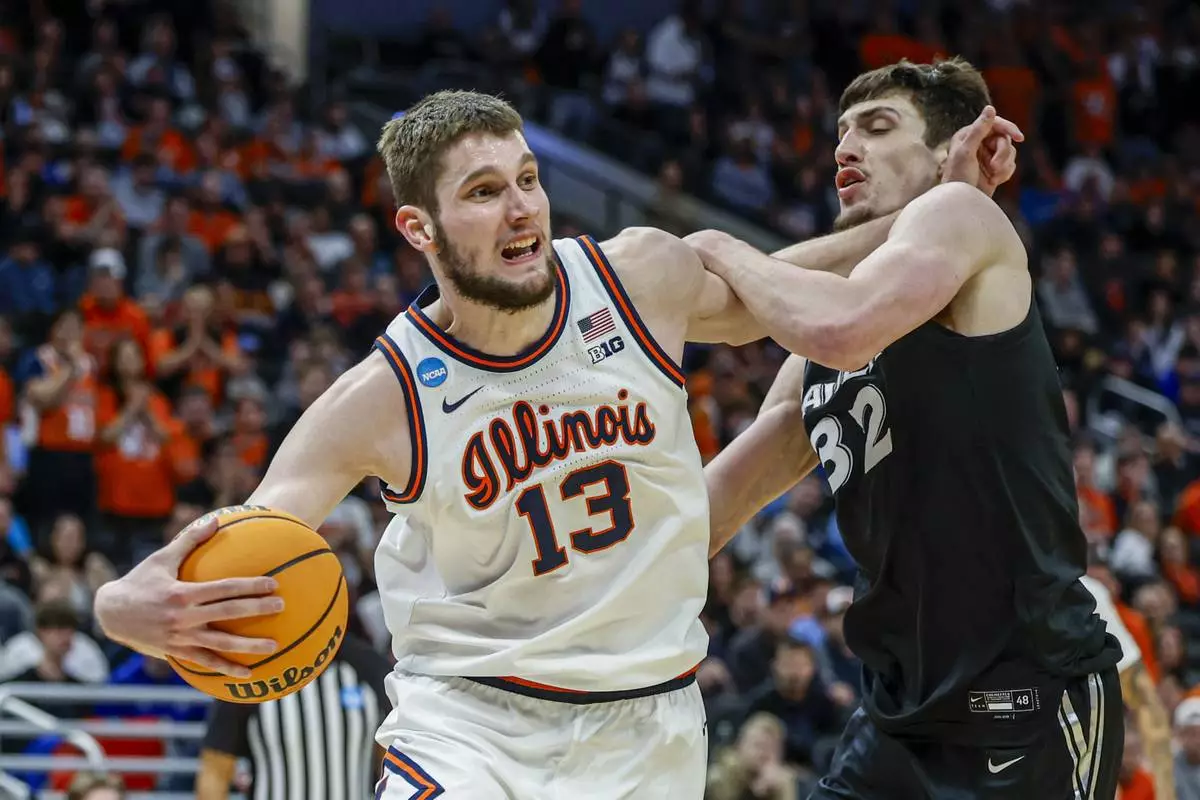
Illinois center Tomislav Ivisic (13) drives against Xavier forward Zach Freemantle (32) in the first round of the NCAA college basketball tournament Friday, March 21, 2025, in Milwaukee. (AP Photo/Jeffrey Phelps)
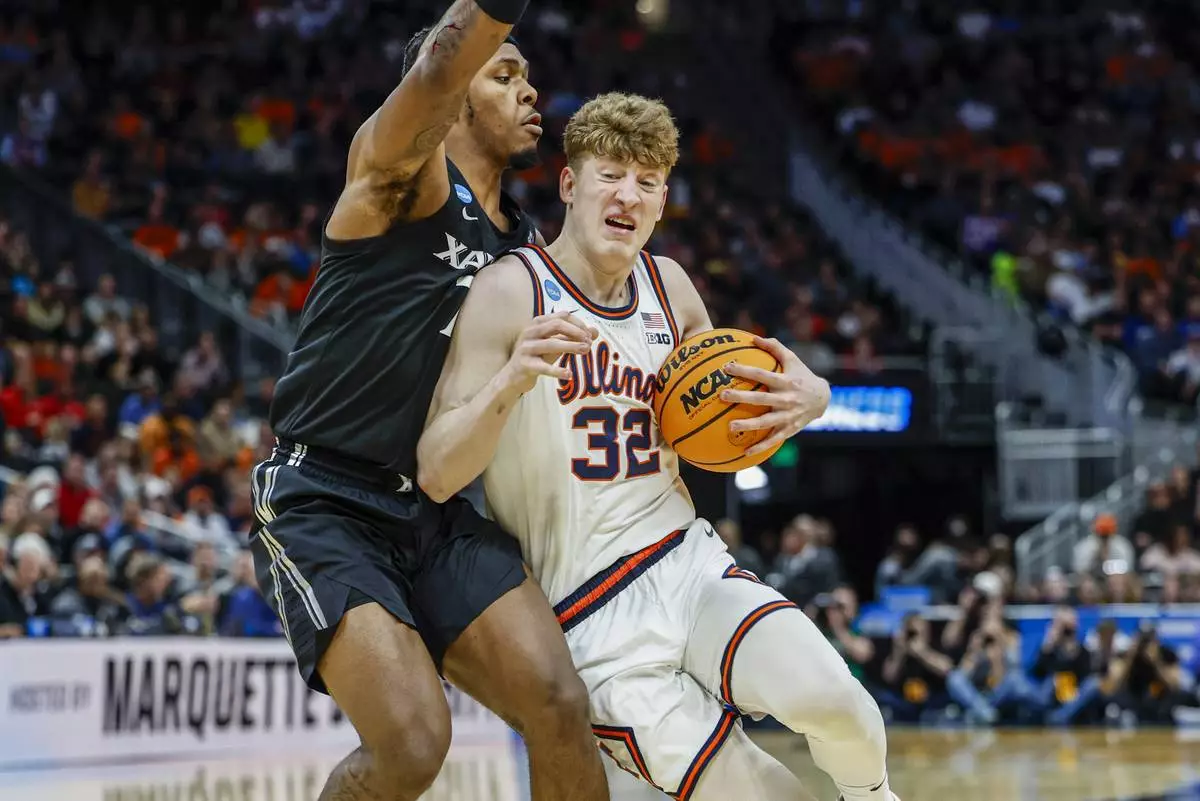
Illinois guard Kasparas Jakucionis (32) drives against Xavier in the first round of the NCAA college basketball tournament Friday, March 21, 2025, in Milwaukee. (AP Photo/Jeffrey Phelps)

Illinois guard Kasparas Jakucionis (32) reacts during a game against Xavier in the first round of the NCAA college basketball tournament Friday, March 21, 2025, in Milwaukee. (AP Photo/Jeffrey Phelps)
RHO, Italy (AP) — No ice is colder and harder than speedskating ice. The precision it takes has meant that Olympic speedskaters have never competed for gold on a temporary indoor rink – until the 2026 Milan Cortina Winter Games.
In the pursuit of maximum glide and minimum friction, Olympic officials brought on ice master Mark Messer, a veteran of six previous Olympic speedskating tracks and the ice technician in charge of the Olympic Oval in Calgary, Canada — one of the fastest tracks in the world with over 300 records.
Messer has been putting that experience to work one thin layer of ice at a time since the end of October at the new Speed Skating Stadium, built inside adjacent trade fair halls in the city of Rho just north of Milan.
“It’s one of the biggest challenges I’ve had in icemaking,’’ Messer said during an interview less than two weeks into the process.
If Goldilocks were a speedskater, hockey ice would be medium hard, for fast puck movement and sharp turns. Figure skating ice would be softer, allowing push off for jumps and so the ice doesn’t shatter on landing. Curling ice is the softest and warmest of all, for controlled sliding.
For speedskating ice to be just right, it must be hard, cold and clean. And very, very smooth.
“The blades are so sharp, that if there is some dirt, the blade will lose the edge,’’ Messer said, and the skater will lose speed.
Speedskater Enrico Fabris, who won two Olympic golds in Turin in 2006, has traded in his skates to be deputy sports manager at the speedskating venue in Rho. For him, perfect ice means the conditions are the same for all skaters — and then if it's fast ice, so much the better.
"It's more of a pleasure to skate on this ice,'' he said.
Messer’s first Olympics were in Calgary in 1988 — the first time speedskating was held indoors. “That gave us some advantages because we didn’t have to worry about the weather, wind blowing or rain,’’ he said. Now he is upping the challenge by becoming the first ice master to build a temporary rink for the Olympics.
Before Messer arrived in Italy, workers spent weeks setting up insulation to level the floor and then a network of pipes and rubber tubes that carry glycol — an antifreeze — that is brought down to minus 7 or minus 8 degrees Celsius (17.6 to 19.4 degrees Fahrenheit) to make the ice.
Water is run through a purification system — but it can’t be too pure, or the ice that forms will be too brittle. Just the right amount of impurities “holds the ice together,’’ Messer said.
The first layers of water are applied slowly, with a spray nozzle; after the ice reaches a few centimeters it is painted white — a full day’s work — and the stripes are added to make lanes.
“The first one takes about 45 minutes. And then as soon as it freezes, we go back and do it again, and again and again. So we do it hundreds of times,’’ Messer said.
As the ice gets thicker, and is more stable, workers apply subsequent layers of water with hoses. Messer attaches his hose to hockey sticks for easier spreading.
What must absolutely be avoided is dirt, dust or frost — all of which can cause friction for the skaters, slowing them down. The goal is that when the skaters push “they can go as far as possible with the least amount of effort,’’ Messer said.
The Zamboni ice resurfacing machine plays a key role in keeping the track clean, cutting off a layer and spraying water to make a new surface.
One challenge is gauging how quickly the water from the resurfacing machine freezes in the temporary rink.
Another is getting the ice to the right thickness so that the Zamboni, weighing in at six tons, doesn’t shift the insulation, rubber tubing or ice itself.
“When you drive that out, if there’s anything moving it will move. We don’t want that,’’ Messer said.
The rink got its first big test on Nov. 29-30 during a Junior World Cup event. In a permanent rink, test events are usually held a year before the Olympics, leaving more time for adjustments. “We have a very small window to learn,’’ Messer acknowledged.
Dutch speedskater Kayo Vos, who won the men’s neo-senior 1,000 meters, said the ice was a little soft — but Messer didn’t seem too concerned.
“We went very modest to start, now we can start to change the temperatures and try to make it faster and still maintain it as a safe ice,’’ he said.
Fine-tuning the air temperature and humidity and ice temperature must be done methodically — taking into account that there will be 6,000 spectators in the venue for each event. The next real test will be on Jan. 31, when the Olympians take to the ice for their first training session.
“Eighty percent of the work is done but the hardest part is the last 20 percent, where we have to try to find the values and the way of running the equipment so all the skaters get the same conditions and all the skaters get the best conditions,’’ Messer said.
AP Winter Olympics: https://apnews.com/hub/milan-cortina-2026-winter-olympics

Serpentines are set on the ice of the stadium where speed skating discipline of the Milan Cortina 2026 Winter Olympics will take place, in Rho, outskirt of Milan, Tuesday, Nov. 11, 2025. (AP Photo/Luca Bruno)

Ice Master Mark Messer poses in the stadium where speed skating discipline of the Milan Cortina 2026 Winter Olympics will take place, in Rho, outskirt of Milan, Tuesday, Nov. 11, 2025. (AP Photo/Luca Bruno)
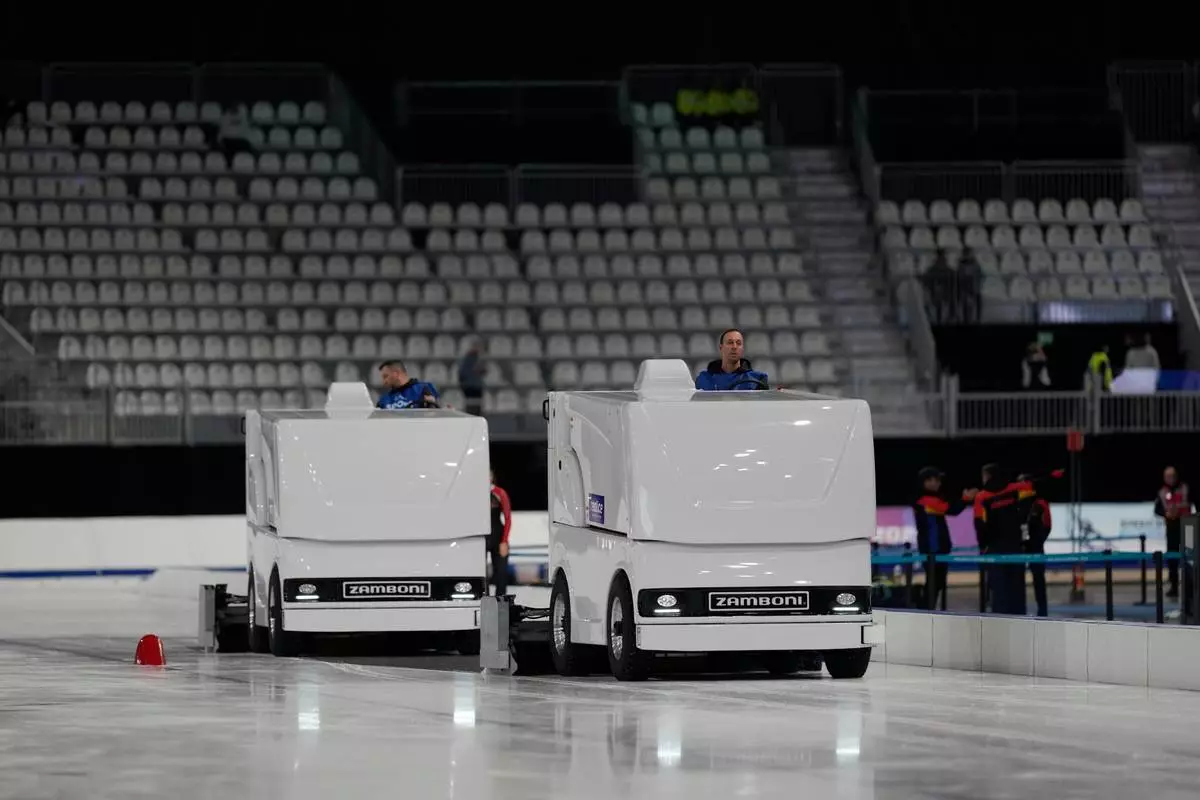
Workers clean the ice surface during a peed skating Junior World Cup and Olympic test event, in Rho, near Milan, Italy, Saturday, Nov. 29, 2025. (AP Photo/Luca Bruno)

Ice Master Mark Messer poses in the stadium where speed skating discipline of the Milan Cortina 2026 Winter Olympics will take place, in Rho, outskirt of Milan, Tuesday, Nov. 11, 2025. (AP Photo/Luca Bruno)

Ice Master Mark Messer poses in the stadium where speed skating discipline of the Milan Cortina 2026 Winter Olympics will take place, in Rho, outskirt of Milan, Tuesday, Nov. 11, 2025. (AP Photo/Luca Bruno)