China's 41st Antarctic expedition team set sail from New Zealand on Friday for the Ross Sea, embarking on a joint research mission to conduct scientific investigations of the Antarctic in autumn.
After completing resupply and crew rotation in mid-March at New Zealand's Lyttelton Harbor in Christchurch, the team aboard China's research icebreaker Xuelong 2, or Snow Dragon 2, officially launched the Ross Sea joint expedition.
This marks China's first-ever research autumn mission in the Antarctic sea, with Chinese and international scientists working together to explore the ecosystem of the deep bay off the Antarctic coast.
He Jianfeng, deputy leader and principal investigator of the 41st Antarctic Expedition, emphasized that the expedition will make a significant contribution to scientific understanding.
"A mission during this season, focusing on the entire ecosystem, is very rare internationally. Actually, we are the first ones to research on Antarctic krill, birds, and mammals in particular. We have received a wide response from international scientists. It involves the most countries participating since our expedition in the Antarctic Ocean so far," said He.
The expedition team includes 44 researchers from nine countries, namely China, the United States, the United Kingdom, Norway, Australia, New Zealand, South Korea, Malaysia, and Thailand.
They will spend about a month conducting research on the dark marine ecosystem in the Ross Sea.
"This is my first time to be here, to be on the icebreaking research vessel. I come from a very tropic [region]. So I'm very excited and very happy to learn everything here. I plan to collect microplastics from the Ross Sea. I hope I can have an international publication. My knowledge can be extended to the younger generation, to see or to tell what is happening now and let them think about their future," said a Thai researcher from Chulalongkorn University, a member of the crew.
"My job is to study phytoplankton, and because largely, phytoplankton have never been studied in the March-April time period. And so, it's unknown whether they're active. The cruise is an incredible opportunity for me and the entire science crew," said Walker Smith, a professor of Shanghai Jiaotong University and another member of the crew.
While international data on summer investigations in the Antarctic Ocean is abundant, He, the chief scientist, emphasized that there is a dire lack of data on other seasons.
Taking place during the Antarctic autumn, this expedition will focus on the "dark season" -- a period with no sunlight, scarce food, and widespread sea ice -- and aims to explore how Antarctic species like krill survive in such extreme conditions.
This mission will help fill international gaps in research and lead the study of dark ecosystems in the surrounding waters of the Antarctic, increasing China's global presence in polar scientific research.
Furthermore, researchers will test the Xuelong 2 icebreaker's performance in autumn conditions, gathering data that will help the future design and international application of China's polar research vessels.
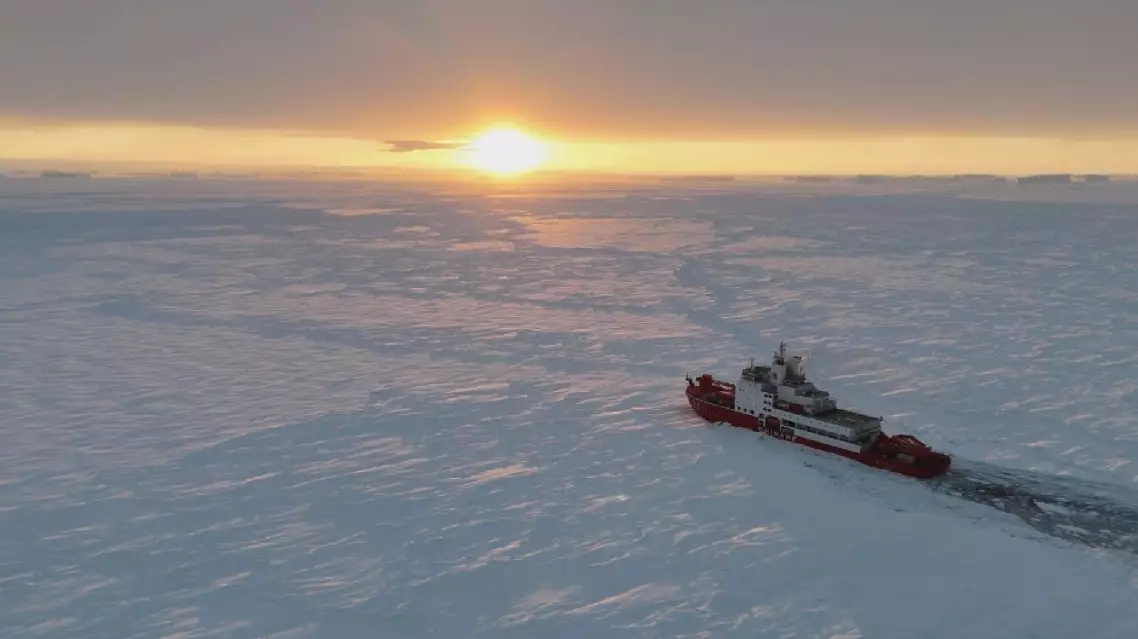
Chinese icebreaker sets sail for landmark autumn expedition in Antarctic sea