Skip to Content Facebook Feature Image

What is Signal, the chat app used by US officials to share attack plans?

News

What is Signal, the chat app used by US officials to share attack plans?
News

News

What is Signal, the chat app used by US officials to share attack plans?

2025-03-26 01:17 Last Updated At:01:21

LONDON (AP) — A magazine journalist's account of being added to a group chat of U.S. national security officials coordinating plans for airstrikes has raised questions about how highly sensitive information is supposed to be handled.

Atlantic Editor-in-Chief Jeffrey Goldberg detailed a discussion that happened over the Signal messaging app hours before strikes on Iran-backed Houthi-rebels in Yemen ordered by U.S. President Donald Trump.

The National Security Council has since said the text chain “appears to be authentic" and that it is looking into how a journalist’s number was added to the chain.

Here's a look at the app in question.

It's an app that can be used for direct messaging and group chats as well as phone and video calls.

Signal uses end-to-end encryption for its messaging and calling services that prevents any third-party from viewing conversation content or listening in on calls.

In other words, messages and calls sent on Signal are scrambled and only the sender and recipient at each end will have the key to decipher them.

Signal's encryption protocol is open source, meaning that it's freely available for anyone to inspect, use or modify. The encryption protocol is also used by another popular chat service, social media company Meta's WhatsApp platform.

Encryption on Signal is turned on by default, unlike another popular messaging app, Telegram, which requires users to turn it on and does not make it available for group chats.

Signal has features that are found on other messaging apps. It allows users to host group chats with up to 1,000 people and messages can be set to automatically disappear after a certain time.

Signal touts the privacy of its service and its head defended the app's security practices on Tuesday.

“Signal is the gold standard in private comms,” Meredith Whittaker, president of Signal, said on X, without directly addressing the Atlantic report.

Experts agree Signal is more secure than conventional texting.

But it could be hacked.

Government officials have used Signal for organizational correspondence, such as scheduling sensitive meetings, but in the Biden administration, people who had permission to download it on their White House-issued phones were instructed to use the app sparingly, according to a former national security official who served in the administration.

The official, who requested anonymity to speak about methods used to share sensitive information, said Signal was most commonly used to notify someone that they should check for a classified message sent through other means.

Beyond concerns about security, Signal and other similar apps may allow users to skirt open records laws. Without special archiving software, the messages frequently aren’t returned under public information requests.

In the Atlantic article, Goldberg wrote that some messages were set to disappear after one week and some after four.

Encrypted messaging apps are increasingly popular with government officials, according to a recent Associated Press review.

State, local and federal officials in nearly every state have accounts on encrypted messaging apps, according to the review, which found many of those accounts registered to government cellphone numbers. Some were also registered to personal numbers.

The app's origins date back more than a decade, when it was set up by an entrepreneur who goes by the name Moxie Marlinspike, who was briefly head of product security at Twitter after he sold his mobile security startup to the social media company. Marlinspike merged two existing open source apps, one for texting and one for voice calls, to create Signal.

The nonprofit Signal Foundation was set up in 2018 to support the app's operations as well as “investigate the future of private communication,” according to the foundation's website. The foundation says it is a nonprofit “with no advertisers or investors, sustained only by the people who use and value it.”

The foundation's board has five members, including Brian Acton, who cofounded WhatsApp and donated $50 million to set up the foundation.

Associated Press writers Tara Copp, Aamer Madhani and Eric Tucker contributed to this report from Washington.
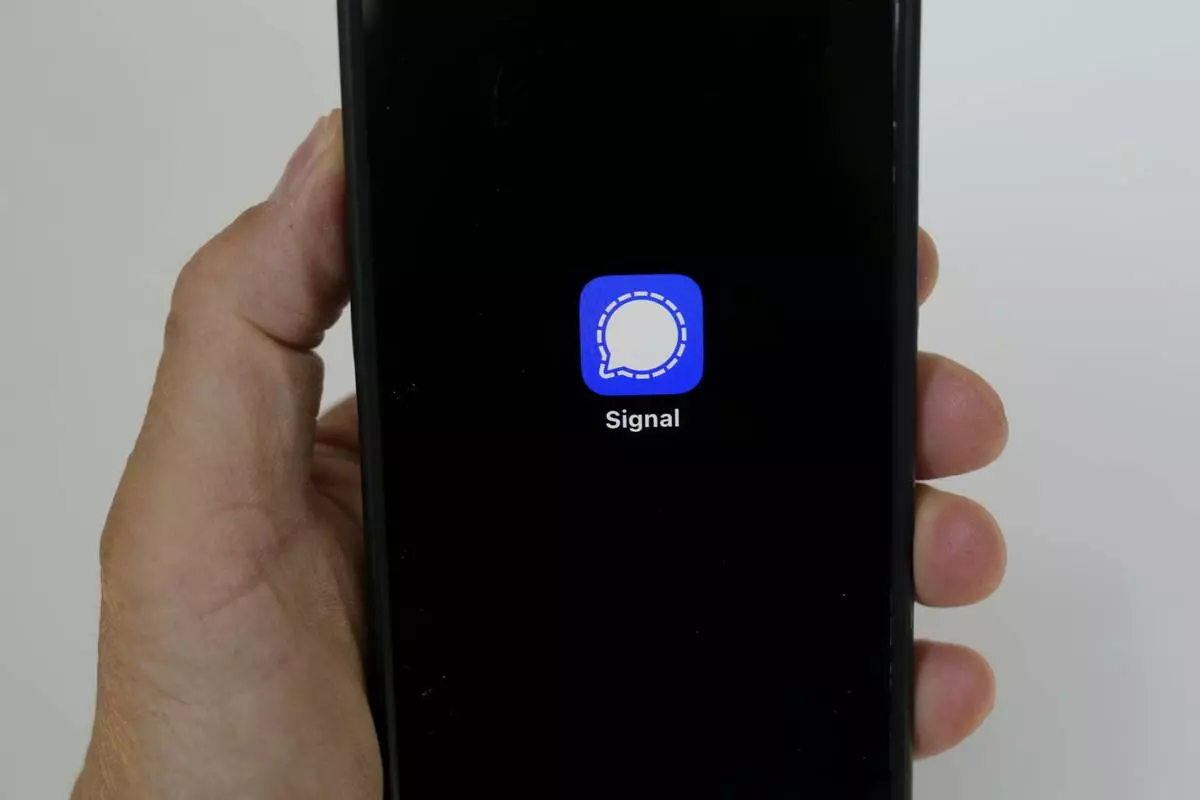
FILE - An image of the Signal app is shown on a mobile phone in San Francisco, March 18, 2025. (AP Photo/Jeff Chiu, file)
FILE - An image of the Signal app is shown on a mobile phone in San Francisco, March 18, 2025. (AP Photo/Jeff Chiu, file)
BUENOS AIRES, Argentina (AP) — Venezuelans on Saturday were scrambling to understand who is in charge of their country after a U.S. military operation that captured President Nicolás Maduro.

President Donald Trump delivered a shocking pick: The United States, perhaps in coordination with one of Maduro's most trusted aides.

Delcy Rodríguez has served as Maduro's vice president since 2018, overseeing much of Venezuela's oil-dependent economy as well as its feared intelligence service. But she is someone the Trump administration apparently is willing to work with, at least for now.

“She’s essentially willing to do what we think is necessary to make Venezuela great again,” Trump told reporters of Rodríguez, who faced U.S. sanctions during Trump’s first administration for her role in undermining Venezuelan democracy.

In a major snub, Trump said opposition leader Maria Corina Machado, who was awarded last year's Nobel Peace Prize, didn't have the support to run the country.

Trump said Rodríguez had a long conversation with Secretary of State Marco Rubio in which Trump claimed she said, “‘We’ll do whatever you need.’”

“I think she was quite gracious,” Trump added. “We can’t take a chance that somebody else takes over Venezuela that doesn’t have the good of the Venezuelan people in mind.”

Rodríguez tried to project strength and unity among the ruling party's many factions, downplaying any hint of betrayal. In remarks on state TV, she demanded the immediate release of Maduro and his wife, Cilia Flores, and denounced the U.S. operation as a flagrant violation of the United Nations charter.

“There is only one president in this country, and his name is Nicolás Maduro," Rodríguez said, surrounded by top civilian officials and military commanders.

There was no immediate sign that the U.S. was running Venezuela.

“What will happen tomorrow? What will happen in the next hour? Nobody knows,” Caracas resident Juan Pablo Petrone said.

Trump indicated that Rodríguez had been sworn in already as president of Venezuela, per the transfer of power outlined in the constitution. However, state television has not broadcast any swearing-in ceremony.

In her televised address, Rodríguez did not declare herself acting president or mention a political transition. A ticker at the bottom of the screen identified her as the vice president. She gave no sign that she would be cooperating with the U.S.

“What is being done to Venezuela is an atrocity that violates international law,” she said. “History and justice will make the extremists who promoted this armed aggression pay.”

The Venezuelan constitution also says a new election must be called within a month in the event of the president’s absence.

But experts have been debating whether the succession scenario would apply here, given the government’s lack of popular legitimacy and the extraordinary U.S. military intervention.

Venezuelan military officials were quick to project defiance in video messages.

“They have attacked us but will not break us,” said Defense Minister Gen. Vladimir Padrino López, dressed in fatigues.

Interior Minister Diosdado Cabello appeared on state TV in a helmet and flak jacket, urging Venezuelans to “trust in the political leadership and military” and “get out on the streets” to defend the country’s sovereignty.

“These rats attacked and they will regret what they did,” he said of the U.S.

A lawyer educated in Britain and France, Rodríguez has a long history of representing the revolution started by the late Hugo Chávez on the world stage.

She and her brother, Jorge Rodríguez, head of the Maduro-controlled National Assembly, have strong leftist credentials born from tragedy. Their father was a socialist leader who died in police custody in the 1970s, a crime that shook many activists of the era, including a young Maduro.

Unlike many in Maduro’s inner circle, the Rodríguez siblings have avoided criminal indictment in the U.S. Delcy Rodríguez has developed strong ties with Republicans in the oil industry and on Wall Street who balked at the notion of U.S.-led regime change.

Among her past interlocutors was Blackwater founder Erik Prince and, more recently, Richard Grenell, a Trump special envoy who tried to negotiate a deal with Maduro for greater U.S. influence in Venezuela.

Fluent in English, Rodríguez is sometimes portrayed as a well-educated moderate in contrast to the military hardliners who took up arms with Chávez against Venezuela's democratically elected president in the 1990s.

Many of them, especially Cabello, are wanted in the U.S. on drug trafficking charges and stand accused of serious human rights abuses. But they continue to hold sway over the armed forces, the traditional arbiter of political disputes in Venezuela.

That presents major challenges to Rodríguez asserting authority. But experts say that Venezuela’s power brokers have long had a habit of closing ranks behind their leaders.

“These leaders have all seen the value of staying united. Cabello has always taken a second seat or third seat, knowing that his fate is tied up with Maduro’s, and now he very well might do that again,” said David Smilde, a sociology professor at Tulane University who has conducted research into Venezuela's political dynamics over the past three decades.

“A lot depends on what happened last night, which officials were taken out, what the state of the military looks like now," Smilde said. "If it doesn’t have much firepower anymore, they’re more vulnerable and diminished and it will be easier for her to gain control.”

Shortly before Trump's press conference, Machado, the opposition leader, called on her ally Edmundo González — a retired diplomat widely considered to have won the country’s disputed 2024 presidential election — to “immediately assume his constitutional mandate and be recognized as commander-in-chief."

In an triumphant statement, Machado promised that her movement would “restore order, free political prisoners, build an exceptional country and bring our children back home.”

She added: “Today we are prepared to assert our mandate and take power."

Asked about Machado, Trump was blunt: “I think it would be very tough for (Machado) to be the leader," he said.

“She doesn’t have the support or respect within the country.”

Venezuelans expressed shock, with many speculating on social media that Trump had mixed up the two women's names. Machado has not responded to Trump's remarks.

Goodman reported from Miami.

Venezuelan Vice President and Oil Minister Delcy Rodriguez gives a press conference at the Miraflores presidential palace in Caracas, Venezuela, March 10, 2025. (AP Photo/Ariana Cubillos, File)

Venezuelan Vice President and Oil Minister Delcy Rodriguez gives a press conference at the Miraflores presidential palace in Caracas, Venezuela, March 10, 2025. (AP Photo/Ariana Cubillos, File)

A supporter of Venezuelan President Nicolas Maduro stands on a median strip waving a national flag in Caracas, Venezuela, Saturday, Jan. 3, 2026, after U.S. President Donald Trump announced that Maduro had been captured and flown out of the country. (AP Photo/Ariana Cubillos)

A supporter of Venezuelan President Nicolas Maduro stands on a median strip waving a national flag in Caracas, Venezuela, Saturday, Jan. 3, 2026, after U.S. President Donald Trump announced that Maduro had been captured and flown out of the country. (AP Photo/Ariana Cubillos)

Recommended Articles