Skip to Content Facebook Feature Image

Valieva's attorneys accuse WADA of 'procedural fraud,' ask court to revisit her doping case

ENT

Valieva's attorneys accuse WADA of 'procedural fraud,' ask court to revisit her doping case
ENT

ENT

Valieva's attorneys accuse WADA of 'procedural fraud,' ask court to revisit her doping case

2025-03-28 03:33 Last Updated At:03:41

Attorneys for Russian figure skater Kamila Valieva are taking her doping case back to court, arguing the World Anti-Doping Agency withheld and altered evidence that could have proven her contamination claim during the hearing that resulted in her four-year suspension.

The experiment conducted by scientist Martial Saugy at the request of Russia’s anti-doping agency through its channels at WADA was kept secret until The Associated Press revealed details of it last September, along with WADA’s concerns about it.

“We have a big issue,” WADA’s director general wrote to its general counsel after learning of the experiment. “How come we have Saugy doing an opinion for Valieva, super-favorable to her?”

Details of Saugy’s experiment about how Valieva could have been contaminated by drinking a strawberry smoothie her grandfather made never showed up during a five-day-long hearing at the Court of Arbitration for Sport in 2023 at which WADA and others had been asked to produce all material related to the skater's positive test.

After reading the AP story about the experiment, Valieva’s attorneys filed an appeal with the Swiss Supreme Court — considered the last, and usually futile, attempt to appeal CAS decisions — asking for details of the experiment to be released.

WADA eventually provided it, and the AP obtained a copy of Saugy’s 11-page memo. It details the painstaking lengths he took to see if Valieva’s contamination claim was plausible.

Valieva, now 18, was the headliner on the team that finished first in the Olympic team figure skating event at the 2022 Beijing Games but ended up with the bronze medal after her result was scrubbed because of the doping positive. Her suspension ends late in 2025 and reports are that she will return to competition in time for next year's Milan-Cortina Olympics.

In a filing this week to the court, Valieva’s attorneys write: “The production of Professor Saugy’s report by (WADA) confirms the procedural fraud that motivated the request for review.”

They claim WADA did not disclose the experiment to CAS, which would have added a theory for Valieva’s positive test for scant traces of the drug and also subjected Saugy to cross-examination at the hearing, and when they finally did hand it over, it had been altered to look less favorable for Valieva.

WADA spokesman James Fitzgerald said “any allegation of wrongdoing on WADA’s part is completely rejected” and that the agency would “vigorously defend its position in this matter.”

He said the report "was not WADA’s document to share” and wouldn’t have been covered by discovery obligations.

“The report was not helpful to Ms. Valieva’s case and, anyway, would have had no impact on the result as the Court of Arbitration for Sport Panel ultimately rejected the athlete’s strawberry dessert explanation, not based on the scientific plausibility but rather because it was not supported by sufficient factual evidence,” Fitzgerald said.

In contamination cases such as the one that ruined the then 15-year-old’s 2022 Olympics and painted her as the helpless pawn of powerful Russian coaches and sports leaders, the athlete has the burden of proving how the drug got into their system.

CAS arbitrators labeled as “inherently implausible” the idea that Valieva would have taken the smoothie her grandpa made on a long train ride and eaten it over a period of days.

Saugy said he was prevented from speaking about the report per terms of a confidentiality agreement he had signed.

In the experiment, the scientist tried to replicate conditions under which the grandfather said he made the smoothie by crushing pills on a wooden cutting board that had not been cleaned.

Saugy made estimates on how much residue from the pills, combined with its mingling with the fruit on the same cutting board, could have ended up in the smoothie Valieva claimed she drank on a train from Moscow to St. Petersburg, where she went to compete in December 2021.

“Depending on the quantity and the time of ingestion of this contaminated food by the athlete, the scenario cannot be excluded,” Saugy wrote of the theory that Valieva could have accidentally ingested the drug.

Saugy also included that finding in his conclusion at the end of the report. But further down in that four-paragraph section, he wrote that “the voluntary intake of a dose of Trimetazidine 4 to 5 days before the antidoping test stays the most plausible scenario.”

In arguing the report was altered, Valieva's attorneys say Saugy’s experiment — which included breakdowns of how the drug metabolizes in a person's system — did not support the theory that the scant amount of the drug in Valieva's system at the time of her positive test could have resulted from intentional use of the drug.

“This additional conclusion, which is unrelated to the purpose of the expert appraisal and the questions posed, contradicts the rest of the report,” the lawyers said.

They also point out that the original request, sent by a WADA deputy director at RUSADA’s request, contains eight questions, while the report only includes Saugy's answers to the first seven. The excluded question: “How did the TMZ enter the athlete's body?”

“It seems clear that Professor Saugy initially answered this question and subsequently deleted his comments precisely because they were 'super favorable' to Kamila Valieva,” the attorneys argue, in repeating the phrasing used by WADA's director general when he expressed alarm over the experiment.

The drug Valieva tested positive for, Trimetazidine, is the same one that showed up in the systems of 23 Chinese swimmers who were not penalized after WADA accepted that country’s contamination explanation for their positive tests.

That case brought harsh scrutiny on WADA — the U.S. government stopped paying its dues to the drug-fighting organization — and the Valieva case illustrates a disconnect between how WADA handled scenarios involving different countries whose athletes tested positive for the same drug and made similar contamination claims.

Valieva’s case was the latest chapter in a saga that, at the time, had dragged on for eight years. Russian sports leaders had been found to be cheating the system at the highest levels, and also lying to WADA when it came asking for evidence of the malfeasance.

Russia’s anti-doping agency was non-compliant at the time the Valieva case played out, which forced it to run the request for Saugy’s experiment through WADA.

WADA, therefore, received the results of the test, and that alarmed director general Olivier Niggli, whose texts to Gunther Younger, the head of the agency’s new intelligence and investigations unit, were seen by the AP.

“If it is a RUSADA opinion, we should absolutely not be involved in anyway,” Niggli wrote. “This is a big issue on our side to get involved in such an opinion that will be used in court. We have to stop that urgently.”

AP Olympics: https://apnews.com/hub/winter-olympics
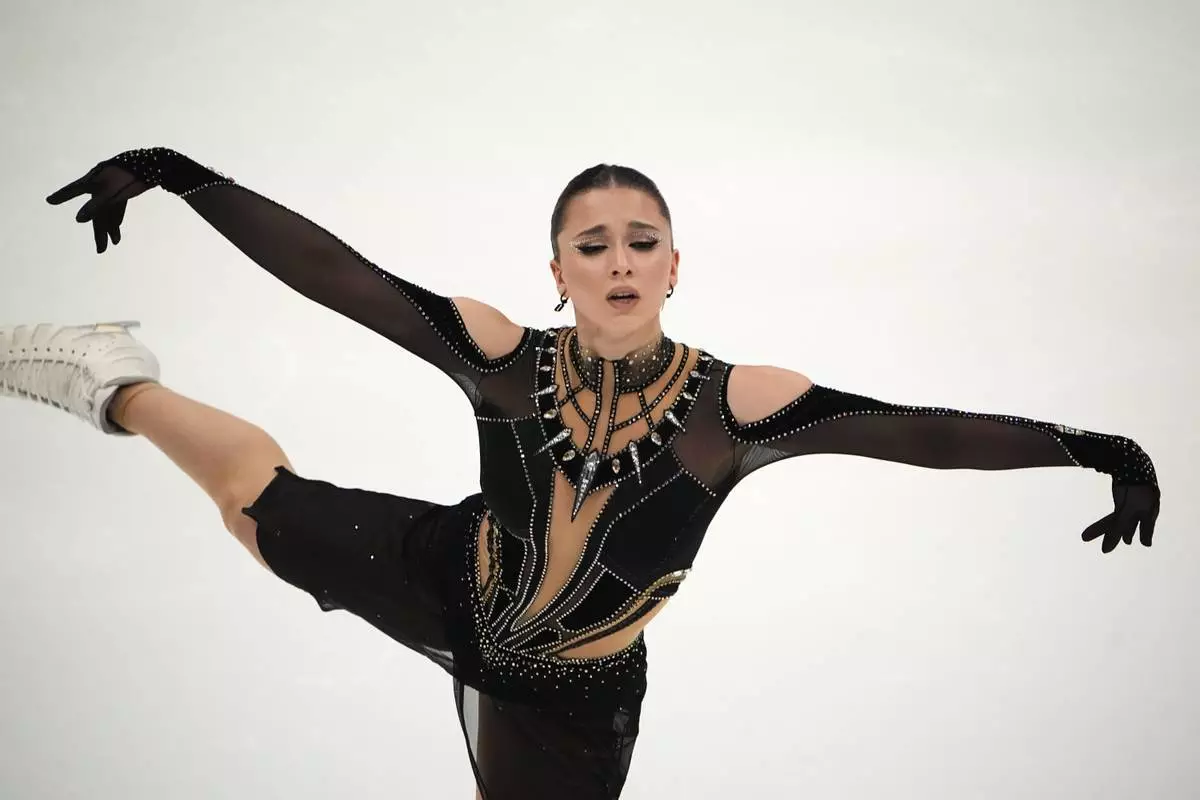
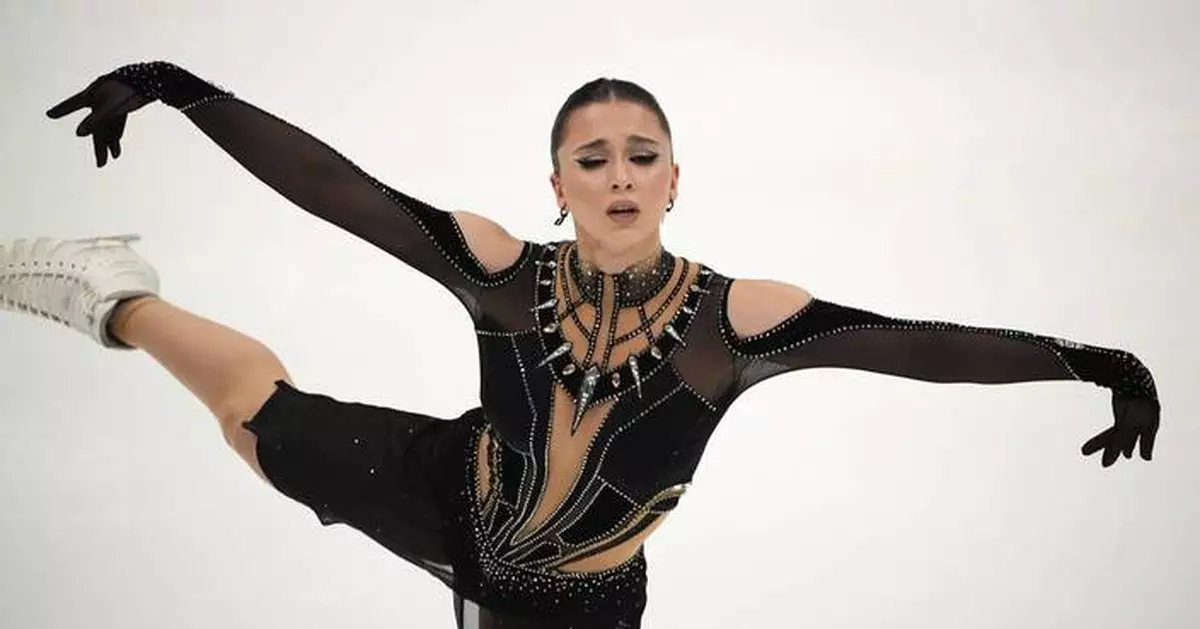
FILE - Russian Kamila Valieva competes in the women's free skate program at the 2023 Russian Figure Skating Grand Prix, the Golden Skate of Moscow, Nov. 26, 2023, in Moscow. (AP Photo/Alexander Zemlianichenko, File)
FILE - Russian Kamila Valieva competes in the women's free skate program at the 2023 Russian Figure Skating Grand Prix, the Golden Skate of Moscow, Nov. 26, 2023, in Moscow. (AP Photo/Alexander Zemlianichenko, File)

WASHINGTON (AP) — A day after the audacious U.S. military operation in Venezuela, President Donald Trump on Sunday renewed his calls for an American takeover of the Danish territory of Greenland for the sake of U.S. security interests, while his top diplomat declared the communist government in Cuba is “in a lot of trouble.”

The comments from Trump and Secretary of State Marco Rubio after the ouster of Venezuela's Nicolás Maduro underscore that the U.S. administration is serious about taking a more expansive role in the Western Hemisphere.

With thinly veiled threats, Trump is rattling hemispheric friends and foes alike, spurring a pointed question around the globe: Who's next?

“It’s so strategic right now. Greenland is covered with Russian and Chinese ships all over the place," Trump told reporters as he flew back to Washington from his home in Florida. "We need Greenland from the standpoint of national security, and Denmark is not going to be able to do it.”

Asked during an interview with The Atlantic earlier on Sunday what the U.S.-military action in Venezuela could portend for Greenland, Trump replied: “They are going to have to view it themselves. I really don’t know.”

Trump, in his administration's National Security Strategy published last month, laid out restoring “American preeminence in the Western Hemisphere” as a central guidepost for his second go-around in the White House.

Trump has also pointed to the 19th century Monroe Doctrine, which rejects European colonialism, as well as the Roosevelt Corollary — a justification invoked by the U.S. in supporting Panama’s secession from Colombia, which helped secure the Panama Canal Zone for the U.S. — as he's made his case for an assertive approach to American neighbors and beyond.

Trump has even quipped that some now refer to the fifth U.S. president's foundational document as the “Don-roe Doctrine.”

Saturday's dead-of-night operation by U.S. forces in Caracas and Trump’s comments on Sunday heightened concerns in Denmark, which has jurisdiction over the vast mineral-rich island of Greenland.

Danish Prime Minister Mette Frederiksen in a statement that Trump has "no right to annex" the territory. She also reminded Trump that Denmark already provides the United States, a fellow member of NATO, broad access to Greenland through existing security agreements.

“I would therefore strongly urge the U.S. to stop threatening a historically close ally and another country and people who have made it very clear that they are not for sale,” Frederiksen said.

Denmark on Sunday also signed onto a European Union statement underscoring that “the right of the Venezuelan people to determine their future must be respected” as Trump has vowed to “run” Venezuela and pressed the acting president, Delcy Rodriguez, to get in line.

Trump on Sunday mocked Denmark’s efforts at boosting Greenland’s national security posture, saying the Danes have added “one more dog sled” to the Arctic territory’s arsenal.

Greenlanders and Danes were further rankled by a social media post following the raid by a former Trump administration official turned podcaster, Katie Miller. The post shows an illustrated map of Greenland in the colors of the Stars and Stripes accompanied by the caption: “SOON."

“And yes, we expect full respect for the territorial integrity of the Kingdom of Denmark,” Amb. Jesper Møller Sørensen, Denmark's chief envoy to Washington, said in a post responding to Miller, who is married to Trump's influential deputy chief of staff Stephen Miller.

During his presidential transition and in the early months of his return to the White House, Trump repeatedly called for U.S. jurisdiction over Greenland, and has pointedly not ruled out military force to take control of the mineral-rich, strategically located Arctic island that belongs to an ally.

The issue had largely drifted out of the headlines in recent months. Then Trump put the spotlight back on Greenland less than two weeks ago when he said he would appoint Republican Gov. Jeff Landry as his special envoy to Greenland.

The Louisiana governor said in his volunteer position he would help Trump “make Greenland a part of the U.S.”

Meanwhile, concern simmered in Cuba, one of Venezuela’s most important allies and trading partners, as Rubio issued a new stern warning to the Cuban government. U.S.-Cuba relations have been hostile since the 1959 Cuban revolution.

Rubio, in an appearance on NBC's “Meet the Press,” said Cuban officials were with Maduro in Venezuela ahead of his capture.

“It was Cubans that guarded Maduro,” Rubio said. “He was not guarded by Venezuelan bodyguards. He had Cuban bodyguards.” The secretary of state added that Cuban bodyguards were also in charge of “internal intelligence” in Maduro’s government, including “who spies on who inside, to make sure there are no traitors.”

Trump said that “a lot” of Cuban guards tasked with protecting Maduro were killed in the operation. The Cuban government said in a statement read on state television on Sunday evening that 32 officers were killed in the U.S. military operation.

Trump also said that the Cuban economy, battered by years of a U.S. embargo, is in tatters and will slide further now with the ouster of Maduro, who provided the Caribbean island subsidized oil.

“It's going down,” Trump said of Cuba. “It's going down for the count.”

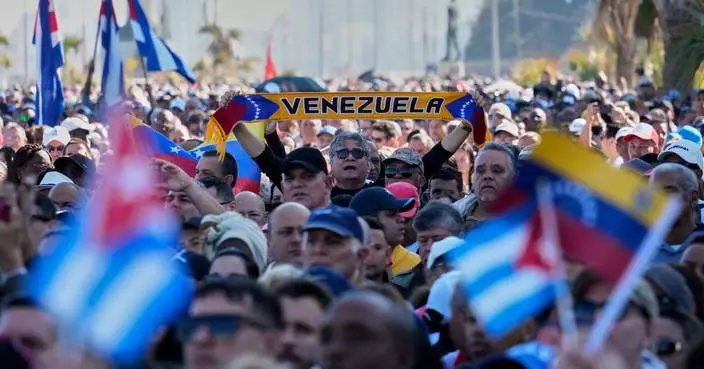
Cuban authorities called a rally in support of Venezuela’s government and railed against the U.S. military operation, writing in a statement: “All the nations of the region must remain alert, because the threat hangs over all of us.”

Rubio, a former Florida senator and son of Cuban immigrants, has long maintained Cuba is a dictatorship repressing its people.

“This is the Western Hemisphere. This is where we live — and we’re not going to allow the Western Hemisphere to be a base of operation for adversaries, competitors, and rivals of the United States," Rubio said.

Cubans like 55-year-old biochemical laboratory worker Bárbara Rodríguez were following developments in Venezuela. She said she worried about what she described as an “aggression against a sovereign state.”

“It can happen in any country, it can happen right here. We have always been in the crosshairs,” Rodríguez said.

AP writers Andrea Rodriguez in Havana, Cuba, and Darlene Superville traveling aboard Air Force One contributed reporting.

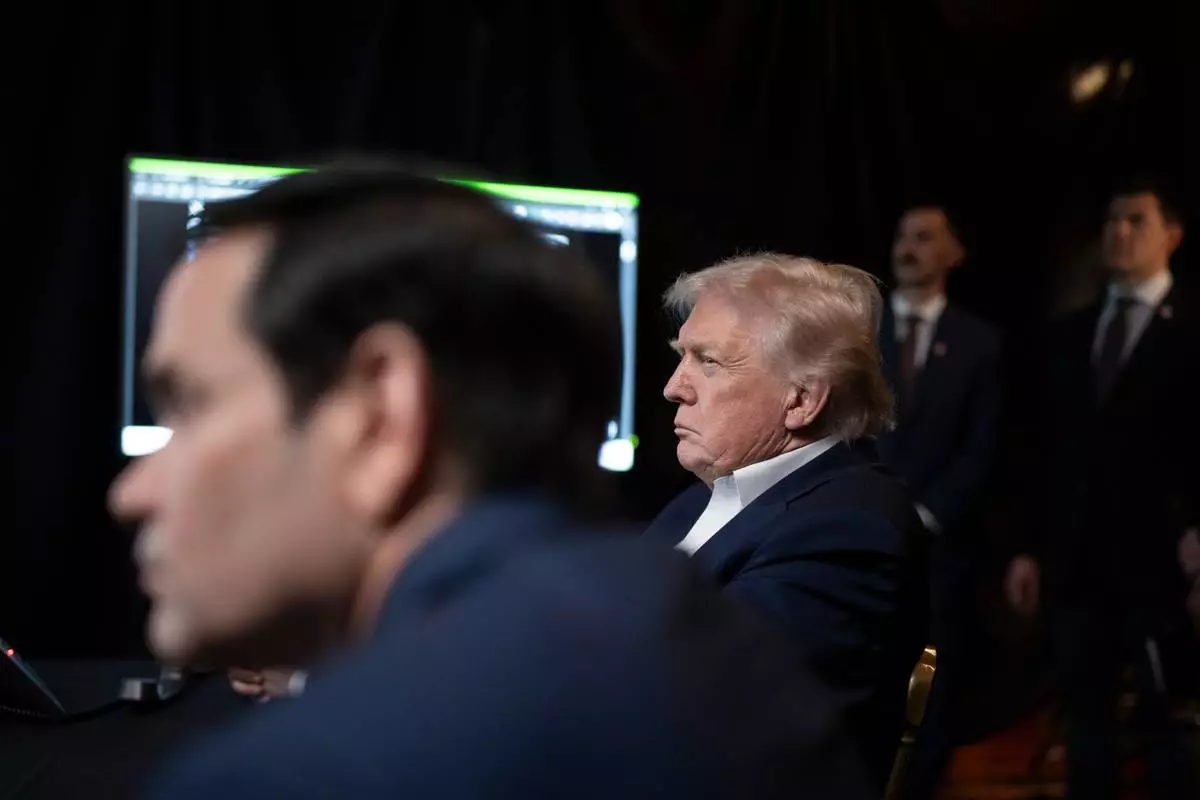
In this photo released by the White House, President Donald Trump monitors U.S. military operations in Venezuela, with Secretary of State Marco Rubio at Mar-a-Lago in Palm Beach, Fla., Saturday, Jan. 3, 2026. (Molly Riley/The White House via AP)

In this photo released by the White House, President Donald Trump monitors U.S. military operations in Venezuela, with Secretary of State Marco Rubio at Mar-a-Lago in Palm Beach, Fla., Saturday, Jan. 3, 2026. (Molly Riley/The White House via AP)

Recommended Articles