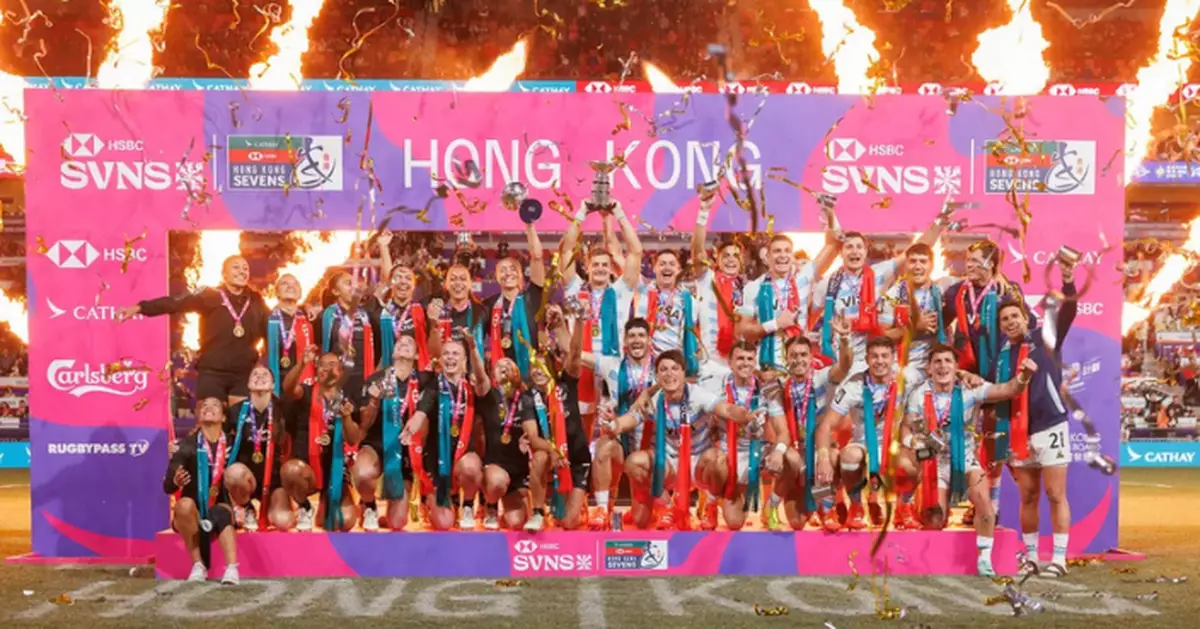
New Zealand women and Argentina men claimed the Cathay/HSBC Hong Kong Sevens titles to back up their victories in Vancouver last month and extend their leads in the HSBC SVNS 2025 standings after five rounds.
New Zealand beat rivals Australia 26-19 in another epic encounter as Jorja Miller produced two moments of magic to make it three Hong Kong titles in a row for the Black Ferns Sevens. Although she had her team-mates to thank for not only surviving but scoring during her time in the sin bin for a tip tackle.
“We knew we had to come out for finals footie and I’m so proud of the group. We love Hong Kong and the history of it. The crowd and the atmosphere here, it gets us going, it brings out the best rugby.”HSBC Player of the Final Miller said.
Argentina added a third successive title win of the SVNS season with a 12-7 victory over France. Los Pumas Sevens made it 16 games unbeaten as they edged out Olympic champions France to win their maiden Hong Kong Sevens crown and extend their lead at the top of the series table to 12 points, ahead of Fiji.
HSBC Player of the final Marcos Moneta scored the crucial second try in the final and said: 'It’s amazing to win here, it means so much to us as Hong Kong is a really historic tournament. I got my debut here and last year I broke my fibula here before the Olympic Games, so it was a mixture of emotions. My parents decided to be here with me. These are the things I was thinking about at the anthem. It is the perfect day."
Canada claimed the women’s bronze with a 21-17 win over France while Australia beat Fiji 22-21 with a last gasp try from 19-year-old Sidney Harvey to take the men’s bronze.
The results in Hong Kong mean that all eight of the men’s teams and six of the women’s teams have already secured their places in the World Championship. The men’s teams are Argentina, Fiji, Spain, South Africa, France, New Zealand, Australia and Great Britain. The six confirmed women’s teams are New Zealand, Australia, France, USA, Canada and Japan.
New Zealand women and Argentina men continue to lead the current SVNS standings after five rounds, going in to the final regular season round in Singapore on 5-6 April. New Zealand head to the Singapore tournament with an eight-point lead over Australia while Argentina are 12 points ahead of Fiji and in pole position to become HSBC SVNS 2025 league winners.
The pools for HSBC SVNS Singapore were allocated following the Hong Kong final and produced some mouthwatering match-ups. The competition format involves four pools of three teams each, replicating the format used in Cape Town during the second round of HSBC SVNS 2025.
Olympic champions and SVNS leaders New Zealand are in women’s Pool A with Brazil and China. Reigning SVNS champions Australia will face Japan and Spain in Pool B. Pool C sees Olympic medallists Canada and the USA together with Great Britain. France, Fiji and Ireland compete in Pool D.
Men’s SVNS title favourites Argentina are in Pool A with Great Britain and South Africa. Olympic champions France will play Ireland and Kenya in Pool B. Australia, Spain and Uruguay will battle it out in Pool C. While Fiji, New Zealand and the USA are in Pool D.
BUENOS AIRES, Argentina (AP) — The libertarian government of Argentina's President Javier Milei announced Friday it would issue a dollar bond for the first time in nearly eight years, as the cash-strapped country seeks a return to international markets and faces an enormous sum of debt due in the coming months.
The dollar-denominated sovereign bond, issued under Argentine law and targeted at foreign and local investors, has an interest rate, or coupon, of 6.5% and matures in November 2029, the Economy Ministry said, without offering details on the size of the offering.
Analysts say the bond auction signals growing confidence in President Milei's reforms after his party's landslide midterm election victory reassured bondholders that his government would be able to pay them back.
“It shows they are taking steps — slowly — toward normalizing the market and reducing dependence on international reserves, which is a big concern,” said Fernando Marull, an Argentine economist.
“Ideally, debt should be paid with refinancing, not with scarce reserves. It’s like going to a bank and refinancing your loan instead of paying the whole thing in cash from your pocket. That's why this is so important."
Economy Minister Luis Caputo said the money would be crucial for settling part of the $4.2 billion in debt that’s coming due on Jan. 9 without tapping reserves. Because the bond won’t be issued under foreign law, he said, it won’t need congressional approval.
“The reopening of foreign currency debt markets will expand the Treasury’s options regarding the instruments available for debt management," Caputo wrote on social media, attributing the move to Milei's success in reining in the budget deficit and lifting most capital controls that fenced off its debt markets.
Regaining access to international borrowing markets has been one of Milei's goals since the radical libertarian economist took office in late 2023 on a bid to lower severe inflation, stabilize Argentina’s troubled economy and reverse years of hefty public spending under left-wing populist governments.
Chronic economic crises have led Argentina to default on its debt nine times, most recently in a 2020 restructuring. As a result, high borrowing costs and legal tussles with restive foreign investors have left the country unable to take on debt abroad for most of the past two decades.
Without tapping global capital markets — which is how many governments around the world borrow or roll over debts — Argentina will struggle to expand its economy, and to repay the more than $40 billion it owes the International Monetary Fund.
Earlier this year, Caputo secured a fresh $20 billion loan from the IMF to help Milei press ahead with fiscal reforms. To unlock successive tranches of funds, Milei's government committed to building up its net hard-currency reserves to around $5 billion by the year's end.
IMF spokesperson Julie Kozack told reporters on Thursday that “meeting the end-of-year reserve target will be challenging" for Argentina. Warning that Milei’s current exchange rate policy of propping up the peso slowed reserve accumulation, she added:
“We continue to advocate that the authorities should use the window of opportunity to implement a consistent and robust monetary and foreign exchange framework to help support the accumulation of reserves.”
Milei has diverted billions of dollars from central bank coffers to strengthen the depreciating Argentine peso in recent months.
That strategy was pushed to the extreme in the run-up to the midterm elections as doubts about the trajectory of Milei's harsh austerity plan triggered a run on the peso. With the official rate of the peso crashing against the dollar, U.S. President Donald Trump stepped in to save his ideological ally with a $20 billion credit line and outright purchases of pesos.
While the electoral win thrilled markets and vindicated Trump, unease remains that nothing can stop Milei from burning through foreign reserves again if he depends on a strong peso to fight inflation — not even this bond auction, which experts say is less attractive to foreign investors for being issued under local law.
“I don’t think this represents a return to international markets,” said Juan Battaglia, chief economist at Cucchiara, a stock brokerage in Buenos Aires.
“The government has made significant progress in normalizing the financial account, but there is still a long way to go.”
Argentine President Javier Milei, right, and General Secretary of the Presidency Karina Milei, his sister, cheer for their party's lawmakers during the swearing-in ceremony for newly elected legislators at Congress in Buenos Aires, Argentina, Wednesday, Dec. 3, 2025. (AP Photo/Rodrigo Abd)