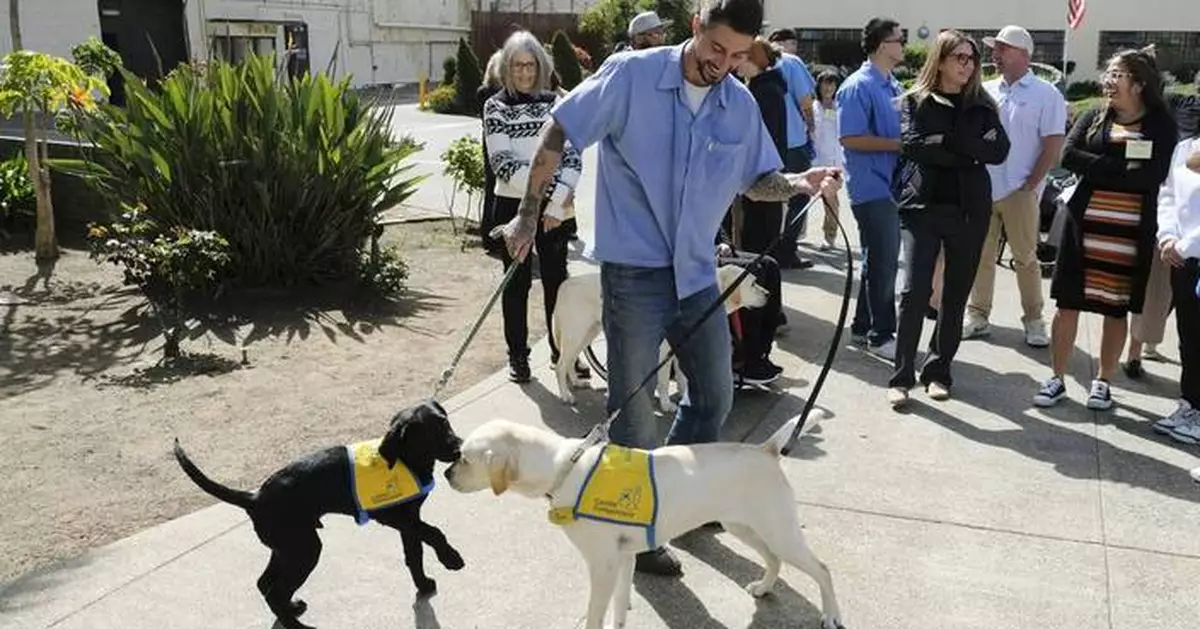
Skip to Content Facebook Feature Image

With tears and tail wags, San Quentin inmates reunite with puppies they raised into service dogs

News

With tears and tail wags, San Quentin inmates reunite with puppies they raised into service dogs
News

News

With tears and tail wags, San Quentin inmates reunite with puppies they raised into service dogs

2025-04-02 04:17 Last Updated At:13:38

SAN QUENTIN, Calif. (AP) — Hugs, tears, barking and tail wagging abounded at San Quentin’s prison when two black Labradors reunited with the incarcerated men who helped raise them to be service dogs.

The emotional reunion brought together Chase Benoit, Jared Hansen and the 2-year-old dogs they helped train: Wendel and Artemis. It was the men's first time seeing their former canine companions again and their first time meeting the dogs' disabled handlers in person.

More Images
Artemis, a service dog, is seen by the wheelchair of handler Benjamin Carter at the San Quentin Rehabilitation Center in San Quentin, Calif., Friday, March 28, 2025. (AP Photo/Eric Risberg)

Artemis, a service dog, is seen by the wheelchair of handler Benjamin Carter at the San Quentin Rehabilitation Center in San Quentin, Calif., Friday, March 28, 2025. (AP Photo/Eric Risberg)

Incarcerated men at the San Quentin Rehabilitation Center do a demonstration with the dogs they are raising during a celebration in San Quentin, Calif., Friday, March 28, 2025. (AP Photo/Eric Risberg)
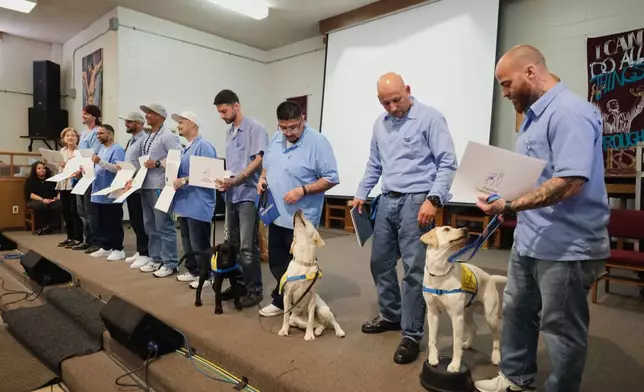
Incarcerated men at the San Quentin Rehabilitation Center do a demonstration with the dogs they are raising during a celebration in San Quentin, Calif., Friday, March 28, 2025. (AP Photo/Eric Risberg)

Jared Hansen, right, and other incarcerated men at the San Quentin Rehabilitation Center hold up their dog training certificates during a celebration in San Quentin, Calif., Friday, March 28, 2025. (AP Photo/Eric Risberg)
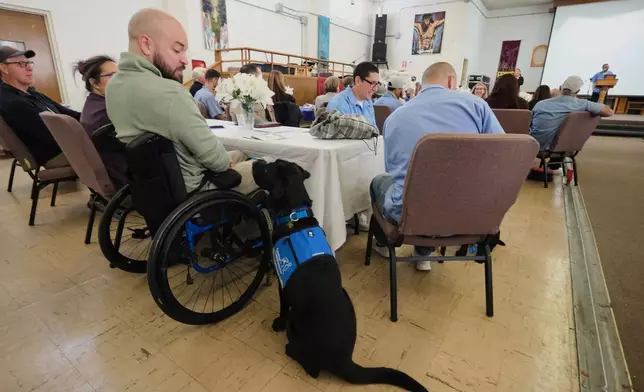
Jared Hansen, right, and other incarcerated men at the San Quentin Rehabilitation Center hold up their dog training certificates during a celebration in San Quentin, Calif., Friday, March 28, 2025. (AP Photo/Eric Risberg)

Handler Benjamin Carter looks at his service dog Artemis during a gathering at the San Quentin Rehabilitation Center in San Quentin, Calif., Friday, March 28, 2025. (AP Photo/Eric Risberg)
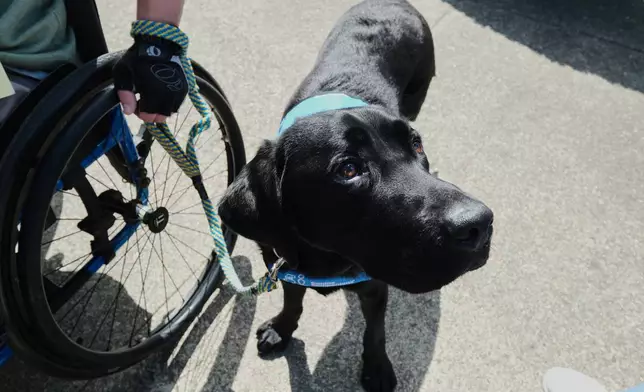
Handler Benjamin Carter looks at his service dog Artemis during a gathering at the San Quentin Rehabilitation Center in San Quentin, Calif., Friday, March 28, 2025. (AP Photo/Eric Risberg)
Artemis, a service dog, is seen by the wheelchair of handler Benjamin Carter at the San Quentin Rehabilitation Center in San Quentin, Calif., Friday, March 28, 2025. (AP Photo/Eric Risberg)

Artemis, a service dog, is seen by the wheelchair of handler Benjamin Carter at the San Quentin Rehabilitation Center in San Quentin, Calif., Friday, March 28, 2025. (AP Photo/Eric Risberg)

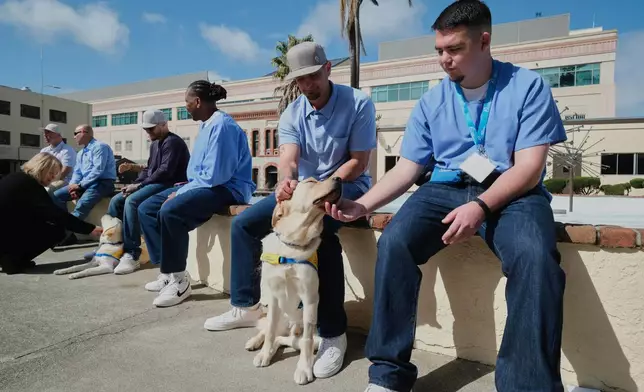
Incarcerated men at the San Quentin Rehabilitation Center pet a service dog in training at the prison in San Quentin, Calif., Friday, March 28, 2025. (AP Photo/Eric Risberg)
Incarcerated men at the San Quentin Rehabilitation Center pet a service dog in training at the prison in San Quentin, Calif., Friday, March 28, 2025. (AP Photo/Eric Risberg)

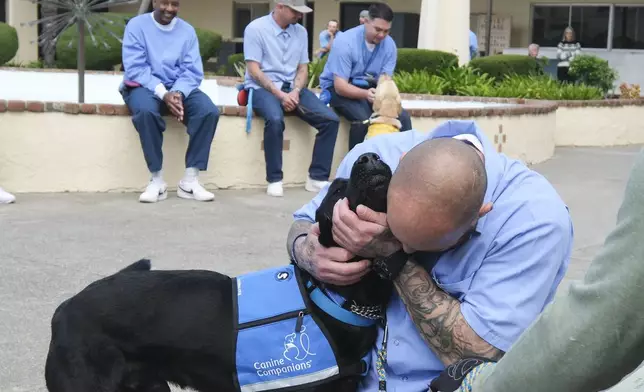
Jared Hansen, who is incarcerated at the San Quentin Rehabilitation Center, is greeted by Artemis, a service dog he helped train, in San Quentin, Calif., Friday, March 28, 2025. (AP Photo/Eric Risberg)
Jared Hansen, who is incarcerated at the San Quentin Rehabilitation Center, is greeted by Artemis, a service dog he helped train, in San Quentin, Calif., Friday, March 28, 2025. (AP Photo/Eric Risberg)

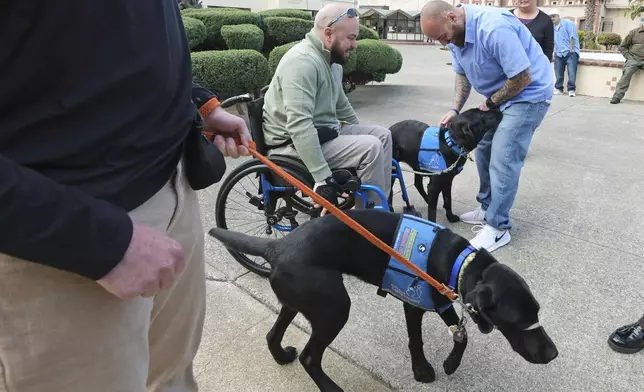
Jared Hansen, right, who is incarcerated at the San Quentin Rehabilitation Center, visits with Artemis as his handler, Benjamin Carter, looks on in San Quentin, Calif., Friday, March 28, 2025. (AP Photo/Eric Risberg)
Jared Hansen, right, who is incarcerated at the San Quentin Rehabilitation Center, visits with Artemis as his handler, Benjamin Carter, looks on in San Quentin, Calif., Friday, March 28, 2025. (AP Photo/Eric Risberg)

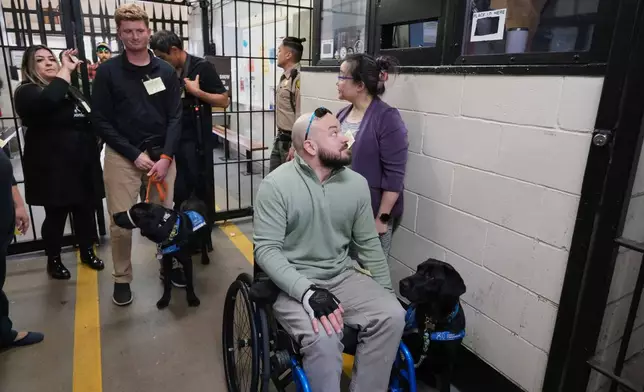
Benjamin Carter, in a wheelchair, with his service dog Artemis, and Robert Quigley, who is deaf, with his service dog Wendel, go through a secure entryway into the San Quentin Rehabilitation Center in San Quentin, Calif., Friday, March 28, 2025. (AP Photo/Eric Risberg)
Benjamin Carter, in a wheelchair, with his service dog Artemis, and Robert Quigley, who is deaf, with his service dog Wendel, go through a secure entryway into the San Quentin Rehabilitation Center in San Quentin, Calif., Friday, March 28, 2025. (AP Photo/Eric Risberg)

Chase Benoit, who is incarcerated at the San Quentin Rehabilitation Center, holds a pair of service dogs in training in San Quentin, Calif., Friday, March 28, 2025. (AP Photo/Eric Risberg)

Chase Benoit, who is incarcerated at the San Quentin Rehabilitation Center, holds a pair of service dogs in training in San Quentin, Calif., Friday, March 28, 2025. (AP Photo/Eric Risberg)

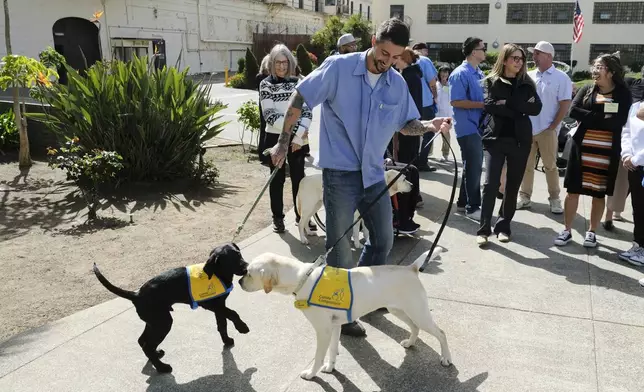
The encounter Friday in San Quentin’s main courtyard brought Benoit and Hansen full circle after helping launch the prison’s puppy training program in April 2023.

“Being in this program, it’s given me something that I think I’ve searched for my whole life,” said Benoit, who is serving 15 years-to-life for second-degree murder. “And that was meaningful purpose, doing something that’s good, better, bigger than myself and feeling like I’m part of something great.”

Robert Quigley, who is deaf, teared up after seeing his spirited dog Wendel bark and get excited when he saw Benoit, his old trainer.

“He remembers me, for sure, I could tell when he came in. I’m so happy that you love him, and that you have a bond,” Benoit told Quigley through an American Sign Language interpreter.

“He’s with me 24/7. He’s very gentle and good with people,” answered Quigley, a recent college graduate who took Wendel home in November after the black Labrador and golden retriever mix completed another six months of professional training outside prison.

Benoit and Jensen were part of an initial group of four incarcerated trainers who shared their 4 foot-by-10 foot cells with the 4-month-old puppies. The men divided the responsibility of caring for and teaching the dogs foundational commands for a year.

Canine Companions, a nonprofit based in Santa Rosa, runs the program and provides free service dogs to people with disabilities. It has built the San Quentin program to 16 trainers and two dog sitters who, as of this week, are training eight puppies.

Artemis, a black Labrador, was matched with Benjamin Carter, a veterinarian from Portland, Oregon, who uses a wheelchair, and traveled to California for the reunion.

Like proud parents, Carter and Hansen shared notes on Artemis' calm and loving personality and penchant for cuddles.

“Seeing him in action and actually serving somebody in the community, it’s just … I’m at a loss for words right now. It’s amazing!” said Hansen, who has been in prison for 15 years for bank robbery.

Artemis, or Artie, pushes door plates, pulls doors open, fetches things around the house and does many other tasks that would be hard for Carter alone.

“He is responsive when he’s working. He is cuddly when he is off the clock. He’s an amazing companion. And all that structure and love and trust was built from these guys here, so I’m just super grateful to them,” Carter said.

The puppies are placed with incarcerated trainers when the dogs are between 2 and 4 months of age and stay with them until they are about 16 to 17 months old. Every three months the puppies are taken out for socialization experiences like interacting with children, riding in cars or going to the grocery store.

The incarcerated men teach them about 20 skills, including fetching, sitting and walking on a leash. After the dogs leave the prison, they train for several more months with professional trainers.

People incarcerated at San Quentin and who participate in the program have been convicted of crimes that include bank robberies, gun offenses and murder. Only those who are in an “earned living unit,” where residents participate in an array of self-help programs, are allowed to apply for puppy training. Inmates with records that include any animal or child cruelty crimes are not allowed to participate, said James Dern, national director of puppy programs for Canine Companions.

Dern said dogs trained in their prison programs have a 10% greater success rate at becoming service dogs than other candidates because of the amount of time and care that incarcerated puppy raisers put into their dogs.

“Being given something to care about other than themselves and the opportunity to give back and to sort of start to make amends for the things they have done in their lives can be life changing,” Dern said.

San Quentin was once home to the largest death row population in the United States. The puppy training program started the year it transformed into a lockup where less-dangerous prisoners receive education, training and rehabilitation. Since then, another 11 correctional facilities have joined the nonprofit for a total of 24 prison institutions, Dern said.

Speaking to a crowd at the prison chapel gathered to celebrate the program, Benoit credited Canine Companions with bringing out the humanity, love and caring in the incarcerated community. "Instead of keeping it to themselves within their small community of professional trainers or even volunteer puppy raisers, they shared this with us in prison and I think that’s huge,” he said.
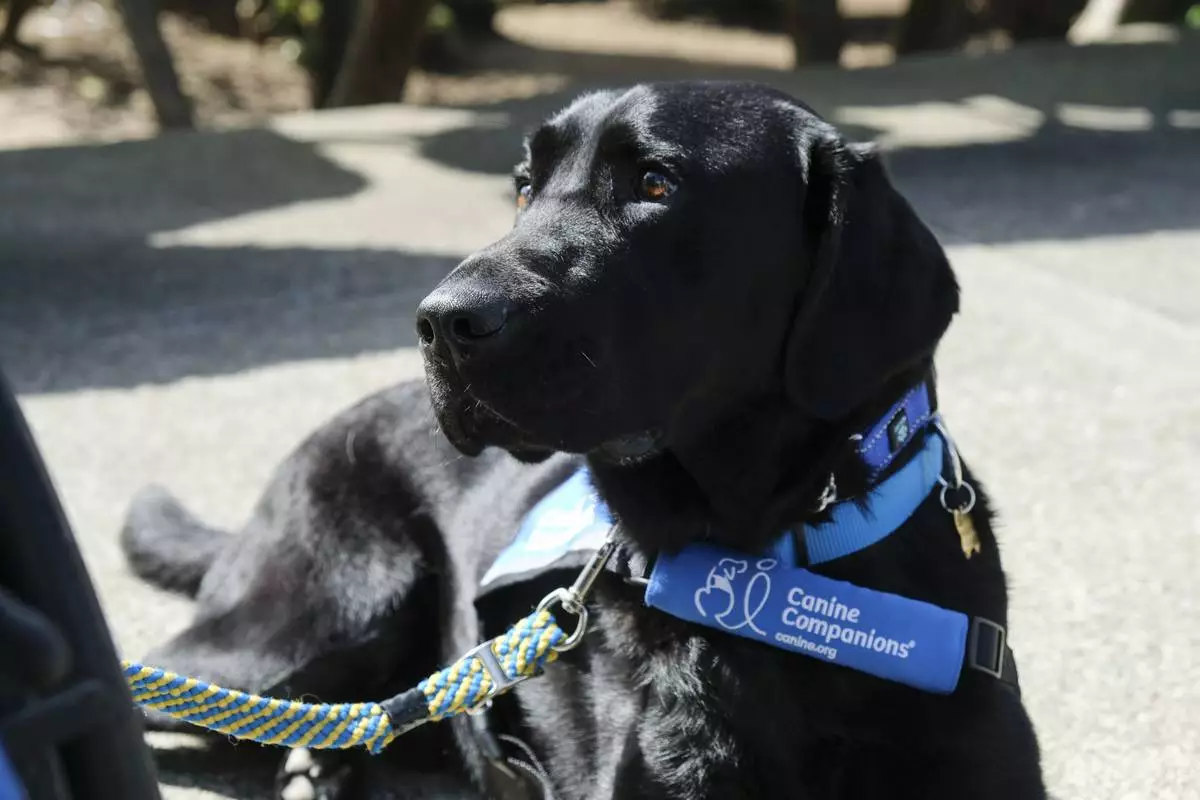
Artemis, a service dog, is seen by the wheelchair of handler Benjamin Carter at the San Quentin Rehabilitation Center in San Quentin, Calif., Friday, March 28, 2025. (AP Photo/Eric Risberg)

Artemis, a service dog, is seen by the wheelchair of handler Benjamin Carter at the San Quentin Rehabilitation Center in San Quentin, Calif., Friday, March 28, 2025. (AP Photo/Eric Risberg)

Incarcerated men at the San Quentin Rehabilitation Center do a demonstration with the dogs they are raising during a celebration in San Quentin, Calif., Friday, March 28, 2025. (AP Photo/Eric Risberg)
Incarcerated men at the San Quentin Rehabilitation Center do a demonstration with the dogs they are raising during a celebration in San Quentin, Calif., Friday, March 28, 2025. (AP Photo/Eric Risberg)

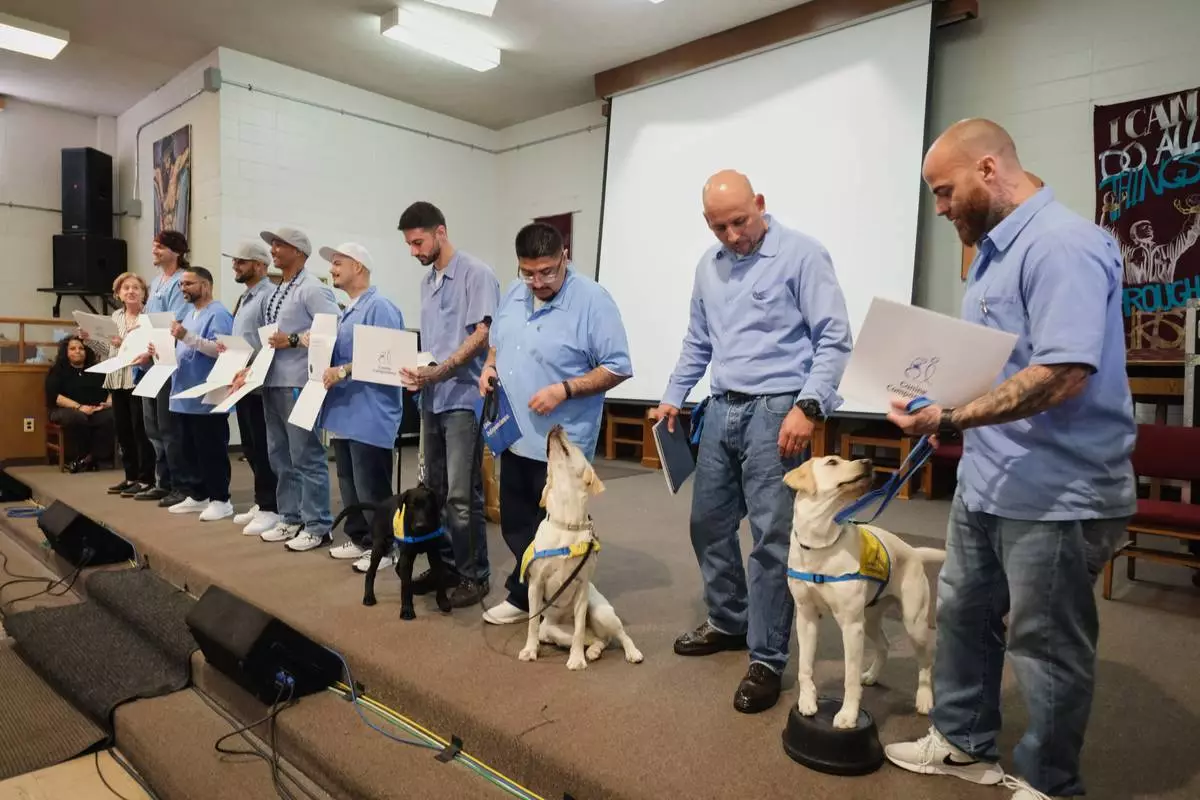
Jared Hansen, right, and other incarcerated men at the San Quentin Rehabilitation Center hold up their dog training certificates during a celebration in San Quentin, Calif., Friday, March 28, 2025. (AP Photo/Eric Risberg)
Jared Hansen, right, and other incarcerated men at the San Quentin Rehabilitation Center hold up their dog training certificates during a celebration in San Quentin, Calif., Friday, March 28, 2025. (AP Photo/Eric Risberg)

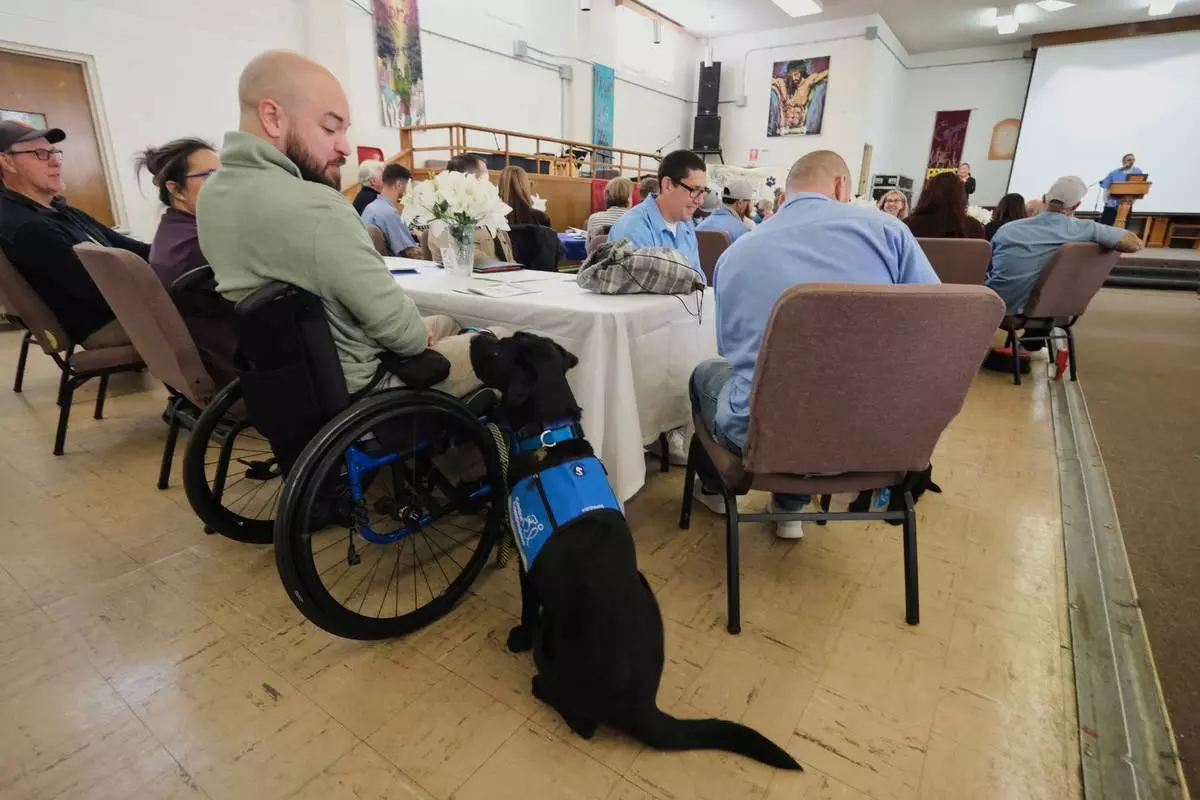
Handler Benjamin Carter looks at his service dog Artemis during a gathering at the San Quentin Rehabilitation Center in San Quentin, Calif., Friday, March 28, 2025. (AP Photo/Eric Risberg)
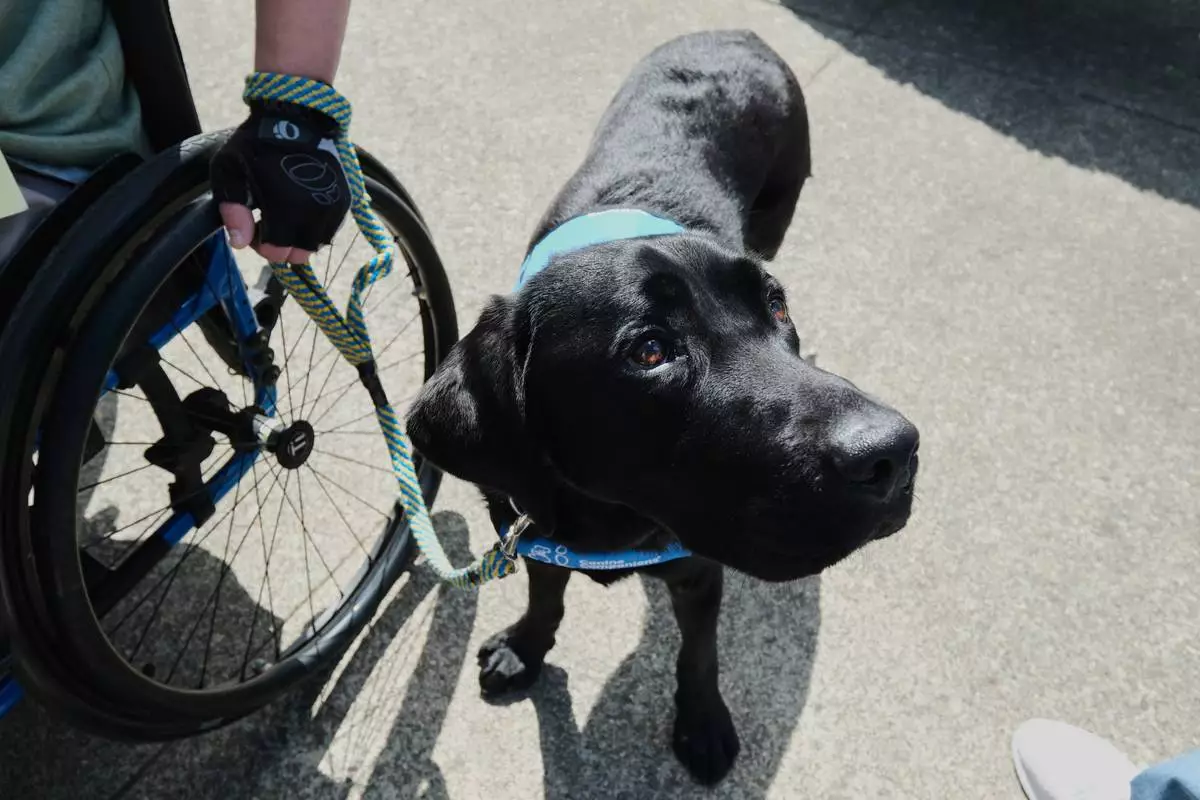
Handler Benjamin Carter looks at his service dog Artemis during a gathering at the San Quentin Rehabilitation Center in San Quentin, Calif., Friday, March 28, 2025. (AP Photo/Eric Risberg)
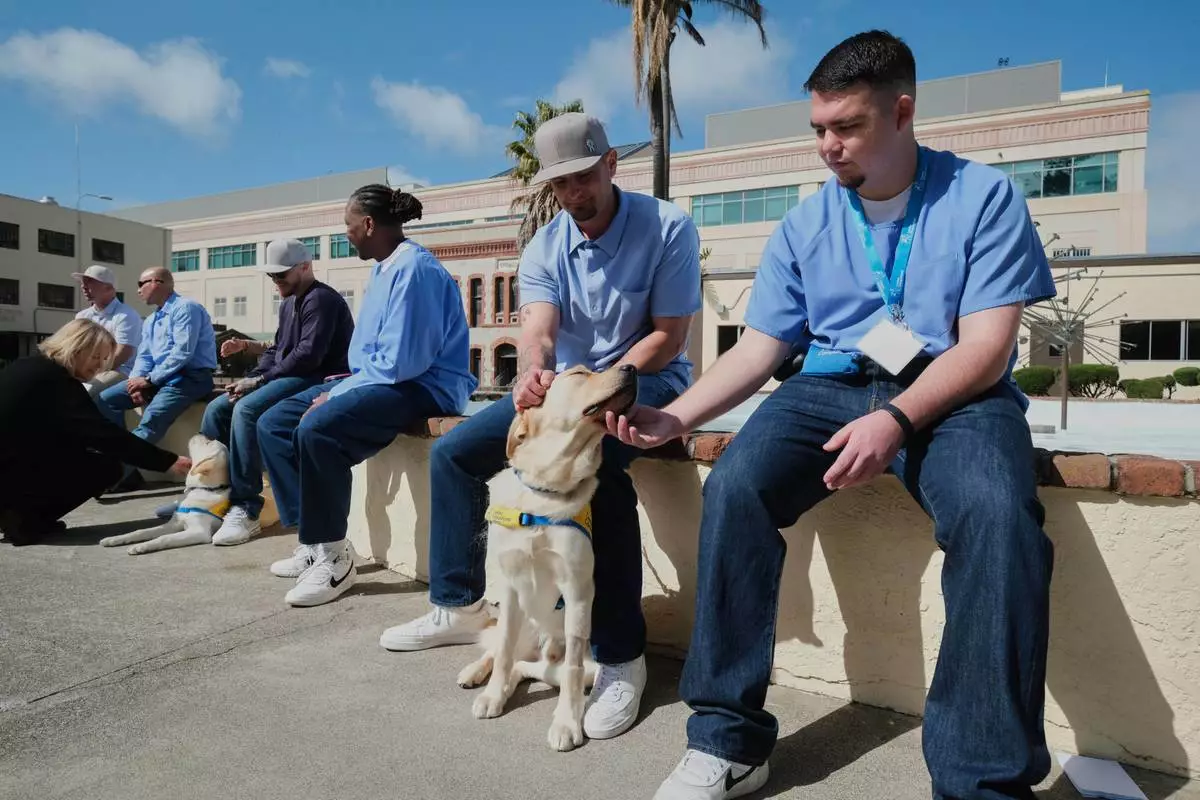
Artemis, a service dog, is seen by the wheelchair of handler Benjamin Carter at the San Quentin Rehabilitation Center in San Quentin, Calif., Friday, March 28, 2025. (AP Photo/Eric Risberg)

Artemis, a service dog, is seen by the wheelchair of handler Benjamin Carter at the San Quentin Rehabilitation Center in San Quentin, Calif., Friday, March 28, 2025. (AP Photo/Eric Risberg)

Incarcerated men at the San Quentin Rehabilitation Center pet a service dog in training at the prison in San Quentin, Calif., Friday, March 28, 2025. (AP Photo/Eric Risberg)
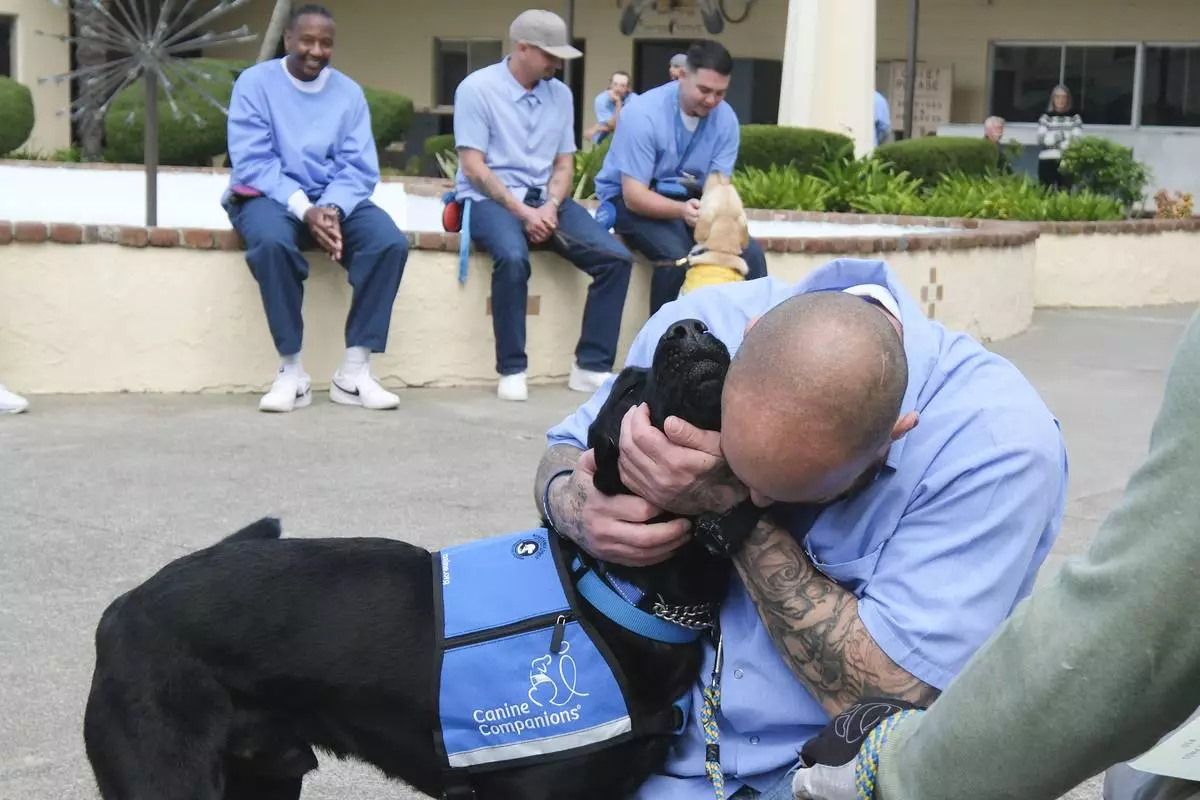
Incarcerated men at the San Quentin Rehabilitation Center pet a service dog in training at the prison in San Quentin, Calif., Friday, March 28, 2025. (AP Photo/Eric Risberg)

Jared Hansen, who is incarcerated at the San Quentin Rehabilitation Center, is greeted by Artemis, a service dog he helped train, in San Quentin, Calif., Friday, March 28, 2025. (AP Photo/Eric Risberg)
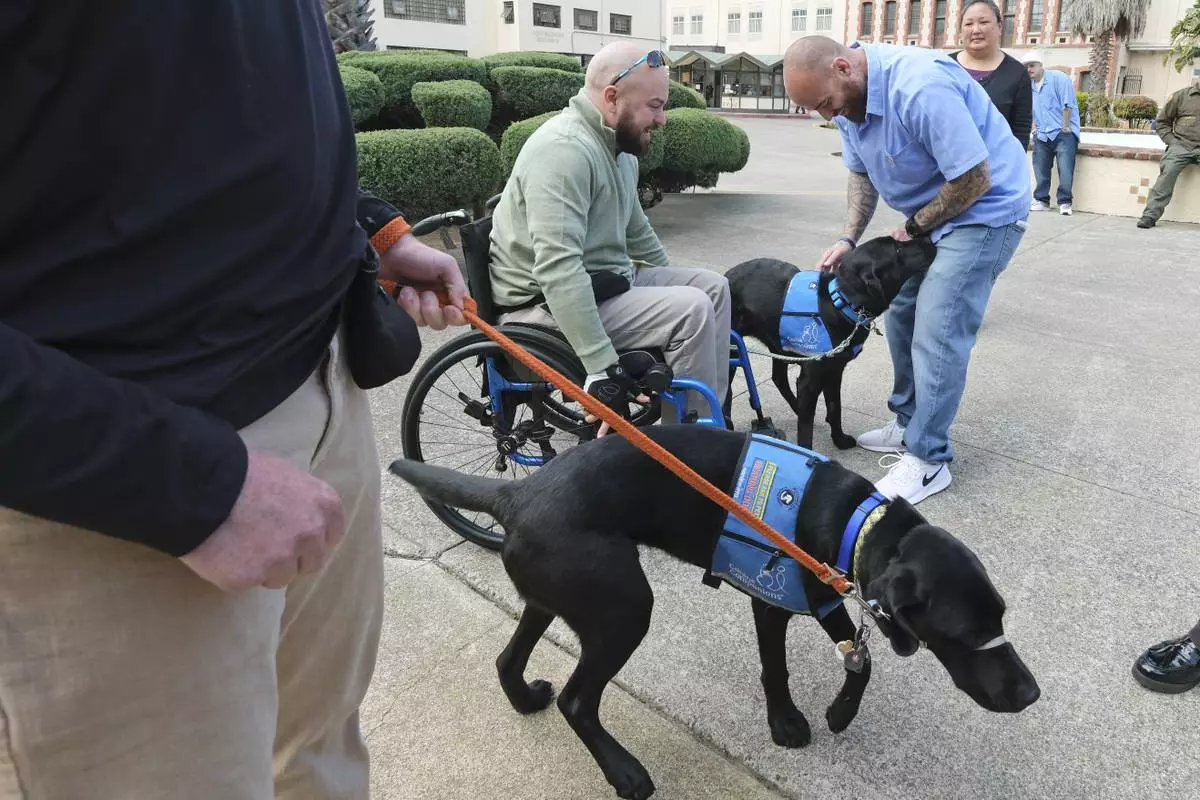
Jared Hansen, who is incarcerated at the San Quentin Rehabilitation Center, is greeted by Artemis, a service dog he helped train, in San Quentin, Calif., Friday, March 28, 2025. (AP Photo/Eric Risberg)

Jared Hansen, right, who is incarcerated at the San Quentin Rehabilitation Center, visits with Artemis as his handler, Benjamin Carter, looks on in San Quentin, Calif., Friday, March 28, 2025. (AP Photo/Eric Risberg)
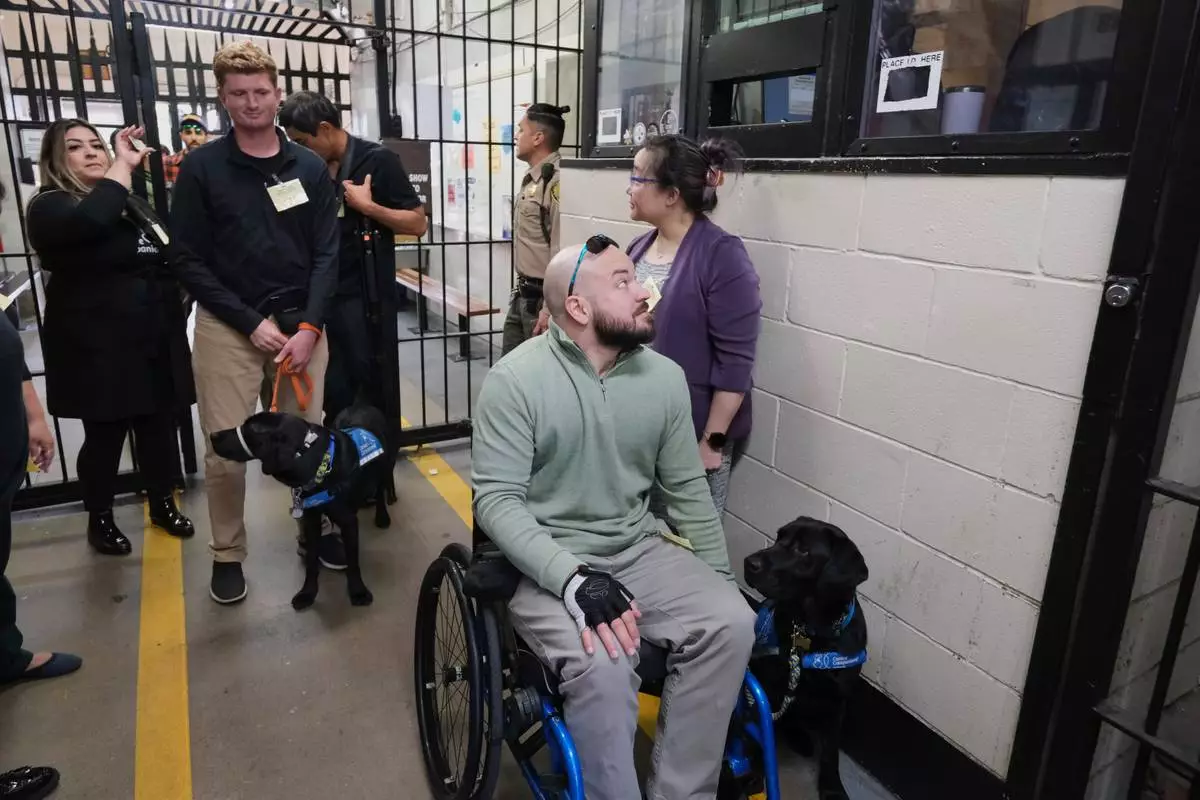
Jared Hansen, right, who is incarcerated at the San Quentin Rehabilitation Center, visits with Artemis as his handler, Benjamin Carter, looks on in San Quentin, Calif., Friday, March 28, 2025. (AP Photo/Eric Risberg)

Benjamin Carter, in a wheelchair, with his service dog Artemis, and Robert Quigley, who is deaf, with his service dog Wendel, go through a secure entryway into the San Quentin Rehabilitation Center in San Quentin, Calif., Friday, March 28, 2025. (AP Photo/Eric Risberg)
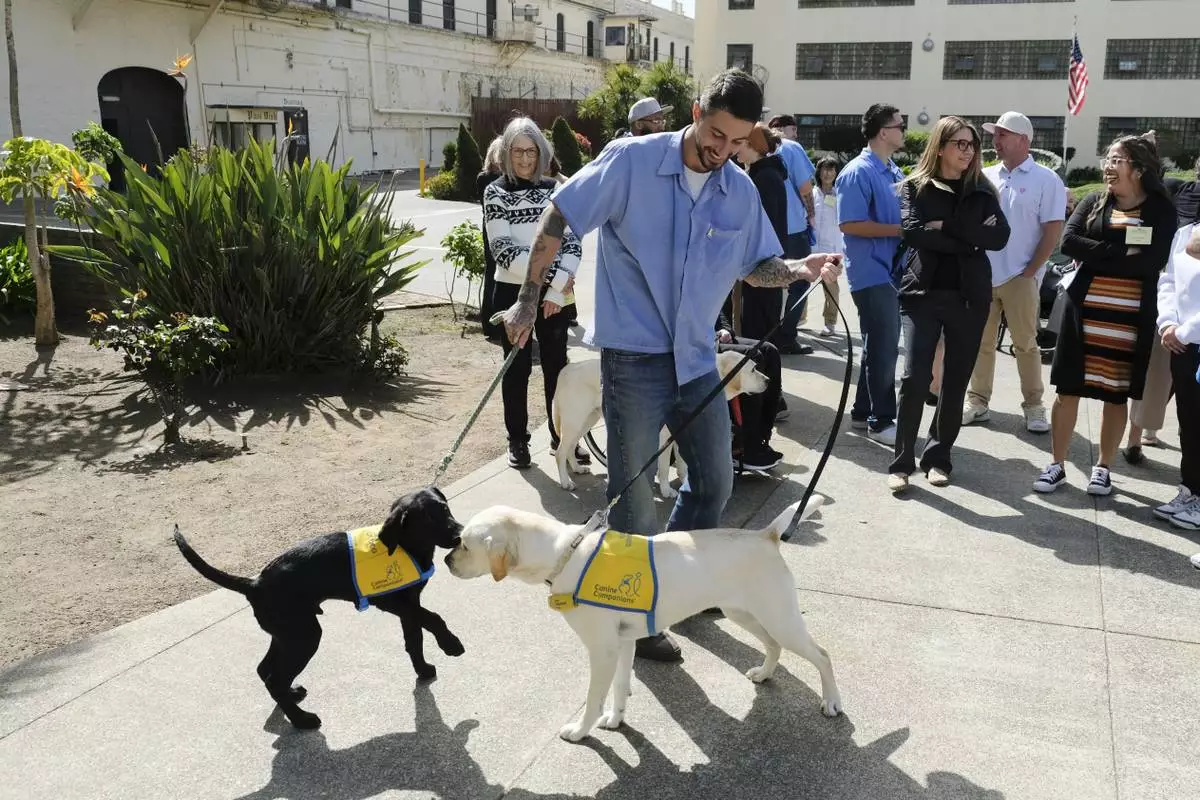
Benjamin Carter, in a wheelchair, with his service dog Artemis, and Robert Quigley, who is deaf, with his service dog Wendel, go through a secure entryway into the San Quentin Rehabilitation Center in San Quentin, Calif., Friday, March 28, 2025. (AP Photo/Eric Risberg)

Chase Benoit, who is incarcerated at the San Quentin Rehabilitation Center, holds a pair of service dogs in training in San Quentin, Calif., Friday, March 28, 2025. (AP Photo/Eric Risberg)

Chase Benoit, who is incarcerated at the San Quentin Rehabilitation Center, holds a pair of service dogs in training in San Quentin, Calif., Friday, March 28, 2025. (AP Photo/Eric Risberg)
RHO, Italy (AP) — No ice is colder and harder than speedskating ice. The precision it takes has meant that Olympic speedskaters have never competed for gold on a temporary indoor rink – until the 2026 Milan Cortina Winter Games.

In the pursuit of maximum glide and minimum friction, Olympic officials brought on ice master Mark Messer, a veteran of six previous Olympic speedskating tracks and the ice technician in charge of the Olympic Oval in Calgary, Canada — one of the fastest tracks in the world with over 300 records.

Messer has been putting that experience to work one thin layer of ice at a time since the end of October at the new Speed Skating Stadium, built inside adjacent trade fair halls in the city of Rho just north of Milan.

“It’s one of the biggest challenges I’ve had in icemaking,’’ Messer said during an interview less than two weeks into the process.

If Goldilocks were a speedskater, hockey ice would be medium hard, for fast puck movement and sharp turns. Figure skating ice would be softer, allowing push off for jumps and so the ice doesn’t shatter on landing. Curling ice is the softest and warmest of all, for controlled sliding.

For speedskating ice to be just right, it must be hard, cold and clean. And very, very smooth.

“The blades are so sharp, that if there is some dirt, the blade will lose the edge,’’ Messer said, and the skater will lose speed.

Speedskater Enrico Fabris, who won two Olympic golds in Turin in 2006, has traded in his skates to be deputy sports manager at the speedskating venue in Rho. For him, perfect ice means the conditions are the same for all skaters — and then if it's fast ice, so much the better.

"It's more of a pleasure to skate on this ice,'' he said.

Messer’s first Olympics were in Calgary in 1988 — the first time speedskating was held indoors. “That gave us some advantages because we didn’t have to worry about the weather, wind blowing or rain,’’ he said. Now he is upping the challenge by becoming the first ice master to build a temporary rink for the Olympics.

Before Messer arrived in Italy, workers spent weeks setting up insulation to level the floor and then a network of pipes and rubber tubes that carry glycol — an antifreeze — that is brought down to minus 7 or minus 8 degrees Celsius (17.6 to 19.4 degrees Fahrenheit) to make the ice.

Water is run through a purification system — but it can’t be too pure, or the ice that forms will be too brittle. Just the right amount of impurities “holds the ice together,’’ Messer said.

The first layers of water are applied slowly, with a spray nozzle; after the ice reaches a few centimeters it is painted white — a full day’s work — and the stripes are added to make lanes.

“The first one takes about 45 minutes. And then as soon as it freezes, we go back and do it again, and again and again. So we do it hundreds of times,’’ Messer said.

As the ice gets thicker, and is more stable, workers apply subsequent layers of water with hoses. Messer attaches his hose to hockey sticks for easier spreading.

What must absolutely be avoided is dirt, dust or frost — all of which can cause friction for the skaters, slowing them down. The goal is that when the skaters push “they can go as far as possible with the least amount of effort,’’ Messer said.

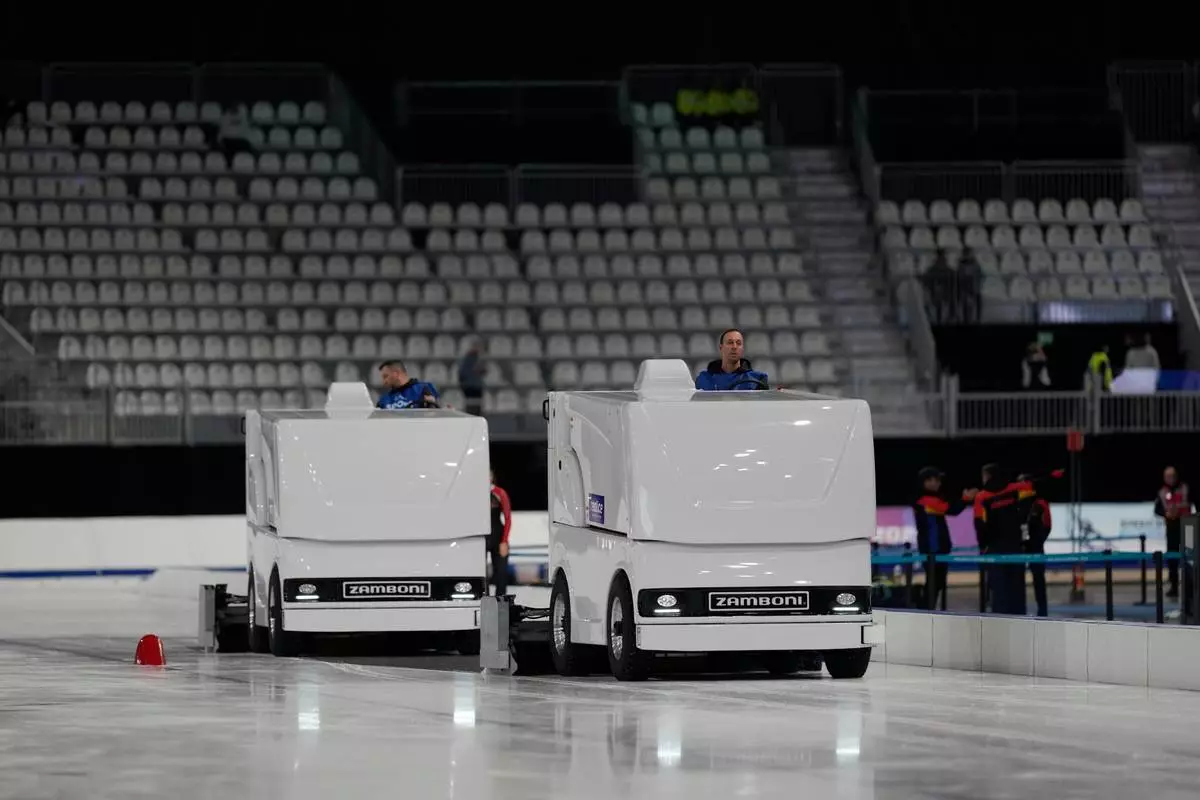
The Zamboni ice resurfacing machine plays a key role in keeping the track clean, cutting off a layer and spraying water to make a new surface.

One challenge is gauging how quickly the water from the resurfacing machine freezes in the temporary rink.

Another is getting the ice to the right thickness so that the Zamboni, weighing in at six tons, doesn’t shift the insulation, rubber tubing or ice itself.

“When you drive that out, if there’s anything moving it will move. We don’t want that,’’ Messer said.

The rink got its first big test on Nov. 29-30 during a Junior World Cup event. In a permanent rink, test events are usually held a year before the Olympics, leaving more time for adjustments. “We have a very small window to learn,’’ Messer acknowledged.

Dutch speedskater Kayo Vos, who won the men’s neo-senior 1,000 meters, said the ice was a little soft — but Messer didn’t seem too concerned.

“We went very modest to start, now we can start to change the temperatures and try to make it faster and still maintain it as a safe ice,’’ he said.

Fine-tuning the air temperature and humidity and ice temperature must be done methodically — taking into account that there will be 6,000 spectators in the venue for each event. The next real test will be on Jan. 31, when the Olympians take to the ice for their first training session.

“Eighty percent of the work is done but the hardest part is the last 20 percent, where we have to try to find the values and the way of running the equipment so all the skaters get the same conditions and all the skaters get the best conditions,’’ Messer said.

AP Winter Olympics: https://apnews.com/hub/milan-cortina-2026-winter-olympics

Serpentines are set on the ice of the stadium where speed skating discipline of the Milan Cortina 2026 Winter Olympics will take place, in Rho, outskirt of Milan, Tuesday, Nov. 11, 2025. (AP Photo/Luca Bruno)

Serpentines are set on the ice of the stadium where speed skating discipline of the Milan Cortina 2026 Winter Olympics will take place, in Rho, outskirt of Milan, Tuesday, Nov. 11, 2025. (AP Photo/Luca Bruno)

Ice Master Mark Messer poses in the stadium where speed skating discipline of the Milan Cortina 2026 Winter Olympics will take place, in Rho, outskirt of Milan, Tuesday, Nov. 11, 2025. (AP Photo/Luca Bruno)

Ice Master Mark Messer poses in the stadium where speed skating discipline of the Milan Cortina 2026 Winter Olympics will take place, in Rho, outskirt of Milan, Tuesday, Nov. 11, 2025. (AP Photo/Luca Bruno)

Workers clean the ice surface during a peed skating Junior World Cup and Olympic test event, in Rho, near Milan, Italy, Saturday, Nov. 29, 2025. (AP Photo/Luca Bruno)

Workers clean the ice surface during a peed skating Junior World Cup and Olympic test event, in Rho, near Milan, Italy, Saturday, Nov. 29, 2025. (AP Photo/Luca Bruno)

Ice Master Mark Messer poses in the stadium where speed skating discipline of the Milan Cortina 2026 Winter Olympics will take place, in Rho, outskirt of Milan, Tuesday, Nov. 11, 2025. (AP Photo/Luca Bruno)

Ice Master Mark Messer poses in the stadium where speed skating discipline of the Milan Cortina 2026 Winter Olympics will take place, in Rho, outskirt of Milan, Tuesday, Nov. 11, 2025. (AP Photo/Luca Bruno)

Ice Master Mark Messer poses in the stadium where speed skating discipline of the Milan Cortina 2026 Winter Olympics will take place, in Rho, outskirt of Milan, Tuesday, Nov. 11, 2025. (AP Photo/Luca Bruno)

Ice Master Mark Messer poses in the stadium where speed skating discipline of the Milan Cortina 2026 Winter Olympics will take place, in Rho, outskirt of Milan, Tuesday, Nov. 11, 2025. (AP Photo/Luca Bruno)

Recommended Articles