Skip to Content Facebook Feature Image

Chinese, Russian FMs agree to deepen practical cooperation, safeguard just int'l order

China

China

China

Chinese, Russian FMs agree to deepen practical cooperation, safeguard just int'l order

2025-04-02 05:04 Last Updated At:13:07

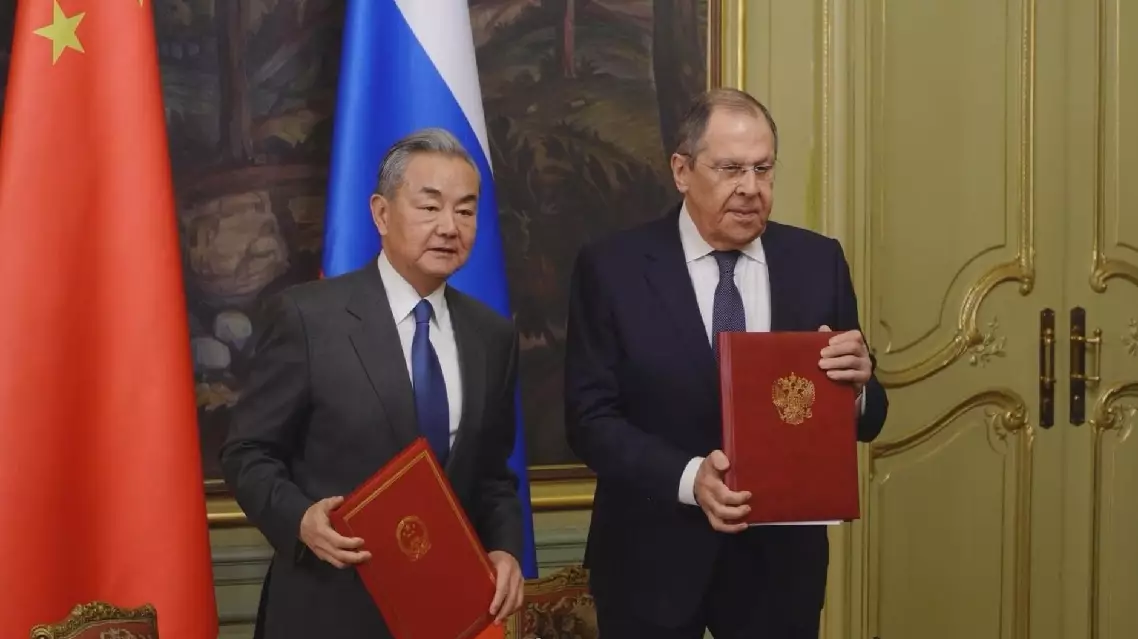
Chinese Foreign Minister Wang Yi and Russian Foreign Minister Sergey Lavrov agreed on Tuesday to jointly advance the development of bilateral relations and cooperation across various fields.

Wang is on an official visit to Russia where he held talks with Lavrov.

Wang, also a member of the Political Bureau of the Communist Party of China Central Committee, said Chinese President Xi Jinping and Russian President Vladimir Putin have twice engaged in strategic communication so far this year, guiding the steady progress of bilateral relations amid the major changes unseen in a century and making new important deployments to deepen comprehensive strategic coordination between the two countries.

China is willing to work with Russia to implement the consensus reached by the two heads of state, jointly advance the development of bilateral relations and cooperation across various fields, and continue to benefit the two peoples, Wang said.

Wang noted that this year marks the 80th anniversary of the victories of the Chinese People's War of Resistance Against Japanese Aggression, the Soviet Union's Great Patriotic War and the World Anti-Fascist War, as well as the 80th anniversary of the founding of the United Nations (UN).

China is willing to work with Russia to shoulder the special responsibilities as permanent members of the UN Security Council to safeguard the outcomes of World War II, as well as international fairness and justice, he said.

China is also ready to work with Russia to promote a multi-polar world and greater democracy in international relations, so as to make new contributions to the cause of peace and development, he added.

Wang expressed his confidence that under the strategic guidance of the two heads of state, the China-Russia comprehensive strategic partnership of coordination for a new era will gain fresh momentum and reach a new stage.

For his part, Lavrov said that Putin and Xi have injected strong impetus into bilateral strategic coordination, guiding bilateral relations to an unprecedented level.

Russia and China share a long tradition of good-neighborliness and friendship, a long border and broad common interests, Lavrov said, adding that Russia is willing to work with China in accordance with the guiding principles set by the two heads of state to achieve new results in bilateral relations.

Lavrov noted that facing the complex international landscape, Russia and China have maintained close coordination to inject stability to the world.

Russia highly appreciates the global initiatives that China proposed, fully supports China's position on the Taiwan question, and is willing to jointly uphold the purposes and principles of the UN Charter, and safeguard a just and equitable international order, he said.

The two sides agreed to strengthen coordination between the two foreign ministries and prepare for exchanges at all levels later this year, deepen practical cooperation in various fields and consolidate the material foundation of bilateral relations.

They pledged to make the China-Russia Years of Culture a success, enrich cultural exchanges and enhance friendship between the two peoples.

They also agreed to enhance coordination within frameworks such as the Shanghai Cooperation Organization, BRICS, the G20 and the UN to jointly safeguard the legitimate rights and interests of Global South countries.

The two sides also exchanged views on the Ukraine crisis. Lavrov said that Russia eyes for eliminating the root causes of the crisis and is committed to building a lasting security architecture for Eurasia.

Wang reiterated China's consistent position and expressed support for all peace efforts, noting that China is willing to continue to build more international consensus through the Group of Friends for Peace and play a constructive role in promoting a political settlement of the crisis.

The two sides also coordinated their positions on the current international situation, particularly developments in the Asia-Pacific region.
Chinese, Russian FMs agree to deepen practical cooperation, safeguard just int'l order
Chinese, Russian FMs agree to deepen practical cooperation, safeguard just int'l order
Chinese, Russian FMs agree to deepen practical cooperation, safeguard just int'l order


Chinese, Russian FMs agree to deepen practical cooperation, safeguard just int'l order

Chinese, Russian FMs agree to deepen practical cooperation, safeguard just int'l order

Chinese, Russian FMs agree to deepen practical cooperation, safeguard just int'l order

The Israeli government is set to prohibit 37 international aid organizations from operating in the Gaza Strip and the West Bank effective Jan 1, 2026, after authorities stated the groups failed to comply with stricter registration requirements, according to an Israeli media report on Tuesday.

The report from The Times of Israel cited the statement from Israel's Ministry of Diaspora Affairs and Combating Antisemitism, saying that the new regulations are based on security concerns aimed at removing non-government organizations' staff allegedly linked to so-called "terrorist organizations."

The report came after the Israeli government announced the same day that it would suspend the activities of several international aid organizations, including Doctors Without Borders, in the Gaza Strip starting January 1, 2026, citing the organizations' failure to submit information on their Palestinian staff as required.

Last year, Israel rolled out new regulations on registration requiring international aid groups to provide detailed information of their staff's names, funding sources, and operation status.

On Wednesday, Israel's Coordinator of Government Activities in the Territories stated that the registration mandates were necessary to prevent humanitarian supplies from being exploited by Hamas.

In an online interview with China Global Television Network (CGTN) on Wednesday, Bushra Khalidi, policy lead at Oxfam, a global organization that fights inequality to end poverty and injustice, said the impact of the ban will be "devastating."

"It is devastating. We've seen the numbers from the IPC (Integrated Food Security Phase Classification) a few weeks ago. We saw them in the summer. There's been a slight improvement, but that's not good enough for the time of a ceasefire. And six months after the famine was declared, we should have seen much more improvement in Gaza," said Khalidi.

"It's winter here in Palestine. It was raining. It rained a record (amount) of rain per millimeter yesterday in Palestine since 1992. So, the impact is devastating. But the fact that shelter materials, for example, cannot enter. For families, this will mean slower repairs. It will mean fewer supplies. It will mean a longer wait for basic services. It will directly affect the access to clean water, to sanitation, to shelter materials, to public health interventions. Aid that should be moving predictably will remain delayed, it will remain restricted and it will remain stranded," she added.

She also emphasized that the operating environment became nearly impossible for organizations to navigate long before the new ban was announced.

"We have been obstructed and blocked from operating freely and unobstructedly for the last two years by Israel. Israel has killed a record number of humanitarian workers in the last two years. It has bombed our premises, it has bombed our convoys, it has blocked our items. It has driven famine like conditions in Gaza because of blocking humanitarian access. So, I think it's really important to set that scene, is that what is happening now is nothing new. It only continues within the kind of campaign that Israel has orchestrated to drive basically the population of Gazans' survival. So, we are, we have not been able to enter any materials in since March, in fact, us and many other organizations. And of course that has severely restricted our ability to scale up our operations," said Khalidi.

Hadja Lahbib, European Commissioner for Equality, Preparedness and Crisis Management, said on Wednesday that Israel's move is no different from cutting off lifesaving supplies for the local population, adding that the European Union has made clear that all obstacles to humanitarian access must be lifted.

Israel bans operations of 37 int'l aid groups in Gaza Strip, West Bank

Israel bans operations of 37 int'l aid groups in Gaza Strip, West Bank

Recommended Articles