Skip to Content Facebook Feature Image

Frontgrade Gaisler Launches New GRAIN Line and Wins SNSA Contract to Commercialize First Energy-Efficient Neuromorphic AI for Space Applications

News

Frontgrade Gaisler Launches New GRAIN Line and Wins SNSA Contract to Commercialize First Energy-Efficient Neuromorphic AI for Space Applications
News

News

Frontgrade Gaisler Launches New GRAIN Line and Wins SNSA Contract to Commercialize First Energy-Efficient Neuromorphic AI for Space Applications

2025-04-02 14:01 Last Updated At:14:10

GOTHENBURG, Sweden--(BUSINESS WIRE)--Apr 2, 2025--

The Swedish National Space Agency (SNSA) has awarded Frontgrade Gaisler, a leading provider of radiation-hardened microprocessors for space missions, a contract to commercialize the first neuromorphic System on Chip (SoC) device for space applications. Already in development at Frontgrade Gaisler, the device is part of the company’s new GRAIN (Gaisler Research Artificial Intelligence NOEL-V) product line.

This press release features multimedia. View the full release here: https://www.businesswire.com/news/home/20250401194593/en/

The first GRAIN device that Frontgrade Gaisler will premiere – the Gr801 SoC – integrates Akida™ neuromorphic technology from BrainChip, the world’s first commercial producer of ultra-low power, fully digital, event-based, neuromorphic AI. The GR801 combines Gaisler’s NOEL-V RISC-V processor and the Akida neuromorphic AI processor into a single integrated circuit to enable energy-efficient AI applications in the space environment. Sweden’s Royal Institute of Technology (KTH) is contributing to this development by designing a demonstration application that uses a neuromorphic sensor directly connected to Gaisler’s new GR801 device.

Frontgrade Gaisler is designing the entire GRAIN product line to enable more advanced and autonomous space missions, and to enhance the space industry's capabilities in energy-efficient AI. The GR801 SoC will support both commercial and institutional space missions, enabling new applications and meeting strict power and weight constraints.

“Our latest innovation opens new avenues and complements our existing range of proven and reliable processing products,” said Sandi Habinc, General Manager at Frontgrade Gaisler. “GRAIN is an exciting new pursuit for Gaisler because we are well positioned to enable new capabilities for real-time data processing, autonomous navigation, Earth observation, and object detection and tracking.”

“Our continued collaboration with Frontgrade Gaisler to incorporate Akida IP into space SoCs showcases the importance of having environmentally hardened solutions, already proven to perform in the most extreme conditions,” said Sean Hehir, CEO of BrainChip. “We have worked hard to ensure our neuromorphic technology can meet the low-energy, low-latency, high-performance needs of GRAIN and other space-based devices in order to provide AI at – and beyond – the edge.”

Frontgrade Gaisler announced its new GRAIN product line at the second RISC-V in Space Workshop 2025, in Gothenburg, Sweden. The event focuses on how RISC-V technology is being leveraged in space systems, ranging from satellites to deep space missions. Learn more about the GRAIN product line at gaisler.com/grain

About Frontgrade Gaisler

Frontgrade Gaisler, a Frontgrade company, is a leading provider of radiation-hardened microprocessors and IP cores for critical applications, particularly in the space industry. The company’s processors are ideal for any space mission or other high-reliability application due to their reliability, fault tolerance, and radiation tolerance. Frontgrade Gaisler microprocessors can be found all over the solar system, from Mercury to Neptune.

About Frontgrade Technologies

Frontgrade Technologies is a leading provider of high-reliability, radiation-assured solutions for defense, intelligence, commercial, and civil applications. With over 60 years of space flight heritage, Frontgrade offers a complementary and integrated suite of mission-matched electronics, including rad-hard and rad-tolerant components, mission processing subsystems, amplifiers, custom ASICs, motion control systems, waveguides, antennas, and power management solutions.

About Swedish National Space Agency

The Swedish National Space Agency (SNSA) is an administrative authority under the Ministry of Education responsible for government-funded national and international space operations in Sweden in terms of research and development.

About KTH Royal Institute of Technology

The KTH Neurocomputing Systems team (NCS) led by Prof. Jörg Conradt contributes expertise in neuromorphic sensor and computing algorithms for the development of a demonstrator system. Fundamental research in neuromorphic computing at the NCS lab investigates theory, models, and applied implementations of distributed neuronal information processing, to (a) discover key principles by which large networks of neurons operate and (b) implement those in engineered systems to enhance their real world performance.

About BrainChip Holdings Ltd (ASX: BRN, OTCQX: BRCHF, ADR: BCHPY) BrainChip is the worldwide leader in Edge AI on-chip processing and learning. The company’s first-to-market, fully digital, event-based AI processor, Akida™, uses neuromorphic principles to mimic the human brain, analyzing only essential sensor inputs at the point of acquisition, processing data with unparalleled efficiency, precision, and economy of energy. Akida uniquely enables Edge learning local to the chip, independent of the cloud, dramatically reducing latency while improving privacy and data security. Akida Neural processor IP, which can be integrated into SoCs on any process technology, has shown substantial benefits on today’s workloads and networks, and offers a platform for developers to create, tune and run their models using standard AI workflows like Tensorflow/Keras. In enabling effective Edge compute to be universally deployable across real world applications such as connected cars, consumer electronics, and industrial IoT, BrainChip is proving that on-chip AI, close to the sensor, is the future, for its customers’ products, as well as the planet. BrainChip was founded in Australia in 2004 and is a public company listed on the Australian Stock Exchange (ASX). Explore the benefits of neuromorphic computing at www.brainchip.com.

Frontgrade Gaisler, a leading provider of radiation-hardened microprocessors for space missions, has launched its new Gaisler Research Artificial Intelligence NOEL-V (GRAIN) product line. The first GRAIN device to premiere – the Gr801 SoC – integrates Akida™ neuromorphic technology from BrainChip, the world’s first commercial producer of ultra-low power, fully digital, event-based, neuromorphic AI.
Frontgrade Gaisler, a leading provider of radiation-hardened microprocessors for space missions, has launched its new Gaisler Research Artificial Intelligence NOEL-V (GRAIN) product line. The first GRAIN device to premiere – the Gr801 SoC – integrates Akida™ neuromorphic technology from BrainChip, the world’s first commercial producer of ultra-low power, fully digital, event-based, neuromorphic AI.
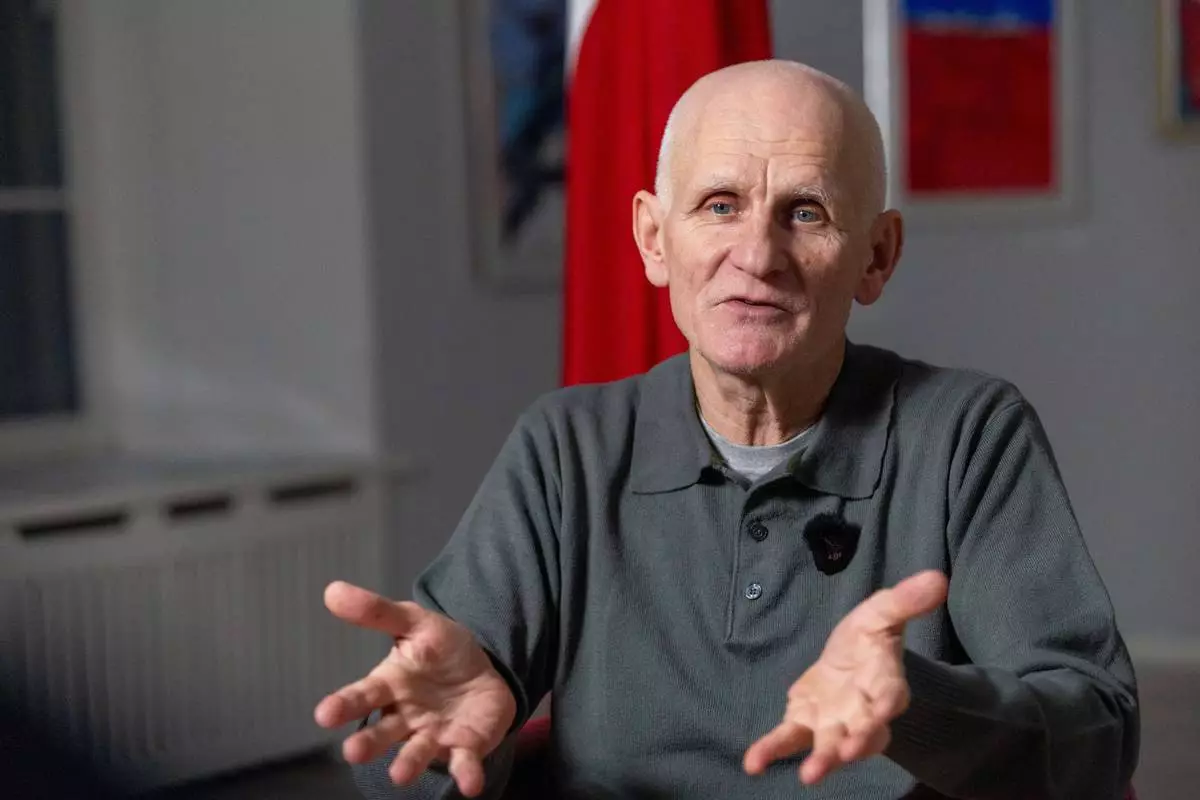
VILNIUS, Lithuania (AP) — Nobel Peace Prize laureate Ales Bialiatski arrived for an interview with The Associated Press on Sunday in the Lithuanian capital, Vilnius, direct from a dentist appointment.

The 63-year-old veteran human rights advocate was experiencing a return to daily life after more than four years behind bars in Belarus. He was suddenly released on Saturday.

Medical assistance in the penal colony where he served his 10-year sentence was very limited, he said in his first sit-down interview after release. There was only one option of treating dental problems behind bars — pulling teeth out, he said.

Bialiatski recalled how in the early hours of Saturday he was in an overcrowded prison cell in the Penal Colony no. 9 in eastern Belarus when suddenly he was ordered to pack his things. Blindfolded, he was driven somewhere: “They put a blindfold over my eyes. I was looking occasionally where we were headed, but only understood that we’re heading toward west.”

In Vilnius, he hugged his wife for the first time in years.

“When I crossed the border, it was as if I emerged from the bottom of the sea and onto the surface of the water. You have lots of air, sun, and back there you were in a completely different situation — under pressure,” he told the AP.

Bialiatski was one of 123 prisoners released by Belarus in exchange for the U.S. lifting sanctions imposed on the Belarusian potash sector, crucial for the country’s economy.

A close ally of Russia, Belarus has faced Western isolation and sanctions for years. Its authoritarian President Alexander Lukashenko has ruled the nation of 9.5 million with an iron fist for more than three decades, and the country has been repeatedly sanctioned by the West for its crackdown on human rights and for allowing Moscow to use its territory in the 2022 invasion of Ukraine.

In an effort at a rapprochement with the West, Belarus has released hundreds of prisoners since July 2024.

Bialiatski won the Nobel Peace Prize in 2022 along with the prominent Russian rights group Memorial and Ukraine’s Center for Civil Liberties. Awarded the prize while in jail awaiting trial, he was later convicted of smuggling and financing actions that violated the public order — charges widely denounced as politically motivated — and sentenced to 10 years in prison.

The veteran advocate, who founded Belarus’ oldest and most prominent human rights group, Viasna, was imprisoned at a penal colony in Gorki in a facility notorious for beatings and hard labor.

He told AP that he wasn’t beaten behind bars — his status as a Nobel Peace Prize laureate, perhaps, protected him from physical violence, he said.

But he said he went through much of what all political prisoners in Belarus go through: solitary confinement, arbitrary punishment for minor infractions, not being able to see your loved ones, rarely being able to receive letters.

“We can definitely talk about inhumane treatment, about creating conditions that violate your integrity and some kind of human dignity,” he said.

Bialiatski is concerned about two of his Viasna colleagues, Marfa Rabkova and Valiantsin Stefanovic, who remain imprisoned, and about all 1,110 political prisoners still behind bars, according to Viasna.

“Despite the fact that prisoners are being freed right now, new people regularly end up behind bars. Some kind of schizofrenia is taking place: with one hand, the authorities release Belarusian political prisoners, and with the other they take in more prisoners to trade, to maintain this abnormal situation in Belarus,” he said.

The advocate vows to continue to fight for the release of all political prisoners, adding: “There is no point in freeing old ones if you're taking in new ones.”

He intends to use his status as a Nobel Peace Prize laureate — of which he learned in prison and couldn't initially believe it — to help Belarusians “who chose freedom.”

“This prize was given not to me as a person, but to me as a representative of the Belarusian civil society, of the millions of Belarusians who expressed will and desire for democracy, for freedom, for human rights, for changing this stale situation in Belarus,” he told AP.

“And it was a signal to the Belarusian authorities, too, that it's time to change something in the life of the Belarusians.”

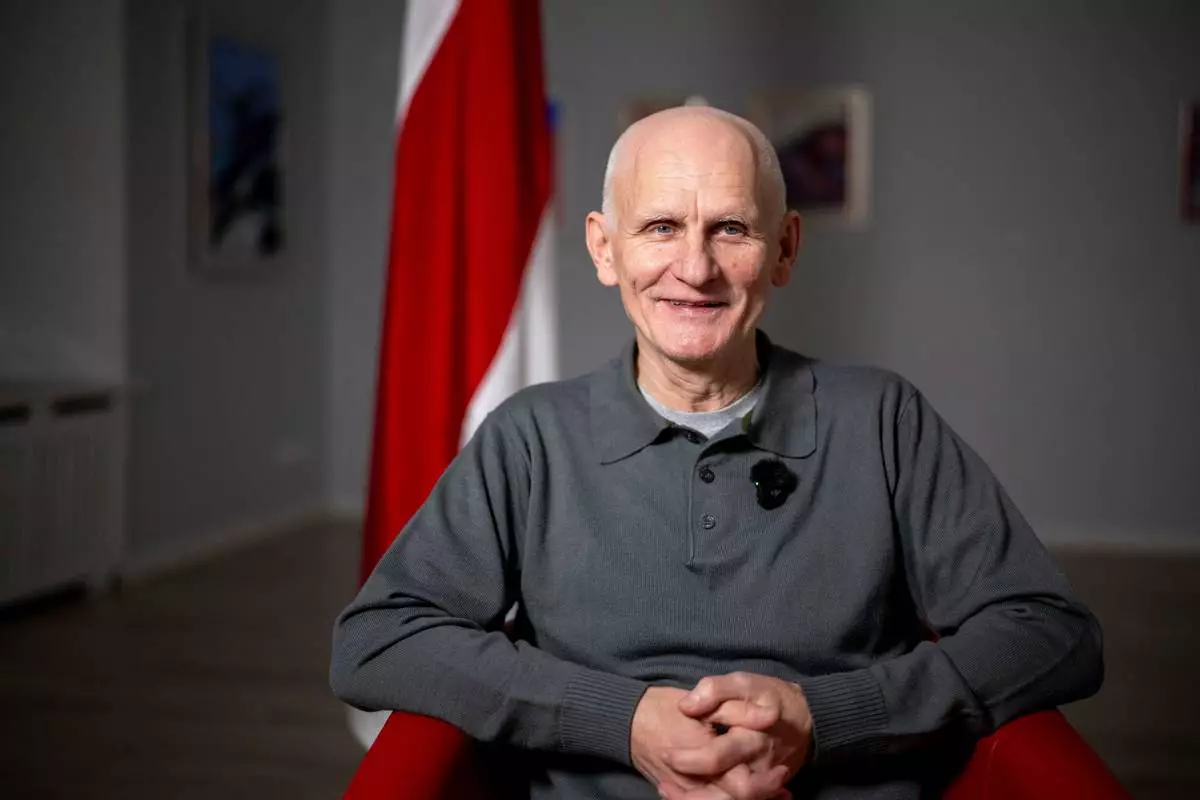
Nobel Peace Prize laureate Ales Bialiatski, one of the Belarusian prisoners released on Saturday, smiles during an interview with the Associated Press in Vilnius, Lithuania, on Sunday, Dec. 14, 2025. (AP Photo/Mindaugas Kulbis)

Nobel Peace Prize laureate Ales Bialiatski, one of the Belarusian prisoners released on Saturday, smiles during an interview with the Associated Press in Vilnius, Lithuania, on Sunday, Dec. 14, 2025. (AP Photo/Mindaugas Kulbis)

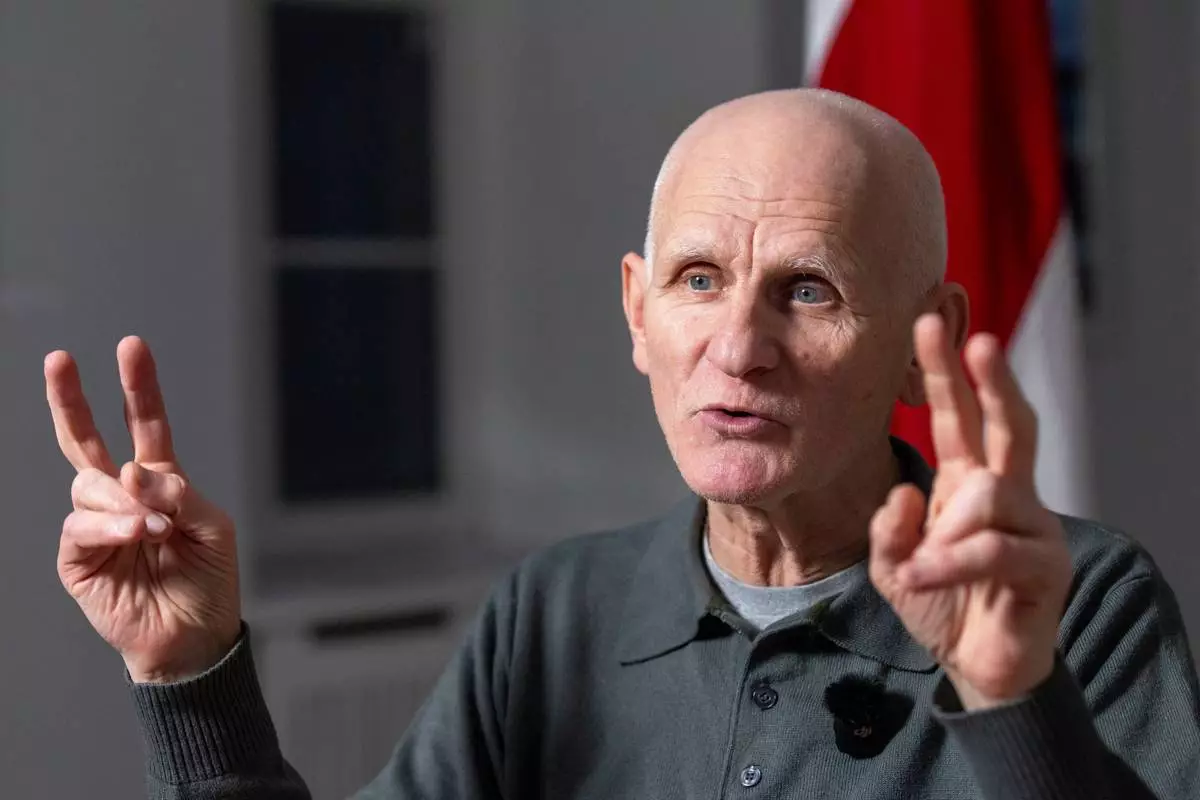
Nobel Peace Prize laureate Ales Bialiatski, one of the Belarusian prisoners released on Saturday, gestures during an interview with the Associated Press in Vilnius, Lithuania, on Sunday, Dec. 14, 2025. (AP Photo/Mindaugas Kulbis)

Nobel Peace Prize laureate Ales Bialiatski, one of the Belarusian prisoners released on Saturday, gestures during an interview with the Associated Press in Vilnius, Lithuania, on Sunday, Dec. 14, 2025. (AP Photo/Mindaugas Kulbis)

Nobel Peace Prize laureate Ales Bialiatski, one of the Belarusian prisoners released on Saturday, gestures during an interview with the Associated Press in Vilnius, Lithuania, on Sunday, Dec. 14, 2025. (AP Photo/Mindaugas Kulbis)

Nobel Peace Prize laureate Ales Bialiatski, one of the Belarusian prisoners released on Saturday, gestures during an interview with the Associated Press in Vilnius, Lithuania, on Sunday, Dec. 14, 2025. (AP Photo/Mindaugas Kulbis)

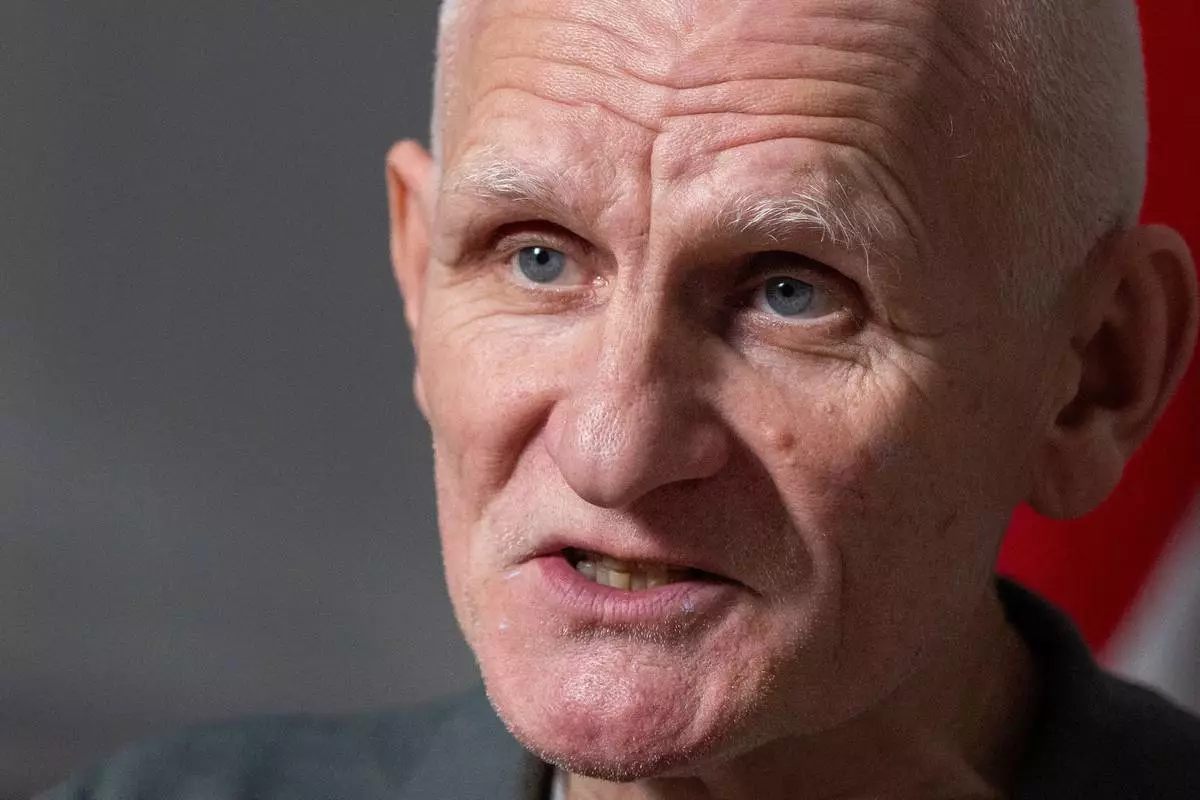
Nobel Peace Prize laureate Ales Bialiatski, one of the Belarusian prisoners released on Saturday, speaks during an interview with the Associated Press in Vilnius, Lithuania, on Sunday, Dec. 14, 2025. (AP Photo/Mindaugas Kulbis)

Nobel Peace Prize laureate Ales Bialiatski, one of the Belarusian prisoners released on Saturday, speaks during an interview with the Associated Press in Vilnius, Lithuania, on Sunday, Dec. 14, 2025. (AP Photo/Mindaugas Kulbis)

Recommended Articles