As the Qingming Festival approaches this Friday, various traditional folk activities have been held across China, celebrating the rich cultural heritage of the occasion.
With a 2,500-year history, Qingming Festival, or the Festival of Pure Brightness, observed in early April, uniquely combines ancestral worship with the celebration of spring. Falling on the 15th day after the spring equinox, this ritual-rich observance reflects China's enduring values of ancestral veneration and inspires deep introspection about what gives life meaning.
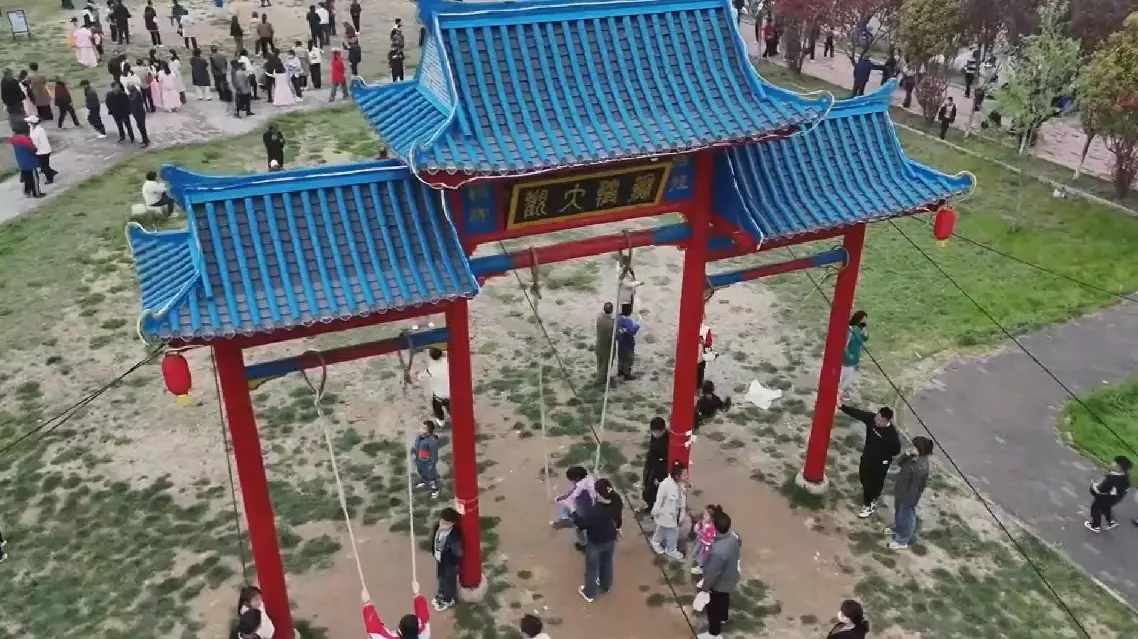
In Sijia Village, Huayin City, northwest China’s Shaanxi Province, a unique swing festival is held to mark the occasion. Eighteen different types of traditional swings, such as the spinning wheel swing, the Bagua swing reminiscent of a rotating carousel, and the balance swing designed for two people, have attracted many visitors.
Historically, Sijia Village served as a military post guarding the strategic Tongguan pass, a former mountain pass and fortress located south of the confluence of the Wei and Yellow Rivers. The swing tradition in the village has its origins in military training exercises like climbing and river crossing. The local swing culture further developed as regional trade flourished, eventually evolving into the "swing festival" that continues today.
"It's very exciting and tests your skill, endurance, and most importantly, your arm strength. You need to maintain balance," said Qu Xiangyang, a visitor.
In Rudong County, Nantong City, east China's Jiangsu Province, another traditional Qingming activity takes place - kite flying.
Flying kites as a way of making wishes is an age-old Qingming custom in this region. As a result, the Qingming Festival in Nantong is also known as the "Kite Festival."
The local Banyao whistling kite making skills is listed as one of the first national intangible cultural heritage items.
According to a folk culture expert, people traditionally write the names of diseases or misfortunes on paper, attach it to a kite, and release it into the sky. This practice is believed to drive away illness and disaster, while also serving as a way to make wishes.
In south China's Guangdong Province, a large tug-of-war competition is underway in Maoming City. Teams from different towns and streets are competing, attracting many locals to cheer on their teams.
Tug-of-war, which originated during the late Spring and Autumn period (770 BC - 476 BC), became part of Qingming customs during the Tang Dynasty (618-907). Emperor Xuanzong of the Tang Dynasty once organized large-scale tug-of-war competitions for the festival.
"Tug-of-war became very popular in the Tang Dynasty, even emerging as the national sport. It originated in the Jingchu region and later spread across the country. In ancient Lingnan (Southern China), tug-of-war games were a common tradition. Through these events, people seek to pray for peace, prosperity, and abundant harvests," said Yao Guojun, vice dean of the College of Arts and Law, Guangdong University of Petrochemical Technology.
Traditional folk activities held for Qingming Festival