WASHINGTON (AP) — The Energy Department has identified thousands of federal workers it deems "nonessential” and would not be protected if there is another round of large-scale firings, according to a document obtained by The Associated Press.
The jobs at risk include more than 8,500 positions across the Energy Department and the National Nuclear Security Administration — which upgrades and maintains the nation's nuclear warheads. The department identified them as eligible to be cut to meet the goals of President Donald Trump’s executive order for mass reductions in federal employees.
It was not clear if every position identified as nonessential would be eliminated. All federal agencies had until March 13 to identify what departments and positions could be consolidated in a planning process to streamline the agencies and ready them for potential “large scale reductions in force,” Trump’s Feb. 26 order directed.
Asked if large-scale firings are coming, the Energy Department, through spokesperson Ben Dietderich, said multiple plans are being considered and no final decisions have been made.
Sen. Patty Murray of Washington and Rep. Marcy Kaptur of Ohio said gutting the department would raise energy costs for families and businesses, slow innovation and put national and global security at risk.
“It is extremely concerning that the department is reportedly considering firing the very experts tasked with maintaining a safe, secure and reliable nuclear weapons stockpile,” the two Democrats said in a joint statement to The Associated Press. “These dangerous cuts should not transpire. We call for this foolishness to be set aside.”
There are about 17,500 federal positions within the department, which has a wide range of responsibilities beyond those for nuclear weapons. It also operates hydroelectric dams, cleans up contaminated radioactive waste sites, maintains and modernizes the power grid and provides grants for things like home weatherization. Only 9,004 of those positions were deemed essential, according to the document.
The majority of the employees within the National Nuclear Security Administration were deemed essential, according to the document. The majority of the national labs operated by the Energy Department are run by contractors and also would not be affected.
In February, the Trump administration ended up scrambling to reinstate hundreds of National Nuclear Security Administration employees who were laid off by Elon Musk's Department of Government Efficiency after it became apparent many were directly supporting nuclear weapons management.
About 3,000 employees at the Energy Department work directly for the nuclear security agency, which manages national security complexes nationwide where nuclear weapons material and warhead components are stored and refurbished to maintain the nuclear weapons stockpile.
According to the document, about 500 positions at the nuclear security agency and about 8,000 jobs across the Energy Department were deemed nonessential. Some of those have already been reduced through deferred resignations.
Energy Secretary Chris Wright has said the department grew too big during the Biden administration in the last four years and now he’s right-sizing it. He acknowledged publicly that it was a mistake to lay off the nuclear security agency workers in February.
Unlike some of the other federal agencies where cuts have left a deep impact on employment in the national capital region, much of the Energy Department's workforce is scattered throughout the country in different energy sectors.
An earlier round targeted probationary employees but was thrown out by a federal judge.

President Donald Trump waves as he arrives at the Trump International Golf Club, Friday, April 4, 2025, in West Palm Beach, Fla. (AP Photo/Alex Brandon)

FILE - Tesla CEO Elon Musk attends the opening of the Tesla factory Berlin Brandenburg in Gruenheide, Germany, March 22, 2022. (Patrick Pleul/Pool via AP, File)
WASHINGTON (AP) — President Donald Trump is meeting with oil executives at the White House on Friday in hopes of securing $100 billion in investments to revive Venezuela’s ability to fully tap into its expansive reserves of petroleum — a plan that rides on their comfort in making commitments in a country plagued by instability, inflation and uncertainty.
Since the U.S. military raid to capture former Venezuelan leader Nicolás Maduro on Saturday, Trump has quickly pivoted to portraying the move as a newfound economic opportunity for the U.S., seizing tankers carrying Venezuelan oil, saying the U.S. is taking over the sales of 30 million to 50 million barrels of previously sanctioned Venezuelan oil and will be controlling sales worldwide indefinitely.
On Friday, U.S. forces seized their fifth tanker over the past month that has been linked to Venezuelan oil. The action reflected the determination of the U.S. to fully control the exporting, refining and production of Venezuelan petroleum, a sign of the Trump administration's plans for ongoing involvement in the sector as it seeks commitments from private companies.
It's all part of a broader push by Trump to keep gasoline prices low. At a time when many Americans are concerned about affordability, the incursion in Venezuela melds Trump’s assertive use of presidential powers with an optical spectacle meant to convince Americans that he can bring down energy prices.
The meeting, set for 2:30 p.m. EST, will be open to the news media, according to an update to the president's daily schedule. “At least 100 Billion Dollars will be invested by BIG OIL, all of whom I will be meeting with today at The White House,” Trump said Friday in a pre-dawn social media post.
Trump is set to meet with executives from 17 oil companies, according to the White House. Among the companies attending are Chevron, which still operates in Venezuela, and ExxonMobil and ConocoPhillips, which both had oil projects in the country that were lost as part of a 2007 nationalization of private businesses under Maduro’s predecessor, Hugo Chávez.
The president is meeting with a wide swath of domestic and international companies with interests ranging from construction to the commodity markets. Other companies slated to be at the meeting include Halliburton, Valero, Marathon, Shell, Singapore-based Trafigura, Italy-based Eni and Spain-based Repsol.
Large U.S. oil companies have so far largely refrained from affirming investments in Venezuela as contracts and guarantees need to be in place. Trump has suggested on social media that America would help to backstop any investments.
Venezuela’s oil production has slumped below one million barrels a day. Part of Trump's challenge to turn that around will be to convince oil companies that his administration has a stable relationship with Venezuela’s interim President Delcy Rodríguez, as well as protections for companies entering the market.
Secretary of State Marco Rubio, Energy Secretary Chris Wright and Interior Secretary Doug Burgum are slated to attend the oil executives meeting, according to the White House.
Meanwhile, the United States and Venezuelan governments said Friday they were exploring the possibility of r estoring diplomatic relations between the two countries, and that a delegation from the Trump administration arrived to the South American nation on Friday.
The small team of U.S. diplomats and diplomatic security officials traveled to Venezuela to make a preliminary assessment about the potential re-opening of the U.S. Embassy in Caracas, the State Department said in a statement.
Trump also announced on Friday he’d meet with President Gustavo Petro in early February, but called on the Colombian leader to make quick progress on stemming flow of cocaine into the U.S.
Trump, following the ouster of Maduro, had made vague threats to take similar action against Petro. Trump abruptly changed his tone Wednesday about his Colombian counterpart after a friendly phone call in which he invited Petro to visit the White House.
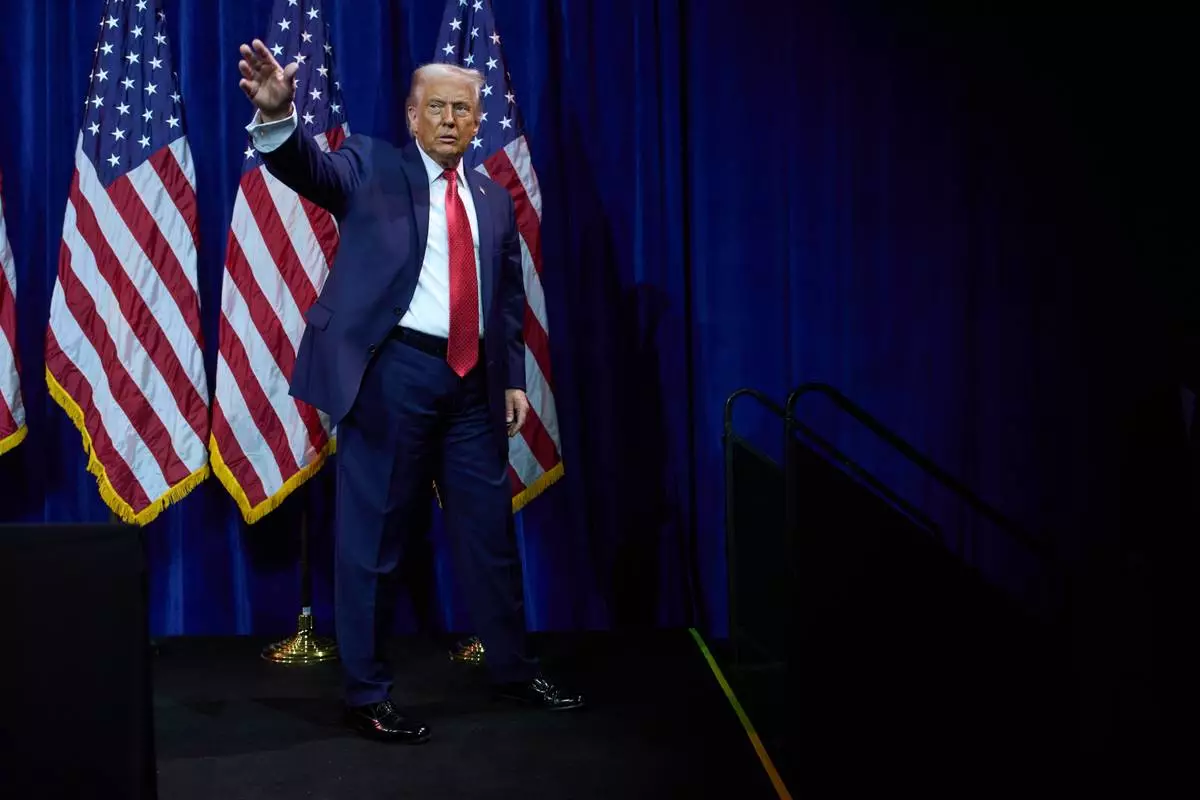
President Donald Trump waves as he walks off stage after speaking to House Republican lawmakers during their annual policy retreat, Tuesday, Jan. 6, 2026, in Washington. (AP Photo/Evan Vucci)