Skip to Content Facebook Feature Image

Congress has the power to halt Trump's tariffs. But Republicans aren't ready to use it

News

Congress has the power to halt Trump's tariffs. But Republicans aren't ready to use it
News

News

Congress has the power to halt Trump's tariffs. But Republicans aren't ready to use it

2025-04-05 03:27 Last Updated At:03:30

WASHINGTON (AP) — As stock markets tumble in the aftermath of President Donald Trump's sweeping tariffs, Republicans in Congress were watching with unease and talking of clawing back their power to levy tariffs — but almost none seemed ready to turn their words into action.

The Republican president is upending longstanding GOP principles like support for free trade, yet despite clear misgivings and a Constitutional mandate to decide tariffs, most lawmakers were not ready to cross Trump. Instead, they were focusing all their attention on advancing the president's " big, beautiful bill ” of tax breaks and spending cuts, even as tariffs — in essence, import taxes — threatened to raise consumer prices across the board and push the global economy into a recession.

More Images
House Minority Leader Hakeem Jeffries, D-N.Y., criticizes the agenda of President Donald Trump and the tactics of billionaire Elon Musk in a pivotal Wisconsin election where Democrats won, during a news conference at the Capitol, in Washington, Wednesday, April 2, 2025. (AP Photo/J. Scott Applewhite)

House Minority Leader Hakeem Jeffries, D-N.Y., criticizes the agenda of President Donald Trump and the tactics of billionaire Elon Musk in a pivotal Wisconsin election where Democrats won, during a news conference at the Capitol, in Washington, Wednesday, April 2, 2025. (AP Photo/J. Scott Applewhite)

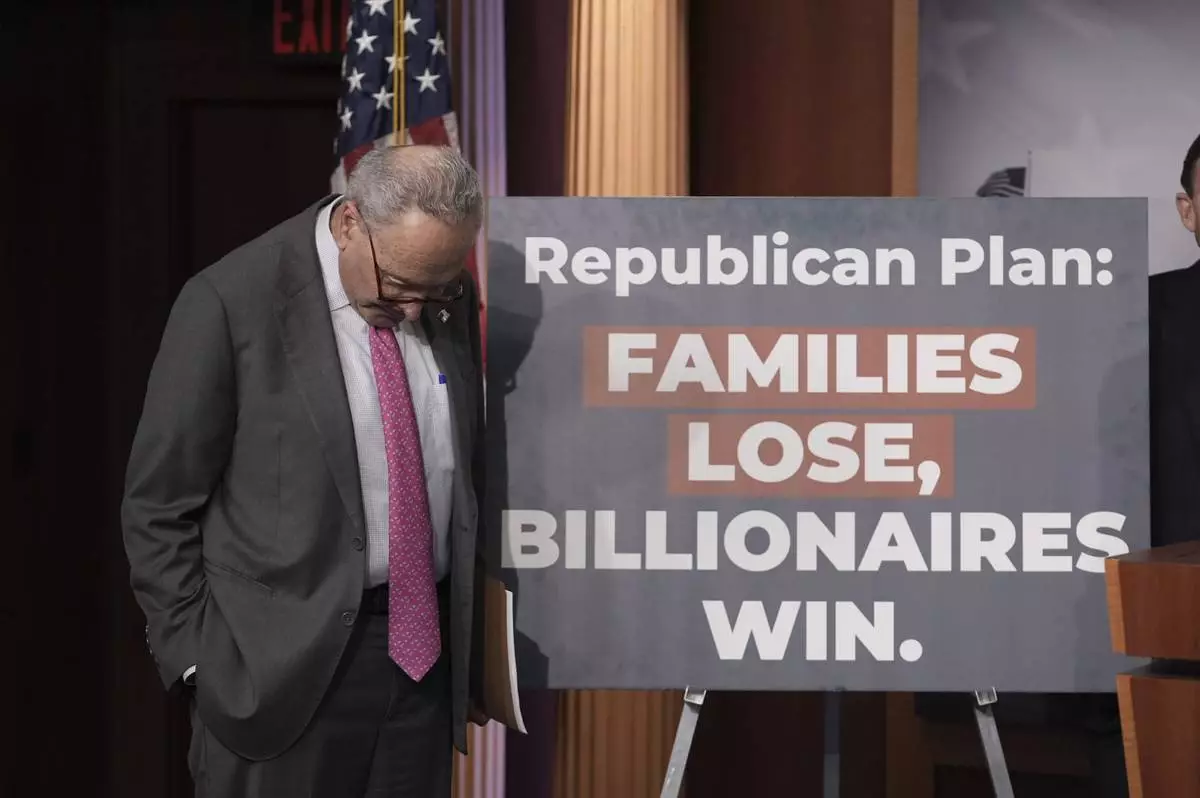
Senate Minority Leader Chuck Schumer, D-N.Y., attends a news conference discussing the Republican-backed budget plan at the Capitol, in Washington, Thursday, April 3, 2025. (AP Photo/J. Scott Applewhite)

Senate Minority Leader Chuck Schumer, D-N.Y., attends a news conference discussing the Republican-backed budget plan at the Capitol, in Washington, Thursday, April 3, 2025. (AP Photo/J. Scott Applewhite)

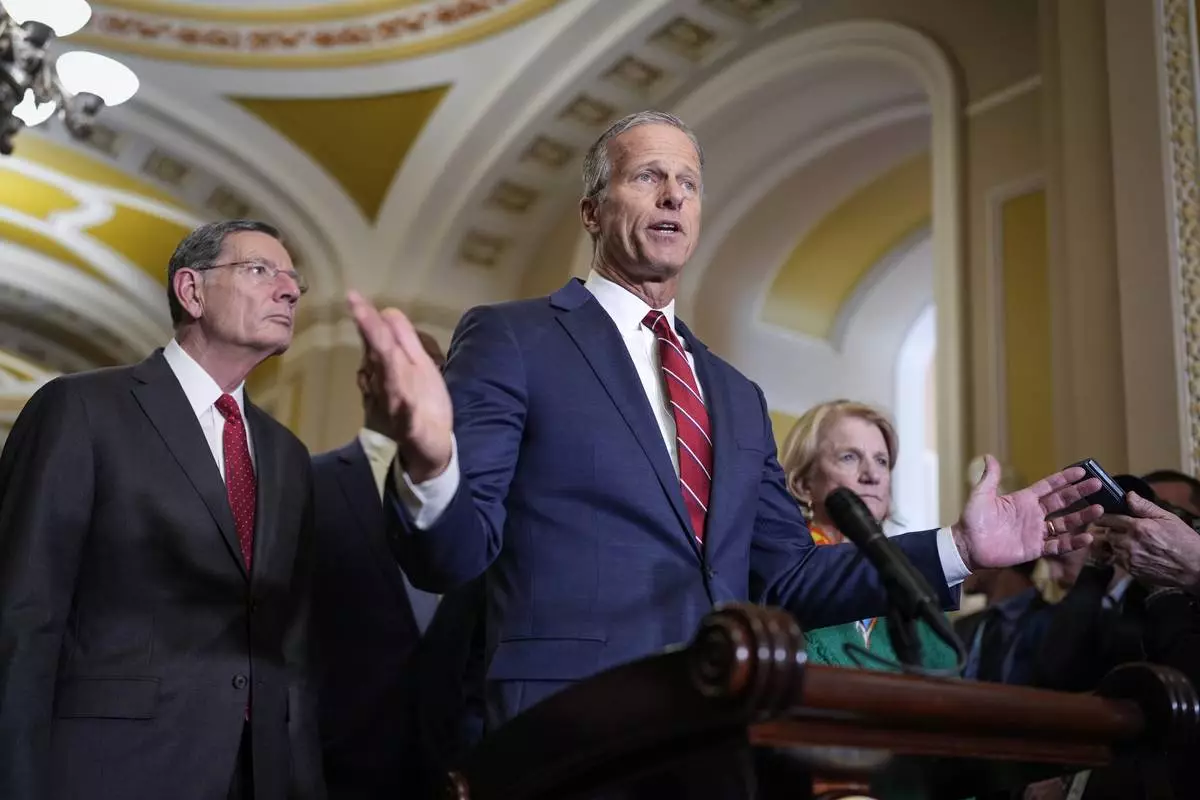
Senate Majority Leader John Thune, R-S.D., joined by Sen. John Barrasso, R-Wyo., the GOP whip, left, talks to reporters ahead of announcements by President Donald Trump on tariffs, at the Capitol, in Washington, Tuesday, April 1, 2025. (AP Photo/J. Scott Applewhite)

Senate Majority Leader John Thune, R-S.D., joined by Sen. John Barrasso, R-Wyo., the GOP whip, left, talks to reporters ahead of announcements by President Donald Trump on tariffs, at the Capitol, in Washington, Tuesday, April 1, 2025. (AP Photo/J. Scott Applewhite)

Speaker of the House Mike Johnson, R-La., talks with reporters as he arrives for a closed-door strategy session with fellow Republicans ahead of announcements by President Donald Trump on tariffs, at the Capitol, in Washington, Tuesday, April 1, 2025. (AP Photo/J. Scott Applewhite)

Speaker of the House Mike Johnson, R-La., talks with reporters as he arrives for a closed-door strategy session with fellow Republicans ahead of announcements by President Donald Trump on tariffs, at the Capitol, in Washington, Tuesday, April 1, 2025. (AP Photo/J. Scott Applewhite)

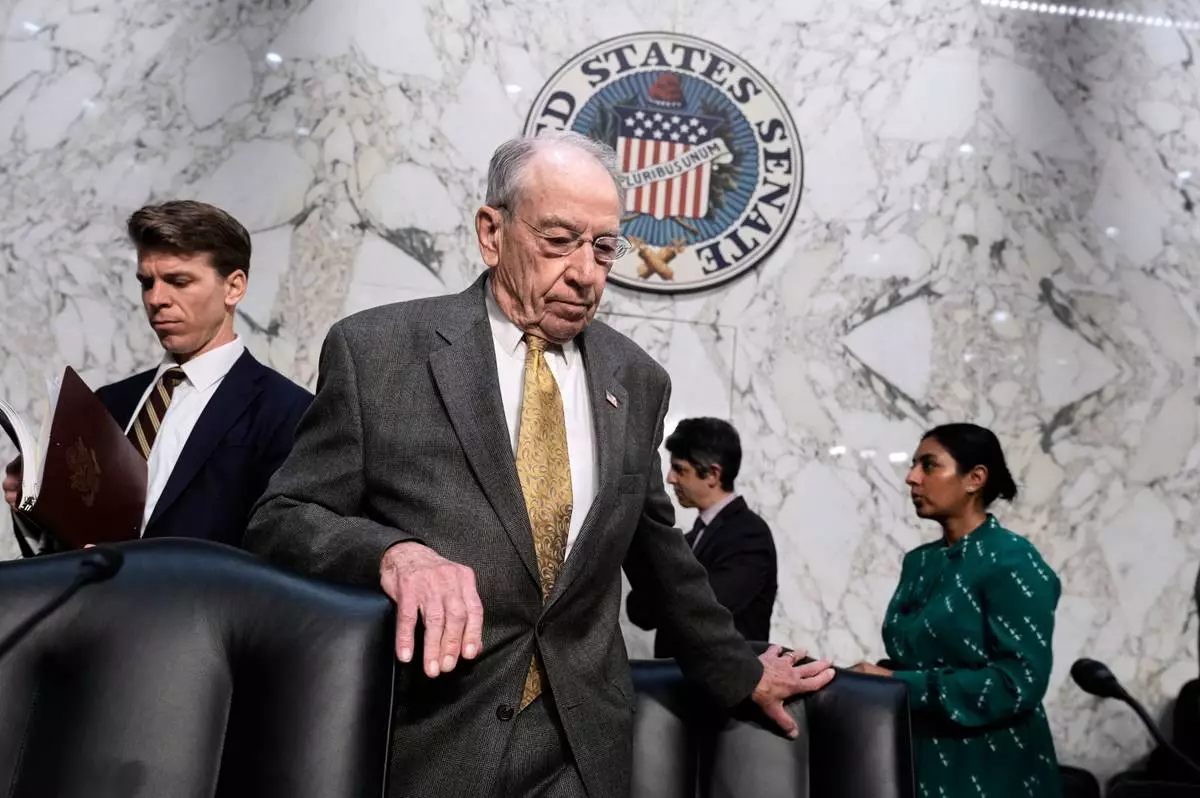
Senate Judiciary Committee Chairman Chuck Grassley, R- Iowa, takes his seat as the panel meets to consider prescription drug pricing and other measures, at the Capitol in Washington, Thursday, April 3, 2025. (AP Photo/J. Scott Applewhite)

Senate Judiciary Committee Chairman Chuck Grassley, R- Iowa, takes his seat as the panel meets to consider prescription drug pricing and other measures, at the Capitol in Washington, Thursday, April 3, 2025. (AP Photo/J. Scott Applewhite)

As the fallout from Trump's announcement reverberated around global markets, Senate Majority Leader John Thune, who has made it clear he is no fan of tariffs, told reporters that he would give Trump "the benefit of the doubt” in hopes that the announcement was just a scare tactic to prod foreign leaders into negotiating better trade deals with the U.S.

“The president is a dealmaker if nothing else, and he's going to continue to deal country by country with each of them,” said Sen. John Barrasso, a Wyoming Republican who is no. 2 in GOP Senate leadership. He added that Treasury Secretary Scott Bessent had told Senate Republicans this week that the tariffs announced by Trump would be a “high level mark with the ultimate goal of getting them reduced” unless other countries retaliate.

But countries like China are already retaliating with tariffs of their own, and while the president has signaled he is open to negotiations, he was mostly sounding a defiant tone Friday, saying on social media that “MY POLICIES WILL NEVER CHANGE” while claiming that foreign investors were lining up to invest in U.S. industries. He was on the golf course Friday near his Mar-a-Lago private club in Florida.

Congress, however, was jittery.

A handful of Republicans have rebuked Trump's strategy as a foolhardy path that will burden U.S. households. Kentucky Sen. Mitch McConnell, the longtime Senate leader who was the standard-bearer for past generations of Republicans, released a lengthy statement saying, “As I have always warned, tariffs are bad policy, and trade wars with our partners hurt working people most.”

McConnell and three other Republicans joined with Democrats this week to help pass a resolution that would nullify Trump's tariffs on Canada, sending a rebuke to the president just hours after his “Liberation Day” announcement. But House Speaker Mike Johnson quickly indicated he has no interest in giving the resolution a vote.

Lawmakers' struggle to act showed the divide among Republicans on trade policy, with a mostly younger group of Republicans fiercely backing Trump's strategy. Rather than heed traditional free trade doctrine, they argue for “America First” protectionism and hope it will revive U.S. manufacturing.

Republican Sen. Josh Hawley said that workers in his home state of Missouri were “absolutely thrilled” with the tariffs. “We've been losing jobs left and right. Farmers want to see a fair deal for our products, both in Canada and in Mexico and from the (European Union)," he added.

For their part, Democrats slammed Trump's tariffs as a reckless maneuver meant to do nothing more than raise funds for the tax breaks Trump and Republicans are trying to pass.

“Why would he raise the costs on American families by $5,000, as it’s estimated? Simply because his very wealthy billionaire friends want a greater tax break,” Senate Democratic Leader Chuck Schumer said in a floor speech Friday.

Other Democrats challenged more Republicans to stand up to Trump. “If they truly believe in capitalism, they need to put their votes where capitalism is and that is that competition works, our world relationships work,” said Sen. Amy Klobuchar, D-Minn., at a news conference.

“Donald Trump is taking us backwards to the Great Depression,” she added.

Sen. Rand Paul, a Kentucky Republican who holds libertarian economic views, has been highly critical of the tariffs, warning they create the same economic problems that exacerbated the Great Depression. He is calling for Congress to reject Trump's plans with legislation that would require congressional approval for taxes on imports.

Other Republicans were looking for roundabout ways to check the president's power on trade policy. Sen. Chuck Grassley, a senior Republican from Iowa, introduced a bipartisan bill Thursday that would require presidents to justify new tariffs to Congress. Lawmakers would then have to approve the tariffs within 60 days, or they would expire.

Although Grassley emphasized that he had long been working on the idea, the timing of the bill was notable. It gave Republicans a chance to talk about their distaste for import taxes and raised the prospect of Congress clawing back some of its power over tariffs. The Constitution gives Congress the responsibility of setting taxes and tariffs, but over the last century, lawmakers have ceded much of their power over import taxes to the president.

A handful of Republicans said they were favorable to Grassley's proposal, though the idea of directly defying Trump seemed to squelch potential for quick action.

“I don’t want to do it in a politically charged environment,” said Sen. Mike Rounds, a South Dakota Republican. “But I absolutely agree. This was set up by the Founding Fathers to be Congress’s role. And, I think we’re way past the point of what the Founding Fathers ever wanted to have happen."

Democratic Sen. Brian Schatz seized on the hesitation from Republicans, saying on social media Friday that the Senate would overwhelmingly repeal or constrain tariff authority “if every Senator voted their conscience and their state’s interest.”

“Mostly everyone hates this, they are just too afraid of the Mad King at the moment,” Schatz added.

Sen. John Kennedy, a Louisiana Republican, also predicted the bill would never pass “because of the voting requirements in the Senate.”

But he was still taking to social media to offer a folksy bit of advice: “Tariffs are like whiskey: A little whiskey, under the right circumstances, can be refreshing — but too much whiskey, under the wrong circumstances, can make you drunk as a goat.”

Associated Press writer Kevin Freking contributed
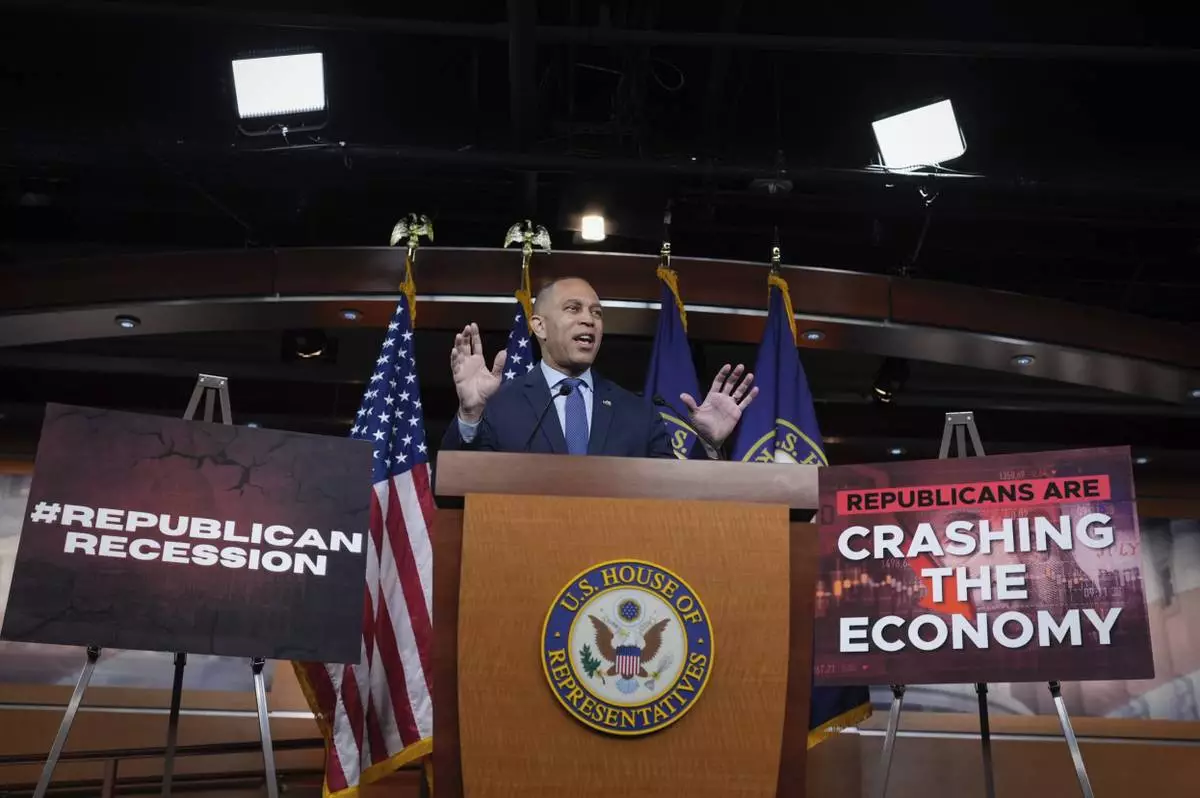
House Minority Leader Hakeem Jeffries, D-N.Y., criticizes the agenda of President Donald Trump and the tactics of billionaire Elon Musk in a pivotal Wisconsin election where Democrats won, during a news conference at the Capitol, in Washington, Wednesday, April 2, 2025. (AP Photo/J. Scott Applewhite)
House Minority Leader Hakeem Jeffries, D-N.Y., criticizes the agenda of President Donald Trump and the tactics of billionaire Elon Musk in a pivotal Wisconsin election where Democrats won, during a news conference at the Capitol, in Washington, Wednesday, April 2, 2025. (AP Photo/J. Scott Applewhite)

Senate Minority Leader Chuck Schumer, D-N.Y., attends a news conference discussing the Republican-backed budget plan at the Capitol, in Washington, Thursday, April 3, 2025. (AP Photo/J. Scott Applewhite)
Senate Minority Leader Chuck Schumer, D-N.Y., attends a news conference discussing the Republican-backed budget plan at the Capitol, in Washington, Thursday, April 3, 2025. (AP Photo/J. Scott Applewhite)

Senate Majority Leader John Thune, R-S.D., joined by Sen. John Barrasso, R-Wyo., the GOP whip, left, talks to reporters ahead of announcements by President Donald Trump on tariffs, at the Capitol, in Washington, Tuesday, April 1, 2025. (AP Photo/J. Scott Applewhite)

Senate Majority Leader John Thune, R-S.D., joined by Sen. John Barrasso, R-Wyo., the GOP whip, left, talks to reporters ahead of announcements by President Donald Trump on tariffs, at the Capitol, in Washington, Tuesday, April 1, 2025. (AP Photo/J. Scott Applewhite)
Speaker of the House Mike Johnson, R-La., talks with reporters as he arrives for a closed-door strategy session with fellow Republicans ahead of announcements by President Donald Trump on tariffs, at the Capitol, in Washington, Tuesday, April 1, 2025. (AP Photo/J. Scott Applewhite)

Speaker of the House Mike Johnson, R-La., talks with reporters as he arrives for a closed-door strategy session with fellow Republicans ahead of announcements by President Donald Trump on tariffs, at the Capitol, in Washington, Tuesday, April 1, 2025. (AP Photo/J. Scott Applewhite)

Senate Judiciary Committee Chairman Chuck Grassley, R- Iowa, takes his seat as the panel meets to consider prescription drug pricing and other measures, at the Capitol in Washington, Thursday, April 3, 2025. (AP Photo/J. Scott Applewhite)

Senate Judiciary Committee Chairman Chuck Grassley, R- Iowa, takes his seat as the panel meets to consider prescription drug pricing and other measures, at the Capitol in Washington, Thursday, April 3, 2025. (AP Photo/J. Scott Applewhite)

WASHINGTON (AP) — Sluggish December hiring concluded a year of weak employment gains that have frustrated job seekers even though layoffs and unemployment have remained low.

Employers added just 50,000 jobs last month, nearly unchanged from a downwardly revised figure of 56,000 in November, the Labor Department said Friday. The unemployment rate slipped to 4.4%, its first decline since June, from 4.5% in November, a figure also revised lower.

The data suggests that businesses are reluctant to add workers even as economic growth has picked up. Many companies hired aggressively after the pandemic and no longer need to fill more jobs. Others have held back due to widespread uncertainty caused by President Donald Trump’s shifting tariff policies, elevated inflation, and the spread of artificial intelligence, which could alter or even replace some jobs.

Still, economists were encouraged by the drop in the unemployment rate, which had risen in the previous four straight reports. It had also alarmed officials at the Federal Reserve, prompting three cuts to the central bank's key interest rate last year. The decline lowered the odds of another rate reduction in January, economists said.

“The labor market looks to have stabilized, but at a slower pace of employment growth,” Blerina Uruci, chief economist at T. Rowe Price, said. There is no urgency for the Fed to cut rates further, for now."

Some Federal Reserve officials are concerned that inflation remains above their target of 2% annual growth, and hasn't improved since 2024. They support keeping rates where they are to combat inflation. Others, however, are more worried that hiring has nearly ground to a halt and have supported lowering borrowing costs to spur spending and growth.

November's job gain was revised slightly lower, from 64,000 to 56,000, while October's now shows a much steeper drop, with a loss of 173,000 positions, down from previous estimates of a 105,000 decline. The government revises the jobs figures as it receives more survey responses from businesses.

The economy has now lost an average of 22,000 jobs a month in the past three months, the government said. A year ago, in December 2024, it had gained 209,000 a month. Most of those losses reflect the purge of government workers by Elon Musk's Department of Government Efficiency.

Nearly all the jobs added in December were in the health care and restaurant and hotel industries. Health care added 38,500 jobs, while restaurants and hotels gained 47,000. Governments — mostly at the state and local level — added 13,000.

Manufacturing, construction and retail companies all shed jobs. Retailers cut 25,000 positions, a sign that holiday hiring has been weaker than previous years. Manufacturers have shed jobs every month since April, when Trump announced sweeping tariffs intended to boost manufacturing.

Wall Street and Washington are looking closely at Friday's report as it's the first clean reading on the labor market in three months. The government didn’t issue a report in October because of the six-week government shutdown, and November’s data was distorted by the closure, which lasted until Nov. 12.

The hiring slowdown reflects more than just a reluctance by companies to add jobs. With an aging population and a sharp drop in immigration, the economy doesn't need to create as many jobs as it has in the past to keep the unemployment rate steady. As a result, a gain of 50,000 jobs is not as clear a sign of weakness as it would have been in previous years.

And layoffs are still low, a sign firms aren't rapidly cutting jobs, as typically happens in a recession. The “low-hire, low-fire” job market does mean current workers have some job security, though those without jobs can have a tougher time.

Ernesto Castro, 44, has applied for hundreds of jobs since leaving his last in May. Yet the Los Angeles resident has gotten just three initial interviews, and only one follow-up, after which he heard nothing.

With nearly a decade of experience providing customer support for software companies, Castro expected to find a new job pretty quickly as he did in 2024.

“I should be in a good position,” Castro said. “It’s been awful.”

He worries that more companies are turning to artificial intelligence to help clients learn to use new software. He hears ads from tech companies that urge companies to slash workers that provide the kind of services he has in his previous jobs. His contacts in the industry say that employees are increasingly reluctant to switch jobs amid all the uncertainty, which leaves fewer open jobs for others.

He is now looking into starting his own software company, and is also exploring project management roles.

December’s report caps a year of sluggish hiring, particularly after April's “liberation day” tariff announcement by Trump. The economy generated an average of 111,000 jobs a month in the first three months of 2025. But that pace dropped to just 11,000 in the three months ended in August, before rebounding slightly to 22,000 in November.

Last year, the economy gained just 584,000 jobs, sharply lower than that more than 2 million added in 2024. It's the smallest annual gain since the COVID-19 pandemic decimated the job market in 2020.

Subdued hiring underscores a key conundrum surrounding the economy as it enters 2026: Growth has picked up to healthy levels, yet hiring has weakened noticeably and the unemployment rate has increased in the last four jobs reports.

Most economists expect hiring will accelerate this year as growth remains solid, and Trump's tax cut legislation is expected to produce large tax refunds this spring. Yet economists acknowledge there are other possibilities: Weak job gains could drag down future growth. Or the economy could keep expanding at a healthy clip, while automation and the spread of artificial intelligence reduces the need for more jobs.

Productivity, or output per hour worked, a measure of worker efficiency, has improved in the past three years and jumped nearly 5% in the July-September quarter. That means companies can produce more without adding jobs. Over time, it should also boost worker pay.

Even with such sluggish job gains, the economy has continued to expand, with growth reaching a 4.3% annual rate in last year's July-September quarter, the best in two years. Strong consumer spending helped drive the gain. The Federal Reserve Bank of Atlanta forecasts that growth could slow to a still-solid 2.7% in the final three months of last year.

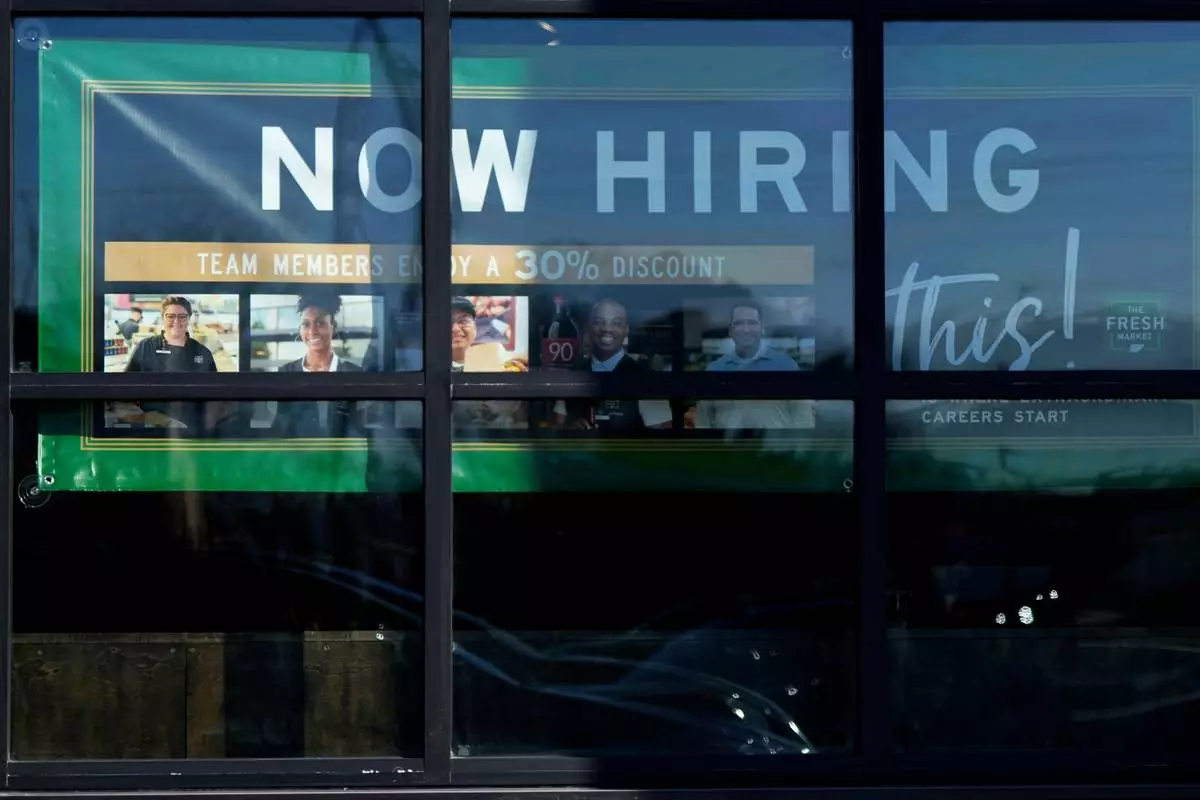
FILE - A hiring sign is displayed at a grocery store in Northbrook, Ill., Tuesday, Jan. 21, 2025. (AP Photo/Nam Y. Huh)

FILE - A hiring sign is displayed at a grocery store in Northbrook, Ill., Tuesday, Jan. 21, 2025. (AP Photo/Nam Y. Huh)

Recommended Articles