Skip to Content Facebook Feature Image

Lakota artist smudges the former gold mine inside the Black Hills

News

Lakota artist smudges the former gold mine inside the  Black Hills
News

News

Lakota artist smudges the former gold mine inside the Black Hills

2025-04-05 20:01 Last Updated At:20:11


When Lakota artist Marty Two Bulls Jr. looks at the Black Hills of South Dakota, he doesn’t just see its natural beauty. He also sees a scar cut deep into the heart of the universe.

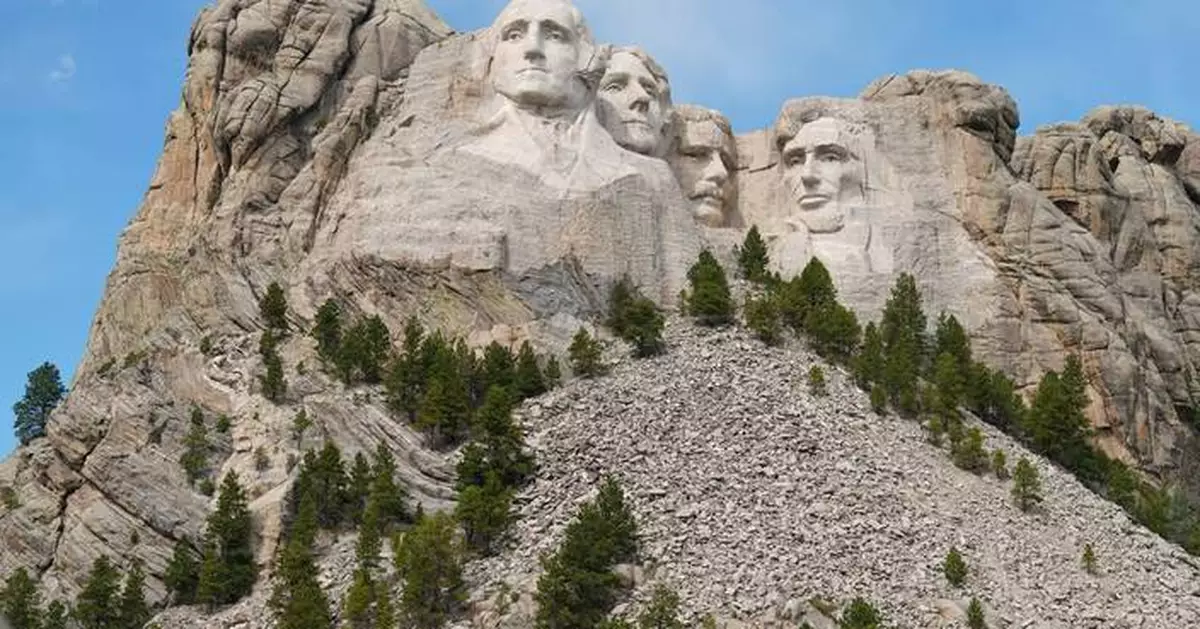
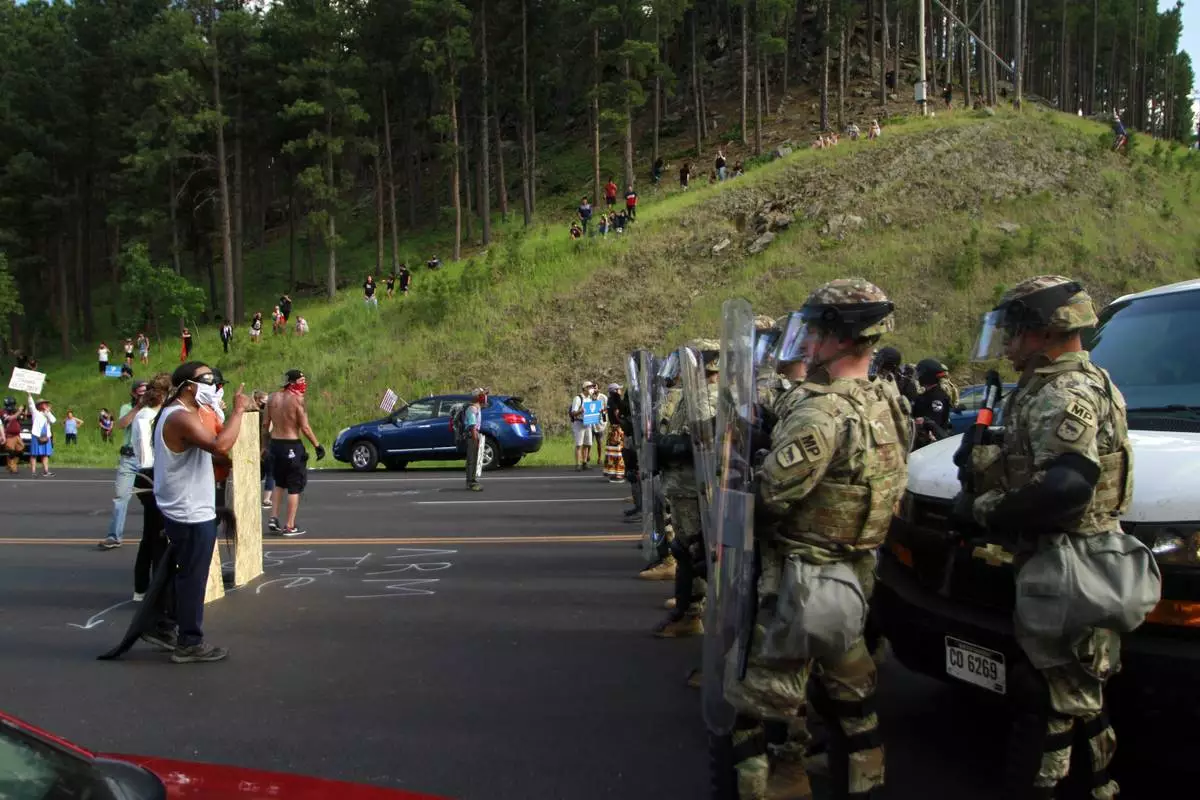
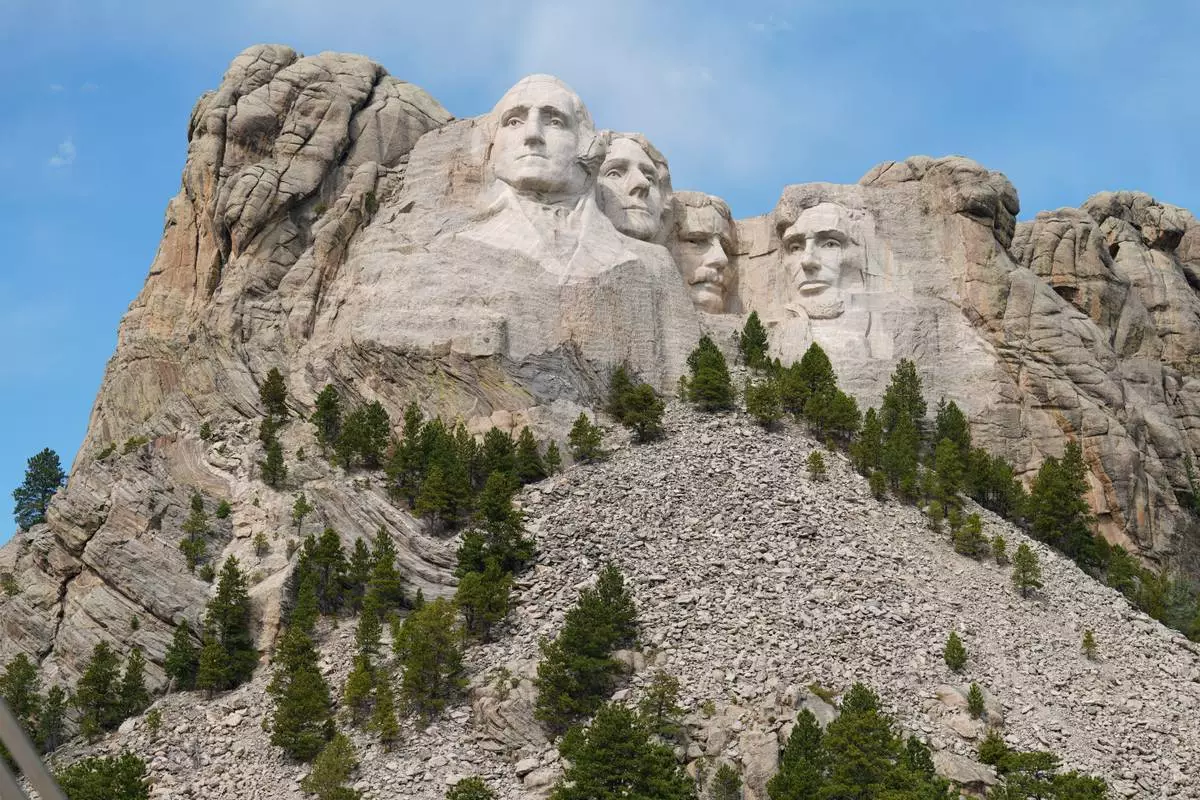
The mountain range is central to the origin story of several tribal nations, including his, and it has become an international symbol of the ongoing struggle for Indigenous land rights and the destruction of sacred sites. To the Lakota, Mount Rushmore is the most visible scar on the mountains. The former gold mine beneath is another, and that's what motivated Two Bulls to use his performance art to cleanse it.

“You hear ‘land back’, and it means a lot of different things to different people,” he said, referring to the Indigenous-led movement to restore tribal self-determination through ownership and stewardship of their homelands. “It’s been interesting trying to reframe some of these conversations about stewardship and land rights and treaties.”

When the green pines on top meet the blue sky above, it creates the perception of a black outline, which is why the Lakota, Dakota, and Nakota people call it “He Sapa’, which means “black ridge.” To them, it is where their creation began. But for generations, this sacred place was mined and stripped of gold, leaving lasting marks.

Today, the former Homestake Gold Mine, a 300-mile (480-kilometer) tunnel system carved inside the mountains, houses the Sanford Underground Research Facility, where scientists study particle physics and dark matter. The deep mine shafts encased in granite are ideal for research into the secrets of the stars.

As an artist in residence at SURF last year, Two Bulls felt a connection to its depths but a tremendous sense of loss when he ventured into the mine.

“I was bearing witness to the desecration that Homestake did every day. It was heartbreaking,” he said. And it left him wondering: “How do you recover from a desecration or a crime?”

Two Bulls also respected the work being conducted by some of the world’s top minds inside the Black Hills, and he wanted to find a way to show them that this place was important long before its value was measured in gold or scientific research. He decided the best solution was also the simplest: smudge.

Smudging is the act of cleansing, spiritually and physically, by burning plants like sage, cedar or sweetgrass and enveloping one’s self or a space in the smoke. It has been a common practice across Indian Country for generations. Last week, using sage donated by Native people from as close as the Pine Ridge Indian Reservation and as far away as the West Coast, Two Bulls burned several bundles, each representing the prayers of the community that donated it.

For an hour, he burned the bundles in a small stove at the entrance to the former mine, fanning the flames with eagle feathers to smudge the place that his people revere as the center of the cosmos.

Sensors in the mine nearly a mile below ground detected the smoke, a spokesperson for SURF said.

“To see how that was put together, that floored me,” said Rylan Sprague, a botanist and member of the Cheyenne River Sioux Tribe who chairs SURF’s cultural advisory committee. “Leave it to an artist to take something that seems so regular and turn it into something totally different.”

Two Bulls said Western science often overlooks or misunderstands Indigenous ways of thinking about the world and our origins, and that he wants his art project, called Azilya — the Lakota word for smudging — to be a way for the two to meet. An exhibition of his art from his time at SURF exploring that concept is currently on display at the South Dakota School of Mines and Technology.

Several researchers and members of SURF’s staff watched Two Bulls smudge the mine. Sprague said he could see from the looks on their faces that the SURF employees in attendance understood the reverence Two Bulls and his community have for the place where they work.

The room was largely quiet as Two Bulls sent smoke and prayers a mile beneath the earth’s surface.

“It’s not a site that I think they think about as a sacred site. It’s a work site,” Two Bulls said. “I hope that that happens. That’s my intention.”
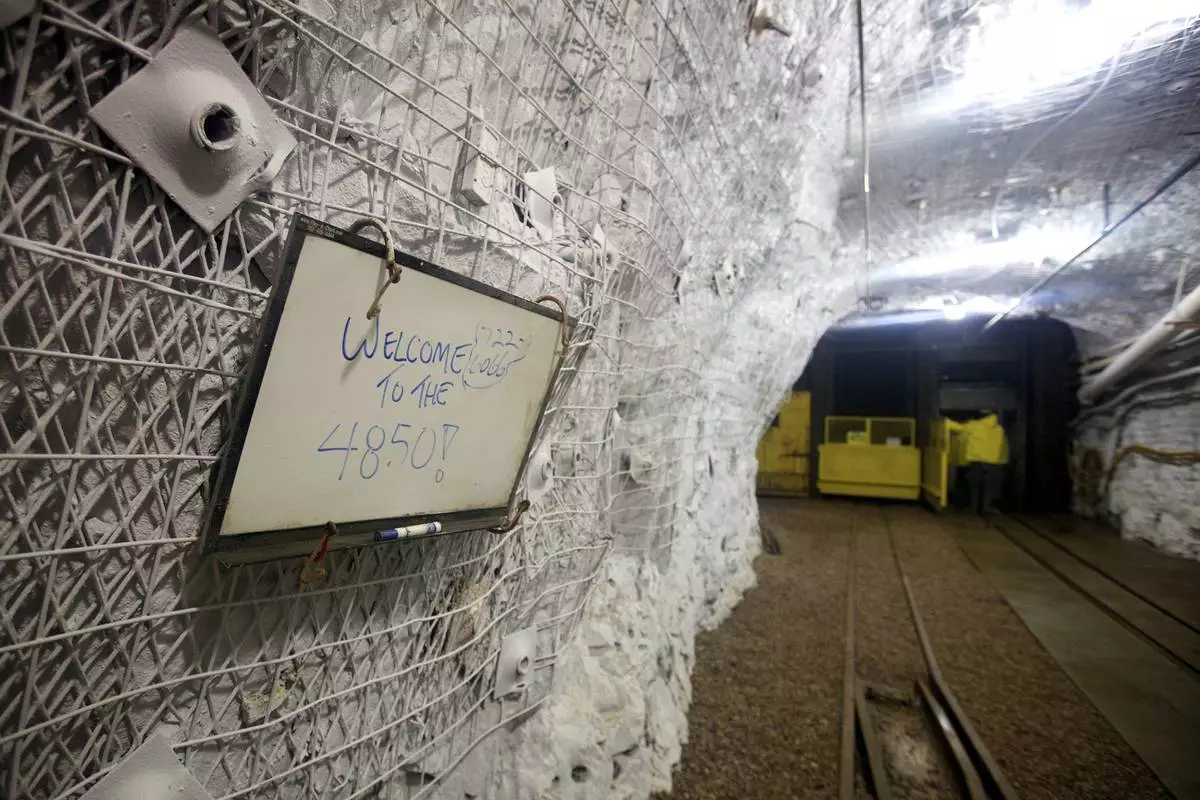
FILE - A sign welcomes visitors to a lab 4,850 feet beneath the earth, Wednesday, May 30, 2012, where the Sanford Underground Research Facility inside the now-shuttered Homestake Gold Mine in Lead, S.D., will house the world's most sensitive dark-matter detector. (AP Photo/Amber Hunt, File)
FILE - A sign welcomes visitors to a lab 4,850 feet beneath the earth, Wednesday, May 30, 2012, where the Sanford Underground Research Facility inside the now-shuttered Homestake Gold Mine in Lead, S.D., will house the world's most sensitive dark-matter detector. (AP Photo/Amber Hunt, File)

FILE - Native American protesters confront a line of law enforcement officers in Keystone, S.D., on the road leading to Mount Rushmore ahead of President Donald Trump's visit to the memorial on Friday, July 3, 2020. (AP Photo/Stephen Groves, File)
FILE - Native American protesters confront a line of law enforcement officers in Keystone, S.D., on the road leading to Mount Rushmore ahead of President Donald Trump's visit to the memorial on Friday, July 3, 2020. (AP Photo/Stephen Groves, File)

FILE - A massive sculpture carved into Mount Rushmore depicts U.S. presidents George Washington, Thomas Jefferson, Theodore Roosevelt and Abraham Lincoln at the Mount Rushmore National Memorial Thursday, Sept. 21, 2023, in, Keystone, S.D. (AP Photo/David Zalubowski, File)
FILE - A massive sculpture carved into Mount Rushmore depicts U.S. presidents George Washington, Thomas Jefferson, Theodore Roosevelt and Abraham Lincoln at the Mount Rushmore National Memorial Thursday, Sept. 21, 2023, in, Keystone, S.D. (AP Photo/David Zalubowski, File)
MONTREAL (AP) — Mike Matheson and Juraj Slafkovsky scored goals 37 seconds apart to start the third period, propelling the Montreal Canadiens to a 6-3 win over the last-place Vancouver Canucks on Monday night.

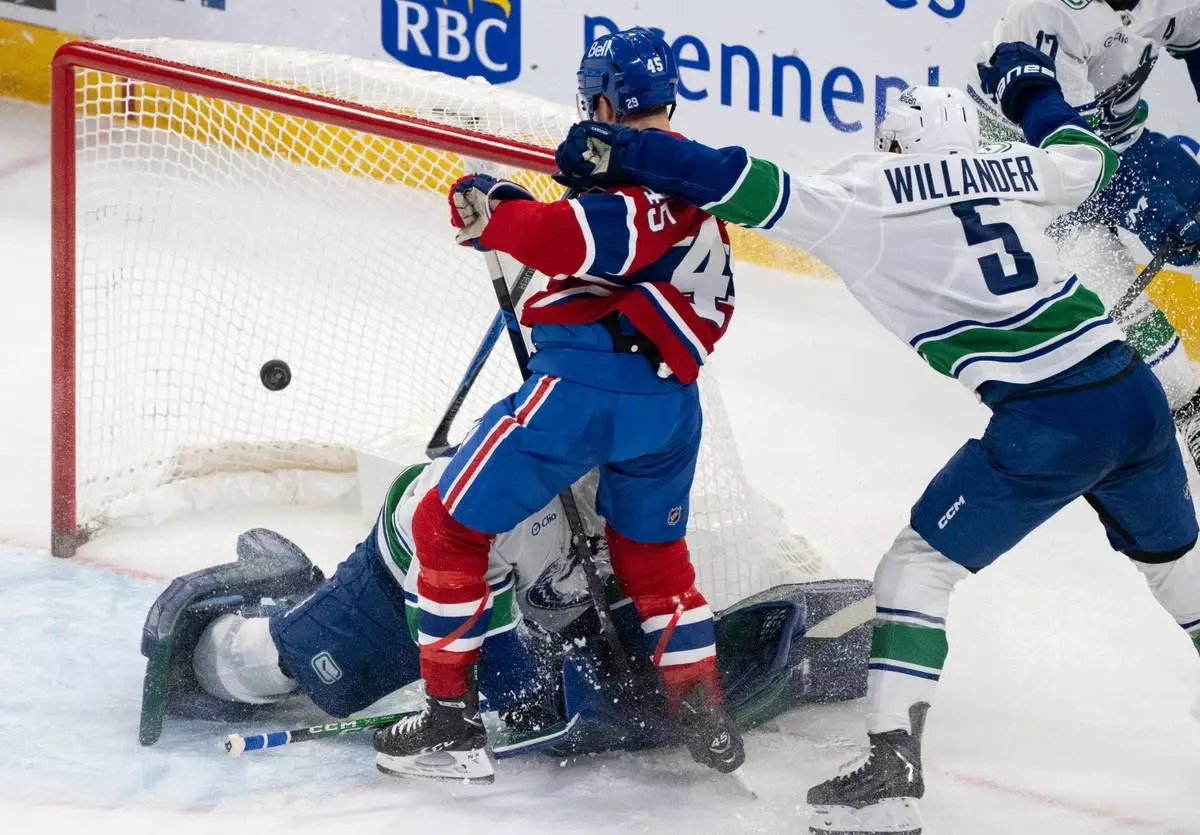
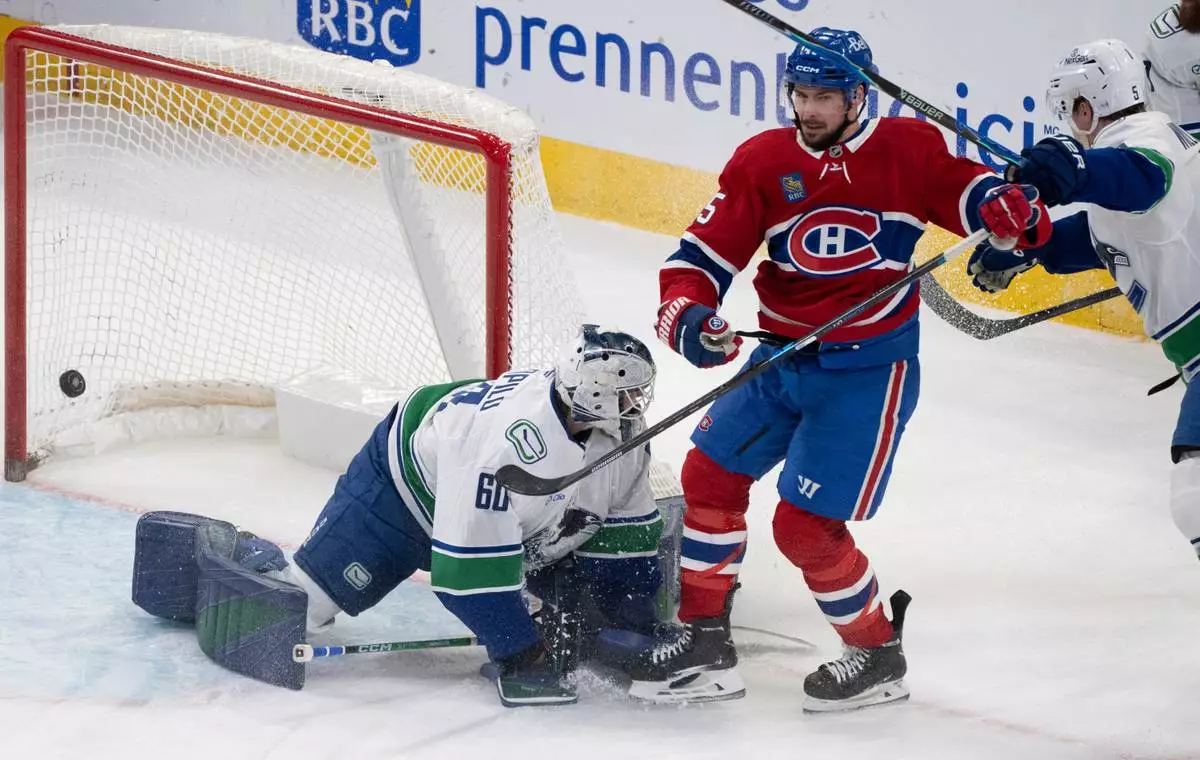
Alexandre Carrier scored twice in a 20-second span in the second period for Montreal, which rebounded from a 4-0 home-ice loss to the Detroit Red Wings on Saturday.

Noah Dobson and Oliver Kapanen also scored in the Canadiens' fourth straight win over the Canucks.

Jakub Dobes, making his first start since Jan. 1, stopped 20 shots for Montreal. Dobes defeated Vancouver for the second time in as many outings this season.

Elias Pettersson, Evander Kane and Max Sasson scored for the Canucks.

Vancouver has lost the first four games of its season-long six-game Eastern Conference road trip. Overall, the Canucks have lost seven straight and nine of their last 10.

Nikita Tolopilo made 35 saves in his first appearance in goal for Vancouver since Dec. 8.

The Belarusian goaltender was recalled Sunday under emergency conditions from the Canucks’ AHL affiliate.

Starter Thatcher Demko was placed on injured reserve with a lower-body injury he suffered in his team’s 5-0 loss to the Toronto Maple Leafs on Saturday. Demko returned to Vancouver to be further evaluated by the Canucks’ medical staff.

Vancouver scored the opening goal of the game for the first time in six games, marking their first lead in a game since Dec. 30.

Carrier’s first goal was his 100th career point. It also was the first career multigoal game for the 29-year-old blueliner.

Canucks: At Ottawa on Tuesday in the fifth game of a six-game trip.

Canadiens: At Washington Capitals on Tuesday.

AP NHL: https://apnews.com/hub/nhl

Montreal Canadiens' Alexandre Carrier, second from left, scores against Vancouver Canucks goaltender Nikita Tolopilo (60) as Canucks' Tom Willander (5) defends during second-period NHL hockey game action in Montreal, Monday, Jan. 12, 2026. (Christinne Muschi/The Canadian Press via AP)

Montreal Canadiens' Alexandre Carrier, second from left, scores against Vancouver Canucks goaltender Nikita Tolopilo (60) as Canucks' Tom Willander (5) defends during second-period NHL hockey game action in Montreal, Monday, Jan. 12, 2026. (Christinne Muschi/The Canadian Press via AP)

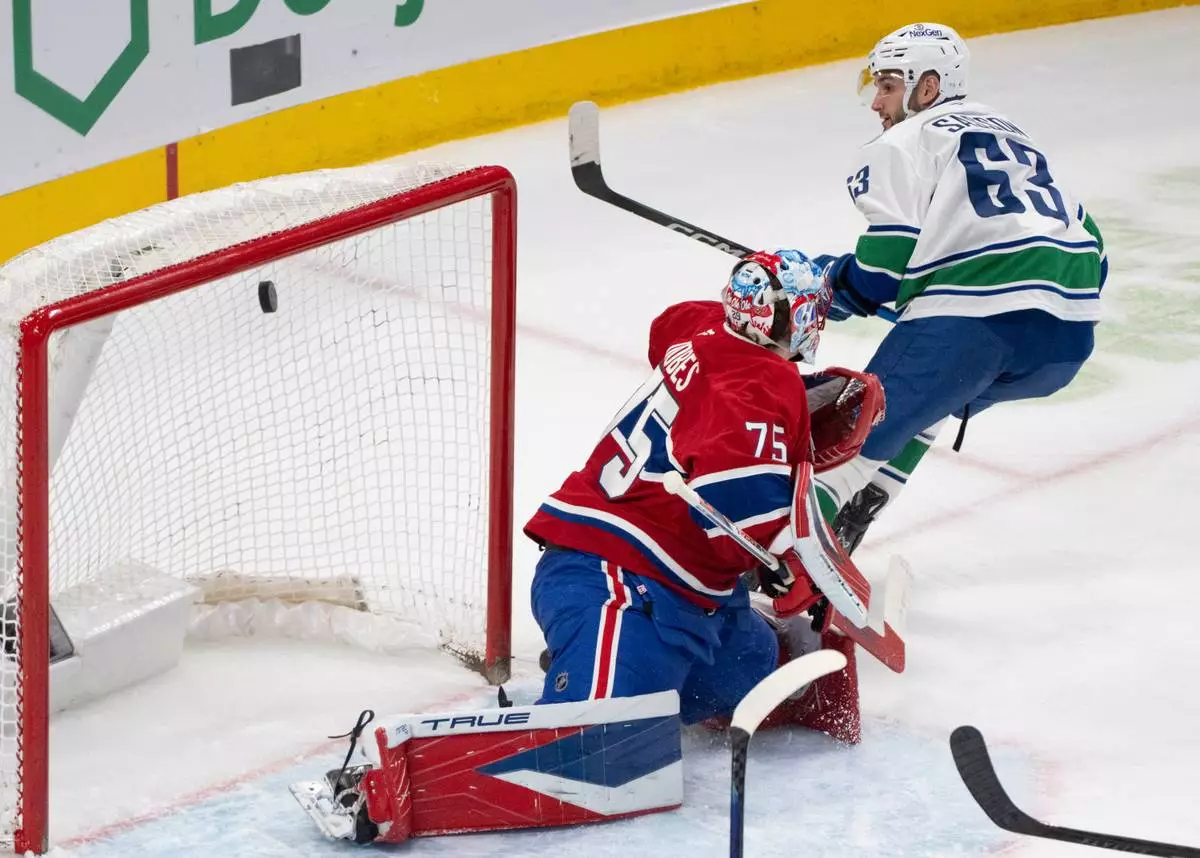
Vancouver Canucks' Max Sasson (63) scores against Montreal Canadiens goaltender Jakub Dobes (75) during second-period NHL hockey game action in Montreal, Monday, Jan. 12, 2026. (Christinne Muschi/The Canadian Press via AP)

Vancouver Canucks' Max Sasson (63) scores against Montreal Canadiens goaltender Jakub Dobes (75) during second-period NHL hockey game action in Montreal, Monday, Jan. 12, 2026. (Christinne Muschi/The Canadian Press via AP)

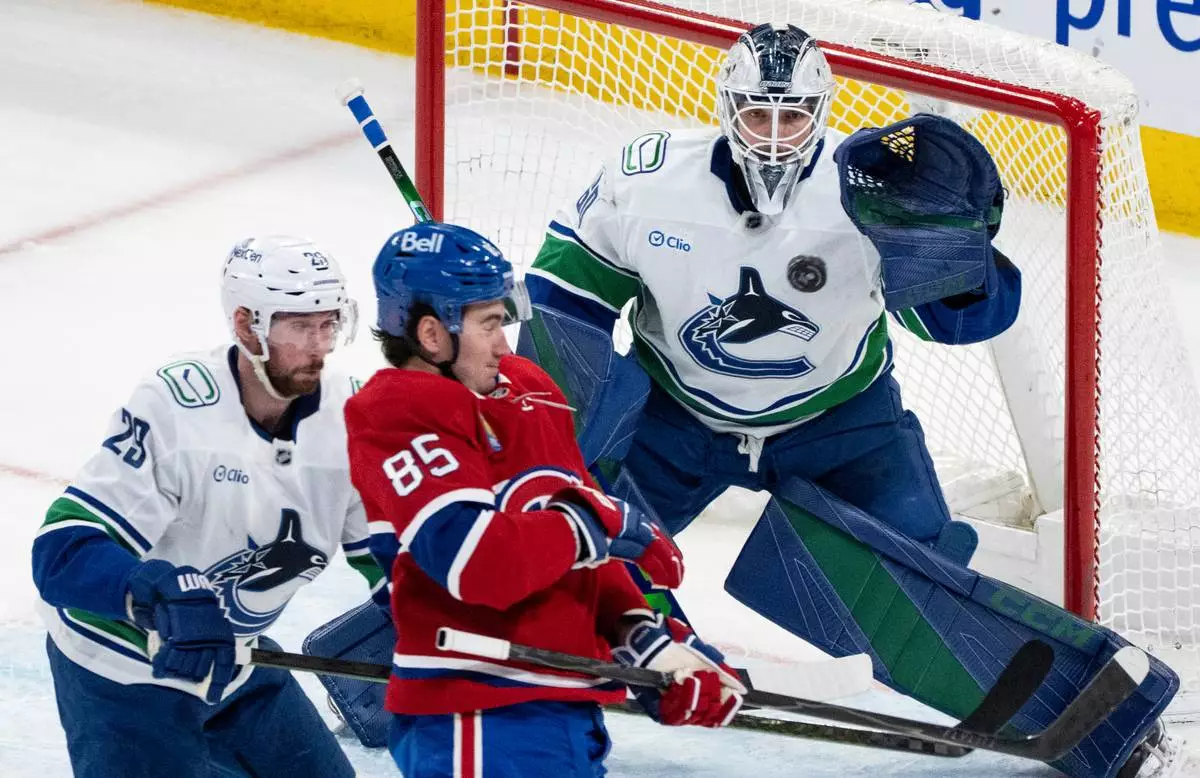
Vancouver Canucks goaltender Nikita Tolopilo (60) watches the puck in front of Montreal Canadiens' Alexandre Texier (85) as Canucks' Marcus Pettersson (29) defends during second-period NHL hockey game action in Montreal, Monday, Jan. 12, 2026. (Christinne Muschi/The Canadian Press via AP)

Vancouver Canucks goaltender Nikita Tolopilo (60) watches the puck in front of Montreal Canadiens' Alexandre Texier (85) as Canucks' Marcus Pettersson (29) defends during second-period NHL hockey game action in Montreal, Monday, Jan. 12, 2026. (Christinne Muschi/The Canadian Press via AP)

Montreal Canadiens' Alexandre Carrier (45) scores against Vancouver Canucks goaltender Nikita Tolopilo, bottom left, as Canucks' Tom Willander (5) defends during second-period NHL hockey game action in Montreal, Monday, Jan. 12, 2026. (Christinne Muschi/The Canadian Press via AP)

Montreal Canadiens' Alexandre Carrier (45) scores against Vancouver Canucks goaltender Nikita Tolopilo, bottom left, as Canucks' Tom Willander (5) defends during second-period NHL hockey game action in Montreal, Monday, Jan. 12, 2026. (Christinne Muschi/The Canadian Press via AP)

Recommended Articles