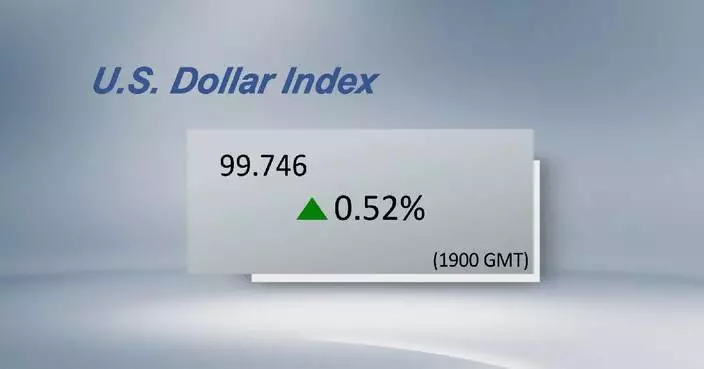
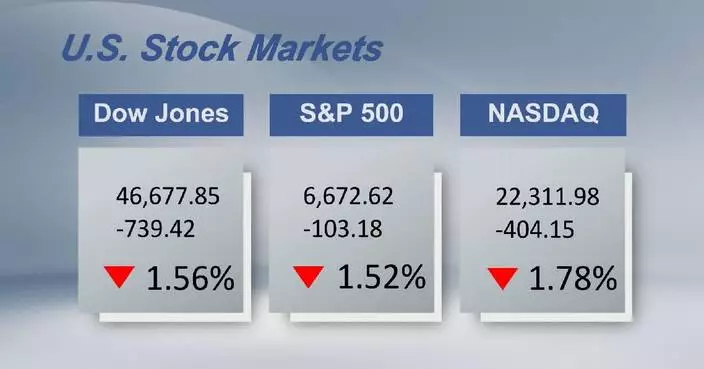
In a swift response to the U.S. government's April 2 announcement of "reciprocal tariffs" on all trade partners, China rolled out a series of strong countermeasures within just one day, triggering sharp reactions in the U.S. stock markets and causing the U.S. tariff war to hit a brick wall once again, according to a commentary by The Real Point published on Saturday.
An edited English-language version of the commentary is as follows:
The U.S. government on Wednesday announced the imposition of "reciprocal tariffs" on all its trading partners. In response, China immediately stated that it would take countermeasures to safeguard its legitimate rights and interests.
On Friday, a series of countermeasures were implemented, including a 34-percent tariff on all U.S.-origin imports, initiating proceedings against the United States under the WTO dispute settlement mechanism, and placing multiple U.S. entities on its export control list.
Following the news, U.S. stock market futures plunged, with Dow futures, Nasdaq 100 futures, and S and P 500 futures all dropping by more than 3 percent.
Market analysts expressed concern that if the U.S. government does not change its tariff policy, the country's economic growth will slow significantly.
The United States claims it has suffered losses in international trade and, under the pretext of "reciprocity," announced a 34-percent "reciprocal tariff" on Chinese goods. This move violates the WTO's Most-Favored-Nation principle, undermines China's legitimate right to development, and represents a typical act of unilateral bullying.
Li Haidong, a professor at the China Foreign Affairs University, said that China's countermeasures are highly targeted and precise, reflecting its strong determination to safeguard its sovereignty, security, and right to development, while also defending international trade rules and the multilateral trade system.
Both economic principles and factual data show that the U.S. narrative of "trade unfairness" is unfounded.
The U.S. trade deficit is a result of market forces, influenced by factors such as industrial competitiveness, economic structure, international division of labor, trade policies, and the status of the dollar.
Moreover, the United States selectively ignores its overwhelming advantage in service trade. WTO Director-General Ngozi Okonjo-Iweala recently pointed out that in 2023, U.S. service exports exceeded 1 trillion U.S. dollars, accounting for 13 percent of global service trade; by 2024, the U.S. service trade surplus totaled 300 billion dollars.
This shows that the U.S. is not suffering losses in international trade, but rather reaping substantial profits.
China and the United State both stand to gain from cooperation and lose from confrontation.
Industry analysts believe that the U.S. imposition of "reciprocal tariffs" will have some short-term impact on China's economy. However, after multiple rounds of trade friction, China's economic resilience and ability to withstand pressure have significantly strengthened.
In addition, as China's foreign trade "circle of friends" continues to expand, it served to help significantly disperse the pressure of U.S. tariff hikes.
China has a population of over 1.4 billion, a rapidly developing new type of productive forces, and a policy of expanding openness. These factors provide China's economy with the resilience to withstand risks and make steady progress.
Recently, several U.S. companies, including Apple, Eli Lilly, Cargill, and Tyco, have expressed confidence in cultivating success in China, stating their optimism about the country's economic prospects.
In contrast, the situation over the past few years has already proven that the U.S. imposition of tariffs not only fails to resolve the trade imbalance but also exacerbates its own economic woes.
According to data from the U.S. Department of Commerce, the U.S. trade deficit reached 1.21 trillion U.S. dollars in 2024, a 50-percent increase from 2017, before the U.S. government launched its global tariff war.
From 2018 to 2024, China's trade surplus with the United States rose from 323.33 billion U.S. dollars to 361 billion U.S. dollars. This clearly demonstrates that tariff barriers do not address U.S. concerns. Instead, mutually beneficial cooperation is the shared desire of people across nations.
Controlling inflation is another goal of the U.S. government, but tariff pressures are counterproductive to this aim.
Data shows that the U.S. Consumer Price Index (CPI) increased by 3.5 percent year on year in March, reaching the highest level since September 2023. This indicates that the U.S.inflation rebound since the beginning of this year is not a temporary phenomenon.
The latest data from the World Federation of Large Enterprises shows that the U.S. consumer confidence index for March was 92.9, marking a decline for the fourth consecutive month. Research from Yale University indicates that after the implementation of "reciprocal tariffs," if other countries take retaliatory measures, the short-term increase in U.S. personal consumption expenditure prices will expand by 2.1 percent.
U.S. businesses are also having a hard time.
According to data from the World Trade Consulting Company, the new tariffs will impose an additional cost of 433 billion U.S. dollars on U.S. companies.
Mark Zandi, chief economist at Moody's Analytics, noted that the probability of a U.S. recession this year has risen to 40 percent, up from 15 percent at the beginning of the year.
As Laurent Saint-Martin, minister delegate for foreign trade and French nationals abroad, put it, "No one benefits from a trade war," with the first to suffer being the United States itself.
In today's world, with the deepening of multipolarity and economic globalization, unilateralism and protectionism, which prioritize one's own interests at the expense of others, have lost their appeal.
The U.S. should immediately correct its wrongdoings and stop using tariffs as a tool to coerce other countries. All countries around the world should also unite to collectively resist U.S. unilateral bullying and safeguard the multilateral trade system.
China strikes back with flurry of countermeasures, making US tariff war hit wall again: commentary