SEOUL. South Korea (AP) — The United States has blocked imports of sea salt products from a major South Korean salt farm accused of using slave labor, becoming the first trade partner to take punitive action against a decadeslong problem on salt farms in remote islands off South Korea’s southwest coast.
U.S. Customs and Border Protection issued a withhold release order against the Taepyung salt farm, saying information “reasonably indicates” the use of forced labor at the company in the island county of Sinan, where most of South Korea’s sea salt products are made.
Under the order issued last Wednesday, Customs personnel at all U.S. ports of entry are required to hold sea salt products sourced from the farm.
Taepyung is South Korea's largest salt farm, producing about 16,000 tons of salt annually, which accounts for approximately 6% of the country’s total output, according to government data, and is a major supplier to South Korean food companies. The farm, located on Jeungdo island in Sinan and leasing most of its salt fields to tenants, has been repeatedly accused of using forced labor, including in 2014 and 2021.
South Korean officials stated that this was the first time a foreign government had suspended imports from a South Korean company due to concerns over forced labor.
In a statement to The Associated Press on Monday, South Korea’s Foreign Ministry said relevant government agencies, including the Ministry of Oceans and Fisheries, have been taking steps to address labor practices at Taepyung since 2021. While not providing direct evidence, it said it assesses that none of the salt produced there now is sourced from forced labor. The ministry said it plans to “actively engage” in discussions with the U.S. officials over the matter.
The fisheries ministry said it plans to promptly review the necessary measures to seek the lifting of the U.S. order.
The widespread slavery at Sinan’s salt farms was exposed in 2014 when dozens of slavery victims — most of them with disabilities — were rescued from the islands following an investigation by mainland police. Some of their stories were documented by The Associated Press, which highlighted how slavery persisted despite the exposure.
U.S. Customs said it identified several signs of forced labor during its investigation of Taepyung, including “abuse of vulnerability, deception, restriction of movement, retention of identity documents, abusive living and working conditions, intimidation and threats, physical violence, debt bondage, withholding of wages, and excessive overtime.”
Lawyer Choi Jung Kyu, part of a group of attorneys and activists who petitioned U.S. Customs to take action against Taepyung and other South Korean salt farms in 2022, expressed hope that the U.S. ban would increase pressure on South Korea to take more effective steps to eliminate the slavery.
“Since the exposure of the problem in 2014, the courts have recognized the legal responsibility of the national government and local governments, but forced labor among salt farm workers has not been eradicated,” Choi said. “Our hope is that the export ban would force companies to strengthen due diligence over supply chains and lead to the elimination of human rights violations.”
Choi’s law firm and other groups representing salt farm slavery victims issued a statement urging the South Korean government to take stronger action to prevent the ongoing abuse, including harsher punishments for trafficking and forced labor crimes. They also criticized the lack of support measures for victims, such as employment and housing assistance, which has led some to return to salt farms.
Most of the salt farm slaves rescued in 2014 had been lured to the islands to work by brokers hired by salt farm owners, who would beat them into long hours of hard labor and confine them at their houses for years while providing little or no pay.
The slavery was revealed in early 2014 when two police officers from the capital, Seoul, disguised themselves as tourists to clandestinely rescue a victim who had been reported by his family as missing. One of the Seoul police officers told AP they went undercover because of concerns about collaboration between the island’s police and salt farm owners. Dozens of farm owners and job brokers were indicted, but no police or officials were punished despite allegations some knew about the slavery.
In 2019, South Korea’s Supreme Court upheld a lower court ruling that ordered the government to compensate three men who had been enslaved on salt farms in Sinan and the neighboring county of Wando, acknowledging that local officials and police failed to properly monitor their living and working conditions.
The salt farm slavery issue resurfaced in 2021 when around a dozen workers at Taepyung were discovered to have endured various labor abuses, including forced labor and wage theft.
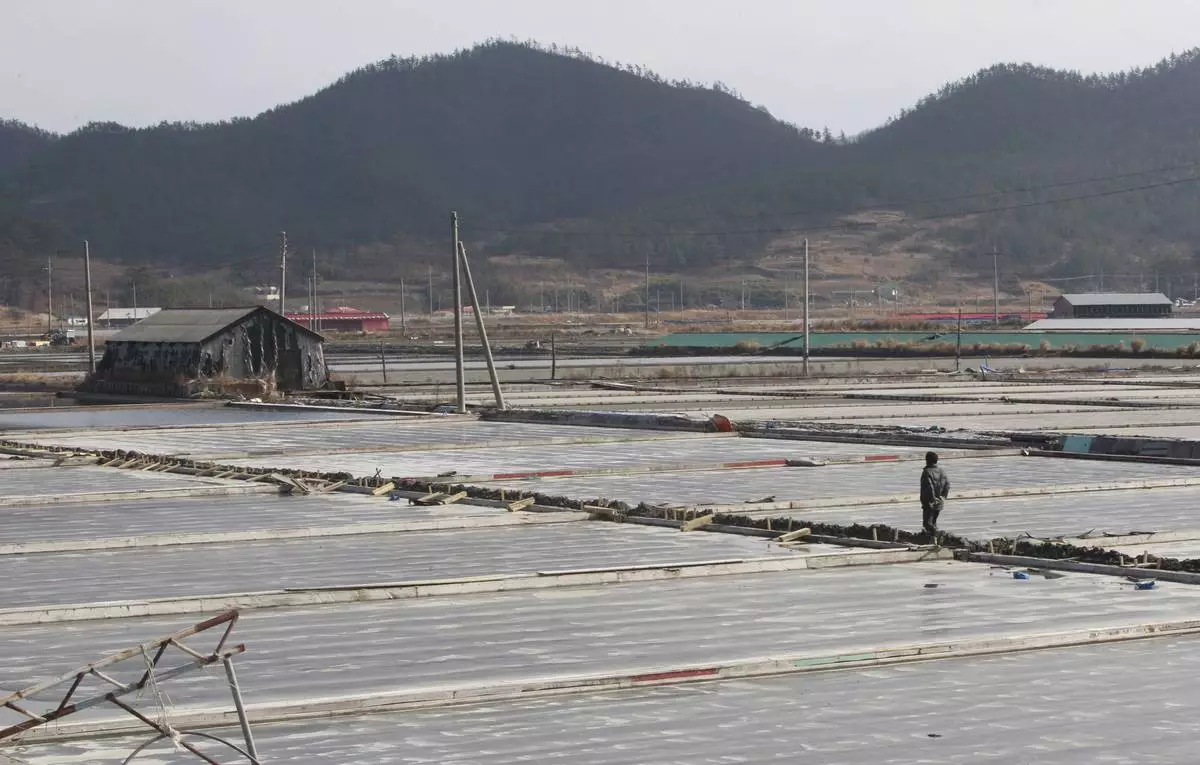
FILE - A salt farm owner walks around his salt farm on Sinui Island, South Korea, Feb. 19, 2014. (AP Photo/Ahn Young-joon, File)
DUBAI, United Arab Emirates (AP) — U.S. President Donald Trump said Iran wants to negotiate with Washington after his threat to strike the Islamic Republic over its bloody crackdown on protesters, a move coming as activists said Monday the death toll in the nationwide demonstrations rose to at least 544.
Iran had no immediate reaction to the news, which came after the foreign minister of Oman — long an interlocutor between Washington and Tehran — traveled to Iran this weekend. It also remains unclear just what Iran could promise, particularly as Trump has set strict demands over its nuclear program and its ballistic missile arsenal, which Tehran insists is crucial for its national defense.
Meanwhile Monday, Iran called for pro-government demonstrators to head to the streets in support of the theocracy, a show of force after days of protests directly challenging the rule of 86-year-old Supreme Leader Ayatollah Ali Khamenei. Iranian state television aired chants from the crowd, who shouted “Death to America!” and “Death to Israel!”
Trump and his national security team have been weighing a range of potential responses against Iran including cyberattacks and direct strikes by the U.S. or Israel, according to two people familiar with internal White House discussions who were not authorized to comment publicly and spoke on condition of anonymity.
“The military is looking at it, and we’re looking at some very strong options,” Trump told reporters on Air Force One on Sunday night. Asked about Iran’s threats of retaliation, he said: “If they do that, we will hit them at levels that they’ve never been hit before.”
Trump said that his administration was in talks to set up a meeting with Tehran, but cautioned that he may have to act first as reports of the death toll in Iran mount and the government continues to arrest protesters.
“I think they’re tired of being beat up by the United States,” Trump said. “Iran wants to negotiate.”
He added: “The meeting is being set up, but we may have to act because of what’s happening before the meeting. But a meeting is being set up. Iran called, they want to negotiate.”
Iran through country's parliamentary speaker warned Sunday that the U.S. military and Israel would be “legitimate targets” if America uses force to protect demonstrators.
More than 10,600 people also have been detained over the two weeks of protests, said the U.S.-based Human Rights Activists News Agency, which has been accurate in previous unrest in recent years and gave the death toll. It relies on supporters in Iran crosschecking information. It said 496 of the dead were protesters and 48 were with security forces.
With the internet down in Iran and phone lines cut off, gauging the demonstrations from abroad has grown more difficult. The Associated Press has been unable to independently assess the toll. Iran’s government has not offered overall casualty figures.
Those abroad fear the information blackout is emboldening hard-liners within Iran’s security services to launch a bloody crackdown. Protesters flooded the streets in the country’s capital and its second-largest city on Saturday night into Sunday morning. Online videos purported to show more demonstrations Sunday night into Monday, with a Tehran official acknowledging them in state media.
In Tehran, a witness told the AP that the streets of the capital empty at the sunset call to prayers each night. By the Isha, or nighttime prayer, the streets are deserted.
Part of that stems from the fear of getting caught in the crackdown. Police sent the public a text message that warned: “Given the presence of terrorist groups and armed individuals in some gatherings last night and their plans to cause death, and the firm decision to not tolerate any appeasement and to deal decisively with the rioters, families are strongly advised to take care of their youth and teenagers.”
Another text, which claimed to come from the intelligence arm of the paramilitary Revolutionary Guard, also directly warned people not to take part in demonstrations.
“Dear parents, in view of the enemy’s plan to increase the level of naked violence and the decision to kill people, ... refrain from being on the streets and gathering in places involved in violence, and inform your children about the consequences of cooperating with terrorist mercenaries, which is an example of treason against the country,” the text warned.
The witness spoke to the AP on condition of anonymity due to the ongoing crackdown.
The demonstrations began Dec. 28 over the collapse of the Iranian rial currency, which trades at over 1.4 million to $1, as the country’s economy is squeezed by international sanctions in part levied over its nuclear program. The protests intensified and grew into calls directly challenging Iran’s theocracy.
Nikhinson reported from aboard Air Force One.
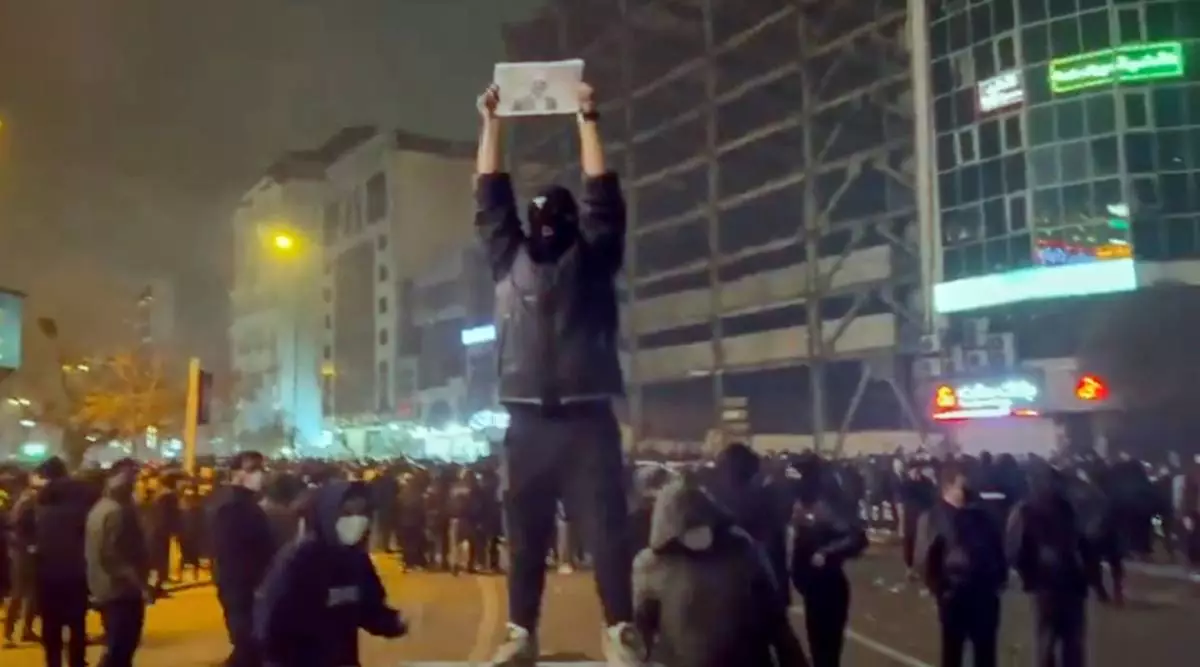
In this frame grab from video obtained by the AP outside Iran, a masked demonstrator holds a picture of Iran's Crown Prince Reza Pahlavi during a protest in Tehran, Iran, Friday, January. 9, 2026. (UGC via AP)
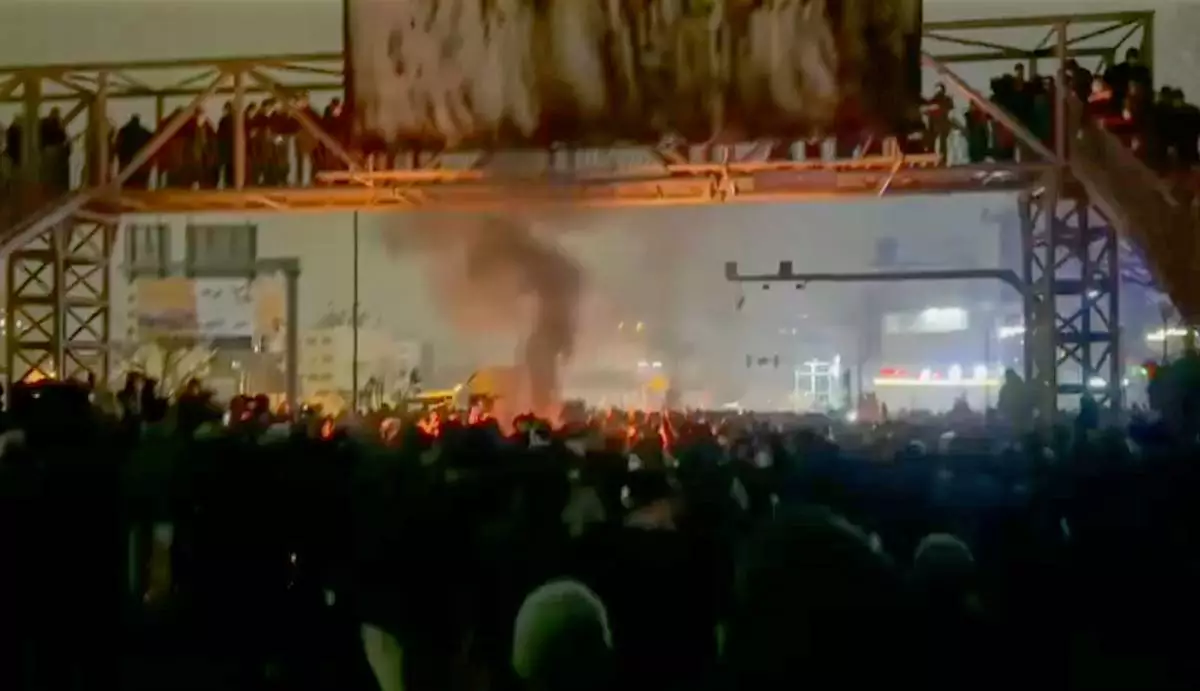
In this frame grab from footage circulating on social media from Iran shows protesters taking to the streets despite an intensifying crackdown as the Islamic Republic remains cut off from the rest of the world in Tehran, Iran, Friday, Jan. 9, 2026.(UGC via AP)
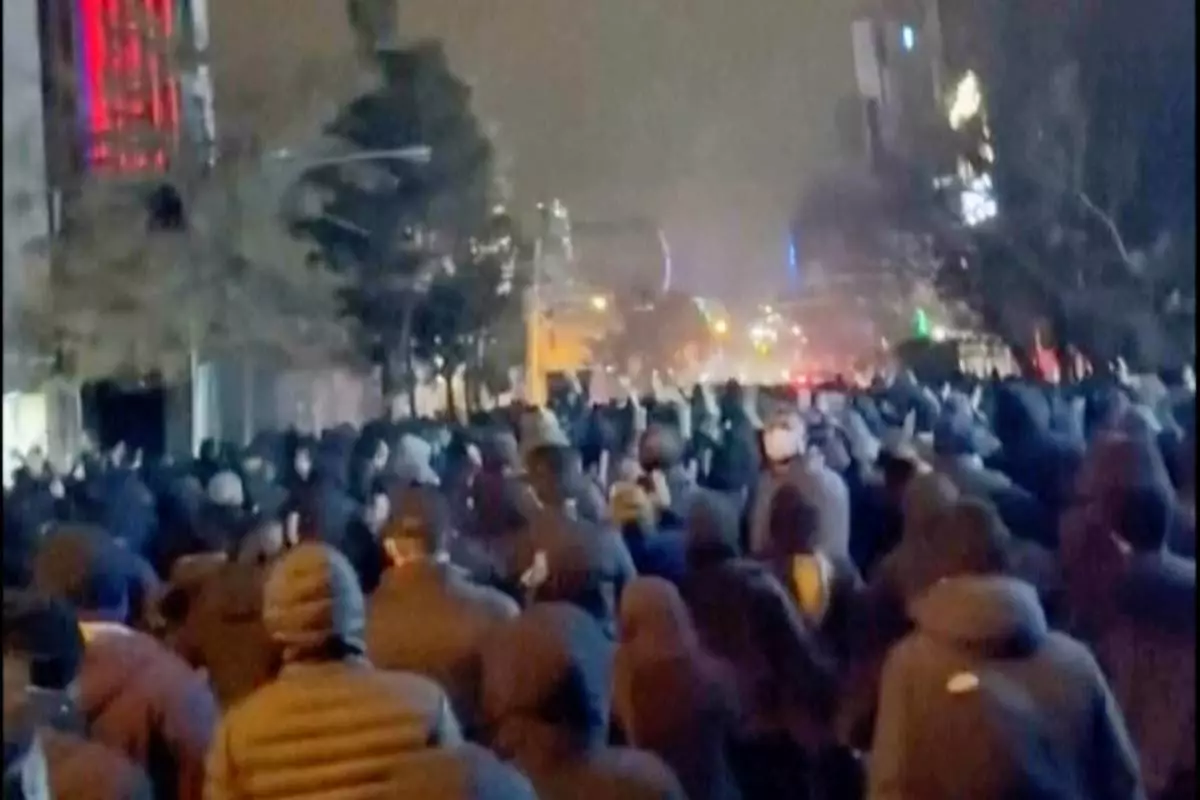
In this frame grab from footage circulating on social media from Iran showed protesters once again taking to the streets of Tehran despite an intensifying crackdown as the Islamic Republic remains cut off from the rest of the world in Tehran, Iran, Saturday Jan. 10, 2026. (UGC via AP)